
In my extensive work with gear manufacturing and metrology, I have often encountered the challenge of accurately measuring the helix angle of spiral gears. Unlike spur gears, where parameters such as pressure angle, module, and pitch diameter can be relatively straightforwardly determined using gear calipers, spiral gears introduce the complexity of a helical tooth form. The helix angle at the pitch circle is critical for defining the gear’s geometry and ensuring proper meshing in transmission systems. Without this angle, even with known module and pressure angle, the pitch diameter cannot be accurately calculated, leading to potential design and assembly issues. This article details my preliminary research into developing a dedicated measuring instrument for spiral gear helix angles, focusing on measurement methodologies, instrument design principles, and practical applications. Throughout this study, the term ‘spiral gear’ will be repeatedly emphasized to underscore its central role in this investigation.
The fundamental problem arises when one obtains a physical sample of a spiral gear and needs to reverse-engineer its key parameters. For a standard spur gear, whether modified or non-modified, measurements with gear calipers can yield pressure angle, module (or diametral pitch), and base circle pitch. Consequently, the pitch diameter can be calculated from the module and tooth count. However, for a spiral gear, while the caliper can still measure pressure angle and module, the pitch diameter remains elusive because the helix angle at the pitch circle is unknown. Therefore, determining this helix angle is paramount to obtaining complete data for the spiral gear. Various methods exist for measuring this angle. Well-equipped facilities might use sophisticated instruments to measure the helix angle on the base cylinder and then compute the pitch circle helix angle. However, based on my observations, most workshops struggle to address this issue efficiently, often resorting to cumbersome and time-consuming techniques. In this work, I present and refine a measurement approach I have experimented with, aiming for simplicity and accuracy.
Before the advent of specialized gear measuring tools, a rather rudimentary yet functional method was employed. First, the outside diameter of the spiral gear is measured. If the tooth count is odd and direct measurement is difficult, a sleeve can be fabricated based on the gear’s outer contour, and the outside diameter is determined from the sleeve’s inner diameter. Next, ink or marking dye is applied to the tooth tips. A rectangular flat plate is used as a straight edge, and a piece of white paper is placed on it. A line is drawn on the paper along the plate’s edge. The spiral gear is then positioned with one end flush against this line, and the gear is rolled so that the tooth tips mark the paper. This process, analogous to generating a lead trace, produces an imprint of the tooth path on the paper.
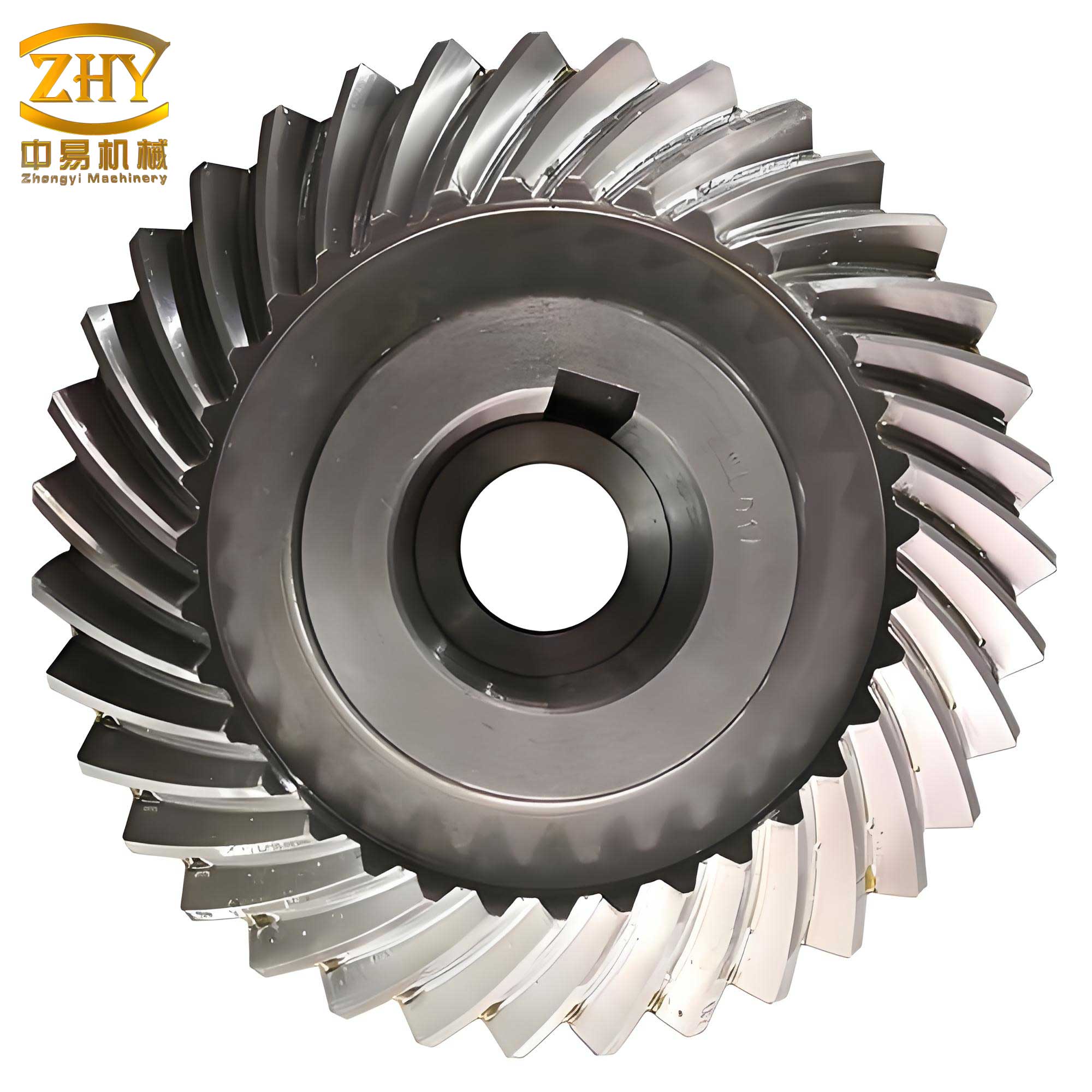
Using a protractor, the end-face helix angle \(\alpha_f\) at the tooth tip circle can be measured from this imprint. This angle is related to the helix angle at the outside diameter \(\beta_o\). The relationship is derived from the geometry of the spiral gear. The lead \(L\) of the spiral gear, which is the axial distance for one complete turn of the helix, can be calculated from the outside diameter \(d_o\) and the measured end-face angle at the tip. The formula is:
$$ L = \pi d_o \cdot \cot(\alpha_f) $$
where \(\alpha_f\) is the angle measured at the tooth tip. To verify the correctness of this calculated lead, the spiral gear can be mounted on a universal milling machine. The machine’s table feed screw is connected via change gears to the spindle to achieve a specific lead ratio. A dial indicator is then brought into contact with the helical tooth flank of the spiral gear mounted on the spindle. As the machine’s table moves longitudinally, the spiral gear rotates. If the dial indicator reading remains constant or shows minimal fluctuation, the calculated end-face angle (and thus the lead) is correct. Otherwise, the angle needs adjustment, and the change gears must be recalculated until the indicator stabilizes. Once the lead is accurately determined, the traditional approach involved assuming the pitch diameter based on the tooth height or by referencing a mating tool like a rack. However, this assumption is flawed, especially for modified (shifted) spiral gears, as it does not account for profile shifts accurately. A more reliable method uses the lead and the transverse circular pitch at the pitch circle to compute the helix angle at the pitch circle \(\beta\).
With the development and availability of gear tooth calipers, the measurement process improved slightly. The primary advantage is that the module \(m_n\) (or diametral pitch \(P_d\)) of the spiral gear can now be directly measured. This addresses a shortcoming of the previous method. The procedure still requires determining the lead \(L\) as before. Then, using the known normal circular pitch \(p_n\) (since the normal module \(m_n = p_n / \pi\) is now known) and the lead, the helix angle at the pitch circle \(\beta\) can be calculated using the following fundamental relationship for spiral gears:
$$ \tan(\beta) = \frac{\pi d}{L} $$
and also,
$$ p_n = p_t \cdot \cos(\beta) = \frac{\pi d}{N} \cdot \cos(\beta) $$
where \(d\) is the pitch diameter, \(N\) is the number of teeth, \(p_t\) is the transverse circular pitch, and \(p_n\) is the normal circular pitch. Combining these, we can derive:
$$ \tan(\beta) = \frac{\pi \cdot m_n \cdot N}{L \cdot \cos(\beta)} $$
Rearranging gives a direct formula using knowns:
$$ \sin(\beta) = \frac{\pi m_n N}{L} $$
Thus, once \(\beta\) is calculated, the pitch diameter \(d\) can be found from:
$$ d = \frac{m_n N}{\cos(\beta)} = \frac{N}{P_d \cos(\beta)} $$
This method, though more accurate, still involves considerable time and effort in determining the lead. To streamline the entire process and eliminate cumbersome calculations, I designed a dedicated measuring instrument. The core principle of this instrument is based on the kinematic coupling between a spiral gear and a simulated single-tooth rack or a master gear tooth. It is known that a spiral gear of given pitch and pressure angle can mesh not only with another spiral gear but also with a helical rack (often called a “spiral gear rack”). For proper meshing, when the rack body is perpendicular to the axis of the spiral gear, the inclination of the rack tooth must precisely match the helix angle of the spiral gear at its pitch circle. Even a slight deviation will cause the rack body to tilt relative to the gear axis. Extending this principle, if the rack is reduced to a single representative tooth (a “mock tooth”), its inclination must equal the pitch helix angle of the spiral gear for the bodies to align perpendicularly during meshing. My instrument exploits this: by using a mock tooth of known pressure angle and adjustable orientation, when it is brought into mesh with the spiral gear sample, the angle through which the mock tooth carrier rotates directly indicates the pitch helix angle of the spiral gear.
The instrument’s design comprises three main assemblies: the base body, the spiral gear fixture, and the indicator arm. The base houses a handwheel that, via a lead screw, moves the spiral gear fixture in and out. The spiral gear fixture holds the gear under test between two centers, ensuring they are coaxial and that the axis of rotation is level with the pivot axis of the indicator arm. The indicator arm is the heart of the device; its accuracy dictates the measurement precision. It carries the mock tooth on its front and has a graduated scale on the back for reading the angle. I explored two distinct designs for this indicator mechanism.
The first design employs a gear train to drive separate degree and minute hands, similar to a clock mechanism. This design allows direct reading of degrees and minutes from dials. However, it is mechanically complex and costly to manufacture due to the multiple gears involved. The following table summarizes the key components of this design:
| Component No. | Name | Description and Function |
|---|---|---|
| 1 | Mock Tooth | Single tooth element with adjustable pressure angle. Mounted on the indicator arm and can slide within a dovetail slot. |
| 2 | Indicator Arm | Pivots on the base. Carries the mock tooth and the dial mechanism. Precision grinding is required for bearing surfaces. |
| 3 | Fixed Block | Secured to the base via clamp screws. Provides a dovetail guide for the mock tooth assembly. |
| 4 | Clamp Head | Locks the mock tooth in position after pressure angle adjustment. |
| 5 | Pressure Angle Reference | Attached to the fixed block for setting the mock tooth pressure angle using a template. |
| 6 | Dial Face | Graduated in degrees and minutes. Fixed to the indicator arm. |
| 7 | Minute Hand | Driven via a gear train from the arm pivot. Indicates minutes. |
| 8 | Degree Hand | Directly coupled to the arm pivot. Indicates degrees. |
| 9 | Glass Cover | Protects the dial face. |
| 10 | Adjusting Screw | Fine-tunes the position of the fixed block to ensure proper meshing alignment. |
The gear train ratio is designed so that a full rotation of the indicator arm (360 degrees) corresponds to a specific movement of the minute hand, typically achieving a resolution of 1 minute of arc. The mathematical relationship for the gear train is:
$$ \text{Gear Ratio} = \frac{\text{Teeth on Driven Gear}}{\text{Teeth on Driving Gear}} = \frac{360^\circ}{\text{Desired Minutes per Revolution}} $$
For instance, if one desires 360 minutes per revolution (i.e., 6 degrees per minute mark), the ratio would be 1:1 for a direct drive, but typically a compound train is used for finer control. The complexity of this system led me to develop a second, simplified design.
The second indicator design replaces the entire gear train with a single differential dial (or graduated wheel). This dial is directly attached to the pivot axis of the indicator arm. As the arm rotates, the dial rotates with it. A fixed index line on the base or a vernier scale is used to read the angle. This design is significantly simpler and cheaper to manufacture. Its accuracy hinges primarily on the precision of the graduations on the dial. A potential drawback is that minutes (or finer subdivisions) must be read using a vernier scale attached to the base, similar to a vernier caliper, rather than having separate hands. To ensure smooth rotation, high-precision bearings, such as those from automotive distributors, can be incorporated. The components for this design are listed below:
| Component No. | Name | Description and Function |
|---|---|---|
| 1 | Mock Tooth | Same as in Design 1. |
| 2 | Indicator Arm | Simplified version without internal gears. Carries the mock tooth and the differential dial. |
| 3 | Differential Dial | A large, precisely graduated wheel fixed to the indicator arm’s pivot shaft. Rotates with the arm. |
| 4 | Locking Screw | Secures the differential dial to the shaft. |
| 5 | Vernier Scale | Fixed to the base, used in conjunction with the dial to read angles to the desired resolution (e.g., 5 minutes). |
| 6 | Bearing Assembly | Provides low-friction rotation for the indicator arm pivot. |
The angular measurement principle is straightforward. The dial is graduated in degrees (e.g., 0 to 360). The vernier scale allows interpolation. If the dial has 360 divisions for degrees, and the vernier has 12 divisions spanning 23 degrees on the dial, then the least count is \( \frac{1}{12} \) of a degree, or 5 minutes. The reading is taken where a vernier line aligns perfectly with a dial line.
The procedure for using the instrument, regardless of the indicator design, is as follows and aims for high precision. First, adjust the pressure angle of the mock tooth to match that of the spiral gear under test. This is done using a template gauge for each standard pressure angle (e.g., 14.5°, 20°, 25°). The template is placed against a reference surface on the indicator arm, and the mock tooth is adjusted until its flank contacts the template perfectly. After setting the pressure angle, the mock tooth is retracted slightly using a fine-adjustment screw to prevent interference during initial engagement. The goal is to have the mock tooth mesh near the pitch line of the spiral gear, not at the tip. The spiral gear sample is mounted between centers on the fixture. The handwheel is then turned to advance the gear towards the mock tooth. Simultaneously, the indicator arm is gently rotated by hand to allow the mock tooth to engage with the helical teeth of the spiral gear. The gear is advanced until full contact is achieved along the tooth flanks. At this point, the spiral gear’s axis and the mock tooth’s reference line are perpendicular if the mock tooth’s inclination matches the gear’s pitch helix angle. The angle indicated on the dial (or by the hands) is read directly as the helix angle \(\beta\) at the pitch circle of the spiral gear. This measurement is performed for several teeth around the gear to check for consistency and any manufacturing errors.
The accuracy of the instrument is inherently tied to the quality of its manufacture and the precision of its components. Critical factors include the concentricity and perpendicularity of the centers, the precision of the pivot bearing, the accuracy of the mock tooth profile, and most importantly, the graduation of the angular scale. For the differential dial design, achieving exact equal divisions is paramount. Even with good manufacturing capabilities, some systematic error might exist. Therefore, for spiral gears requiring very high precision, the measured helix angle should be considered an initial value. To verify and refine it, one can use the calculated pitch diameter \(d\) from the measured module \(m_n\) and the measured helix angle \(\beta\) to compute the theoretical lead \(L_{calc}\):
$$ L_{calc} = \pi d \cdot \cot(\beta) = \frac{\pi m_n N}{\sin(\beta)} $$
This calculated lead can then be set up on a precision universal milling machine or a lead checker. The spiral gear is mounted on the machine spindle, and the table feed is geared to produce the calculated lead. A high-resolution dial indicator is positioned to contact the tooth flank. As the table moves, any deviation from the theoretical lead will cause the dial indicator needle to move. If movement is observed, the helix angle \(\beta\) needs correction. The direction of error (increase or decrease in angle) is determined from the indicator’s behavior. A new lead is computed with the adjusted angle, and the change gears are modified accordingly. This iterative process continues until the dial indicator shows minimal fluctuation, confirming the exact helix angle and lead. This hybrid approach combines the speed of the instrument with the absolute verification capability of machine-based lead testing.
To illustrate the practical application and calculations, consider a detailed example. Suppose we have a spiral gear with an unknown pitch helix angle. The following parameters are measured or known from initial steps:
– Outside Diameter, \(d_o = 85.00 \, \text{mm}\)
– Number of teeth, \(N = 24\)
– Helix hand: Right-hand.
– Using gear calipers: Normal module, \(m_n = 3.25 \, \text{mm}\) (which gives normal diametral pitch \(P_{dn} \approx 7.815 \, \text{in}^{-1}\)), Pressure angle \(\alpha_n = 20^\circ\).
– Using the roll method on a surface plate, the end-face helix angle at the tip circle is measured as \(\alpha_f = 21.5^\circ\) (approximate).
First, we compute the approximate lead \(L\) from the tip circle geometry:
$$ L = \pi d_o \cdot \cot(\alpha_f) = \pi \times 85.00 \times \cot(21.5^\circ) $$
$$ \cot(21.5^\circ) \approx 2.5317 $$
$$ L \approx 3.1416 \times 85.00 \times 2.5317 \approx 676.24 \, \text{mm} $$
Now, using the normal module and tooth count, we can estimate the pitch helix angle \(\beta\) from the relationship involving the lead:
$$ \sin(\beta) = \frac{\pi m_n N}{L} = \frac{\pi \times 3.25 \times 24}{676.24} $$
$$ \pi m_n N = 3.1416 \times 3.25 \times 24 \approx 244.98 $$
$$ \sin(\beta) \approx \frac{244.98}{676.24} \approx 0.3623 $$
$$ \beta \approx \arcsin(0.3623) \approx 21.24^\circ $$
Thus, the preliminary helix angle is about 21.24 degrees. The pitch diameter \(d\) is:
$$ d = \frac{m_n N}{\cos(\beta)} = \frac{3.25 \times 24}{\cos(21.24^\circ)} $$
$$ \cos(21.24^\circ) \approx 0.9321 $$
$$ d \approx \frac{78.00}{0.9321} \approx 83.69 \, \text{mm} $$
Now, using the instrument, we would mount the spiral gear, set the mock tooth to 20° pressure angle, and engage it. Suppose the instrument reads \(\beta_{inst} = 21^\circ 15’\) (i.e., 21.25°). This closely matches our calculation, validating the method. For higher precision, we would then use the milling machine verification with lead \(L_{inst} = \pi d \cot(\beta_{inst})\).
The development of this spiral gear helix angle measuring instrument addresses a common metrology gap in small to medium workshops. By leveraging the kinematic principle of meshing, it provides a direct, relatively fast measurement. The two design variants offer a trade-off between ease of reading and manufacturing complexity. The instrument’s accuracy is sufficient for many industrial applications, and when combined with lead verification on standard machine tools, it can achieve high precision. Further improvements could involve incorporating digital angular encoders and electronic displays to eliminate reading errors and facilitate data recording. Additionally, the mock tooth could be made from hardened steel and lapped to a master profile for longer life and better accuracy. The concept can also be extended to measure other spiral gear parameters, such as profile deviation or lead variation, by adding appropriate probes and recording systems.
In conclusion, the measurement of spiral gear geometry, particularly the helix angle, is crucial for ensuring proper function in power transmission systems. The traditional methods are often laborious and indirect. The instrument described in this preliminary study offers a targeted solution. Its design is rooted in fundamental gear theory—specifically, the condition for correct meshing between a spiral gear and a rack tooth. While the mechanical realization requires careful craftsmanship, the principle is accessible. Future work will focus on refining the design for mass production, conducting rigorous uncertainty analysis, and exploring integration with computer-aided metrology systems. Throughout this endeavor, the central component remains the spiral gear, and understanding its helical nature is key to advancing gear measurement technology.
To further elaborate on the mathematical foundations, let’s derive some key formulas used in spiral gear analysis. The transverse module \(m_t\) is related to the normal module \(m_n\) by:
$$ m_t = \frac{m_n}{\cos(\beta)} $$
The pitch diameter \(d\) is:
$$ d = m_t \cdot N = \frac{m_n N}{\cos(\beta)} $$
The axial pitch \(p_x\) is the distance between corresponding points on adjacent teeth measured parallel to the gear axis:
$$ p_x = \frac{L}{N} = \frac{\pi d}{N \tan(\beta)} = \frac{\pi m_n}{\sin(\beta)} $$
The normal circular pitch \(p_n\) is:
$$ p_n = \pi m_n $$
These relationships form a cohesive system for spiral gear parameter conversion. When measuring a spiral gear, consistency checks can be performed using these equations. For instance, if the measured lead \(L\) and the counted teeth \(N\) yield an axial pitch \(p_x\), and the normal module \(m_n\) is measured, then from \(p_x = \pi m_n / \sin(\beta)\), we can solve for \(\beta\) and compare with the instrument reading.
Another important consideration is the effect of profile shift (modification) on the measurement. For a profile-shifted spiral gear, the operating pitch circle might differ from the standard pitch circle. However, the basic helix angle measurement at the reference pitch circle remains valid if the instrument’s mock tooth is designed to mesh at the reference pitch line. In practice, for shifted gears, the tooth thickness varies, but the helix angle is defined by the tool used in generation and is constant across different diameters for a parallel axis helical gear. Therefore, the instrument should still measure the base helix angle correctly, which is related to the pitch helix angle by the pressure angle:
$$ \tan(\beta_b) = \tan(\beta) \cdot \cos(\alpha_t) $$
where \(\alpha_t\) is the transverse pressure angle, given by:
$$ \tan(\alpha_t) = \frac{\tan(\alpha_n)}{\cos(\beta)} $$
These formulas might be necessary for ultra-precise work or when the instrument is used to derive data for gear design software.
In terms of instrument calibration, a master spiral gear with a certified helix angle can be used. The instrument reading when measuring this master gear provides an error map, which can be applied as a correction to subsequent measurements. This step enhances the instrument’s accuracy beyond its inherent manufacturing tolerances. Additionally, environmental factors such as temperature can affect dimensional measurements, so controlling the workshop temperature or applying thermal compensation factors might be considered for highest accuracy.
The versatility of the instrument also allows it to be used for inspecting spiral gear cutting tools, such as hobs or shaping cutters. By mounting the tool as the test piece and using a suitable mock tooth (representing a gear tooth), the effective helix angle of the tool can be checked. This is invaluable in tool maintenance and requalification.
Finally, the ongoing digital transformation in metrology suggests a natural evolution for this device. A digital protractor or a rotary encoder with a microcontroller could replace the mechanical dial. The mock tooth could be instrumented with a force sensor to detect optimal meshing contact automatically. The data could be output to a computer for statistical process control. Such advancements would build upon the simple yet effective mechanical principle outlined here, ensuring that spiral gear measurement remains accurate, efficient, and accessible for industries relying on these complex components.
Throughout this discussion, the term ‘spiral gear’ has been intentionally reiterated to maintain focus on the subject. Whether referred to as helical gears or spiral gears, these components are essential in modern machinery, and their precise measurement is a cornerstone of quality assurance. The preliminary instrument described represents a step toward democratizing precise gear metrology, empowering more workshops to characterize and verify spiral gears with confidence.