
In my years of hands-on experience within industrial and manufacturing environments, I have witnessed firsthand the profound impact that simple, yet ingenious, solutions can have on worker safety, operational efficiency, and cost management. Two particular challenges stand out vividly in my memory: the pervasive hazard of airborne dust in foundry operations and the catastrophic wear of critical spiral gear assemblies in drilling machinery. The journeys to overcome these issues were collective efforts, driven by necessity and innovation under the guiding principles of worker welfare and productivity. This account details those practical breakthroughs, utilizing data, formulas, and comparative analyses to encapsulate the lessons learned.
The first major challenge confronted was in a casting workshop. The process of knocking out castings from their molds, known as shakeout or “打箱,” generated immense clouds of silica dust. Working in that environment for even a short period would coat one’s entire body; the air was thick with particulate matter. Workers reported constant discomfort—blackened spit, sore throats, dry nostrils, and blurred vision—which inevitably led to increased absenteeism. The dust concentration was not merely an inconvenience; it was a severe health risk. Initial measurements confirmed the severity, with dust levels alarmingly high. The mission was clear: drastically reduce this exposure without compromising casting quality or workflow efficiency.
The breakthrough came from adopting wet methods. Instead of dry knockout, we introduced controlled water spraying onto the castings shortly after pouring. This fundamentally changed the dynamics of dust generation. To validate the approach, we conducted a controlled experiment comparing the old and new methods. The results were transformative.
| Parameter | Dry Knockout Method | Wet Knockout Method |
|---|---|---|
| Average Dust Concentration | 157 g/m³ | 0.5 g/m³ |
| Typical Knockout Time per Box | 3 hours | 1 hour 30 minutes |
| Effect on Casting Quality | N/A (Baseline) | No deformation, hardening, or cracking observed |
| Worker Feedback | Severe discomfort and health issues | Significantly improved working conditions |
The reduction in dust concentration was nothing short of remarkable. We can quantify this improvement using a standard reduction efficiency formula:
$$ \eta_{\text{dust}} = \left(1 – \frac{C_{\text{wet}}}{C_{\text{dry}}}\right) \times 100\% = \left(1 – \frac{0.5}{157}\right) \times 100\% \approx 99.68\% $$
Here, \( C_{\text{dry}} \) and \( C_{\text{wet}} \) represent the dust concentrations for dry and wet methods, respectively. This near-total elimination was achieved by ensuring the sand mold was thoroughly saturated. The procedure was refined: for castings under 500 kg, water spray amounting to approximately 2% of the casting’s weight was applied 2-3 minutes after pouring. A second spray followed after 4-5 minutes. Knockout commenced shortly after, when the sand was sufficiently permeated. Subsequent cleaning was done on damp sand, preventing re-suspension of particles. Management practices were tightened around the “Three Diligences” – diligent watering, diligent cleaning, diligent inspection – and the “Two Neats” – neat placement and neat disposal. This systemic approach turned a hazardous area into a model of industrial hygiene.
While the dust issue was being conquered in the foundry, a parallel mechanical challenge plagued our drilling operations in the field. The heart of the problem lay in the lubrication of the machine’s spiral gear system. These spiral gear sets, crucial for transmitting power and motion in the drill’s vertical shaft assembly, were failing at an alarming rate. In the harsh, hot conditions of the desert worksite, conventional lithium-based grease would thin out rapidly due to excessive heat generated by friction within the spiral gear housing. The liquefied grease would drain away from the gear teeth, leaving them essentially dry. This led to accelerated abrasive wear, frequent seizures, and catastrophic failures. At one point, a single drill rig could wear out three to five sets of these spiral gear pairs in a month, with some extreme cases requiring replacement every three days. This was unsustainable, causing massive downtime and exorbitant replacement costs.
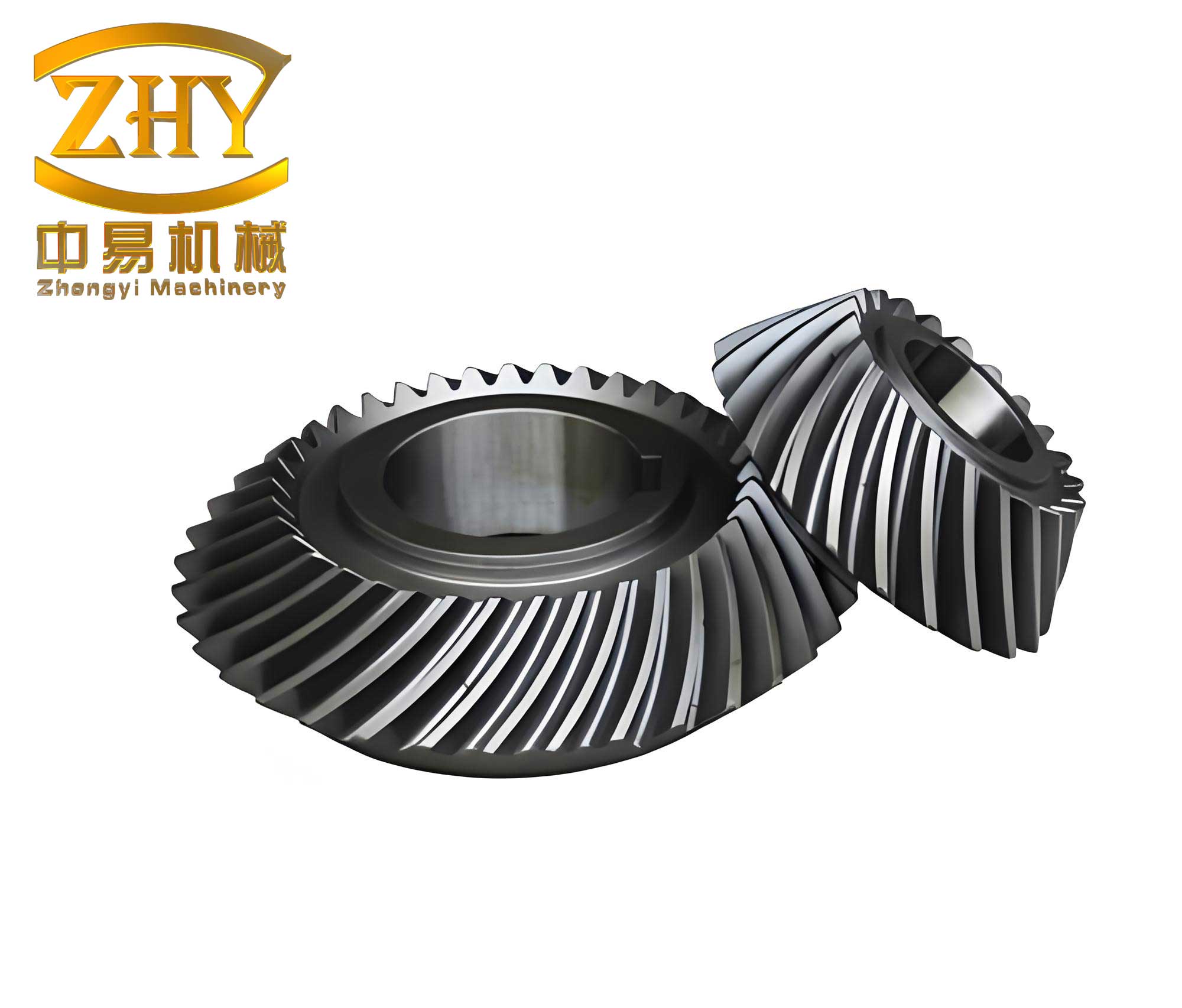
The quest for a solution led us to experiment with alternative lubricants. After several trials, asphalt emerged as a surprisingly effective candidate. Its inherent physical properties addressed the core issues plaguing the spiral gear system. Asphalt has a high softening point, retains viscosity at elevated temperatures, and adheres tenaciously to metal surfaces. When applied, it forms a persistent, protective film on the spiral gear teeth, maintaining lubrication even under high thermal stress. Furthermore, its superior heat dissipation characteristics helped manage the operating temperature of the spiral gear assembly. The fundamental heat transfer from a gear tooth interface can be modeled simplistically by Newton’s law of cooling, where the heat flux \( q \) is proportional to the temperature difference:
$$ q = h \, A \, (T_{\text{gear}} – T_{\text{ambient}}) $$
In this context, the asphalt film, with its different thermal properties compared to grease, potentially alters the effective heat transfer coefficient \( h \) and surface area \( A \), facilitating better cooling of the spiral gear teeth and preventing the thermal runaway that doomed the previous lubricant.
The operational and financial benefits of switching to asphalt lubrication for the spiral gear units were immediately quantifiable. The table below summarizes the before-and-after scenario for a typical drill rig over a monthly period.
| Cost & Performance Factor | Using Conventional Grease | Using Asphalt Lubricant |
|---|---|---|
| Lubricant Monthly Consumption | 30 kg | 5 kg |
| Cost of Lubricant per Month | $240 | $4 |
| Average Number of Spiral Gear Sets Replaced Monthly | 4 sets | 0.5 sets (1 set every 2 months) |
| Cost of Spiral Gears per Month | $320 (at $80/set) | $40 |
| Total Direct Cost per Month (Lubricant + Gears) | $560 | $44 |
| Estimated Monthly Savings | $516 | |
| Spiral Gear Service Life Extension | Baseline (7-10 days) | 60-90 days |
| Downtime for Gear Changes | High (Frequent) | Low (Infrequent) |
The formula for total monthly cost savings \( S \) clearly demonstrates the impact:
$$ S = (C_{g,\text{grease}} + G_{\text{grease}}) – (C_{g,\text{asphalt}} + G_{\text{asphalt}}) $$
where \( C_g \) is lubricant cost and \( G \) is gear replacement cost. Substituting the values: \( S = (240 + 320) – (4 + 40) = 560 – 44 = 516 \) monetary units.
The application method for the asphalt was straightforward. We would break solid asphalt into small pieces and place them directly onto the meshing surfaces of the spiral gears within the housing. The existing residual heat from operation would slowly melt and distribute it. Alternatively, we could pre-melt asphalt into a paste using hot water from the drill’s cooling system and apply it like standard grease. Two applications per 24-hour shift sufficed. Used asphalt could be collected, re-melted, and reused, further enhancing its economic advantage. It is crucial to note that this solution was specifically tailored for the spiral gear sets on the vertical shaft due to their enclosed, high-friction environment. In colder weather, pre-heating the gearbox with a blowtorch before startup was necessary to ensure the asphalt was pliable, and the same method was required for disassembly to avoid damaging the spiral gear components.
The success of these two innovations—wet dust suppression and asphalt lubrication—rested on more than just technical adjustments. Both required a culture of proactive problem-solving and strong frontline leadership. In the foundry, management championed the change, facilitating trials and fostering a collective spirit where every worker’s input on watering schedules and cleanup routines was valued. Similarly, the adoption of asphalt for the spiral gear难题 was a field-engineered solution born from observing the failure patterns and daring to test a non-standard material. The iterative process of testing, measuring, and refining was key. For instance, the performance of the spiral gear under asphalt lubrication could be analyzed by modeling wear volume \( V_w \) using Archard’s wear equation, albeit with modified constants for the asphalt-film interface:
$$ V_w = k \frac{N \, s}{H} $$
Here, \( V_w \) is the wear volume, \( k \) is a dimensionless wear coefficient specific to the lubricated material pair, \( N \) is the normal load on the spiral gear tooth, \( s \) is the sliding distance, and \( H \) is the hardness of the softer material (the gear). The shift to asphalt lubrication effectively reduced the wear coefficient \( k \) for the spiral gear system, leading to the dramatic extension in service life we observed.
Reflecting on these experiences, the interconnectedness of worker safety, mechanical reliability, and economic efficiency becomes undeniably clear. The wet process innovation transformed a health hazard into a safe, even more productive, operation. Its principles can be extended to other dust-generating processes. The formula for required water volume \( W_v \) as a function of casting mass \( m_c \) and desired suppression efficiency can be empirically derived:
$$ W_v \approx 0.02 \, m_c + \beta $$
where \( \beta \) is a correction factor for ambient humidity and sand type. Similarly, the success with asphalt for the spiral gear opens avenues for exploring phase-change materials or high-adhesion polymers in extreme-condition lubrication. The key takeaway is that the spiral gear, a component so vital to continuous operation, was saved not by a complex redesign but by rethinking its maintenance fundamental—the lubricant itself. Every time I now hear the smooth, consistent whirr of a drill rig’s spiral gear assembly, it serves as an audible testament to the power of practical, ground-up innovation. These stories are not just about dust and grease; they are about observing carefully, measuring rigorously, and having the courage to implement simple solutions that yield profound, lasting benefits for both people and machinery.