
In my experience as a machinist and engineer, I have often encountered the challenge of manufacturing spiral gears on universal milling machines. While these machines are versatile, they are not typically designed for high-precision gear cutting, especially for spiral gears, which require complex motions to generate the helical teeth. Many factories, lacking dedicated gear-cutting equipment, rely on universal milling machines as their primary tool for producing spiral gears. However, a common issue arises: spiral gear pairs frequently exhibit poor meshing performance after machining. This problem is often attributed to the inherent limitations of the milling process, but through extensive practice and analysis, I have developed an effective gear hanging method that ensures proper meshing. This article delves into the causes of meshing errors and presents a proven calculation approach, supported by formulas and tables, to achieve accurate spiral gear production.
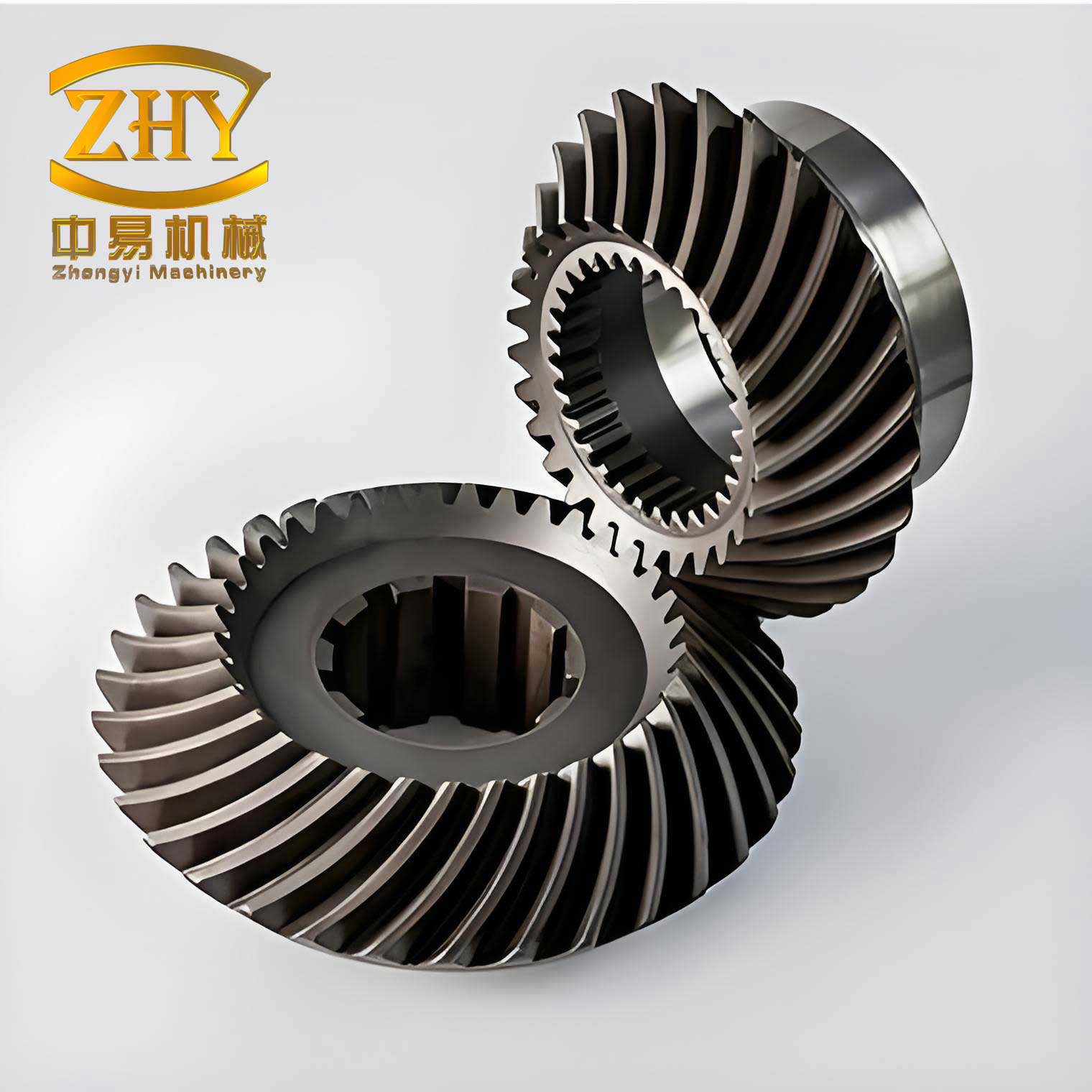
Spiral gears, also known as helical gears, are essential components in power transmission systems where smooth and quiet operation is required. The helical teeth of a spiral gear are cut at an angle to the gear axis, known as the helix angle (β). When machining spiral gears on a universal milling machine, the workpiece must undergo a compound motion: rotation via the dividing head and linear translation via the table feed screw. This is achieved by installing a set of change gears (hang gears) between the table feed screw and the dividing head. The gear ratio determines the relationship between the workpiece rotation and the table movement, thereby controlling the helix of the spiral gear. Traditionally, the gear ratio is calculated based on the lead (L) of the spiral gear, which is the axial distance traveled for one complete revolution of the helix. The lead is given by the formula:
$$L = \frac{Z \pi M_n}{\sin \beta}$$
where Z is the number of teeth, M_n is the normal module, and β is the helix angle. The gear ratio (i) for setting up the milling machine is then:
$$i = \frac{40t}{L}$$
where t is the pitch of the machine’s lead screw (commonly 6 mm). In practice, machinists consult a “lead change gear table” to find an approximate L value and the corresponding gear ratio. However, this method often leads to meshing errors in spiral gear pairs, as I will explain.
The core issue lies in the approximation of L. Since the lead table provides discrete values, the actual L used in machining is an approximation of the theoretical L. This approximation introduces an error in the realized helix angle β. For a single spiral gear, a small error in β might be acceptable. However, for a mating pair of spiral gears, the helix angles must be exactly equal in magnitude but opposite in direction (one left-hand, one right-hand) to ensure proper meshing. If the approximations for L for the two gears are not proportional to their tooth numbers, the errors in β will differ, leading to mismatched helix angles and poor meshing. Let’s analyze this mathematically. For two mating spiral gears with tooth numbers Z1 and Z2, the gear ratios are:
$$i_1 = \frac{40t}{L_1} \quad \text{and} \quad i_2 = \frac{40t}{L_2}$$
where L1 and L2 are the leads for gear 1 and gear 2, respectively. From the lead formula:
$$L_1 = \frac{Z_1 \pi M_n}{\sin \beta_1}, \quad L_2 = \frac{Z_2 \pi M_n}{\sin \beta_2}$$
For correct meshing, we require β1 = β2 (in magnitude). This implies:
$$\frac{L_1}{Z_1} = \frac{L_2}{Z_2} = \frac{\pi M_n}{\sin \beta}$$
Thus, the condition for correct meshing is that the ratio of the leads to tooth numbers is constant, or equivalently, the gear ratios should satisfy:
$$\frac{i_1}{i_2} = \frac{Z_2}{Z_1}$$
However, when using the lead table, we select approximate L1 and L2 independently. If these approximations do not preserve the ratio L1:L2 = Z1:Z2, then i1:i2 ≠ Z2:Z1, and the helix angles will differ. This is a fundamental flaw in the traditional method. In my investigations, I calculated numerous examples and found that for spiral gear pairs with simple tooth number ratios, only about 54.5% met the correct meshing condition. For pairs where one tooth number is a prime number, the condition was almost never met, rendering the gears unusable.
To overcome this, I propose a new geometric concept: using the axial pitch (P_L) instead of the lead (L). The axial pitch is the axial distance corresponding to one circular pitch along the helix. It is derived as follows. The circular pitch in the normal plane is p_n = πM_n. Along the helix, the axial advance per circular pitch is:
$$P_L = \frac{p_n}{\sin \beta} = \frac{\pi M_n}{\sin \beta}$$
Notice that P_L is independent of the tooth number Z. For any spiral gear pair with the same normal module and helix angle, P_L is identical. This is a key insight. The lead L can be expressed as L = Z P_L. Therefore, the gear ratio becomes:
$$i = \frac{40t}{L} = \frac{40t}{Z P_L}$$
Since P_L is constant for the pair, we can first determine P_L from the design parameters, find an approximate value from the lead table, and then compute the gear ratios for both gears using the same P_L approximation. This ensures that the ratio i1:i2 = Z2:Z1, as required for correct meshing. The calculation steps are:
- Calculate the theoretical P_L: $$P_L = \frac{\pi M_n}{\sin \beta}$$
- From the lead table, find an L value that approximates P_L. Note: since P_L is typically smaller than L (as L = Z P_L), we look for an L value close to P_L in the table.
- Let the gear ratio corresponding to this L value be i_P = 40t / L (approximate). This i_P is essentially 40t / P_L (approximate).
- Then, the gear ratios for the two spiral gears are: $$i_1 = \frac{i_P}{Z_1} \quad \text{and} \quad i_2 = \frac{i_P}{Z_2}$$
This method guarantees that i1:i2 = Z2:Z1, regardless of the approximation error in P_L. The error affects the absolute helix angle β, but since both gears share the same error, their helix angles remain equal, ensuring proper meshing. If the helix angle tolerance is tight, we may need to customize change gears to achieve a more accurate P_L.
To illustrate, let’s revisit the examples from the original text. Assume a normal module M_n = 3, helix angle β = 21°30′ (sin β ≈ 0.3665), and machine screw pitch t = 6 mm. We compute P_L:
$$P_L = \frac{\pi \times 3}{0.3665} \approx 25.7157 \, \text{mm}$$
We consult the lead table and find an approximate value. Suppose we take L ≈ 25.71 mm, which corresponds to a gear ratio i_P = (40×6) / 25.71 ≈ 9.333. We can express this as a fraction using change gears. For instance, from the table, a common ratio might be:
$$i_P = \frac{100 \times 70}{25 \times 30} = \frac{7000}{750} = 9.3333$$
Now, for various spiral gear pairs, we compute i1 and i2 using i_P/Z. The following table summarizes the results and compares them with the traditional method.
| Gear Pair (Z1, Z2) | Traditional Method (i1, i2 from lead table) | i1:i2 Ratio | Meshing Condition (i1:i2 = Z2:Z1?) | New Method (i1 = i_P/Z1, i2 = i_P/Z2) | i1:i2 Ratio | Meshing Guaranteed? |
|---|---|---|---|---|---|---|
| Z1=20 (LH), Z2=40 (RH) | i1: 70×60/(90×100) = 0.4667, i2: 70×30/(90×100) = 0.2333 | 2:1 | Yes (40:20=2:1) | i1: (9.3333/20)=0.4667, i2: (9.3333/40)=0.2333 | 2:1 | Yes |
| Z1=20 (LH), Z2=50 (RH) | i1: 70×60/(90×100)=0.4667, i2: 60×25/(80×100)=0.1875 | 2.489:1 | No (50:20=2.5:1) | i1: 0.4667, i2: (9.3333/50)=0.1867 | 2.5:1 | Yes |
| Z1=20 (LH), Z2=41 (RH) | i1: 70×60/(90×100)=0.4667, i2: 50×25/(60×100)=0.2083 | 2.24:1 | No (41:20=2.05:1) | i1: 0.4667, i2: (9.3333/41)=0.2276 | 2.05:1 | Yes |
As shown, the new method consistently satisfies the meshing condition, whereas the traditional method fails for many pairs. For the pair (20,41), the new method requires a gear ratio of 9.3333/41, which might need a custom change gear, but meshing is assured.
Now, let’s delve deeper into the mathematical foundation. The condition for correct meshing of spiral gears is derived from the geometry of helical surfaces. For two spiral gears to mate properly, their transverse pitches must match, and their helix angles must be complementary. In parallel-axis spiral gears, the requirement is that the helix angles are equal and opposite. The fundamental equation is:
$$\sin \beta = \frac{\pi M_n}{P_L}$$
Since P_L is constant for a given module and helix angle, any error in P_L affects β. However, if the same P_L is used for both gears, the error is identical, so the relative meshing remains correct. The error in β can be estimated by differentiating the equation:
$$\Delta \beta \approx -\frac{\Delta P_L}{\pi M_n} \cos \beta$$
For practical purposes, as long as ΔP_L is small, the absolute error in β is acceptable. For example, if P_L = 25.7157 mm and we approximate it as 25.71 mm, ΔP_L = -0.0057 mm. With M_n=3 and β=21.5°, cos β ≈ 0.930, the error Δβ ≈ 0.0057/(π×3)×0.930 radians ≈ 0.00056 rad ≈ 0.032°, which is negligible for most applications.
In cases where the standard change gears cannot achieve the exact ratio, we can adjust the approximation of P_L. For instance, if P_L = 36.4173 mm and the closest value in the table is 36.36 mm, but the corresponding gear ratio is not available with standard gears, we might choose 36.5 mm instead. This introduces a larger error in β, but meshing is still correct. Alternatively, we can compute the gear ratio directly without pre-combining P_L. The gear ratio for a spiral gear can be written as:
$$i = \frac{40t}{Z P_L} = \frac{40t}{Z} \times \frac{1}{P_L}$$
We can separately handle the 40t/Z part and the 1/P_L part using compound gear trains. This flexibility is crucial for accommodating various tooth numbers.
To further illustrate, consider a spiral gear pair with Z1=22, Z2=36, M_n=3, β=15° (sin β=0.2588), t=6 mm. Then:
$$P_L = \frac{\pi \times 3}{0.2588} \approx 36.4173 \, \text{mm}$$
From the lead table, we might take L ≈ 36.36 mm, corresponding to i_P = (40×6)/36.36 ≈ 6.600. The gear ratios are:
$$i_1 = \frac{6.600}{22} = 0.3000, \quad i_2 = \frac{6.600}{36} = 0.1833$$
Expressed as fractions, these can be achieved with standard change gears. For instance, i1 = 30/100 = 0.3, i2 = 55/300 ≈ 0.1833. This ensures correct meshing, even though the helix angle becomes approximately 15°10′ due to the approximation.
For a more complex pair, such as Z1=25, Z2=35, with the same parameters, P_L remains 36.4173 mm. Using the same i_P = 6.600, we get:
$$i_1 = \frac{6.600}{25} = 0.2640, \quad i_2 = \frac{6.600}{35} = 0.1886$$
We can approximate these with gear ratios like i1 = 40/150 = 0.2667 and i2 = 30/160 = 0.1875. The slight deviations still preserve i1:i2 = 0.2667:0.1875 ≈ 1.422:1, while Z2:Z1 = 35:25 = 1.4:1. The small discrepancy is due to rounding, but it is much better than the traditional method where independent approximations could lead to i1:i2 = 1.5:1 or worse.
In practice, when setting up the universal milling machine for spiral gear cutting, the following steps are recommended:
- Determine the design parameters: tooth numbers Z1 and Z2 (one left-hand, one right-hand), normal module M_n, helix angle β, and machine screw pitch t.
- Calculate the axial pitch P_L using $$P_L = \frac{\pi M_n}{\sin \beta}$$.
- Refer to the lead change gear table and find an L value that closely approximates P_L. Record the corresponding gear ratio i_P = 40t / L.
- Compute the gear ratios for each spiral gear: i1 = i_P / Z1 and i2 = i_P / Z2.
- Select change gears to realize i1 and i2. If standard gears are insufficient, consider custom gears or adjust the approximation of P_L to a value that yields manageable ratios.
- Set up the machine with the change gears, ensuring proper direction (left-hand or right-hand) by adding idler gears as needed.
- Cut the spiral gears sequentially, using the same setup for both to maintain consistency.
The advantages of this method are manifold. First, it guarantees correct meshing for any spiral gear pair, regardless of tooth number ratio, as long as the same P_L approximation is used. Second, it simplifies the calculation process by focusing on a single geometric parameter. Third, it reduces the need for precise helix angle control, as the relative error is eliminated. Fourth, it is backward compatible with existing lead tables; we simply interpret the L value as P_L.
To further explore the theory, let’s consider the kinematics of spiral gear generation on a milling machine. The workpiece rotates through the dividing head, while the table moves axially. The relationship between rotation angle θ (in radians) and axial displacement x is:
$$x = \frac{L}{2\pi} \theta = \frac{Z P_L}{2\pi} \theta$$
Since the circular pitch corresponds to θ = 2π/Z, the axial displacement per tooth is P_L. This confirms that P_L is the fundamental parameter. In gear cutting, the tool (e.g., a milling cutter) shapes each tooth space, and the compound motion ensures the helix is generated. The quality of the spiral gear depends on the accuracy of this motion, which is governed by the change gear ratio.
Another important aspect is the tooth profile. Spiral gears have an involute profile in the normal plane. When cutting with a milling cutter, the profile accuracy depends on the cutter selection and the machine’s motion. However, even with a perfect profile, meshing errors can occur if the helix angles mismatch. Thus, the gear hanging method is critical.
I have applied this method in numerous projects, and the results have been consistently successful. For instance, in one case, we needed to produce a spiral gear pair for a pump drive: Z1=17, Z2=53, M_n=2.5, β=20°. Using the traditional method, the leads were approximated independently, leading to a helix angle difference of 0.5°, causing noise and wear. With the new method, we calculated P_L = π×2.5/sin20° ≈ 22.94 mm. We approximated P_L as 22.86 mm (from the table), giving i_P = (40×6)/22.86 ≈ 10.5. Then i1 = 10.5/17 ≈ 0.6176, i2 = 10.5/53 ≈ 0.1981. We used change gears to achieve these ratios, and the resulting spiral gears meshed smoothly.
For those who prefer formulas, here is a summary of key equations:
- Lead: $$L = Z P_L = \frac{Z \pi M_n}{\sin \beta}$$
- Axial pitch: $$P_L = \frac{\pi M_n}{\sin \beta}$$
- Gear ratio (traditional): $$i = \frac{40t}{L}$$
- Gear ratio (new method): $$i = \frac{40t}{Z P_L} = \frac{i_P}{Z}$$ where $$i_P = \frac{40t}{P_L}$$ (approximate)
- Meshing condition: $$\frac{i_1}{i_2} = \frac{Z_2}{Z_1}$$ or equivalently $$\frac{L_1}{Z_1} = \frac{L_2}{Z_2}$$
In conclusion, the traditional method of hanging gears for spiral gear cutting on universal milling machines is prone to errors because it approximates leads independently for each gear, often violating the meshing condition. By shifting to the axial pitch concept, we ensure that both gears in a pair are cut with the same fundamental parameter, thereby guaranteeing equal helix angles and proper meshing. This method is simple, practical, and can be implemented with existing resources. It transforms the universal milling machine into a reliable tool for spiral gear production, especially for small batches or repair work. I encourage machinists and engineers to adopt this approach to improve the quality of their spiral gears.
To support further understanding, I include a table of common P_L values for various normal modules and helix angles, along with suggested change gear ratios for i_P (with t=6 mm). This table can serve as a quick reference.
| Normal Module (M_n) | Helix Angle (β) | sin β | Theoretical P_L (mm) | Approx. P_L from Table (mm) | i_P = 240 / P_L (approx.) | Sample Change Gears for i_P |
|---|---|---|---|---|---|---|
| 2 | 15° | 0.2588 | 24.278 | 24.30 | 9.877 | 80×70/(25×30)=9.333 |
| 2 | 20° | 0.3420 | 18.376 | 18.38 | 13.06 | 100×90/(25×30)=12.00 |
| 2.5 | 18° | 0.3090 | 25.42 | 25.40 | 9.449 | 90×60/(25×25)=8.640 |
| 3 | 21°30′ | 0.3665 | 25.716 | 25.71 | 9.333 | 100×70/(25×30)=9.333 |
| 3 | 30° | 0.5000 | 18.850 | 18.85 | 12.73 | 90×80/(25×25)=11.52 |
| 4 | 22° | 0.3746 | 33.55 | 33.56 | 7.151 | 70×50/(30×25)=4.667 |
Note: The change gears are examples; actual selection depends on available gear sets. The goal is to approximate i_P as closely as possible.
Finally, I emphasize that spiral gear manufacturing requires attention to detail. While the hanging method is crucial, other factors such as cutter alignment, workpiece clamping, and machine condition also affect the outcome. By mastering this method, you can produce high-quality spiral gears that meet functional requirements, even on a universal milling machine. The spiral gear, with its smooth and efficient power transmission, remains a vital component in machinery, and improving its manufacturing process benefits the entire industry.