
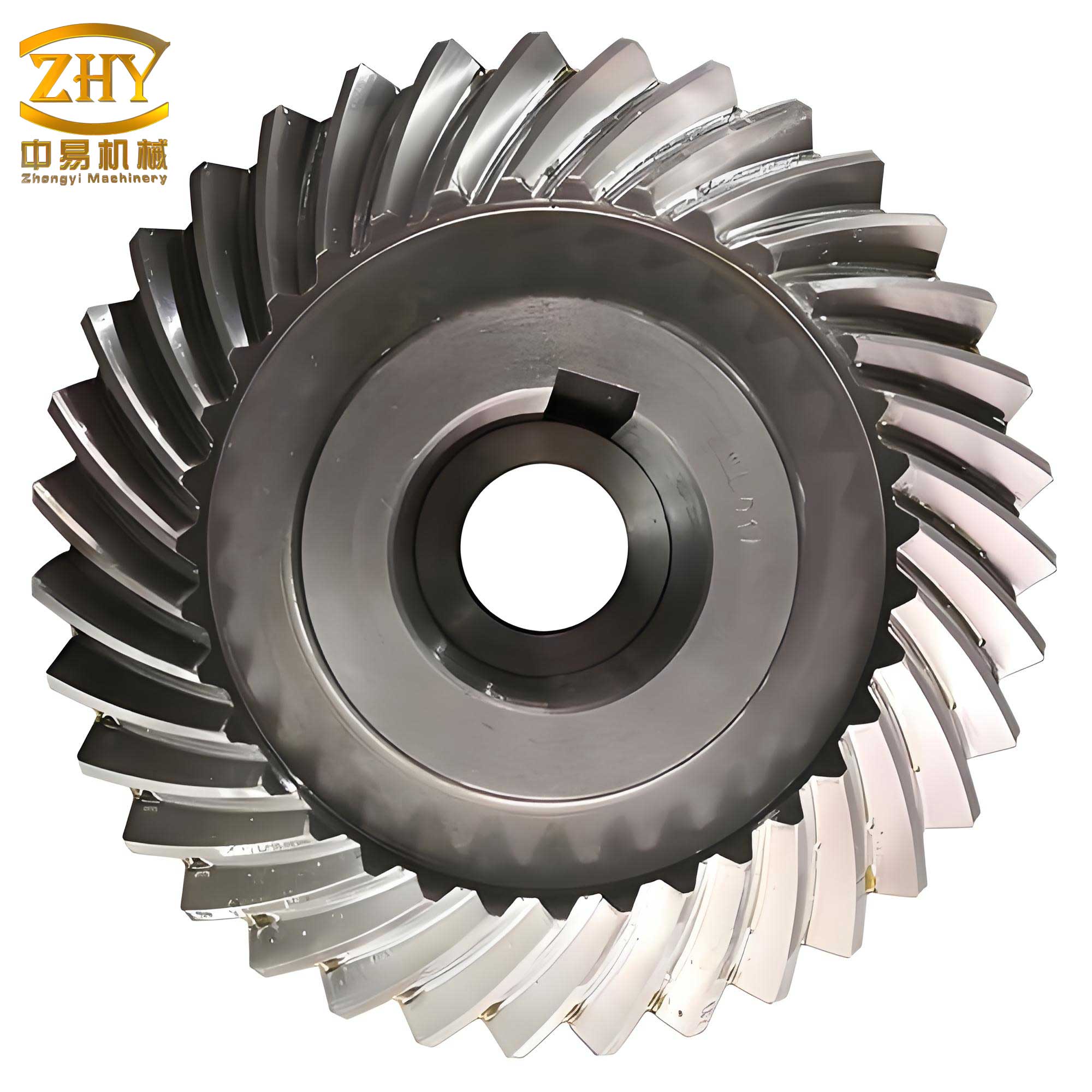
In the realm of mechanical transmissions, gear mechanisms are among the most widely used systems. Among these, involute gears, particularly spiral gears, hold significant importance due to their ability to transmit power efficiently and accurately across non-parallel and intersecting axes. Spiral gears, characterized by their helical teeth with an involute profile in the transverse section, offer advantages such as smooth operation, high load capacity, and reduced noise. However, achieving precise tooth profiles for spiral gears often requires grinding processes to meet stringent technical specifications. This article delves into the study of grinding wheel profiles for machining involute spiral gears, focusing on the mathematical modeling, contact conditions, and numerical methods for profile generation and compensation. The goal is to provide a comprehensive approach to form grinding of spiral gears, addressing challenges like wheel wear and error compensation.
The involute spiral surface is fundamental to understanding spiral gear geometry. It can be generated by a straight line moving in a helical motion around a base cylinder. Consider a base cylinder with radius \( r_b \). A straight line tangent to this cylinder and also tangent to a helix with spiral parameter \( P \) on the cylinder surface will trace out an involute spiral surface when subjected to a screw motion. In practical engineering, the transverse section of a spiral gear tooth is an involute curve. Let’s derive the equations for this surface. In the transverse plane, the involute curve can be parameterized by an angle \( u \). For a left-side tooth flank of a right-hand spiral gear, the involute curve in the initial coordinate system \( Oxy \) is given by:
$$ x_0 = r_b \cos(\sigma + u) + r_b u \sin(\sigma + u) $$
$$ y_0 = r_b \sin(\sigma + u) – r_b u \cos(\sigma + u) $$
Here, \( \sigma \) is the starting angle of the involute relative to the x-axis. To form the spiral surface, this involute undergoes a screw motion around the z-axis, combining rotation by an angle \( \theta \) and translation by \( P\theta \) along the z-axis, where \( P \) is the spiral parameter defined as \( P = \frac{r}{\cos \beta} \), with \( r \) being the pitch circle radius and \( \beta \) the helix angle. Using coordinate transformations, the equation of the spiral surface in a rotated coordinate system \( O_1x_1y_1z_1 \) becomes:
$$ x_1 = r_b \cos(\sigma + \theta + u) + r_b u \sin(\sigma + \theta + u) $$
$$ y_1 = r_b \sin(\sigma + \theta + u) – r_b u \cos(\sigma + \theta + u) $$
$$ z_1 = P \theta $$
The normal vector to this spiral surface at any point can be derived as:
$$ n_x = P r_b u \sin(\sigma + \theta + u) $$
$$ n_y = -P r_b u \cos(\sigma + \theta + u) $$
$$ n_z = r_b^2 u $$
These equations form the basis for analyzing the interaction between the grinding wheel and the spiral gear tooth surface. The grinding process typically uses a disk-shaped wheel, and its profile must be precisely determined to generate the desired spiral gear tooth geometry. The relative motion between the wheel and the workpiece is key to understanding the contact conditions.
When a disk-shaped grinding wheel machines a spiral gear surface, their spatial relationship is defined by the center distance \( a \) and the crossing angle \( \Sigma \) between their axes. For a spiral gear with helix angle \( \beta \), the crossing angle is \( \Sigma = 90^\circ – \beta \). The coordinate transformation from the workpiece system \( Oxyz \) to the wheel system \( O’XYZ \) is expressed as:
$$ X = a – x $$
$$ Y = -y \cos \Sigma – z \sin \Sigma $$
$$ Z = -y \sin \Sigma + z \cos \Sigma $$
During grinding, the wheel and workpiece rotate with angular velocities \( \omega’ \) and \( \omega \), respectively. At the point of contact, the surfaces share a common normal vector \( \mathbf{n} \), and the relative velocity \( \mathbf{v}^{(12)} \) must be perpendicular to this normal. This leads to the contact condition equation:
$$ \mathbf{v}^{(12)} \cdot \mathbf{n} = \left[ \omega (\mathbf{k} \times \mathbf{r} + P \mathbf{k}) – \omega’ (\mathbf{k}’ \times \mathbf{R}) \right] \cdot \mathbf{n} = 0 $$
For spiral surfaces, it can be shown that \( \mathbf{n} \cdot (\mathbf{k} \times \mathbf{r} + P \mathbf{k}) = 0 \), simplifying the contact condition to:
$$ (\mathbf{k}’ \times \mathbf{R}) \cdot \mathbf{n} = 0 $$
Substituting the expressions for \( \mathbf{R} \) and \( \mathbf{n} \), and after algebraic manipulation, the contact condition in terms of the spiral surface parameters becomes:
$$ (P^2 \theta – r_b^2 u) \sin \Sigma \sin(\sigma + \theta + u) – (P a \cos \Sigma + r_b^2 \sin \Sigma) \cos(\sigma + \theta + u) + r_b (P \cos \Sigma + a \sin \Sigma) = 0 $$
This equation, along with the spiral surface equations, defines the contact line between the wheel and the workpiece. The contact line lies on both the spiral surface and the wheel surface. By revolving the contact line around the wheel axis, we obtain the grinding wheel’s profile. However, solving these equations analytically is complex, so numerical methods are employed.
To determine the grinding wheel profile, we treat the contact condition as an implicit equation in parameters \( u \) and \( \theta \). For a given \( \theta \), we solve for \( u \) numerically. This yields discrete points on the contact line. By transforming these points into the wheel coordinate system using the coordinate transformations, we obtain discrete points on the wheel’s axial profile. Fitting these points gives the required wheel profile curve. The axial profile of the wheel is given by:
$$ R = \sqrt{X^2 + Y^2} $$
$$ Z = Z $$
The accuracy of the profile depends on the resolution of \( \theta \) values. A smaller increment in \( \theta \) results in more discrete points and a more accurate curve fit. This numerical approach allows for flexible adaptation to different spiral gear parameters and wheel diameters.
Key properties of the grinding wheel profile emerge from this analysis. For instance, the wheel profile is influenced by gear parameters like module, number of teeth, and helix angle, as well as wheel diameter. To summarize these relationships, consider the following table based on parametric studies:
| Parameter Variation | Effect on Wheel Profile Length | Effect on Profile Curvature | Required Wheel Thickness |
|---|---|---|---|
| Increase in module \( m_n \) | Increases | Becomes steeper | Increases |
| Increase in tooth number \( z_n \) | Increases | Becomes more gradual | Increases |
| Increase in helix angle \( \beta \) | Increases | Becomes more gradual | Increases |
| Decrease in wheel diameter | Decreases | Becomes more curved | May decrease |
These properties are crucial for selecting appropriate grinding wheels and designing the grinding process. For example, a larger wheel diameter tends to produce a longer and flatter contact line, which can improve grinding stability but may require thicker wheels. The concept of a “fixed chordal space point” is noted, where contact lines for different wheel diameters intersect at a common point on the spiral surface, emphasizing the geometric consistency in spiral gear machining.
Moreover, the contact lines themselves exhibit interesting characteristics. For a given spiral gear, as the wheel diameter changes, the contact lines vary in length and shape. The following table illustrates how contact line properties change with wheel diameter for a typical spiral gear:
| Wheel Diameter (mm) | Contact Line Length (mm) | Contact Line Curvature | Observation |
|---|---|---|---|
| Large (e.g., 200) | Long | Flatter | More stable grinding |
| Medium (e.g., 150) | Medium | Moderate | Balanced performance |
| Small (e.g., 100) | Short | Sharper curvature | Higher wear rate |
These insights help in optimizing the grinding process for spiral gears. However, a major challenge in form grinding is wheel wear, which alters the wheel profile over time, leading to errors in the machined spiral gear teeth. To address this, error compensation strategies are essential. By continuously monitoring the wheel diameter during grinding, the worn diameter can be measured, and a new wheel profile can be computed using the same numerical methods. This approach allows for on-the-fly correction of the wheel profile, ensuring consistent accuracy. The process involves the following steps:
- Measure the current wheel diameter after a period of grinding.
- Input the new diameter into the numerical model to recompute the discrete points for the wheel profile.
- Re-fit the curve to generate the updated wheel profile.
- Use this updated profile to re-dress the grinding wheel.
This method leverages computer technology and numerical algorithms to mitigate the effects of wear, though it requires periodic measurement and recalibration, which can be a limitation in fully automated systems.
To delve deeper into the mathematical framework, let’s consider the coordinate transformations in detail. The transformation from the workpiece to the wheel coordinate system involves both translation and rotation. The general transformation matrix can be expressed as a combination of these operations. For instance, the rotation matrix for an angle \( \Sigma \) around an appropriate axis is used. These transformations are vital for mapping points between the two systems and are embedded in the contact condition derivation.
Furthermore, the spiral parameter \( P \) plays a central role in defining the geometry of spiral gears. It relates to the helix angle and pitch circle radius. For a standard spiral gear, the lead \( L \) is given by \( L = 2\pi r \tan \beta \), and \( P = L / (2\pi) = r \tan \beta \). However, in the context of involute spiral gears, the spiral parameter is often defined as \( P = r / \cos \beta \) to align with the screw motion of the involute curve. This distinction is important for accurate modeling.
The numerical solution of the contact condition involves iterative methods. For a range of \( \theta \) values, typically spanning the active portion of the tooth flank, we solve for \( u \) using numerical root-finding techniques such as the Newton-Raphson method. The equation to solve is:
$$ f(u, \theta) = (P^2 \theta – r_b^2 u) \sin \Sigma \sin(\sigma + \theta + u) – (P a \cos \Sigma + r_b^2 \sin \Sigma) \cos(\sigma + \theta + u) + r_b (P \cos \Sigma + a \sin \Sigma) = 0 $$
Given \( \theta \), we find \( u \) that satisfies \( f(u, \theta) = 0 \). Then, using the spiral surface equations, we compute the corresponding point \( (x_1, y_1, z_1) \). Transforming this to the wheel coordinates yields \( (X, Y, Z) \), and finally the axial profile coordinates \( (R, Z) \). These points are then fitted using a spline or polynomial curve to define the wheel profile. The fitting accuracy can be assessed by the residual error between the fitted curve and the discrete points.
In practice, the grinding wheel profile for spiral gears is not a standard shape but a custom curve that depends on the specific gear design. This necessitates advanced manufacturing techniques for wheel dressing. Modern CNC grinding machines can dress wheels along complex curves, making this approach feasible. The table below summarizes the key equations and variables involved in the profile determination process:
| Variable | Description | Formula or Relationship |
|---|---|---|
| \( r_b \) | Base circle radius | \( r_b = r \cos \alpha_t \), where \( \alpha_t \) is transverse pressure angle |
| \( \sigma \) | Involute start angle | Depends on tooth geometry and space width |
| \( u \) | Involute parameter | Angular parameter along involute |
| \( \theta \) | Rotation angle in screw motion | Varies from \( \theta_{\text{min}} \) to \( \theta_{\text{max}} \) |
| \( P \) | Spiral parameter | \( P = r / \cos \beta \) for spiral gears |
| \( \Sigma \) | Crossing angle between axes | \( \Sigma = 90^\circ – \beta \) |
| \( a \) | Center distance | Set based on machine setup |
| \( R, Z \) | Wheel axial profile coordinates | \( R = \sqrt{X^2 + Y^2} \), \( Z = Z \) |
Beyond the theoretical aspects, practical considerations for grinding spiral gears include the selection of grinding wheel abrasives, cooling methods, and machine dynamics. The form grinding process for spiral gears is sensitive to alignment errors, so precise machine calibration is crucial. Additionally, the numerical methods described here can be integrated into CAD/CAM systems for automated wheel profile generation.
Error compensation due to wheel wear is an ongoing research area. While the method of recomputing the profile based on measured diameter is effective, it interrupts production. Alternative approaches include in-process monitoring using sensors to estimate wear in real-time and adaptive control systems that adjust the wheel path accordingly. For spiral gears, this is particularly challenging due to the complex geometry, but advancements in machine learning and IoT could enable predictive maintenance and compensation.
To illustrate the application of this research, consider a case study for machining a spiral gear with the following parameters: module \( m_n = 5 \) mm, number of teeth \( z = 30 \), helix angle \( \beta = 20^\circ \), pressure angle \( \alpha = 20^\circ \), and face width 50 mm. Using the equations, we can compute the wheel profile for a given wheel diameter, say 150 mm. The steps involve setting up the coordinate systems, solving the contact condition for discrete points, and fitting the profile. The resulting wheel profile will be non-standard and require custom dressing.
In conclusion, the study of grinding wheel profiles for machining involute spiral gears involves a blend of geometric modeling, coordinate transformations, and numerical analysis. The key is to derive the contact condition between the wheel and the spiral surface, solve it numerically to obtain discrete points, and fit these points to define the wheel profile. This approach allows for accurate form grinding of spiral gears, with the ability to compensate for wheel wear through recomputation of the profile. The properties of the wheel profile, such as its dependence on gear parameters and wheel diameter, provide guidelines for process optimization. Future work could focus on real-time error compensation and integration with smart manufacturing systems to enhance the efficiency and accuracy of spiral gear production. Spiral gears, with their unique geometry, continue to be critical components in advanced mechanical systems, and advancements in grinding technology will further their application in industries like automotive, aerospace, and robotics.
Throughout this discussion, the term “spiral gear” has been emphasized to highlight the focus on helical gears with involute profiles. The mathematical framework presented here is general and can be adapted to various types of spiral gears, including those with non-standard helix angles or modified tooth forms. By leveraging computational tools, manufacturers can achieve high-precision spiral gears that meet the demanding requirements of modern machinery.