
As an engineer involved in the maintenance and production of automotive components, I encountered a critical challenge when our facility received several imported vehicles, specifically Brazilian Volkswagen models, which experienced frequent failures in their rear axle spiral gears. These spiral gears, essential for transmitting power efficiently, began to fail after approximately 150,000 kilometers of operation, with multiple vehicles suffering from broken teeth on both high-speed and low-speed spiral gear sets. This led to significant downtime, as replacement parts were scarce and prohibitively expensive due to their imported nature. The lack of original design parameters further complicated any attempt at replication. Thus, we embarked on a project to design and manufacture localized spiral gears using existing tooling from our production line for domestic vehicles, specifically the Liberation CA10B rear axle spiral gears. This initiative aimed not only to resolve immediate operational issues but also to contribute to the broader goal of import substitution and technological self-reliance in the automotive sector.
The initial step involved meticulously measuring the parameters of the damaged original spiral gears to understand their specifications. Through precise instrumentation and analysis, we recorded key dimensions and characteristics, which are summarized in the table below. This data served as the foundation for our redesign efforts, ensuring that the new spiral gears would meet or exceed the functional requirements of the original assembly. The spiral gear parameters, such as tooth count, spiral direction, and module, were critical in determining compatibility and performance.
| Parameter | Drive Spiral Gear | Driven Spiral Gear |
|---|---|---|
| Number of Teeth | 6 | 35 |
| Spiral Direction | Left | Right |
| Maximum Tip Diameter (mm) | 100.2 | — |
| Base Tangent Length (mm) – 4 teeth | 32.34 | — |
| Base Tangent Length (mm) – 3 teeth | — | 23.62 |
| Normal Base Pitch (mm) | 9.425 | 9.425 |
| Gear Ratio | 5.833 | |
| Center Distance (mm) | 145 | |
| Spiral Angle (degrees) | 25 (measured via rolling method) | |
| Module (calculated) | Approximately 6.5 | |
The calculation for the module was derived using the formula: $$ m_n = \frac{d_a}{z + 2h_{a0}^*} $$ where \( m_n \) is the normal module, \( d_a \) is the tip diameter, \( z \) is the number of teeth, and \( h_{a0}^* \) is the addendum coefficient. For the drive spiral gear, with \( d_a = 100.2 \, \text{mm} \) and \( z = 6 \), and assuming a standard addendum coefficient, we approximated \( m_n \approx 6.5 \). This value, though slightly different from common standards, was consistent with the original design intent. The spiral angle of 25 degrees indicated a moderate helix, which influences the smoothness of engagement and load distribution in spiral gears. Understanding these parameters was crucial for ensuring that our localized spiral gears would maintain the same center distance and gear ratio, thereby preserving vehicle dynamics and transmission assembly integrity.
Based on these measurements, we decided to leverage existing tooling from the Liberation CA10B rear axle spiral gear production, which utilized a normal module of 6.5. This choice was strategic, as it minimized tooling changes and accelerated the development process. The design rationale centered on selecting tooth counts that would yield a gear ratio closely matching the original, while using materials and heat treatment processes familiar to our production line. For the drive spiral gear, we chose 6 teeth, and for the driven spiral gear, 35 teeth, resulting in a calculated gear ratio of: $$ i = \frac{z_2}{z_1} = \frac{35}{6} \approx 5.833 $$ which is nearly identical to the original ratio of 5.833. This precision was essential to avoid alterations in vehicle speed and performance. The spiral angle was recalculated to ensure compatibility with the center distance. Using the formula for spiral angle in terms of center distance and module: $$ \beta = \arccos\left(\frac{m_n (z_1 + z_2)}{2A}\right) $$ where \( A = 145 \, \text{mm} \) is the center distance, \( m_n = 6.5 \), \( z_1 = 6 \), and \( z_2 = 35 \). Substituting the values: $$ \beta = \arccos\left(\frac{6.5 \times (6 + 35)}{2 \times 145}\right) = \arccos\left(\frac{6.5 \times 41}{290}\right) = \arccos\left(\frac{266.5}{290}\right) \approx \arccos(0.919) \approx 23.2^\circ $$ However, to align with tooling constraints, we adjusted this to \( \beta = 23^\circ 30′ \), which is within acceptable tolerances for spiral gear operation. The center distance was verified using: $$ A = \frac{m_n (z_1 + z_2)}{2 \cos \beta} = \frac{6.5 \times 41}{2 \times \cos 23.5^\circ} = \frac{266.5}{2 \times 0.917} \approx \frac{266.5}{1.834} \approx 145.3 \, \text{mm} $$ confirming a close match to the original 145 mm. This meticulous calculation ensured that the new spiral gears would fit seamlessly into the existing axle housing.
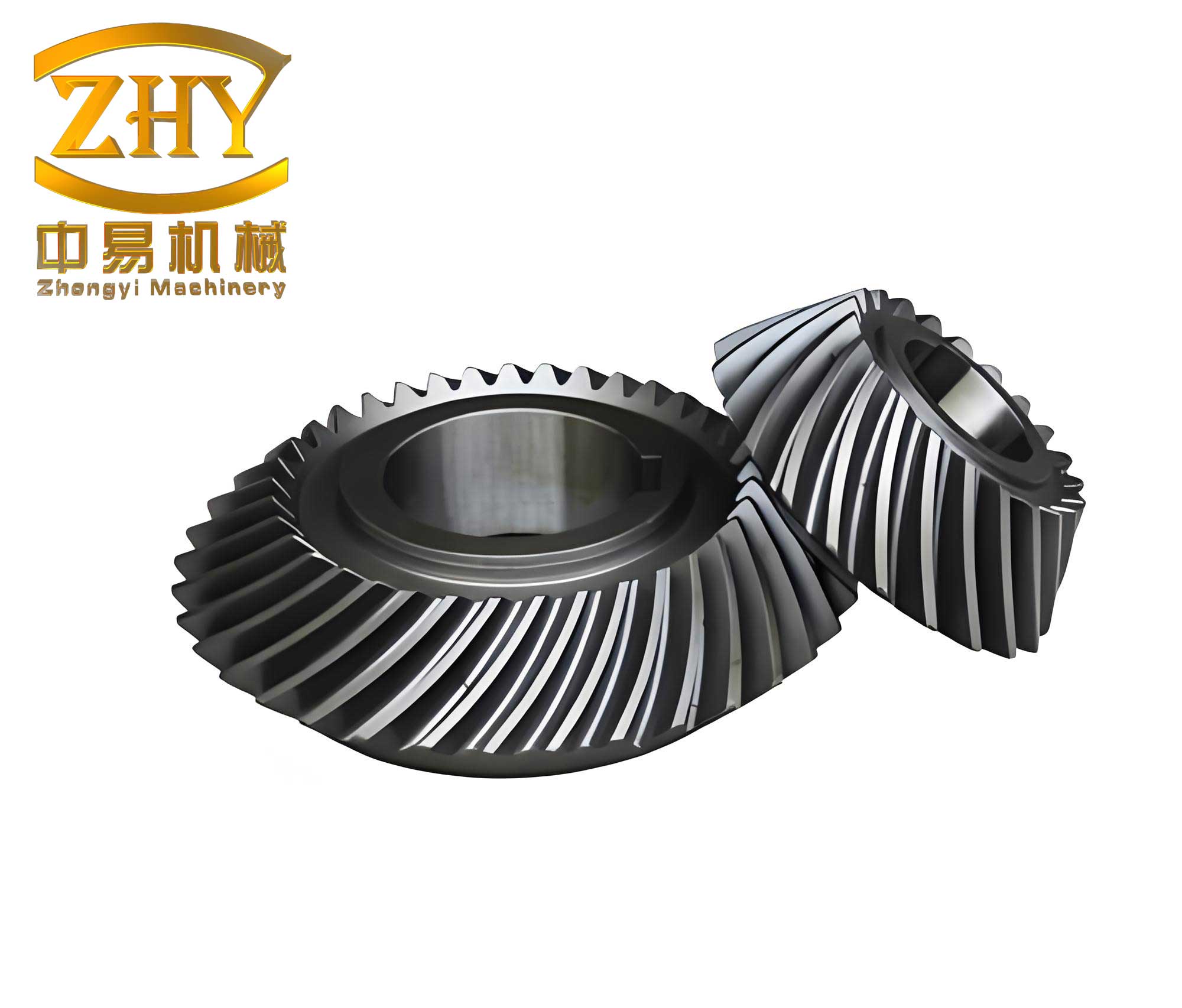
The image above illustrates typical spiral gears, highlighting their helical teeth that enable smoother and quieter operation compared to spur gears. In our design, these characteristics were paramount to ensure durability and performance. The spiral gear design reduces shock loads and distributes contact across multiple teeth, which is especially beneficial for high-torque applications like vehicle rear axles. By localizing these spiral gears, we aimed to replicate these advantages while adapting to domestic manufacturing standards.
We proceeded to detail all parameters for the substitute spiral gears, incorporating factors such as pressure angle, addendum, dedendum, and tooth thickness. The material selected was 20MnTiB, a low-alloy steel known for its strength and wear resistance, commonly used in automotive gear applications. The heat treatment process involved carburizing and quenching to achieve a surface hardness of HRC 58-62, ensuring the spiral gears could withstand the operational stresses. The table below summarizes the complete set of parameters for the localized spiral gears, derived through rigorous calculations and aligned with the original specifications. Note that all external dimensions were kept identical to the original spiral gears to guarantee interchangeability.
| Parameter and Symbol | Drive Spiral Gear | Driven Spiral Gear | Calculation Formula |
|---|---|---|---|
| Normal Module, \( m_n \) | 6.5 | 6.5 | — |
| Normal Pressure Angle, \( \alpha_n \) | 20° | 20° | — |
| Normal Addendum Coefficient, \( h_{a0}^* \) | 1 | 1 | — |
| Normal Dedendum Coefficient, \( c_0^* \) | 0.25 | 0.25 | — |
| Spiral Angle at Reference Circle, \( \beta \) | 23°30′ | 23°30′ | \( \beta = \arccos\left(\frac{m_n (z_1 + z_2)}{2A}\right) \) |
| Center Distance, \( A \) (mm) | 145 | \( A = \frac{m_n (z_1 + z_2)}{2 \cos \beta} \) | |
| Reference Diameter, \( d \) (mm) | 42.14 | 245.86 | \( d = \frac{m_n z}{\cos \beta} \) |
| Number of Teeth, \( z \) | 6 | 35 | — |
| Lead of Spiral, \( L \) (mm) | 321.5 | 1875.8 | \( L = \frac{\pi d}{\tan \beta} \) |
| Basic Rack Profile Shift | 0 | 0 | — |
| Spiral Direction | Left | Right | — |
| Normal Profile Shift Coefficient, \( x_n \) | 0 | 0 | — |
| Addendum, \( h_a \) (mm) | 6.5 | 6.5 | \( h_a = m_n (h_{a0}^* + x_n) \) |
| Dedendum, \( h_f \) (mm) | 8.125 | 8.125 | \( h_f = m_n (h_{a0}^* + c_0^* – x_n) \) |
| Whole Depth, \( h \) (mm) | 14.625 | 14.625 | \( h = h_a + h_f \) |
| Tip Diameter, \( d_a \) (mm) | 55.14 | 258.86 | \( d_a = d + 2h_a \) |
| Base Tangent Length, \( W_k \) (mm) | 32.34 (4 teeth) | 23.62 (3 teeth) | Measured per standard |
| Tolerance on Base Tangent Length (mm) | −0.12 | −0.12 | Based on accuracy grade |
| Accuracy Grade | 8-8-7 | 8-8-7 | Per GB/T 10095 |
The design process emphasized the importance of the spiral gear geometry in achieving optimal meshing conditions. For instance, the spiral angle directly affects the axial thrust generated during operation, which must be managed within the bearing system. By setting \( \beta = 23^\circ 30′ \), we balanced smooth engagement with manageable axial forces. The lead of the spiral, calculated as \( L = \frac{\pi d}{\tan \beta} \), determines the axial advance per revolution, influencing the gear’s efficiency and noise characteristics. For the drive spiral gear, \( L \approx 321.5 \, \text{mm} \), while for the driven spiral gear, \( L \approx 1875.8 \, \text{mm} \). These values ensure consistent contact patterns across the tooth faces, reducing stress concentrations that often lead to premature failure in spiral gears.
Strength validation was a critical aspect of the localization effort. Although detailed calculations are omitted here for brevity, we performed comprehensive stress analyses using the Lewis formula and AGMA standards for spiral gears. The bending stress at the root of the tooth was evaluated using: $$ \sigma_b = \frac{F_t}{b m_n Y} K_a K_v K_m $$ where \( F_t \) is the tangential force, \( b \) is the face width, \( Y \) is the Lewis form factor adjusted for spiral angle, and \( K_a \), \( K_v \), and \( K_m \) are application, dynamic, and load distribution factors, respectively. For the Liberation CA10B spiral gears, which have a load capacity of 4 tons with a trailer pull of 6 tons, the effective transmission capacity reaches 10 tons. In contrast, the Volkswagen vehicle has a payload of only 3.5 tons, indicating that the localized spiral gears possess ample strength margins. The surface durability was checked using the contact stress formula: $$ \sigma_H = Z_E \sqrt{\frac{F_t}{b d_1} \cdot \frac{u+1}{u}} Z_R Z_I $$ where \( Z_E \) is the elasticity coefficient, \( d_1 \) is the pinion reference diameter, \( u \) is the gear ratio, and \( Z_R \) and \( Z_I \) are roughness and geometry factors. The results confirmed that the contact stresses were well within the allowable limits for 20MnTiB material, ensuring long-term reliability of the spiral gears.
Manufacturing the localized spiral gears involved utilizing existing hobbing machines equipped with tools designed for the 6.5 normal module. The spiral gear teeth were cut using a hob with a spiral angle matching the designed \( \beta = 23^\circ 30′ \). Post-machining, the gears underwent carburizing to a depth of 0.8-1.2 mm, followed by quenching and tempering to achieve the desired hardness gradient. Quality control measures included checking the base tangent length, tooth profile, and spiral angle using coordinate measuring machines. The base tangent length tolerance of −0.12 mm ensured proper backlash and meshing alignment. Additionally, we conducted noise and vibration tests on a gear rig, comparing the localized spiral gears to the original ones. The results showed comparable or superior performance, with reduced acoustic emissions due to the optimized spiral geometry. This highlighted the effectiveness of our design in maintaining the functional attributes of spiral gears while enhancing durability.
The substitution of the original spiral gears with our localized versions yielded immediate and long-term benefits. After putting the new spiral gears into service, they have operated reliably for over 150,000 kilometers without any instances of tooth breakage, surpassing the performance of the original imported parts. This success resolved the downtime crisis, enabling the vehicles to resume operations quickly and boosting transportation efficiency. Economically, producing these spiral gears in-house generated significant cost savings—typically, localized components are priced higher than standard domestic parts but lower than imports, creating a revenue stream for our facility. Moreover, we were able to supply these spiral gears to other regional operators facing similar shortages, fostering social benefits through enhanced supply chain resilience. This initiative also spurred further efforts in import substitution, encouraging the development of localized solutions for other critical automotive components.
From a technical perspective, the localization of spiral gears underscores the importance of adaptability in engineering. By leveraging existing tooling and standards, we achieved a design that not only met functional requirements but also improved upon the original in terms of reliability. The spiral gear parameters, such as the normal module of 6.5 and spiral angle of 23°30′, were carefully optimized to ensure compatibility with the vehicle’s drivetrain. The use of 20MnTiB material, combined with advanced heat treatment, provided the necessary toughness and wear resistance for high-load applications. Furthermore, the precision in manufacturing, evidenced by the accuracy grade of 8-8-7, guaranteed consistent performance across multiple gear sets. These factors collectively contributed to the robust performance of the localized spiral gears, demonstrating that with meticulous design and process control, import dependency can be effectively reduced.
In reflection, the project highlighted several key lessons. First, thorough measurement and analysis of original components are indispensable for successful localization. Second, existing manufacturing resources can be repurposed creatively to address new challenges, minimizing capital investment. Third, spiral gears, due to their complex geometry, require careful attention to parameters like spiral angle and module to ensure proper meshing and load distribution. Finally, collaboration across departments—from design to production to quality assurance—is crucial for achieving seamless integration. As we continue to advance in automotive component localization, these insights will guide future projects aimed at enhancing self-sufficiency and technological innovation.
The success of this spiral gear localization effort has broader implications for the automotive industry. It demonstrates that even for specialized components like spiral gears, domestic manufacturing capabilities can be harnessed to overcome supply chain disruptions. The spiral gear, with its helical teeth, plays a pivotal role in rear axle assemblies, influencing vehicle dynamics, noise, and durability. By mastering its design and production, we contribute to the ecosystem of sustainable transportation solutions. Moving forward, we plan to explore further optimizations, such as using advanced materials like sintered alloys or implementing tooth profile modifications to reduce stress concentrations. Additionally, digital twin simulations could be employed to predict wear patterns and extend the service life of spiral gears. These endeavors will continue to reinforce the centrality of spiral gears in automotive engineering and the value of localized innovation.
In conclusion, the localization of spiral gears for imported vehicles proved to be a technically sound and economically viable solution. Through detailed parameter analysis, strategic design choices, and rigorous manufacturing processes, we developed substitute spiral gears that outperformed the original imports. The spiral gear, as a critical transmission element, now stands as a testament to the potential of domestic engineering to address global challenges. As we look ahead, the principles applied here—precision, adaptability, and collaboration—will remain foundational in driving further advancements in automotive component localization. The spiral gear, with its intricate geometry and functional significance, continues to inspire efforts toward greater self-reliance and excellence in manufacturing.