
In the realm of hydraulic systems, the demand for pumps capable of operating under extreme conditions of speed and pressure is ever-increasing. Among various pump types, the spiral gear pump, characterized by its arc-shaped helical teeth, has garnered significant attention due to its superior performance metrics such as reduced flow pulsation and the absence of trapped volume phenomena compared to traditional involute gear pumps. These attributes make the spiral gear pump particularly suitable for high-speed and high-pressure applications. However, the pursuit of higher operational limits introduces complex fluid dynamic challenges, one of the most critical being the inception of vortex cavitation within the pump’s suction chamber. This phenomenon, where vapor-filled cavities form in regions of low pressure within swirling flows, can severely impact pump performance, leading to increased noise, vibration, erosion, and degraded output quality. This article presents a comprehensive numerical investigation into the vortex cavitation occurring in a high-speed, high-pressure spiral gear pump. Utilizing advanced computational fluid dynamics (CFD) techniques, we explore the formation mechanisms, evolutionary patterns, and consequential effects on the pump’s discharge flow characteristics. The insights gained aim to contribute to the design optimization of more robust and efficient spiral gear pumps for demanding industrial applications.
The fundamental operation of a spiral gear pump involves the meshing and unmeshing of two helical gears with an arc-sine tooth profile. As these gears rotate, they entrain fluid from the suction port and transport it to the discharge port. Under high rotational speeds and significant pressure differentials, the flow within the suction chamber becomes highly dynamic. The primary flow interacting with the high-speed rotation of the gear teeth can lead to flow separation and the development of secondary flows, particularly in the regions adjacent to the tooth backs. These conditions are ripe for the generation of vortex structures. When the local pressure within the core of such a vortex drops below the vapor pressure of the fluid, cavitation initiates. This specific type, known as vortex cavitation, is distinct in its structure and evolution. Understanding its behavior is paramount, as it directly influences the pump’s volumetric efficiency and the stability of its output.
To accurately capture the multiphase flow physics involving liquid, vapor, and non-condensable gases (like air) during cavitation, a robust mathematical model is essential. For this study, the Full Cavitation Model (FCM) is employed. This model is preferred over simpler ones as it accounts for all phases and is derived from a generalized form of the Rayleigh-Plesset equation governing bubble dynamics. The governing transport equation for the vapor mass fraction, $f_v$, is central to this model:
$$ \frac{\partial (\rho f_v)}{\partial t} + \nabla \cdot (\rho \vec{v} f_v) = \nabla \cdot (\Gamma \nabla f_v) + R_e – R_c $$
Here, $\rho$ represents the mixture density of the fluid, $\vec{v}$ is the velocity vector, $\Gamma$ is the effective diffusion coefficient, $R_e$ is the vapor generation rate, and $R_c$ is the vapor condensation rate. The mixture density is calculated considering the contributions of liquid ($\rho_l$), vapor ($\rho_v$), and non-condensable gas ($\rho_g$):
$$ \frac{1}{\rho} = \frac{f_v}{\rho_v} + \frac{f_g}{\rho_g} + \frac{1 – f_v – f_g}{\rho_l} $$
The vapor generation and condensation rates are formulated based on the local pressure conditions relative to the fluid’s vapor pressure $p_v$:
$$ R_e = 0.02 \frac{\sqrt[3]{\frac{\sigma}{\rho_l}}}{ \sigma } \rho_v \rho_l \sqrt{ \frac{2}{3} \frac{p_v – p}{\rho_l} } (1 – f_g – f_v) \quad \text{for} \quad p \leq p_v $$
$$ R_c = -0.01 \frac{\sqrt[3]{\frac{\sigma}{\rho_l}}}{ \sigma } \rho_v \rho_l \sqrt{ \frac{2}{3} \frac{p – p_v}{\rho_l} } f_v \quad \text{for} \quad p > p_v $$
In these equations, $\sigma$ denotes the surface tension. This model, coupled with the standard $k-\epsilon$ turbulence model to account for turbulent effects, provides a comprehensive framework for simulating the transient cavitation phenomena within the complex geometry of a spiral gear pump.
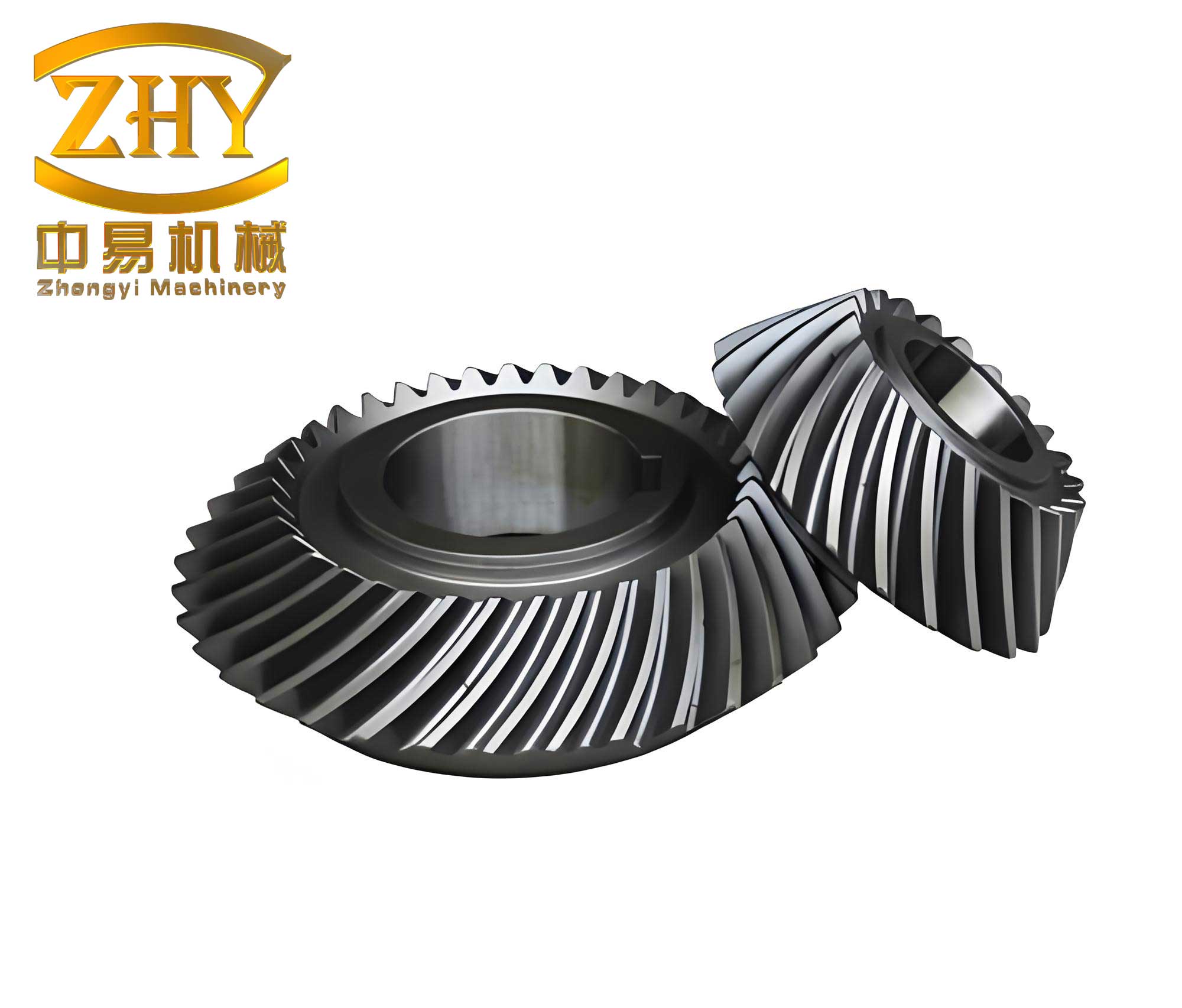
The physical model under investigation is an external meshing spiral gear pump with a tooth profile composed of an arc-sine transition curve. Key design parameters of this spiral gear pump are summarized in the table below. The pump is designed for a nominal displacement of 5 mL/rev and is analyzed at a demanding operational speed of 10,000 rpm to induce and study high-speed flow effects.
| Parameter | Value | Parameter | Value |
|---|---|---|---|
| Suction Port Diameter | 17 mm | Number of Teeth | 7 |
| Discharge Port Diameter | 11 mm | Module | 3 mm |
| Tooth Width | 15.5 mm | Pressure Angle | 14.5° |
| Helix Angle | 31.3° | Center Distance | 21.01 mm |
| Design Displacement | 5 mL/rev | Operating Speed | 10,000 rpm |
| Discharge Pressure | 25 MPa | Fluid Density | 800 kg/m³ |
| Fluid Dynamic Viscosity | 0.007 Pa·s | Vapor Pressure | Set per fluid model |
The three-dimensional fluid domain of the spiral gear pump was extracted from the solid model. A critical aspect of transient CFD simulation for positive displacement pumps like the spiral gear pump is dynamic mesh handling. The mesh was generated using a specialized template for rotating machinery, resulting in approximately 350,000 cells. The suction and discharge ports were meshed with a general mesher, while the rotor region containing the spiral gears was discretized using a rotating template mesher that facilitates the mesh motion corresponding to gear rotation. This approach ensures accurate resolution of the moving interfaces and the small clearances inherent to gear pumps.
Boundary conditions were set to replicate the high-pressure operating scenario. The suction inlet was defined as a pressure inlet with a reference pressure condition, while the discharge outlet was set to a constant pressure of 25 MPa, simulating the high-pressure load. All other surfaces, including the gear and housing walls, were treated as no-slip walls. The simulation was conducted using the commercial CFD software PumpLinx, which is well-regarded for its capabilities in handling cavitation and moving boundaries in rotary pumps. The solver settings included a transient analysis with a time step corresponding to a 1.714286° rotation of the gears (0.00001429 s). The simulation was run for 8 complete revolutions to achieve periodicity, with data from the stabilized latter revolutions used for analysis. Convergence was monitored via residuals with a target of 10-3.
The analysis of the simulation results reveals intricate details about the vortex cavitation within the spiral gear pump. The primary location for vortex formation is identified in the suction chamber, specifically at the trailing edge (tooth back) of both the driving and driven spiral gears. The mechanism is twofold: first, the high-speed rotation of the spiral gear imparts a strong tangential velocity to the fluid; second, the main flow from the suction port interacts with this rotating fluid mass. This interaction creates a velocity gradient and shear, leading to flow separation and the roll-up of vortices in the wake region behind the moving tooth. These vortices are characterized by a low-pressure core. The following table summarizes the key characteristics of the observed vortex cavitation.
| Aspect | Observation |
|---|---|
| Location | Tooth back edges in the suction chamber, away from the meshing zone. |
| Formation Cause | Interaction between main suction flow and high-speed gear rotation, leading to flow separation and vortex roll-up. |
| Cavitation Intensity | Most severe at the vortex core, diminishing radially outward towards the vortex edges. |
| Temporal Behavior | Periodic lifecycle: Initiation, Growth, Maximum intensity, Decay, and Collapse. |
| Spatial Periodicity | Corresponds to tooth passing frequency; identical phenomenon occurs at geometrically similar positions for subsequent teeth. |
The evolution of vortex cavitation over a fraction of the gear rotation cycle (equivalent to one tooth pitch) demonstrates this periodic lifecycle. For a given vortex on the driving gear, the process begins as the tooth moves into a position where flow conditions favor separation. A vortex forms, and as the local pressure in its core plummets, vapor bubbles nucleate and grow ($R_e > 0$). The cavitation cloud reaches its maximum intensity when the vortex is fully developed and the pressure is at its minimum. Subsequently, as the gear continues to rotate, the flow conditions change, the vortex begins to dissipate, pressure recovers, and the vapor bubbles rapidly collapse ($R_c > 0$). This entire cycle repeats for each tooth of the spiral gear, leading to a periodic source of cavitation within the suction chamber. The intensity of cavitation can be quantified by the local vapor volume fraction, $\alpha_v$, which is related to the vapor mass fraction by $\alpha_v \approx f_v \rho / \rho_v$ in regions where vapor is dominant.
The most significant impact of this periodic vortex cavitation is on the pump’s output performance. To isolate this effect, simulations were compared for two cases: one with the full cavitation model active and another with cavitation effects disabled (modeling pure single-phase liquid). The discharge flow rate and pressure over one complete revolution (7 tooth engagements) were analyzed. The presence of vortex cavitation introduces distinct irregularities in the otherwise relatively smooth discharge flow curve of the spiral gear pump. The relationship between the instantaneous discharge flow rate $Q(t)$ and the cavitation activity can be conceptualized. The theoretical ideal flow rate for a gear pump is given by:
$$ Q_{ideal} = 2 \pi n D_m $$
where $n$ is the rotational speed and $D_m$ is the geometric displacement per revolution. However, actual flow $Q_{actual}$ is reduced by internal losses and cavitation effects: $Q_{actual} = Q_{ideal} – \Delta Q_{leakage} – \Delta Q_{cavitation}$. The cavitation-induced flow deficit $\Delta Q_{cavitation}$ is directly linked to the volume of vapor occupying space within the pumping chambers that should ideally be filled with liquid. During the peak of the vortex cavitation cycle, $\Delta Q_{cavitation}$ increases, causing a dip in the instantaneous output.
The results clearly show that under identical high-speed, high-pressure conditions, the spiral gear pump operating with cavitation exhibits a lower mean flow rate and substantially higher flow pulsation compared to the non-cavitating case. Specifically, during the flow rise phase of the discharge cycle, two distinct flow reductions are observed. These reductions are temporally synchronized with the moments of maximum vortex cavitation intensity on the driving and driven spiral gears, respectively. This synchronization confirms that the periodic formation and collapse of vapor-filled vortex cores directly induce periodic fluctuations in the pump’s output. The flow pulsation can be quantified by the fluctuation amplitude $\Delta Q$ or a pulsation coefficient. The following equation estimates the additional flow ripple due to a single cavitation vortex event:
$$ \Delta Q_{pulse} \approx \frac{V_{vapor, max}}{\Delta t_{collapse}} $$
where $V_{vapor, max}$ is the maximum vapor volume associated with a vortex and $\Delta t_{collapse}$ is the characteristic time for its collapse. Although precise values require detailed integration of the flow field, the simulation data allows for qualitative and quantitative correlation.
| Performance Metric | Without Cavitation Model | With Cavitation Model (Vortex Cavitation Active) |
|---|---|---|
| Mean Discharge Flow Rate | Higher | Reduced (typically 2-5% under these conditions) |
| Flow Pulsation Amplitude | Lower, primarily due to gear meshing kinematics | Significantly increased; additional high-frequency pulses superposed on the base waveform |
| Pressure Pulsation at Outlet | Relatively stable around set pressure | High-amplitude, high-frequency fluctuations observable (14 major peaks/valleys per revolution) |
| Output Stability | Good | Degraded; periodic flow and pressure spikes can excite system vibrations |
The pressure at the discharge port also exhibits marked instability due to vortex cavitation. In the non-cavitating scenario, the pressure remains steady near the imposed 25 MPa boundary condition. With cavitation active, the discharge pressure shows frequent, sharp fluctuations. Each major vortex cavitation event that affects the filling of the pumping chamber translates into a momentary drop in the pressure build-up capability, causing a dip in discharge pressure. Since there are two spiral gears and vortex cavitation occurs on each, and given the 7 teeth per gear, the pressure signal over one revolution contains up to 14 significant disturbance cycles attributable to this phenomenon. This pressure pulsation can be described by a perturbation on the steady pressure $p_0$:
$$ p(t) = p_0 + \sum_{k=1}^{14} A_k \sin(2\pi f_k t + \phi_k) + \text{higher harmonics} $$
where $f_k$ are frequencies related to the gear rotational speed and tooth count, and $A_k$ are amplitudes influenced by the intensity of the cavitation events. These pressure pulses are detrimental as they transmit through the hydraulic system, potentially causing noise, fatigue in components, and reduced control accuracy.
In conclusion, this numerical investigation provides a detailed exposition of vortex cavitation dynamics in a high-speed, high-pressure spiral gear pump. The use of the Full Cavitation Model within a high-fidelity CFD framework has successfully captured the genesis of vortex flows in the suction chamber of the spiral gear pump, their evolution into cavitating vortices, and their profound impact on performance. Key findings are that vortex cavitation in a spiral gear pump is a periodic phenomenon localized at the tooth back edges, following a consistent lifecycle. The intensity is greatest at the vortex core. Most importantly, this phenomenon is not benign; it directly introduces additional flow and pressure pulsations, reducing the mean flow output and compromising the stability and smoothness of the discharge—critical factors in precision hydraulic systems. Therefore, for engineers designing spiral gear pumps for extreme duty cycles, mitigating vortex cavitation through geometric optimization of the tooth profile, suction port design, or operational control strategies is essential. Future work may involve parametric studies to establish design guidelines for spiral gear pumps that minimize susceptibility to such cavitation while maintaining their inherent advantages of low flow ripple and high-speed capability. This study underscores the importance of advanced multiphase flow simulation as an indispensable tool in the development of next-generation high-performance spiral gear pumps.