
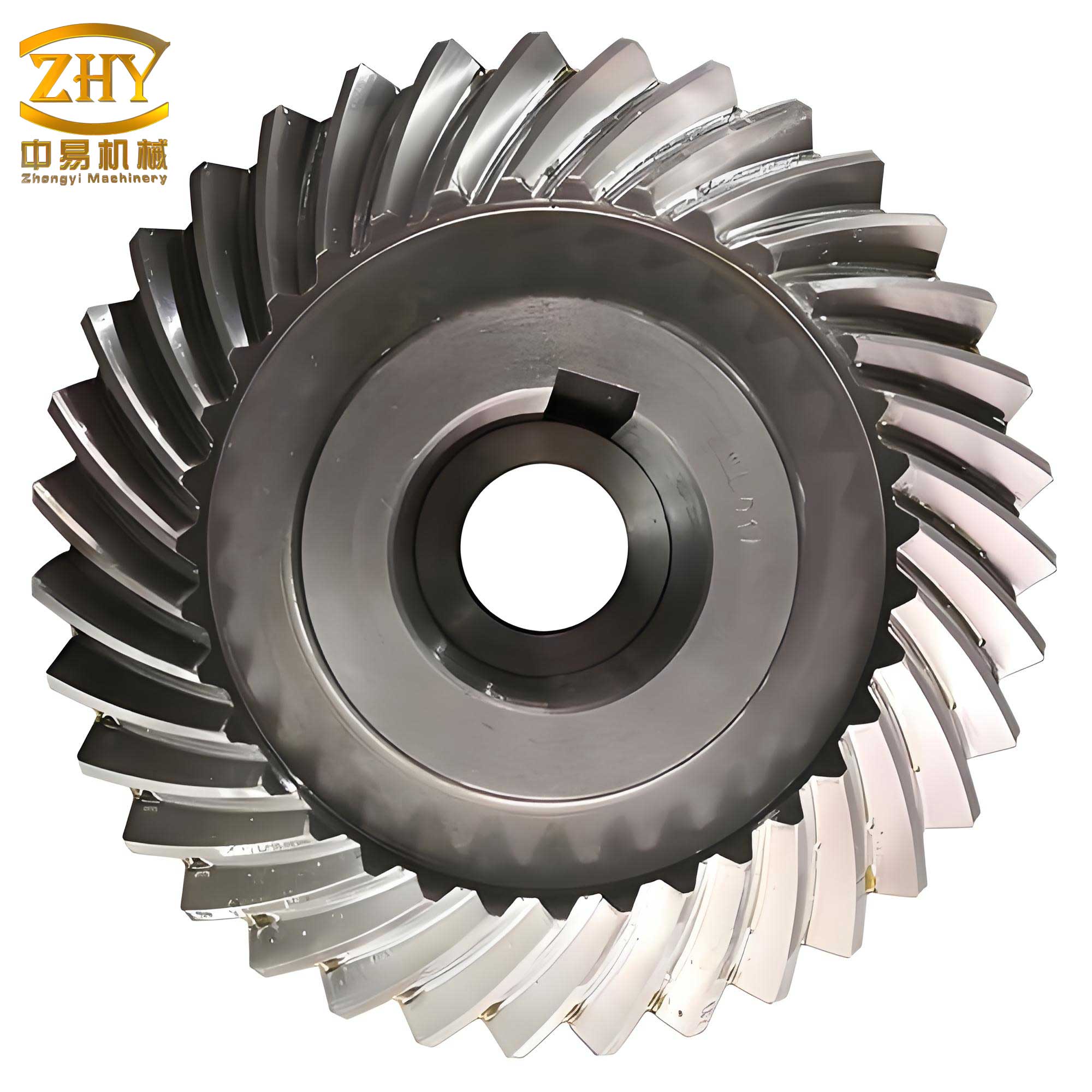
The quality of spiral gears is fundamentally critical to the performance, efficiency, and longevity of automotive powertrains. Their curved tooth traces enable smooth engagement, high load capacity, and quiet operation, making them indispensable in modern vehicle transmissions. Consequently, the precision with which these spiral gears are manufactured directly translates to the operational excellence of the final product. Gear accuracy grading serves as a primary and direct methodology for quality assessment, extensively employed in production. The manufacturing process of spiral gears, typically via hobbing, is a complex system involving the intricate interaction of the cutting tool (hob), the machine tool, and the workpiece (gear blank). This system forms a sophisticated kinematic chain where errors in hob mounting, geometric inaccuracies of the machine tool, and misalignments in workpiece fixturing can all significantly degrade the final gear quality. These manufacturing imperfections, in turn, profoundly impact the gear’s meshing performance during operation—affecting noise, vibration, load distribution, stress levels, and ultimately, the transmission’s durability. Therefore, to effectively control manufacturing quality and enhance in-service performance, this research delves into establishing a comprehensive error model for spiral gears, investigating the propagation of errors from the machining system, and analyzing the consequential effects on meshing dynamics.
The foundation of this work is a spatial error model for cylindrical spiral gears that integrates inaccuracies from the entire hobbing process. This model is constructed based on Multi-Body System (MBS) theory, the principles of gear hobbing, and gear meshing theory. The machine tool structure is abstracted into a series of rigid bodies (bed, saddle, column, hob spindle, workpiece spindle, etc.) linked by ideal and error-prone motions. The relative transformations between these bodies are described using homogeneous coordinate transformation matrices that incorporate a comprehensive set of 49 potential geometric error components. These include linear displacement errors (δx, δy, δz), angular errors (εx, εy, εz), squareness errors between axes (Sxy, Sxz, Syz), and mounting errors for both the hob and the workpiece.
The coordinate transformation from the hob coordinate system {t} to the workpiece system {w} is expressed as:
$$ \mathbf{T}_{wt} = (\mathbf{T}_{34} \cdot \mathbf{T}_{23} \cdot \mathbf{T}_{12})^{-1} \cdot \mathbf{T}_{15} \cdot \mathbf{T}_{56} \cdot \mathbf{T}_{67} \cdot \mathbf{T}_{78} $$
where each $\mathbf{T}_{ij}$ represents the transformation matrix between body *i* and body *j*, encapsulating both nominal motions and their associated errors. The surface of the Archimedean hob cutter is mathematically modeled. Subsequently, applying the gear meshing condition—which requires the relative velocity between the hob and the workpiece to be orthogonal to the common normal vector at the contact point—yields the equation for the generated spiral gear tooth surface, inclusive of all system errors. The meshing equation is given by:
$$ f(u, \theta, \phi_1, \phi_2) = \mathbf{N}_1 \cdot \mathbf{V}_{12} = 0 $$
where $\mathbf{N}_1$ is the normal vector of the hob surface in the machine coordinate system, and $\mathbf{V}_{12}$ is the relative velocity vector between the hob and the gear blank.
Based on this universal gear error model and adhering to the ISO 1328-1:2013 standard for cylindrical gear accuracy, mathematical models for key gear deviation evaluation parameters are established. These include pitch deviation, profile deviation, and helix deviation. The models allow for the numerical calculation of specific metrics such as single pitch deviation ($f_p$), cumulative pitch deviation ($F_p$), total profile deviation ($F_\alpha$), profile form deviation ($f_{f\alpha}$), profile slope deviation ($f_{H\alpha}$), total helix deviation ($F_\beta$), helix form deviation ($f_{f\beta}$), and helix slope deviation ($f_{H\beta}$). For instance, the single pitch deviation between two corresponding points A and B on the evaluated tooth flank is calculated as:
$$ f_p = \alpha r – p_t $$
where $\alpha = \arccos\left(\frac{x_1 x_2 + y_1 y_2}{\sqrt{x_1^2+y_1^2}\sqrt{x_2^2+y_2^2}}\right)$, $r$ is the reference circle radius, and $p_t$ is the theoretical transverse pitch.
Numerical analysis using these models reveals the distinct influence of individual error components from the hob, machine tool, and workpiece on the final gear accuracy. The quantitative impact varies significantly across different error types and evaluation parameters. A key finding is that for most error elements, the values of gear deviations increase monotonically with the magnitude of the error component. However, the sensitivity of different accuracy parameters to specific errors varies greatly. The most influential errors for critical gear deviations are summarized in the table below.
| Gear Accuracy Parameter | Most Significant Error Components | Secondary Influence Error Components |
|---|---|---|
| Single Pitch Deviation ($f_p$) & Cumulative Pitch Deviation ($F_p$) | δy(α), δy(β), δy(z), δy(y), δy(φ₂) | εz(α), εz(φ₂) |
| Total Profile Deviation ($F_α$) | εz(α), εz(φ₂) | δx(γ), δx(φ₁) |
| Profile Form Deviation ($f_{fα}$) | δx(γ), δx(φ₁) | δx(y) |
| Profile Slope Deviation ($f_{Hα}$) | εz(α), εz(φ₂) | δx(y) |
| Total Helix Deviation ($F_β$) & Helix Slope Deviation ($f_{Hβ}$) | εy(y), Sxzc | Sxz |
| Helix Form Deviation ($f_{fβ}$) | Syz | εx(y), Syzc |
To further investigate the direct consequences of manufacturing inaccuracies on performance, the study focuses on profile deviations—a critical error type. A universal mathematical model for spiral gear teeth incorporating arbitrary profile deviation is developed. This model leverages a fundamental property of the involute curve: its normal is always tangent to the base circle. For any point C on the theoretical involute, a corresponding point D on the deviated profile is defined along this normal direction by a deviation function Δ(f), where f is the length of the involute generating line. The equation for the deviated tooth surface becomes:
$$
\begin{aligned}
X_1(\theta_1, \gamma) &= (r_b \cos(\zeta) + \Delta(f)\sin(\zeta)) \cos(\gamma) – (r_b \sin(\zeta) – \Delta(f)\cos(\zeta)) \sin(\gamma) \\
Y_1(\theta_1, \gamma) &= (r_b \cos(\zeta) + \Delta(f)\sin(\zeta)) \sin(\gamma) + (r_b \sin(\zeta) – \Delta(f)\cos(\zeta)) \cos(\gamma) \\
Z_1(\theta_1, \gamma) &= p \gamma
\end{aligned}
$$
where $\zeta = \theta_0 + \theta_1 + \gamma$, $r_b$ is the base radius, $\theta_1$ is the involute roll angle, $\gamma$ is the helix parameter, $p$ is the helix parameter, and $\theta_0$ is half the tooth space angle. Five distinct types of profile deviation functions Δ(f) are analyzed, representing common manufacturing or intentional modification forms:
- Constant Value Type: Δ(f) = -Δ (a uniform offset).
- Linear Increase Type: Δ(f) = -(Δ/g_l)·f (taper thinnest at root).
- Linear Reduction Type: Δ(f) = -Δ·(1 – f/g_l) (taper thinnest at tip).
- Parabolic Convex Type: A parabolic removal centered at the pitch point.
- Parabolic Concave Type: A parabolic addition centered at the pitch point.
Three-dimensional models of gear pairs with these specific profile deviations are created in Pro/ENGINEER. These models are then imported into ANSYS for detailed Finite Element Analysis (FEA) of the static meshing process. A refined hexahedral mesh is applied, and boundary conditions simulate a realistic engagement: a torque of 2 N·m is applied to the driver gear (16 teeth), while the driven gear (39 teeth) is fully constrained except for its rotational degree of freedom, which is tracked to calculate transmission error. The FEA model’s validity is confirmed by comparing its predicted contact ellipses against those derived from theoretical gear contact analysis across multiple mesh positions, showing excellent agreement.
The FEA results provide profound insights into how different profile errors alter the meshing performance of spiral gears. Key performance indicators analyzed include contact pattern, maximum contact pressure, root bending stress, transmission error (TE), and torsional mesh stiffness (TMS).
The Constant Value Type deviation has a minimal impact on the contact pattern and stress distribution. Its primary effect is a slight alteration of the effective tooth thickness and a minor, alternating shift in the Transmission Error and TMS curves, but it does not fundamentally degrade meshing performance.
Both Linear Increase and Linear Reduction types significantly distort the contact pattern. As deviation increases, the contact area shrinks and shifts towards one end of the tooth face—towards the heel for one type and the toe for the other. This leads to concentrated loading, increased contact and bending stresses, higher Transmission Error amplitude, and reduced TMS, thereby degrading performance. The linear increase type also weakens the initial “scraping” contact at the tooth tip during engagement.
The Parabolic Convex Type (tip and root relief) has the most detrimental effect when excessive. It severely exacerbates the initial and final scraping contact, leading to extremely high local pressures. Critically, if the relief amount exceeds a certain threshold, a complete loss of contact (“no-meshing zone”) occurs in the middle of the engagement path, causing a disastrous interruption in power transmission, a spike in Transmission Error, and a collapse in TMS.
Conversely, the Parabolic Concave Type (center relief) demonstrates a potentially beneficial effect. It effectively mitigates or even eliminates the detrimental scraping contact at the entry and exit of mesh. This results in smoother transitions, more stable contact patterns, and significantly reduced fluctuation in contact pressure, bending stress, Transmission Error, and TMS throughout the mesh cycle. While the overall contact area may decrease slightly, the dramatic smoothing of the meshing dynamics suggests this type of deviation, when properly applied, can enhance the meshing performance of spiral gears, particularly in reducing vibration and noise.
The comparative impact of the five deviation types (at an equal magnitude corresponding to ISO grade 8 tolerance) on meshing dynamics is summarized below:
| Performance Metric | Effect of Constant Type | Effect of Linear Types | Effect of Parabolic Convex | Effect of Parabolic Concave |
|---|---|---|---|---|
| Contact Pattern | Negligible change | Shifted & concentrated | Severe scraping, possible mid-mesh loss | Stable, scraping eliminated |
| Max. Contact Pressure/Stress | Minor change | Increased | Extremely high at scraping, zero in loss zone | Lowest & smoothest fluctuation |
| Max. Root Bending Stress | Minor change | Increased | Extremely high at scraping | Lowest & smoothest fluctuation |
| Transmission Error (TE) | Almost no change in waveform | Increased amplitude | Drastically increased, abnormal waveform | Small amplitude, very smooth waveform |
| Torsional Mesh Stiffness (TMS) | Almost no change in waveform | Decreased mean value | Collapse in loss zone, decreased mean | High mean value, very smooth fluctuation |
In conclusion, this research establishes a robust methodological framework for linking the manufacturing process of spiral gears to their functional performance. The integrated error model provides a tool for diagnosing and predicting the impact of specific machine tool and setup inaccuracies on gear geometry. The finite element analysis of designed profile deviations reveals that not all errors are equally detrimental. While constant errors are relatively harmless and linear tapers degrade performance, parabolic form deviations have contrasting effects: convex relief can be catastrophic if overdone, whereas a carefully applied concave relief (center material addition) can significantly smooth meshing action, reducing Transmission Error fluctuation and potentially improving noise and vibration behavior in automotive spiral gear transmissions. This insight is valuable for both quality control in manufacturing and the intentional design of gear tooth modifications for performance optimization.