
From my engineering perspective, the evolution of railway traction has been inextricably linked with the advancement of power transmission systems. Among these, the application of spiral gears represents a significant leap forward, offering solutions to the demanding requirements of modern electric and diesel locomotives and multiple units. Their inherent advantages—superior load-carrying capacity, smooth and quiet meshing, and compact design—have made them indispensable in high-performance applications.
The traditional axle-hung motor drive, while simple, imposes significant unsprung mass and limits the dynamic performance of the bogie. To overcome this, more sophisticated drive systems were developed. One pivotal innovation was the adoption of spiral gears in parallel cardan shaft drives. In this configuration, the motor is flexibly mounted on the bogie frame, transmitting torque through a cardan shaft to a robust gear unit mounted directly on the axle. This arrangement significantly reduces unsprung mass and isolates the gear pair from bogie vibrations, ensuring optimal and consistent meshing conditions within a rigid gear housing. The use of spiral gears here is critical for handling high power densities while maintaining operational quietness.
Another notable system is the quill shaft drive, where the final drive pinion is mounted on a hollow shaft (quill) surrounding the axle. Torque is transmitted from the motor to this quill via flexible couplings. The large spiral gear is mounted directly on the axle, and the driving torque is transferred through springs or rubber elements within the quill assembly. This design further decouples gear meshing from axle deflection and track irregularities.
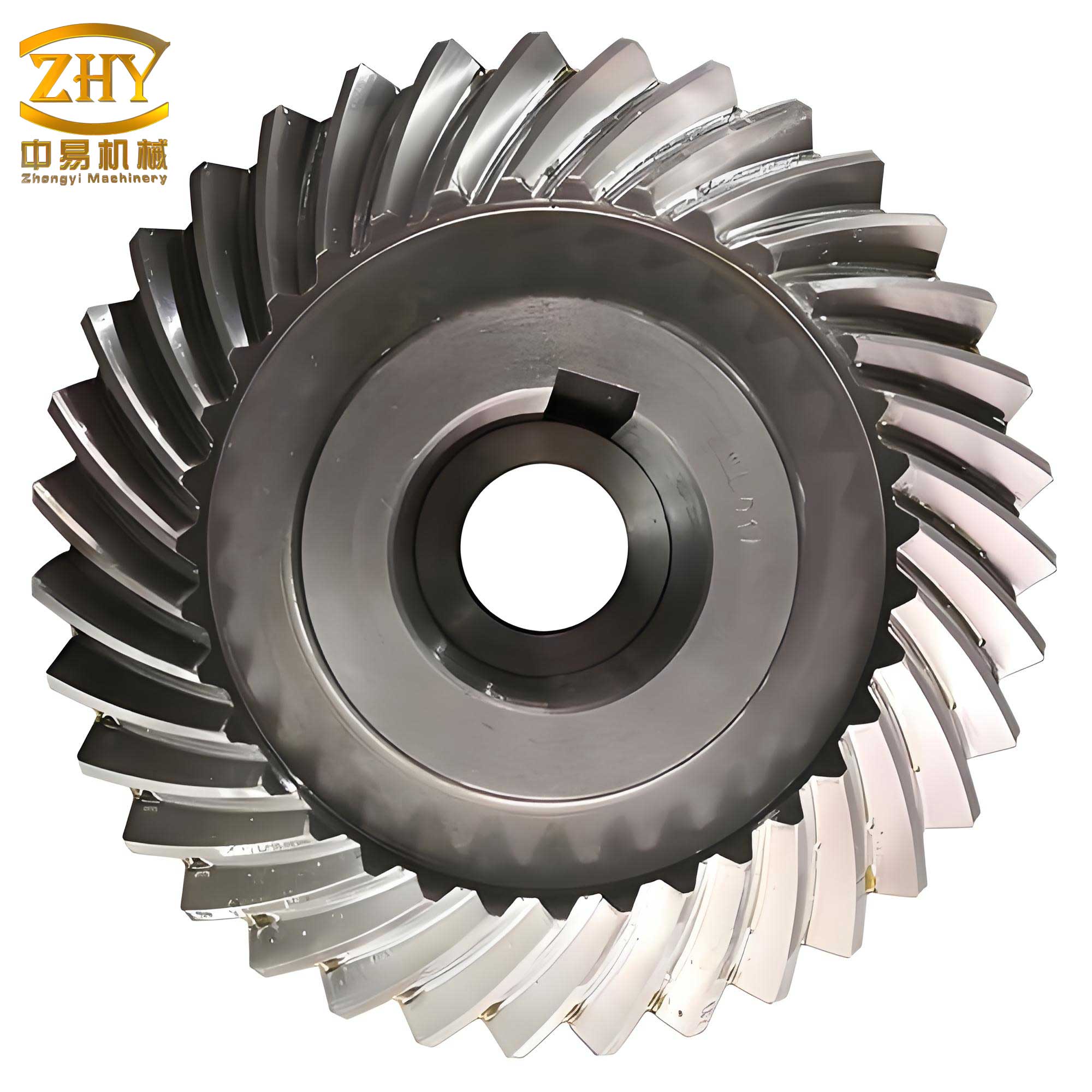
For diesel-electric traction, the final drive systems are often similar to those used in electric locomotives. However, in diesel-hydraulic traction, spiral gears find extensive use within the hydraulic transmission units themselves. High-power hydraulic torque converters and gearboxes, such as the Voith L and Lr series, rely heavily on precisely engineered spiral gears for speed variation and power transmission. These gears operate under exceptionally severe conditions, requiring extreme reliability over hundreds of thousands of kilometers.
The design requirements for railway traction spiral gears are uniquely challenging. They must endure a vast spectrum of operating conditions: from high-torque, low-speed starting to maximum speed running, with frequent acceleration and braking cycles. Furthermore, they are subject to significant dynamic overloads and shock loads arising from wheel slip, track irregularities, and driveline vibrations.
| Drive System Type | Typical Gear Type | Key Characteristics & Role of Spiral Gears |
|---|---|---|
| Axle-Hung Motor Drive | Spur / Low Helix Spiral | Direct drive; high unsprung mass; limited performance. |
| Parallel Cardan Shaft Drive | Spiral Gears | Reduced unsprung mass; rigid gear housing; smooth, high-power transmission. |
| Quill Shaft Drive | Spur Gears (predominantly) | Excellent vibration isolation; spring-driven torque transmission. |
| Diesel-Hydraulic Transmission | Spiral Gears | Inside gearboxes; high-speed, high-load operation in compact spaces. |
Design Philosophy and Load Calculation
The fundamental step in designing a traction gear set is the accurate determination of the transmitted load. The operational profile is complex, characterized by varying proportions of full-load, partial-load, and coasting. The traction characteristic curve, bounded by adhesion limits at low speed and maximum speed at high speed, forms the basis. A practical approach is to define an equivalent mean torque and mean rotational speed based on the duty cycle.
The mean torque $T_m$ and mean speed $n_m$ are calculated from the traction curve using a time-weighted average:
$$ T_m = \frac{\sum (T_i \cdot t_i)}{\sum t_i} $$
$$ n_m = \frac{\sum (n_i \cdot t_i)}{\sum t_i} $$
where $T_i$ and $n_i$ are the torque and speed at a specific operating point, and $t_i$ is the relative duration of that operating condition. For example, a typical shunting locomotive might have a high proportion of low-speed, high-torque operation, while a mainline locomotive’s profile is weighted towards higher speeds.
A critical parameter used to characterize the loading severity of spiral gears is the K-factor or load intensity factor, often denoted by $\gamma$. It is a fundamental metric in initial sizing:
$$ \gamma = \frac{F_t}{b \cdot d_1} = \frac{2T_1}{b \cdot d_1^2} $$
where $F_t$ is the tangential force at the pitch circle (N), $b$ is the facewidth (mm), $d_1$ is the pinion reference diameter (mm), and $T_1$ is the pinion torque (Nmm). Traction gears typically operate at significantly higher $\gamma$ values compared to general industrial gears, reflecting their compact, high-power design philosophy.
The dynamic environment in a locomotive driveline, especially with long cardan shafts, introduces additional torsional oscillations. Key sources include:
- Universal Joint Excitation: Angular misalignment in cardan shafts due to bogie rotation on curves causes periodic torque fluctuations.
- Wheel Diameter Difference: In a wheelset without a differential, a difference in wheel diameters causes longitudinal creep and superimposed torsional moments, particularly at low speeds.
- Stick-Slip Vibration: During very low-speed operation or wheel slip, self-excited vibrations from alternating stick-slip conditions can generate significant inertial torque spikes in the driveline, sometimes exceeding the nominal starting torque.
These dynamic factors must be accounted for through empirical safety factors or detailed torsional vibration analysis during the design phase.
Strength Calculation and Gear Geometry
The strength verification of traction spiral gears is a three-fold process: checking for surface durability (pitting resistance), tooth bending strength, and scoring resistance. While specialized railway standards exist, calculations often reference established international methodologies such as ISO, AGMA, or DIN standards, adapted with experience-based factors.
Surface Durability (Contact Stress): The fundamental contact stress $\sigma_H$ at the pitch point is calculated to prevent pitting fatigue. The ISO 6336-2 formula is commonly referenced:
$$ \sigma_H = Z_E \sqrt{ \frac{F_t}{d_1 b} \cdot \frac{u \pm 1}{u} \cdot Z_H^2 \cdot Z_\epsilon } \cdot \sqrt{K_A K_V K_{H\beta} K_{H\alpha}} $$
where $Z_E$ is the elasticity factor, $u$ is the gear ratio, $Z_H$ is the zone factor, $Z_\epsilon$ is the contact ratio factor, and the $K$-factors account for application, dynamic load, face load distribution, and transverse load distribution, respectively.
Tooth Bending Strength: The root stress $\sigma_F$ is calculated per ISO 6336-3:
$$ \sigma_F = \frac{F_t}{b m_n} Y_F Y_S Y_\beta Y_B \cdot K_A K_V K_{F\beta} K_{F\alpha} $$
where $m_n$ is the normal module, $Y_F$ is the tooth form factor, $Y_S$ is the stress correction factor, $Y_\beta$ is the helix angle factor, and $Y_B$ is the rim thickness factor.
The allowable stress numbers for the material are then compared with the calculated stresses to determine the safety factors. Due to the severe and reversing loads, the required safety factors for traction gears are typically higher than for industrial applications.
| Calculation Aspect | Governing Standard / Formula | Key Adaptation for Traction Gears |
|---|---|---|
| Surface Durability | ISO 6336-2 / AGMA 2001 | High application factor ($K_A$) for dynamic overloads; careful consideration of load distribution factors ($K_{H\beta}$). |
| Bending Strength | ISO 6336-3 / AGMA 2001 | High reliability requirements; material allowances for reversing loads. |
| Scoring Resistance | ISO/TR 13989 / Flash Temperature Method | Critical for high-speed operation; dictates lubricant selection and cooling requirements. |
The geometry of railway spiral gears is optimized for robustness. The normal pressure angle is typically the standard 20°, though higher angles (22.5° or 25°) are increasingly used for heavy-duty final drives to improve tooth root strength. The helix angle is generally moderate, in the range of 10° to 20°. A larger helix angle increases overlap ratio and smoothness but also increases axial thrust and sensitivity to misalignment. Profile shifting (modification) is universally applied. Both pinion and wheel are often given positive addendum modification to increase the operating pressure angle (to 21-22°) and balance the bending strength of both members. To prevent edge loading due to deflection and manufacturing errors, tip and root relief are meticulously applied. Furthermore, longitudinal crowning or bias modification is essential to accommodate misalignment and bending of the gear under load, ensuring even load distribution across the facewidth.
Materials, Heat Treatment, and Manufacturing Precision
Material selection and processing are paramount for reliability. Case-hardening steels such as AISI 4320, 9310, or DIN 20MnCr5 are the standard for high-power traction spiral gears. The deep, hard case provides excellent resistance to pitting and bending fatigue, as well as good overload capacity. The effective case depth is designed to exceed the depth of the maximum subsurface shear stress induced by contact loading. A common specification requires a minimum surface hardness of 58-62 HRC and a case depth of approximately 0.15-0.25 times the normal module. Induction hardening is also used, but it is crucial that the tooth root fillet is fully hardened to induce beneficial compressive residual stresses.
Precision manufacturing is non-negotiable. For cardan shaft drive systems, gear quality is typically required to be at ISO 1328 Class 6 or better. After rough cutting and heat treatment, the gears are finish-ground to achieve the required profile, lead, and pitch accuracy. This high level of precision is essential for minimizing transmission error, which is the primary source of gear whine and vibration excitation. The table below illustrates typical design parameters for traction spiral gears in different applications.
| Parameter | High-Speed EMU Final Drive | Diesel-Hydraulic Transmission Gear | Heavy-Duty Shunter Final Drive |
|---|---|---|---|
| Normal Module, $m_n$ (mm) | 8 – 10 | 4 – 6 | 12 – 16 |
| Pressure Angle, $\alpha_n$ | 20° | 20° | 22.5° – 25° |
| Helix Angle, $\beta$ | 12° – 16° | 15° – 20° | 10° – 14° |
| Primary Material | Case-Hardening Steel (e.g., 20MnCr5) | Case-Hardening Steel (e.g., 9310) | Case-Hardening Steel |
| Heat Treatment | Case Carburizing & Grinding | Case Carburizing & Grinding | Case Carburizing & Grinding |
| Target Accuracy (ISO 1328) | Class 5-6 | Class 5-6 | Class 6-7 |
| Key $\gamma$ Value Range (N/mm²) | 3.0 – 4.5 | 2.5 – 4.0 | 4.0 – 6.0+ |
Lubrication, Maintenance, and Future Trends
Lubrication of traction gearboxes is typically done with dedicated, high-performance EP (Extreme Pressure) gear oils. For final drives mounted on axles, the challenge is managing heat rejection. Prolonged high-speed running can cause significant oil temperature rise due to windage and churning losses, exacerbated by radiant heat from the brakes and track. Effective cooling fins on the gear housing and, in some cases, oil coolers are necessary to maintain oil temperature within safe limits, preventing viscosity breakdown and loss of load-carrying capacity.
Maintenance philosophy aims for high reliability over long intervals. The gears, especially the final drive wheel which is often press-fitted onto the axle, are designed for a service life matching major overhaul periods (e.g., 1 million kilometers or more). Routine maintenance involves oil analysis and periodic inspection via borescopes, with the goal of avoiding in-situ gear replacement.
The future development of spiral gears in railway traction is driven by demands for even higher power density, efficiency, and lower lifecycle cost. This involves:
- Advanced Manufacturing: The adoption of powder metallurgy for certain transmission gears, and hard-skiving as a finishing process to reduce cost and time compared to grinding.
- Advanced Materials: Exploring cleaner steels and alternative case-hardening grades for improved fatigue performance.
- Integrated Design: Optimizing gear macro and micro-geometry in concert with housing stiffness and bearing selection using advanced FEA and system dynamics simulation tools to minimize weight and noise.
- Condition Monitoring: Implementing vibration and oil debris sensors for predictive maintenance, moving from time-based to condition-based servicing.
In conclusion, the successful application of spiral gears in railway traction is a testament to sophisticated mechanical engineering. It requires a holistic approach that integrates precise load analysis, robust mechanical design with appropriate geometry modifications, the selection and processing of high-performance materials, and manufacturing to exceptional standards. As traction systems continue to evolve towards higher speeds and greater efficiency, the role of the optimized spiral gear will remain central, demanding continuous innovation in its design and application.