
In the realm of automotive powertrain systems, the differential assembly plays a critical role in enabling smooth cornering by allowing wheels to rotate at different speeds. At the heart of this assembly lie the differential spiral gears, which are subjected to significant cyclic loads and torsional stresses. As a critical and frequently wearing component, the annual demand for these spiral gears is directly proportional to the global vehicle population. This demand drives continuous innovation in manufacturing processes aimed at improving efficiency, reducing cost, and enhancing component performance. The following article details a significant advancement in this field: the forming-rolling technology for differential spiral gears, developed and refined through extensive research and industrial application.
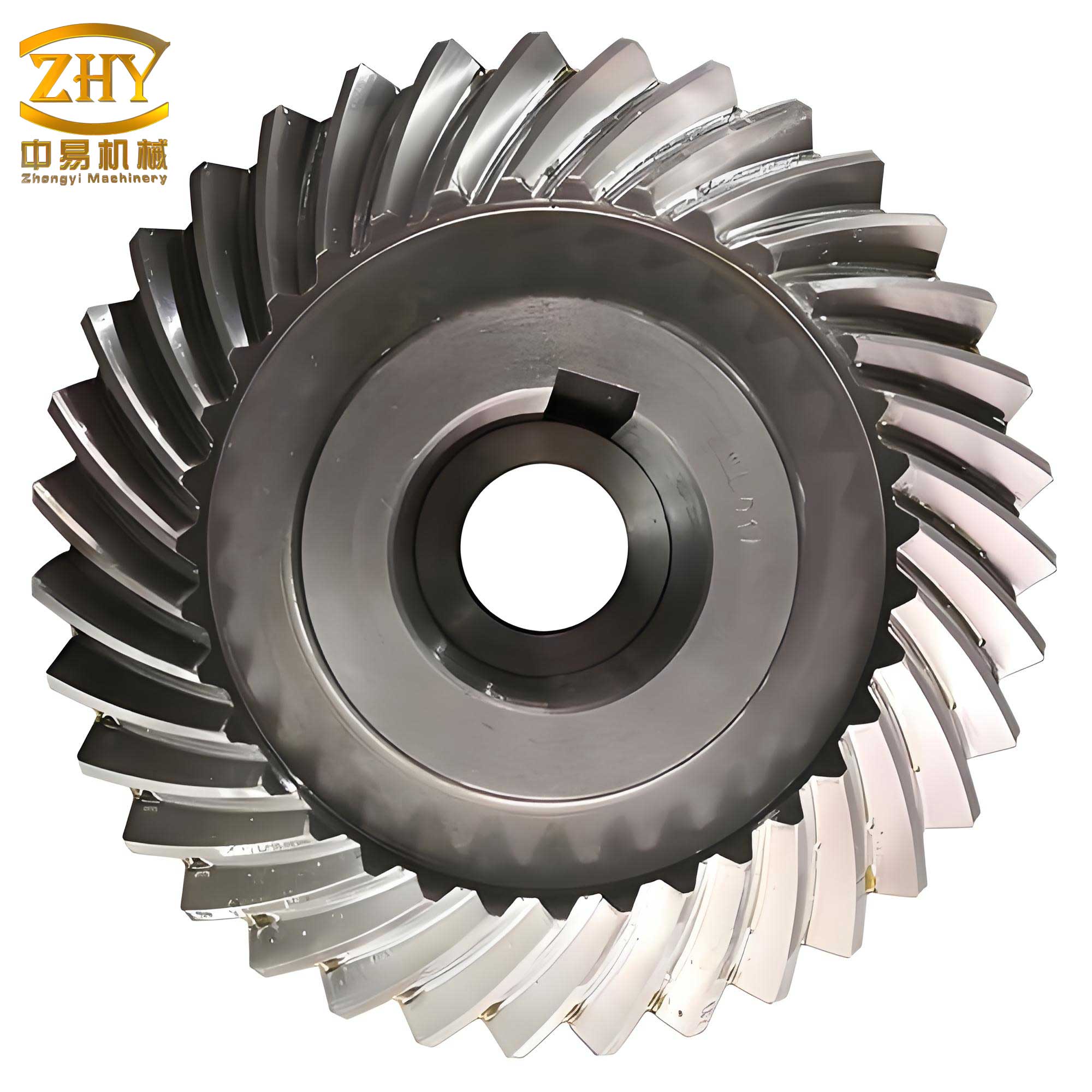
Traditionally, the production of spiral gears for automotive differentials, particularly the larger driven spiral gears, has relied heavily on conventional closed-die forging. A typical process chain for a common automotive driven spiral gear includes: cutting the raw material (bar stock), heating it to forging temperature, performing closed-die forging on heavy machinery, followed by extensive machining, heat treatment, grinding, and final inspection. For a representative spiral gear with a final part weight of, for instance, 5 kg, the initial forged blank can weigh nearly 8 kg. This discrepancy highlights the inherent inefficiency. The traditional forging of such spiral gears requires massive equipment, such as a 10-ton forging hammer or a 12,500-ton hot forging press. The capital investment for such machinery is enormous, accompanied by high energy consumption for both the equipment and the heating furnaces. Furthermore, the closed-die forging process generates significant flash and a thick web that must be subsequently trimmed, leading to substantial material waste and reduced material utilization, ultimately inflating the per-piece cost of the spiral gears.
To dramatically reduce the required equipment tonnage and associated capital investment for producing differential spiral gears, while simultaneously improving technical and economic metrics, a novel forming-rolling technology has been successfully developed and transitioned to batch production. This method is especially well-suited for small and medium-sized automotive forging and gear manufacturing facilities due to its streamlined process flow and lower infrastructure demands.
Process Route and Technical Essence of Forming-Rolling
The forming-rolling process for differential spiral gear blanks represents a paradigm shift from massive single-blow deformation to a localized, progressive plastic forming method. The complete process route is remarkably compact:
- Cutting: Raw material is cut to specific weight/length using a bandsaw.
- Heating: The cut billet is heated to a suitable forging temperature in a furnace (coal, gas, oil, or electric).
- Pre-forming (Blocking): The heated billet is roughly shaped into a perform using a conventional air hammer (e.g., 250 kg capacity) equipped with specialized open-die tooling.
- Forming-Rolling: The pre-form is transferred to a ring rolling mill (e.g., D51-350 type) where it undergoes final shaping into a near-net-shape spiral gear blank.
This sequence is stable, occupies minimal floor space, and integrates seamlessly into existing workshop layouts. The core technical challenges and solutions of this process are summarized below.
1. Design of the Rolling Preform
The geometry of the preform is crucial for successful forming-rolling of complex shapes like spiral gears. An improperly designed preform can lead to filling defects, folding, or excessive flash during rolling. The design is based on principles of localized continuous plastic deformation and specialized theories for profile ring rolling. The goal is to ensure smooth metal flow and complete die cavity filling in the final rolling pass. The volume distribution between the preform and the final spiral gear blank must be precisely controlled. The fundamental volume constancy principle applies:
$$ V_{billet} = V_{preform} = V_{final\_gear\_blank} $$
However, the cross-sectional area (A) distribution along the axial height (h) is strategically modified. For a spiral gear with a web and a rim, the preform often features a simpler “humped” cross-section that pre-distributes material axially. An optimized preform design significantly reduces rolling forces and improves dimensional accuracy.
| Parameter | Description | Design Consideration |
|---|---|---|
| Outer Diameter (Dp) | Preform outer diameter. | Must be less than the final gear blank’s root diameter to allow for radial expansion during rolling. |
| Inner Diameter (dp) | Preform bore diameter. | Must be larger than the final mandrel diameter to allow for wall thinning and height spread. |
| Axial Height (Hp) | Preform height. | Slightly greater than the final gear blank’s height to account for axial spread; critical for web formation. |
| Cross-section Shape | Typically rectangular or convex. | Designed to initiate proper metal flow towards the gear teeth and web areas during rolling. |
2. Design of Open-Die Forging Tooling
The pre-forming step on the air hammer utilizes custom-designed open-die tooling, often referred to as a “blocking die” or “shaping anvil and punch.” This tooling is relatively simple and low-cost compared to closed forging dies. Its function is to convert the cylindrical billet into the rudimentary “humped” preform geometry. The design focuses on:
- Die Cavity Simplicity: Easy to manufacture and maintain.
- Material Flow Guidance: Channels metal to approximate the required axial mass distribution.
- Draft Angles and Fillets: To facilitate billet removal and prevent stress concentrations.
The force required for this operation can be estimated using the slab method for upsetting, modified for the non-cylindrical shape:
$$ F_{preform} \approx Y_{f} \cdot A_{contact} \cdot \left(1 + \frac{\mu \cdot D_{contact}}{3 \cdot H_{instant}}\right) $$
Where \( Y_{f} \) is the flow stress of the material at the forging temperature, \( A_{contact} \) is the instantaneous contact area between the tool and workpiece, \( \mu \) is the friction coefficient, \( D_{contact} \) is the contact diameter, and \( H_{instant} \) is the instantaneous height.
3. Design of the Forming-Rolling Die (Ring Rolling Pass)
This is the most critical element. The ring rolling mill features a main roll (driver) and a mandrel roll (idler). The profiles of these rolls are machined with the negative impression of the final spiral gear blank, including the web, rim, and even preliminary tooth profiles or grooves. This is a “semi-closed” or “profiled” ring rolling process. Key design aspects include:
- Main Roll Profile: Forms the outer contour and the web/rim features of the spiral gear.
- Mandrel Roll Profile: Forms the inner bore and the back-face features of the spiral gear.
- Rolling Gap Control: The gradual reduction of the gap between the main roll and mandrel roll, controlled precisely, governs the wall thinning, diameter expansion, and profile filling.
- Guide Rolls: Essential for maintaining ring circularity and process stability during the rolling of the asymmetric spiral gear profile.
The kinematics of the process are governed by the feed rate of the mandrel roll (v) and the rotational speed of the main roll (ω). The growth rate of the ring’s mean radius (Ṙ) can be related to these parameters and the instantaneous wall thickness (s):
$$ \dot{R} \approx \frac{v \cdot R}{s} $$
Where \( R \) is the instantaneous mean radius. Optimizing the relationship between v and ω is key to preventing defects like fishtailing, folding, or underfilling in the spiral gear teeth region.
| Defect | Description | Primary Causes |
|---|---|---|
| Folding | Lap-like seam on the surface or interior. | Excessive feed rate (v), improper preform shape causing abnormal metal flow. |
| Underfill | Incomplete filling of the die profile (e.g., gear tooth tips). | Insufficient material in preform, low rolling temperature, inadequate feed rate or rolling time. |
| Flash/Burr | Excess thin material squeezed out axially. | Excessive material in preform, too small axial gap between rolls. |
| Ovality/Eccentricity | Non-circular final ring. | Poor guidance, unstable rolling process, uneven heating. |
| Concave/Convex Faces | Dished or domed gear blank faces. | Uneven axial spread due to non-optimized roll profiles or temperature gradient. |
4. Development of Process Procedures
Detailed, step-by-step operating procedures for both the pre-forming and forming-rolling stages are essential for consistent quality. These procedures specify:
- Heating Parameters: Temperature range (e.g., 1150°C – 1200°C for typical gear steels), soaking time.
- Pre-forming Sequence: Number of blows, repositioning of the billet, final dimensions to check.
- Rolling Parameters: Initial positioning of the preform on the mandrel, initial gap setting, feed rate curve, total rolling time, final diameter control.
- Tooling Temperature Management: Pre-heating rolls to avoid thermal shock.
For a typical mid-size automotive differential spiral gear, the pre-forming operation on a 250 kg hammer takes approximately 30 seconds, and the subsequent forming-rolling on a D51-350 mill takes about 20 seconds. This high cycle efficiency enables a single-shift annual production capacity reaching 100,000 pieces for such spiral gears.
Equipment Investment and Production Benefits
The capital expenditure for setting up a production line for differential spiral gears using the forming-rolling technology is substantially lower than for a traditional forging line. The major equipment list and indicative investment are as follows:
| Equipment | Specification / Model | Primary Function | Relative Investment Cost |
|---|---|---|---|
| Bandsaw | Standard Industrial Saw | Precise cutting of billets to weight. | Low |
| Heating Furnace | Gas/Air or Induction | Heating billets to forging temperature. | Medium |
| Air Hammer | 250 kg capacity | Pre-forming the rolling blank. | Medium |
| Ring Rolling Mill | D51-350 Type Radial-Axial/Profiled | Final forming-rolling of the spiral gear blank. | High (but far less than a large press) |
The total investment for such a line is a fraction of that required for a heavy forging press or large hammer line. The economic benefits are compelling. Taking a common 5 kg spiral gear as an example, with a market price for the forged blank around $10 per piece, an annual output of 100,000 pieces generates a revenue of $1 million. The return on investment is rapid. Industrial application data from production plants confirms the following advantages compared to traditional closed-die forging for spiral gears:
| Metric | Traditional Closed-Die Forging | Forming-Rolling Technology | Advantage |
|---|---|---|---|
| Required Equipment Tonnage | Very High (e.g., 10,000+ ton press) | Low-Medium (250 kg hammer + 350 mm mill) | ~70-80% Reduction |
| Capital Investment | Extremely High | Moderate | Significantly Lower |
| Energy Consumption | High (for large press & heating) | Lower (smaller machines, shorter cycle) | ~30-40% Saving |
| Material Utilization | Lower (due to flash & web) | Higher (near-net-shape, minimal flash) | ~15-25% Improvement |
| Production Flexibility | Low (dedicated dies for each part) | Higher (easier roll changeover for similar spiral gears) | Better for mid-volume batches |
| Grain Flow & Mechanical Properties | Good, but can be isotropic | Excellent, continuous circumferential grain flow | Enhanced fatigue resistance for spiral gears |
The material savings are particularly significant. By minimizing flash and producing a near-net-shape blank, the forming-rolling process for spiral gears reduces the raw material input per part. This, combined with lower energy costs and reduced tooling costs (simpler open-die preform tools and roll dies that can be re-machined), results in a substantially lower unit production cost for the spiral gear forgings.
Conclusion and Outlook
The forming-rolling technology for automotive differential spiral gears represents a successful application of advanced plastic forming principles to solve a practical industrial challenge. It effectively decouples the production of high-quality, complex spiral gear forgings from the need for prohibitively expensive, heavy forging installations. By leveraging the principles of incremental, localized deformation in ring rolling, it achieves superior material utilization, favorable grain structure, and excellent dimensional accuracy. The process is robust, efficient, and economically attractive, making it an ideal solution for the supply chain supporting the global automotive industry’s demand for durable and cost-effective spiral gears. Future developments may focus on further integration with in-line heating (induction), automated handling, and advanced process control using real-time monitoring and AI-based parameter optimization to push the quality and efficiency of manufacturing these critical spiral gears even higher.