
In this paper, I apply the theories of differential geometry and analytic geometry to explore the geometric principles of spiral gears meshing. Spiral gears, often referred to as helical gears with non-parallel and non-intersecting axes, are crucial in power transmission and gear machining processes such as hobbing, shaving, grinding, and electrical discharge machining. By establishing the concept of a “projection rack,” I transform the complex meshing problem of spiral gears into a simpler gear-and-rack engagement issue. This approach allows for a deeper investigation into the characteristics of spiral gears meshing, including the overlap coefficient, tight meshing conditions, interference-free criteria, and the meshing region. The principles discussed here are directly applicable to gear manufacturing techniques involving spiral gears, such as gear hobbing, shaving, and grinding with worm-shaped tools.
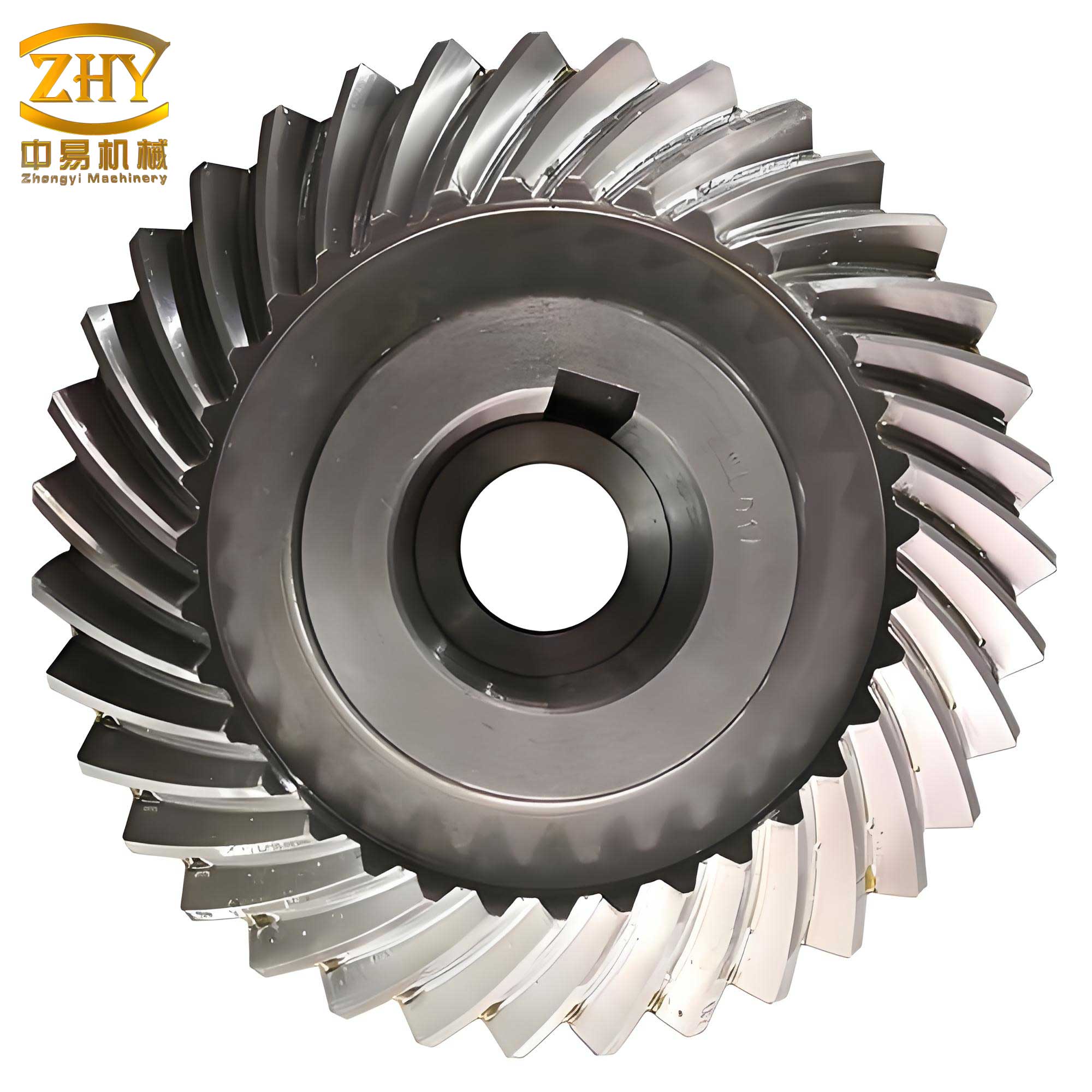
I begin by defining key parameters and symbols used throughout this analysis. For clarity, I summarize these in the table below, which includes geometric properties of spiral gears such as radii, angles, and pitches. These parameters are essential for understanding the meshing behavior of spiral gears.
| Symbol | Definition |
|---|---|
| \( r \) | Pitch circle radius of the spiral gear |
| \( r_0 \) | Reference circle radius (standard gear) |
| \( r_b \) | Base circle radius |
| \( r_a \) | Tip circle radius |
| \( \beta \) | Helix angle on the pitch cylinder of the spiral gear |
| \( \beta_0 \) | Helix angle on the reference circle |
| \( \beta_b \) | Helix angle on the base circle |
| \( \beta_a \) | Helix angle on the tip circle |
| \( p_n \) | Normal pitch on the pitch circle |
| \( p_{n0} \) | Normal pitch on the reference circle |
| \( p_{nb} \) | Normal pitch on the base circle |
| \( p_t \) | Transverse pitch on the pitch circle |
| \( p_{t0} \) | Transverse pitch on the reference circle |
| \( p_{tb} \) | Transverse pitch on the base circle |
| \( p_a \) | Axial pitch |
| \( m_n \) | Normal module |
| \( m_t \) | Transverse module |
| \( m \) | Module of a spur gear |
| \( \alpha_n \) | Normal pressure angle of the spiral gear |
| \( \alpha_t \) | Transverse pressure angle on the pitch circle |
| \( \alpha_{n0} \) | Normal pressure angle of the standard rack (tool angle) |
| \( \alpha_{t0} \) | Transverse pressure angle on the reference circle |
| \( \alpha \) | Pressure angle of a spur gear (meshing angle) |
| \( \alpha_0 \) | Tool angle of a spur gear |
| \( P \) | Lead of the helical surface |
| \( z \) | Number of teeth |
| \( a \) | Center distance between axes |
| \( \Sigma \) | Shaft angle between axes |
The core of my analysis lies in the mathematical representation of the involute helical surface. An involute helical surface is a developable ruled surface generated by a straight line tangent to a helix on the base cylinder. I parameterize this surface using coordinates \( \phi \) and \( \psi \), where \( \phi = \text{constant} \) represents the generator lines and \( \psi = \text{constant} \) represents the helical lines. The vector equation of the surface is given by:
$$ \mathbf{r} = \mathbf{r}_b + u \mathbf{e}, $$
where \( \mathbf{r}_b \) is the position vector on the base cylinder, and \( \mathbf{e} \) is the unit vector along the generator. In cylindrical coordinates, this can be expressed as:
$$ \mathbf{r} = (r_b \cos \theta, r_b \sin \theta, P \theta / 2\pi) + u (\sin \beta_b \cos \theta, \sin \beta_b \sin \theta, \cos \beta_b), $$
with \( \theta \) as the angular parameter. The normal vector to the surface is derived from the cross product of partial derivatives, leading to conditions for projection onto a plane.
I introduce the concept of a “projection rack” by considering the projection of the spiral gear’s helical surface onto a plane perpendicular to the projection direction. The projected lines form the side surface of a rack, which serves as a common rack for two meshing spiral gears. This transformation simplifies the meshing problem to that of a gear and rack, which is well-understood in gear theory. For spiral gears in mesh, this common rack acts as an intermediary, allowing me to analyze their geometric relationships through the engagement with the rack.
The equations governing the projection are derived from differential geometry. The condition for points on the surface to be projected onto a straight line is given by:
$$ \tan \beta = \tan \beta_b \cos \phi, $$
where \( \phi \) is the parameter along the generator. This implies that for a fixed helix angle \( \beta \), the projected generator lines form the teeth of the rack. The effective height of the rack, defined from the gear axis projection, varies with \( \beta \) and influences the length of the involute and transition curves on the spiral gear.
The meshing condition for two spiral gears is based on the equality of their normal base pitches. Since the normal base pitch is constant for a given gear, this condition ensures that the common rack can engage both gears simultaneously. Mathematically, this is expressed as:
$$ m_{n1} \cos \alpha_{n01} = m_{n2} \cos \alpha_{n02}, $$
where subscripts 1 and 2 denote the two spiral gears. In practice, for standard gears, this simplifies to requiring equal normal modules and normal tool angles. The transmission ratio for spiral gears is derived from the base circle radii and helix angles:
$$ i = \frac{\omega_1}{\omega_2} = \frac{r_{b2} \cos \beta_{b2}}{r_{b1} \cos \beta_{b1}}. $$
This ratio remains constant even with changes in center distance or shaft angle, highlighting a key feature of spiral gears meshing.
Next, I analyze the line of action for spiral gears meshing. In gear-and-rack engagement, the contact occurs along a straight line known as the contact line. For two spiral gears sharing a common rack, these contact lines intersect at a point, resulting in point contact between the gears. The locus of these contact points during motion forms the line of action. Using vector geometry, I derive the equation of the line of action in a coordinate system aligned with the gear axes. The line of action is a straight line that touches both base cylinders and is perpendicular to the common rack’s side surface. Its direction is fixed relative to the gear axes, making an angle equal to the complement of the base helix angle.
The parametric equations of the line of action are given by:
$$ \mathbf{R} = \mathbf{R}_0 + \lambda \mathbf{d}, $$
where \( \mathbf{d} \) is the direction vector parallel to the rack’s normal. In component form, this can be written as:
$$ x = a \frac{\tan \alpha_{n02}}{\tan \alpha_{n01} + \tan \alpha_{n02}}, \quad y = \frac{a}{\tan \alpha_{n01} + \tan \alpha_{n02}}, \quad z = \lambda \sin \beta_b, $$
with \( \lambda \) as a parameter. The shortest distance from the line of action to the common perpendicular of the axes is denoted as \( \delta \), which determines whether the meshing is “normal” (i.e., the line of action intersects the common perpendicular). Normal meshing occurs when \( \delta = 0 \), implying that the center distance equals the sum of the pitch circle radii:
$$ a = r_1 + r_2. $$
This condition is a special case in spiral gears meshing, often assumed in traditional gear literature.
The overlap coefficient, a critical parameter for continuous motion transmission, is calculated based on the length of the line of action segment between the tip circles. For spiral gears, the overlap coefficient \( \epsilon \) is given by:
$$ \epsilon = \frac{L}{p_n}, $$
where \( L \) is the total contact length along the line of action. I derive \( L \) using geometric relations:
$$ L = \sqrt{r_{a1}^2 – r_{b1}^2} + \sqrt{r_{a2}^2 – r_{b2}^2} – a \sin \alpha_t, $$
with \( \alpha_t \) as the transverse pressure angle. The overlap coefficient must exceed 1 for smooth operation. I investigate the conditions for maximizing \( \epsilon \) under fixed center distance or shaft angle. For instance, with fixed center distance, the maximum overlap coefficient occurs during normal meshing, highlighting the efficiency of spiral gears in such configurations.
Tight meshing refers to the condition where both flank surfaces of the spiral gears are in contact, as in gear generation processes. I derive the tight meshing equation that relates center distance \( a \) and shaft angle \( \Sigma \). This equation ensures no backlash and is fundamental for gear design and manufacturing. Starting from the projection rack concept, I calculate the distances from the gear axes to the mean line of the rack, where the tooth thickness equals the space width. The sum of these distances gives the center distance for tight meshing:
$$ a = \frac{m_n (z_1 + z_2)}{2 \cos \beta} + \Delta a, $$
where \( \Delta a \) is a correction term depending on tool offset and helix angles. The tight meshing equation can be expressed as:
$$ a = \frac{r_{b1}}{\cos \beta_{b1}} + \frac{r_{b2}}{\cos \beta_{b2}} – \frac{p_n}{2\pi} (\tan \alpha_{n1} + \tan \alpha_{n2}). $$
This equation defines a curve in the \( a \)-\( \Sigma \) plane, delimiting the region where tight meshing is possible. I further show that the tightest meshing (minimum center distance) coincides with normal meshing, optimizing the engagement of spiral gears.
To prevent undercutting during meshing, I establish criteria based on the effective height of the projection rack. Undercutting occurs if the rack’s tip line extends beyond the tangent point of the line of action with the base cylinder. For two spiral gears, the condition to avoid undercutting is:
$$ \sqrt{r_{a1}^2 – r_{b1}^2} \geq a \sin \alpha_t – \sqrt{r_{b2}^2 – r_{b2}^2}, $$
and similarly for gear 2. This ensures that the contact points remain within the active profile. The minimum number of teeth to avoid undercutting can be derived from this inequality, particularly for standard spiral gears. For example, for a gear meshing with a rack, the minimum tooth number is:
$$ z_{\min} = \frac{2 h_a^*}{\sin^2 \alpha_t}, $$
where \( h_a^* \) is the addendum coefficient. This criterion is crucial for designing spiral gears with robust meshing performance.
The meshing region for spiral gears is the set of allowable \( a \) and \( \Sigma \) values that satisfy all constraints: overlap coefficient > 1, tight meshing, and no undercutting. I summarize these constraints in a table to clarify the boundaries of the meshing region.
| Constraint | Equation or Inequality | Description |
|---|---|---|
| Overlap Coefficient | \( \epsilon > 1 \) | Ensures continuous transmission |
| Tight Meshing | \( a = f(\Sigma) \) from tight meshing equation | No backlash condition |
| No Undercutting | \( \sqrt{r_a^2 – r_b^2} \geq \text{threshold} \) | Prevents interference at the root |
In the \( a \)-\( \Sigma \) plane, these constraints form curves that enclose the meshing region. The overlap coefficient curve, tight meshing curve, and undercutting curve intersect to define a feasible area for spiral gears operation. Normal meshing lies within this region, often at the optimal point for maximum overlap coefficient and minimum center distance.
Additionally, I consider practical aspects such as the minimum face width and axial movement range for spiral gears. The face width must be sufficient to cover the projected length of the line of action along the gear axis. From geometry, the minimum face width \( B_{\min} \) for a spiral gear is:
$$ B_{\min} = \frac{L \sin \beta_b}{\cos \alpha_n}, $$
where \( L \) is the length of the line of action segment. The axial movement range restricts the gear’s position to ensure the entire line of action is within the face width. This range is derived from the intersection of the line of action with the tip cylinders, yielding limits on axial displacement to maintain proper meshing of spiral gears.
In conclusion, my analysis provides a comprehensive geometric framework for understanding spiral gears meshing. By leveraging the projection rack concept, I simplify the problem and derive key parameters such as the meshing condition, line of action, overlap coefficient, tight meshing equation, and undercutting criteria. The meshing region integrates these factors, offering a guide for designing and manufacturing spiral gears. The principles are applicable to various gear machining processes, enhancing the accuracy and efficiency of spiral gears in industrial applications. The mathematical rigor, supported by differential and analytic geometry, underscores the versatility and importance of spiral gears in mechanical systems.
Throughout this paper, I emphasize the repeated use of the term “spiral gears” to highlight its centrality in the discussion. The equations and tables summarize the complex relationships, making the content accessible for engineers and researchers. Future work could extend this analysis to non-standard spiral gears or dynamic meshing behavior, further advancing the understanding of spiral gears in modern machinery.