
In my extensive experience as a mold design engineer, the creation of injection molds for precision components like spiral gears represents one of the most challenging yet rewarding endeavors. Spiral gears, with their continuous helical tooth form, are critical for smooth, quiet power transmission in applications such as automotive instrument clusters, where the part discussed herein was utilized. The inherent complexity of molding spiral gears lies in replicating their precise three-dimensional geometry, managing material flow into thin, twisted sections, and ensuring damage-free ejection. This article details my comprehensive approach to designing a successful injection mold for a small nylon spiral gear, drawing from the core principles outlined in the reference material but expanding significantly on the engineering rationale, calculations, and practical considerations. I will delve into every aspect, from initial part analysis to final mold operation, emphasizing the unique strategies required for spiral gears.
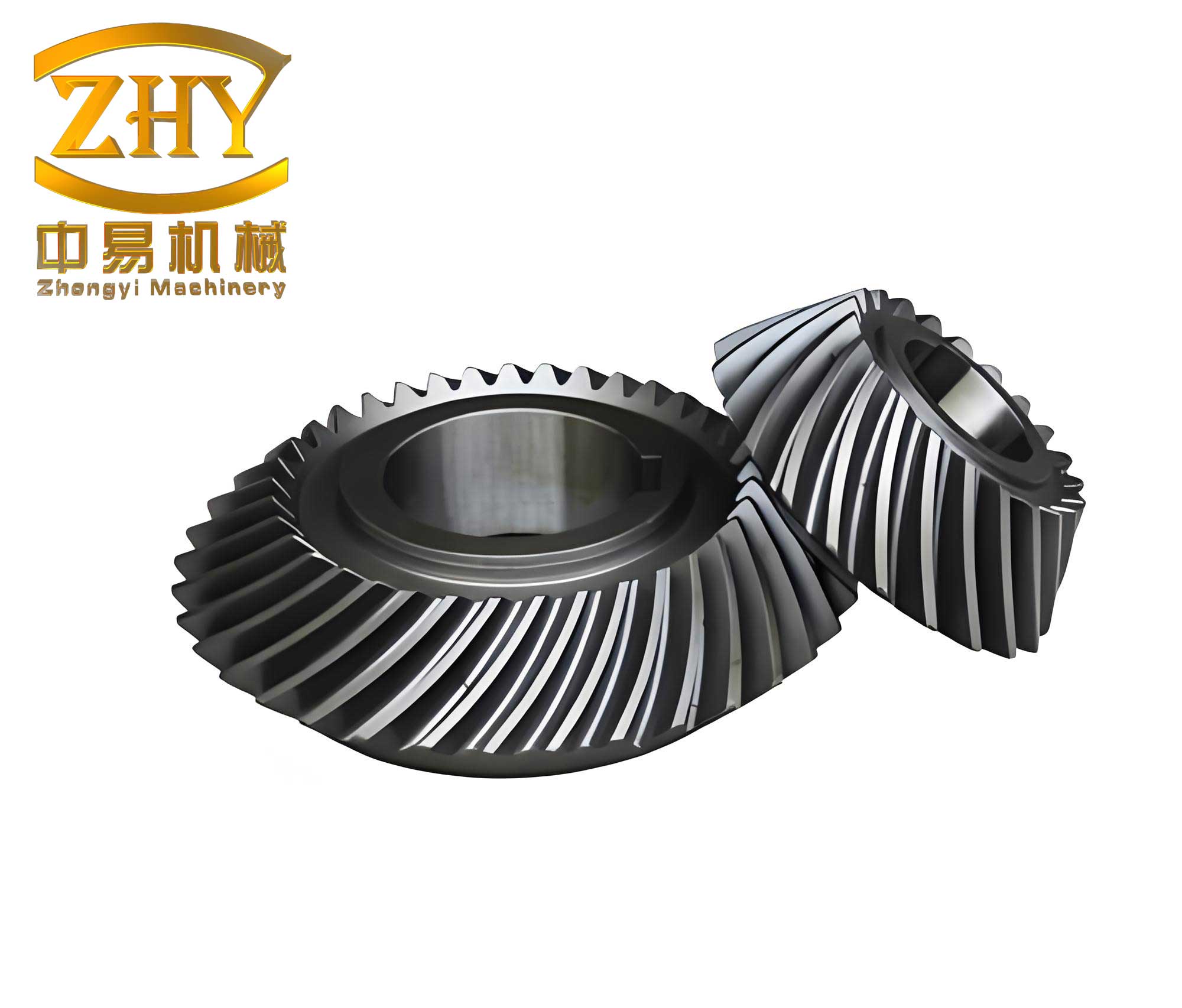
The successful production of spiral gears via injection molding hinges on a deep understanding of the component itself. The specific spiral gear in question, a left-handed helical gear, possesses parameters that dictate stringent mold requirements. A thorough geometric analysis is the indispensable first step. The primary dimensions are as follows:
| Parameter | Symbol | Value | Unit |
|---|---|---|---|
| Number of Teeth | z | 10 | – |
| Module | m | 0.65 | mm |
| Pitch Diameter | d | 6.5 | mm |
| Addendum Diameter | d_a | 7.98 | mm |
| Dedendum Diameter | d_f | 5.16 | mm |
| Lead | L | 453 | mm |
| Helix Angle | β | 2°35′ (≈2.583°) | degree |
These parameters are interrelated through fundamental gear equations. For spiral gears, the helix angle β is crucial as it defines the tooth inclination. The relationship between the lead (L), pitch diameter (d), and helix angle (β) is given by:
$$ L = \frac{\pi \cdot d}{\tan(\beta)} $$
Substituting the values: $$ L = \frac{\pi \times 6.5}{\tan(2.583^\circ)} \approx 453 \, \text{mm} $$, confirming the specification. The material specified is Polyamide 6 (PA6), a common engineering plastic chosen for its good wear resistance, low friction, and toughness—properties essential for gear operation. However, PA6 has a significant and somewhat anisotropic shrinkage rate, typically between 0.5% and 2.0%, which must be meticulously compensated for in the mold cavity design. For these spiral gears, an average volumetric shrinkage (S_v) of 1.5% was anticipated, requiring careful scaling of the master model.
The heart of mold design for spiral gears is the cavity creation. Given the intricate, continuous helical tooth profile, conventional machining methods like milling or grinding are prohibitively difficult and costly for such small, precise features. In my practice, I have found electroforming to be the only viable method for creating these cavity inserts. Electroforming, a specialized electrodeposition process, builds a nickel shell (the cavity) onto a precisely machined master model of the gear. The process flow I follow is: Design and fabricate a master model (positive of the final plastic part) with scaled-up dimensions to account for material shrinkage → Conduct surface preparation and activation → Electroform nickel onto the master in a controlled bath → Machine the back of the electroform for structural integrity → Carefully dissolve or mechanically extract the master model → Finish the internal nickel cavity to final dimensions. The key formula for scaling the master model involves the linear shrinkage factor (k):
$$ k = \frac{1}{1 – S_l} $$
where \( S_l \) is the linear shrinkage percentage (derived from material data). For PA6 with \( S_l \approx 0.015 \), \( k \approx 1.0152 \). Therefore, every critical dimension on the master model must be enlarged by this factor. For instance, the master model’s pitch diameter would be \( d_{master} = d \times k = 6.5 \times 1.0152 \approx 6.599 \, \text{mm} \). This precise compensation is non-negotiable for achieving functional spiral gears.
The design of the gating system is paramount for spiral gears. The aesthetic and functional requirement that no gate vestige appears on the tooth flank eliminates standard edge or pinpoint gates. Furthermore, the small size and rotational symmetry of spiral gears demand a balanced fill to prevent warpage and ensure uniform packing. My solution, proven in practice, is a modified spider or claw gate. This gate type is a variant of a ring gate, where melt enters the cavity through multiple, symmetrically distributed points around the gear’s hub. In this design, three entry points are arranged between a central core pin and a surrounding sleeve. This configuration offers several advantages for spiral gears: it provides balanced radial flow into the cavity, minimizes shear stress, and allows the gate to be sheared off cleanly at the junction between the gear hub and the sprue. The small cross-sectional area of each gate leg acts as a natural thermal restrictor, promoting easy degating. The fill pattern ensures uniform pressure on the helical teeth, reducing the risk of sink marks or distortions. The dimensions of the gate are critical; an enlarged schematic view shows a typical trapezoidal cross-section. The shear rate during injection must be calculated to avoid material degradation. The approximate shear rate (\( \dot{\gamma} \)) in a rectangular gate can be estimated by:
$$ \dot{\gamma} \approx \frac{6Q}{w h^2} $$
where \( Q \) is the volumetric flow rate, \( w \) is the gate width, and \( h \) is the gate height. For PA6, maintaining \( \dot{\gamma} \) below a threshold (e.g., 50,000 s⁻¹) is essential.
Ejecting spiral gears presents a unique challenge not found in molding standard spur gears. During ejection, as the ejector plate moves forward, the helical teeth, which are in contact with the helical cavity walls, induce a rotational force. If not accommodated, this force can cause the plastic spiral gear to twist and scrape against the cavity, leading to damage or even seizure. My design addresses this by integrating a two-stage ejection system and a clever part feature. First, the plastic gear itself is designed with a slight undercut or a dedicated flat surface on its back face. This allows a dedicated annular ejector ring (or “顶圈”) to contact this back face squarely. Second, the mold employs a delayed, secondary ejection sequence. The ejection cycle is broken into two phases: Phase 1 ejects the main runner and sprue, and Phase 2, activated only after the mold has opened a sufficient distance, ejects the spiral gear itself. This delay ensures that the gear is partially free from the main cavity before the ejector ring applies force, allowing the gear to rotate slightly without constraint as it is pushed out. The relative rotation between the spiral gear and the ejector ring is permissible as long as the ring does not interfere with the cavity walls. This entire mechanism is driven by a combination of ejector pins, a separate ejector plate for the ring, and return pins for resetting.
Let me describe the complete, sequential operation of the mold I designed, which follows a one-cavity-per-side (2-cavity total), two-plate with a stripper plate configuration. The process begins with the mold in the clamped position, and the injection of molten PA6. After a sufficient cooling time, the machine platen opens. Stage 1 – First Opening & Runner Ejection: The mold opens at the primary parting line (A-A), separating the stationary mold half (with sprue bushing) from the moving half. The solidified runner system is pulled along with the moving half by an inverted conical puller in the sprue. Almost simultaneously, the machine’s central ejector rod activates, pushing the primary ejector plate. This plate drives a set of ejector pins (顶料杆Ⅰ, 顶料杆Ⅱ) which directly strike the runner system. This action forces a secondary separation at the B-B parting line between the runner stripper plate and the cavity-retaining plate. The runner and sprue are completely stripped off and fall free, aided by gravity and positive stop screws. Stage 2 – Second Opening & Gear Ejection: The main mold opening continues. Only after the stripper plate has traveled a predetermined distance (set by the delay mechanism involving the push rod and the ejector ring plate) does the secondary ejection for the spiral gears initiate. A separate set of push rods now engages the ejector ring plate, driving the annular ejector rings forward. These rings contact the back of each spiral gear and push them out of their respective cavities. The helical geometry causes the gears to rotate slightly as they eject, but this motion is unimpeded. Finally, during mold closing, return pins ensure all ejector components—both for the runner and the gears—are precisely reset to their starting positions before the next injection cycle. This intricate sequence is vital for the reliable, automated production of spiral gears.
Beyond the core structure, numerous detailed calculations and considerations underpin a robust mold design for spiral gears. Venting is critical in the confined tooth spaces to avoid air traps and burn marks. I typically incorporate micro-vents (0.01-0.02 mm deep) at the end of fill points along the parting line. Cooling system design must be aggressive due to the small part size and the need for a fast cycle time. A conformal cooling channel around the cavity insert would be ideal, but practical constraints often lead to a design with baffles and bubblers in the core. The cooling time (\( t_c \)) can be estimated using the formula for a slab:
$$ t_c \approx \frac{s^2}{\pi^2 \alpha} \ln\left[\frac{4}{\pi} \frac{T_m – T_w}{T_e – T_w}\right] $$
where \( s \) is the maximum wall thickness (at the gear root, ~1.2mm), \( \alpha \) is the thermal diffusivity of PA6, \( T_m \) is melt temperature, \( T_w \) is mold temperature, and \( T_e \) is the ejection temperature. For efficient production, this time must be minimized without causing warpage. The following table summarizes key process parameters and material properties I used for these spiral gears:
| Category | Parameter | Value / Specification |
|---|---|---|
| Material (PA6) | Melt Temperature (Tm) | 240 – 260 °C |
| Mold Temperature (Tw) | 60 – 80 °C | |
| Linear Shrinkage (Sl) | 1.3 – 1.7 % | |
| Injection Process | Injection Pressure | 80 – 120 MPa |
| Packing Pressure | 50 – 70% of Injection Pressure | |
| Cooling Time | 8 – 12 seconds | |
| Cycle Time (Total) | 20 – 25 seconds | |
| Mold Steel | Cavity Insert (Electroform) | Nickel (Electroformed) |
| Core & Structural Parts | Pre-hardened Stainless Steel (e.g., P20) |
The structural integrity of the mold is another vital aspect. Spiral gears, though small, generate significant internal pressure during injection. The cavity insert, being a nickel electroform, must be robustly supported. My design nests it within a hardened steel bolster (镶套Ⅱ) which is itself tightly fitted into the mold plate. This prevents any elastic deformation or fatigue failure of the nickel shell under cyclic loading. The clamping force requirement is modest due to the small projected area. The projected area (A_proj) of one spiral gear is approximately the area of its addendum circle: \( A_{proj} = \pi (d_a/2)^2 = \pi (3.99)^2 \approx 50 \, \text{mm}^2 \). For two cavities, total \( A_{proj} \approx 100 \, \text{mm}^2 \). At an injection pressure of 100 MPa, the total separating force is \( F = P \times A = 100 \times 100 \times 10^{-6} = 0.01 \, \text{MN} = 10 \, \text{kN} \). Even a small injection machine (like an SZ-15 with a clamping force of 150 kN) has a vast safety margin, but the force is concentrated on a small area, justifying the robust support structure.
In reflecting on the entire project, the success of molding these precise spiral gears validates the design philosophy centered on specialized processes like electroforming and innovative ejection. The integration of the claw gate, the two-stage ejection with a delayed action, and the precise shrinkage compensation all worked in concert. The produced spiral gears met all dimensional tolerances and functional requirements for meshing and torque transmission in the automotive instrument assembly. However, the design of such molds is an iterative field. Future advancements could explore the use of additive manufacturing (3D printing) to create conformal cooling channels directly within the cavity supports or even to produce the cavity inserts themselves via direct metal laser sintering (DMLS) of tool steel, potentially offering better durability than nickel electroforms for very high-volume production of spiral gears. Furthermore, simulation software for mold filling, cooling, and warpage becomes increasingly valuable for optimizing gate location and size for spiral gears before committing to costly electrode or master model fabrication.
To conclude, the injection molding of spiral gears demands a synthesis of deep gear geometry knowledge, advanced mold manufacturing techniques, and clever mechanical design for part handling. Every element, from the electroformed cavity capturing the subtle helix to the synchronized ejection system that allows the gear to spin free, must be meticulously planned. The prevalence of spiral gears in demanding applications ensures that the continued refinement of their molding technology remains a high priority. Through systematic analysis, calculated design choices, and attention to the unique physics of molding helical forms, producing high-quality spiral gears via injection molding is not only possible but can be highly efficient and reliable. The strategies discussed here—emphasizing precision, balanced filling, and damage-free ejection—form a foundational framework for tackling similar challenges in precision plastic gear molding.