
In my engineering practice, I often encounter challenges related to gear failures in heavy machinery, such as ball mills used in mining operations. Spiral gears, due to their helical tooth design, offer smoother operation and higher load capacity compared to spur gears, but they are still prone to cracks and fractures under harsh working conditions. This study aims to develop a comprehensive methodology for stress analysis of spiral gears using ANSYS finite element software, with a focus on detecting and evaluating gear cracks. The approach integrates parameterized modeling in Pro/ENGINEER (Pro/E) to create accurate gear geometries, which are then imported into ANSYS for detailed contact and bending stress analysis. By comparing stress distributions in spiral gears with and without root cracks, I seek to provide a reliable basis for crack detection and gear integrity assessment. Throughout this article, I will emphasize the importance of spiral gears in industrial applications and delve into the technical nuances of their analysis.
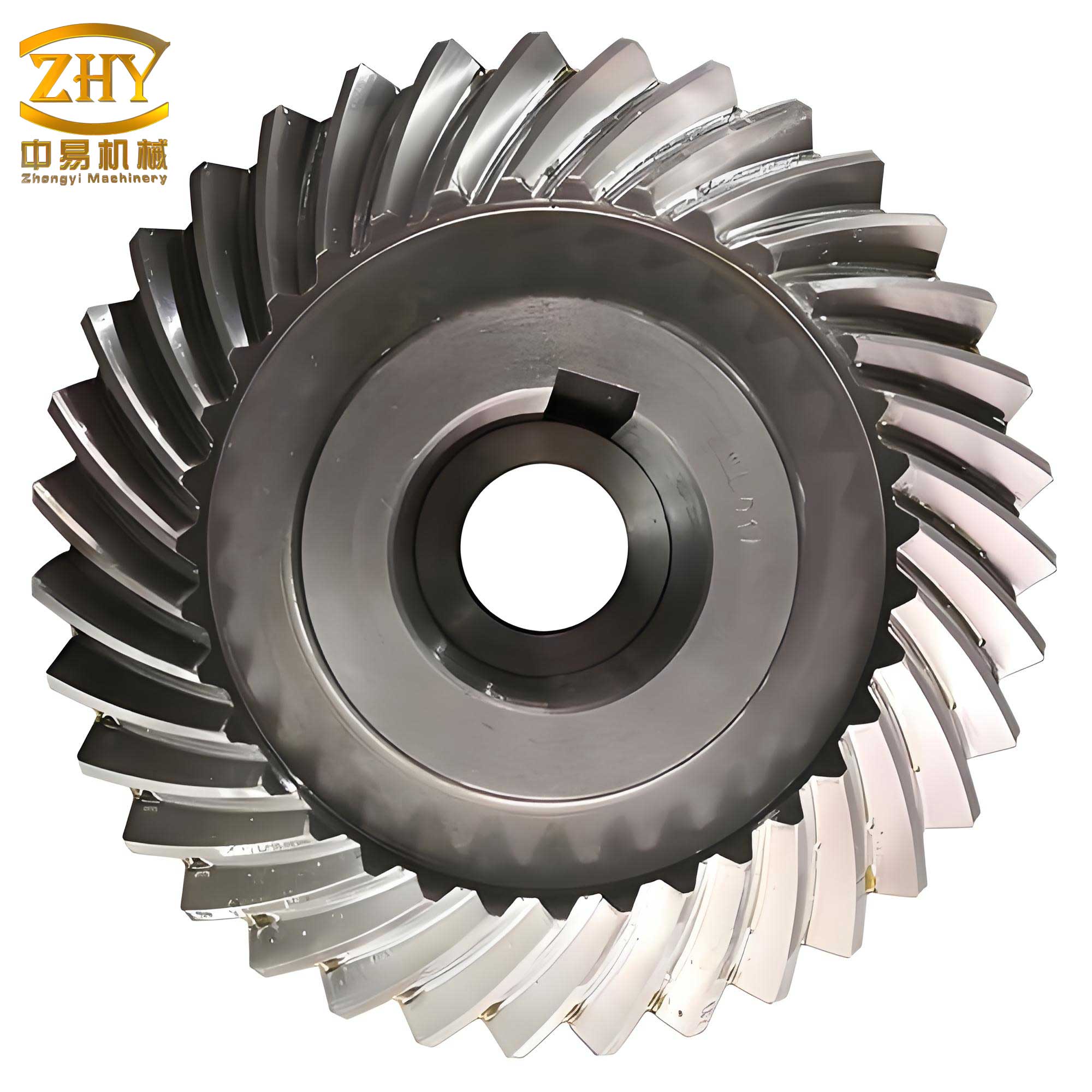
The failure of spiral gears in equipment like ball mills is often attributed to high cyclic loads, environmental contaminants, and stress concentrations at geometric discontinuities. In the case I investigated, spiral gears exhibited cracks at the tooth roots, leading to potential catastrophic failures. To address this, I proposed a finite element analysis (FEA) workflow that leverages the strengths of both Pro/E and ANSYS. The parameterized modeling capability of Pro/E allows for rapid generation of spiral gear geometries with customizable parameters, while ANSYS provides robust nonlinear contact analysis tools. This synergy enables accurate simulation of real-world loading conditions on spiral gears, facilitating a deeper understanding of stress patterns and crack propagation mechanisms. The analysis not only highlights critical stress zones but also quantifies the impact of cracks on gear performance, thereby aiding in preventive maintenance strategies.
My investigation begins with the parameterized design of spiral gears in Pro/E. Spiral gears, characterized by their helical teeth, require precise geometric definitions to ensure proper meshing and load distribution. I used a parametric approach to define key gear parameters, which can be easily modified for different designs. The table below summarizes the basic parameters used for the spiral gears in this study, based on a typical ball mill drive system:
| Parameter | Symbol | Value (Active Gear/Driven Gear) | Unit |
|---|---|---|---|
| Normal Module | \(M_n\) | 4 | mm |
| Number of Teeth | \(Z\) | 36 / 112 | – |
| Face Width | \(B\) | 125 / 120 | mm |
| Normal Pressure Angle | \(\alpha_n\) | 20 | ° |
| Helix Angle | \(\beta\) | 9°22′ | ° |
| Hand of Helix | – | Left / Right | – |
| Profile Shift Coefficient | \(X_n\) | 0.404 / -0.025 | – |
| Normal Addendum Coefficient | \(h_a^*\) | 1 | – |
| Normal Dedendum Coefficient | \(c^*\) | 0.25 | – |
| Center Distance | \(a\) | 300 | mm |
| Contact Ratio | \(\epsilon\) | 1.74 | – |
| Motor Power | \(P\) | 95 | kW |
| Motor Speed | \(n\) | 730 | r/min |
To create the tooth profile, I employed the involute curve equation, which is fundamental for gear design. In Pro/E, I used the “From Equation” feature to generate the involute curve. The parametric equations for the involute in Cartesian coordinates are:
$$ x = r_b (\cos(\theta) + \theta \sin(\theta)) $$
$$ y = r_b (\sin(\theta) – \theta \cos(\theta)) $$
where \(r_b\) is the base circle radius, calculated as \(r_b = \frac{M_n Z}{2 \cos(\beta)}\) for spiral gears, considering the helix angle \(\beta\). For the helical nature of spiral gears, I also created a helical curve along the tooth width to guide the sweep operation. The helical curve was defined using the following equation in cylindrical coordinates:
$$ r = \frac{d_b}{2} $$
$$ \theta = t \cdot 360 \cdot B \cdot \tan(\beta) \cdot \cos(\gamma) / (\pi \cdot d_b) $$
$$ z = t \cdot B $$
where \(d_b\) is the base diameter, \(B\) is the face width, \(\beta\) is the helix angle, \(\gamma\) is the transverse pressure angle, and \(t\) is a parameter ranging from 0 to 1. This approach ensures accurate modeling of the helical tooth form in spiral gears. For the tooth root region, where the root circle diameter might be smaller than the base circle diameter, I approximated the non-involute portion with a circular arc of radius \(r = 0.38 M_n / \cos(\beta)\), as recommended in gear design handbooks. This arc is tangent to both the involute curve and the root circle, providing a smooth transition to reduce stress concentration.
After defining the curves, I used the “Sweep Blend” tool in Pro/E to create a single tooth entity by sweeping the involute profile along the helical path. This process was repeated for all teeth using pattern features, resulting in a complete spiral gear model. The parameterized design allows for quick modifications; for instance, by changing the input parameters in Pro/E’s program editor, I can generate different spiral gear configurations without rebuilding the model from scratch. This flexibility is crucial for analyzing various spiral gear designs under different operating conditions. The final spiral gear model includes features like keyways and hubs, which were also parameterized for consistency.
Once the spiral gear model was ready, I exported it to ANSYS for finite element analysis. The seamless data exchange between Pro/E and ANSYS is facilitated by interfaces like ANSYS Geometry (ANSYS GEOM), which preserves geometric integrity and reduces preprocessing time. In ANSYS, I focused on a segment of the gear pair involving three teeth in contact, as this approximates the actual load-sharing behavior due to the high contact ratio of spiral gears. For crack analysis, I introduced a simulated crack at the tooth root of the active gear, with dimensions of 0.1 mm in width, 0.7 mm in depth, and 7.6 mm in length, representing a typical fatigue crack. The finite element model for both intact and cracked spiral gears was constructed similarly to ensure comparative validity.
The finite element analysis in ANSYS involved several key steps: element selection, material definition, meshing, application of loads and constraints, and solution. I chose SOLID185 elements for the gear bodies, which are 3-D 8-node elements suitable for nonlinear contact analysis. For the contact interfaces between the spiral gear teeth, I used CONTA174 and TARGE170 elements to model surface-to-surface contact. These elements allow for frictional contact with a coefficient of friction set to 0.2, reflecting typical gear operating conditions. The real constants for contact were configured with a stiffness factor (FKN) of 1, penetration tolerance (FTOLN) of 0.1, and other options like KEYOPT(5)=3 and KEYOPT(9)=1 to enable augmented Lagrange method and automatic contact adjustment, respectively. These settings ensure accurate convergence in the nonlinear analysis of spiral gears.
The materials for the spiral gears were defined based on common alloy steels: 38SiMnMo for the active gear and 35SiMn for the driven gear. The material properties are summarized in the table below:
| Material Property | Symbol | Value | Unit |
|---|---|---|---|
| Elastic Modulus | \(E\) | 2.06 × 10⁸ | kPa (mN/mm²) |
| Poisson’s Ratio | \(\nu\) | 0.278 | – |
| Density | \(\rho\) | 7.84 × 10⁻⁶ | kg/mm³ |
Meshing was performed with intelligent sizing, setting a global element size of 5 mm, but I refined the mesh at critical regions like the tooth contact zones and root fillets to capture stress gradients accurately. The final mesh for the three-tooth contact model consisted of approximately 1,070,896 elements, ensuring a balance between computational efficiency and result precision. For loading, I applied the torque derived from the motor power and speed. The torque \(T\) on the active gear is calculated as:
$$ T = 9554.99 \frac{P}{n} = 9554.99 \times \frac{95}{730} \approx 1243.1 \, \text{N·m} $$
The tangential force \(F_t\) at the pitch circle is then:
$$ F_t = \frac{2T}{d} = \frac{2 \times 1243.1}{0.15} \approx 16573.33 \, \text{N} $$
where \(d\) is the pitch diameter. This force was distributed as nodal forces on the contact surfaces of the active gear teeth, with each node receiving a fraction based on the number of contact nodes. Constraints were applied to simulate realistic boundary conditions: all degrees of freedom were fixed for the driven gear, while the active gear was constrained radially and axially but allowed to rotate freely. This setup mimics the actual mounting of spiral gears in a drive system.
The nonlinear solution was conducted with time-stepping control, setting 10 substeps per load step and a maximum of 40 equilibrium iterations. The analysis accounted for large deflections and contact nonlinearities, which are essential for accurate stress prediction in spiral gears. After solving, I extracted results for bending stress and contact stress, focusing on the maximum values and their locations. The stress contours revealed that the highest stresses occur at the tooth root and contact areas, consistent with gear failure theories. For intact spiral gears, the maximum bending stress at the root of the active gear was 247.08 MPa, while the maximum contact stress was 669.11 MPa. In spiral gears with a root crack, these values increased to 286.12 MPa for bending stress and 729.98 MPa for contact stress, indicating a moderate but significant effect of the crack on stress levels.
To quantify the stress variations, I analyzed the stress distribution along the tooth width. In intact spiral gears, the root stress shows a smooth, continuous variation due to the helical load distribution. However, in cracked spiral gears, the stress field becomes discontinuous near the crack, with stress concentrations at the crack tips. This discontinuity is a key indicator for crack detection in spiral gears. The table below compares the stress values and characteristics for both cases:
| Aspect | Intact Spiral Gear | Spiral Gear with Crack |
|---|---|---|
| Max Bending Stress (MPa) | 247.08 | 286.12 |
| Max Contact Stress (MPa) | 669.11 | 729.98 |
| Stress Distribution at Root | Continuous along tooth width | Discontinuous near crack; stress concentration at tip |
| Displacement Magnitude | Lower | Higher due to crack opening |
| Effect on Gear Mesh | Uniform load sharing | Localized load increase near crack |
The results underscore that even small cracks in spiral gears can elevate stress levels, though the high contact ratio of spiral gears helps distribute loads and mitigate immediate failure risks. The stress intensification at the crack tip follows principles of fracture mechanics, which can be described by the stress intensity factor \(K\). For a surface crack in a gear tooth, \(K\) can be approximated as:
$$ K = \sigma \sqrt{\pi a} \, f\left(\frac{a}{t}\right) $$
where \(\sigma\) is the applied stress, \(a\) is the crack depth, \(t\) is the tooth thickness, and \(f\) is a geometric correction factor. In my analysis, the increased stress near the crack aligns with higher \(K\) values, promoting crack growth under cyclic loading. This insight is vital for predicting the remaining life of spiral gears in service.
Beyond stress analysis, I also evaluated the computational efficiency of the Pro/E-ANSYS workflow. The parameterized modeling in Pro/E reduces model preparation time by over 50% compared to manual CAD methods, while the ANSYS simulation provides reliable stress data within a few hours on a standard workstation. This efficiency makes the approach suitable for routine gear inspection and design optimization in industries reliant on spiral gears. Furthermore, the methodology can be extended to other gear types, such as bevel or worm gears, by adjusting the parametric equations accordingly.
In conclusion, my study demonstrates that finite element analysis using ANSYS, coupled with parameterized Pro/E models, is a powerful tool for stress evaluation in spiral gears. The analysis confirms that stress concentrations in spiral gears primarily occur at tooth roots and contact zones, with cracks exacerbating these stresses. The comparison between intact and cracked spiral gears reveals distinct stress patterns that can serve as diagnostic features for crack detection. For instance, the discontinuous stress distribution along the tooth width in cracked spiral gears contrasts with the smooth variation in intact ones, offering a potential metric for non-destructive testing. These findings contribute to safer and more reliable operation of spiral gears in heavy machinery, ultimately reducing downtime and maintenance costs. Future work could involve dynamic analysis of spiral gears under variable loads or experimental validation using strain gauges on actual gear systems.
Throughout this investigation, I have emphasized the critical role of spiral gears in mechanical transmissions and the need for advanced analysis techniques to ensure their durability. The integration of parametric design and finite element analysis not only enhances accuracy but also streamlines the engineering process, making it accessible for both researchers and practitioners. As industries continue to demand higher performance from spiral gears, methodologies like the one presented here will become increasingly valuable for innovation and reliability assurance.