
The conventional machining of hardened internal spiral gears, especially those characterized by a small number of teeth, large module, and large pressure angle, presents significant challenges. Traditional gear hobbing or shaping methods are often unsuitable, and grinding processes are difficult to implement due to spatial constraints and complex tooling requirements. This research explores a novel approach utilizing Electrical Discharge Machining (EDM), specifically a helical feed motion成型 method, to machine these complex components. Building upon a modified precision EDM machine, this study investigates the theoretical framework, designs the necessary process apparatus, and conducts experimental validation for the成型 machining of hard-faced internal spiral gears.
The core principle of this method involves using a tool electrode shaped as an external spur gear. This tool electrode undergoes a compound motion: a vertical feed motion synchronized with a helical rotation. This synchronized motion, replicating the conjugate action of an internal helical gear pair, allows the tool’s profile to be copied onto a pre-machined bore in the workpiece. The critical relationship governing this motion is that the tool gear and the workpiece internal gear must have identical helical angles and hand, while the lead of the drive mechanism (e.g., a ball screw) must equal the lead of the workpiece gear. The setup transforms the vertical stroke of the EDM machine’s head into a precise helical path. A key innovation is the design and fabrication of an auxiliary helical motion attachment installed on a standard EDM machine frame.
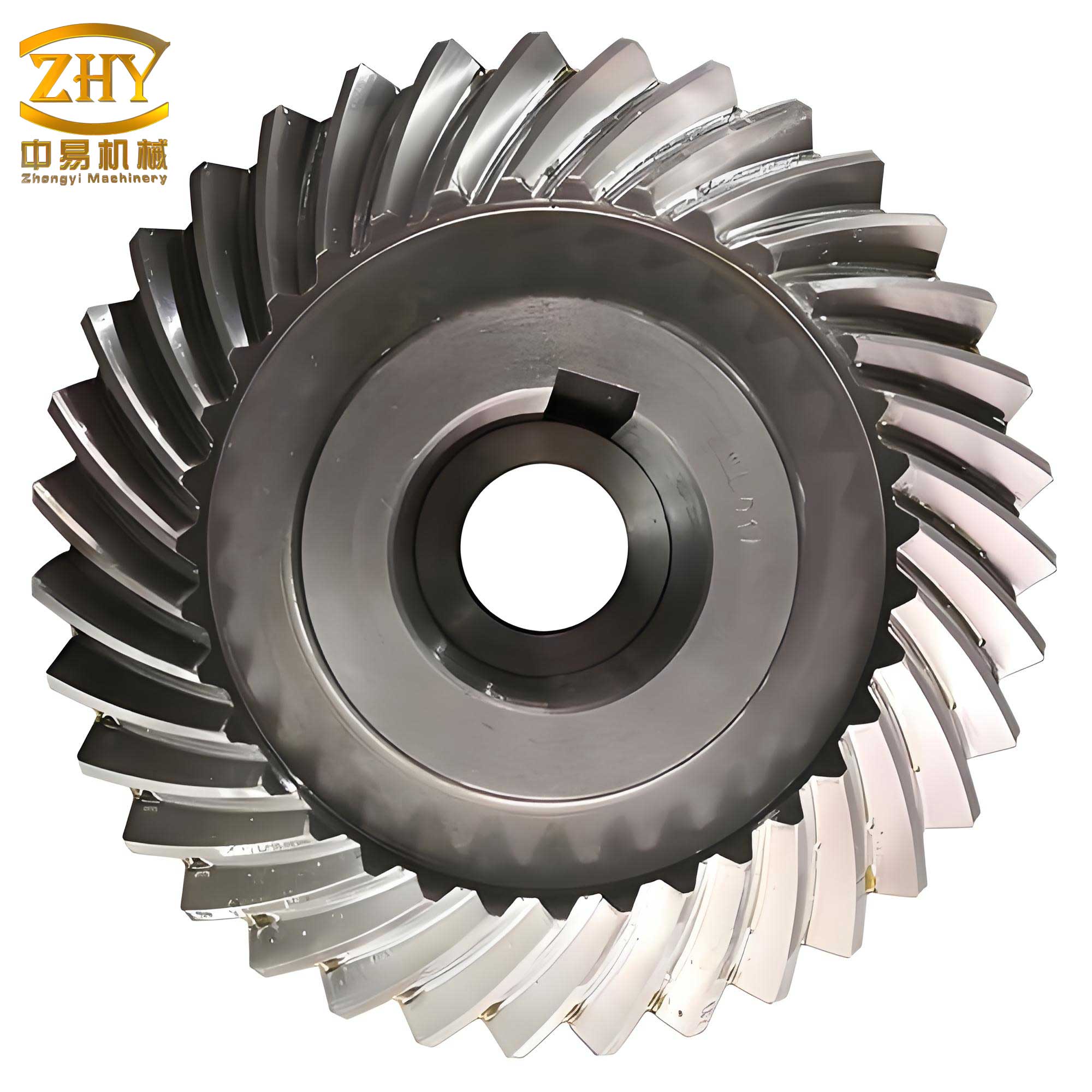
Central to achieving precision in EDM is the design of the tool electrode. Unlike conventional cutting, the EDM tool electrode’s profile is not identical to the final workpiece cavity due to the existence of a spark gap. The tool gear is essentially a modified version of the internal spiral gear it machines. Its design must account for the spark gap (δ) and compensate for inherent process phenomena like non-uniform wear and “tip discharge” effects. The basic size relationship for the tool’s addendum circle diameter, considering the spark gap, can be derived from gear geometry. The required profile shift coefficient (x_t) for the tool gear, accounting for a nominal single-sided spark gap δ, is calculated based on the change in base tangent length. For a given spark gap, the shift coefficient is determined.
$$ W_{k\_tool} = W_{k\_work} + 2 \delta \sin \alpha_t $$
$$ W_k = m_t \cos \alpha_t [\pi (k – 0.5) + z \cdot inv\alpha_t + 2x_t \tan \alpha_t] $$
Solving these yields the tool’s shift coefficient:
$$ x_t = \frac{\delta \sin \alpha_t}{m_t \cos \alpha_t \tan \alpha_t} – x_w = \frac{\delta}{m_t \cos \alpha_t} – x_w $$
where $W_k$ is base tangent length, $m_t$ is transverse module, $\alpha_t$ is transverse pressure angle, $z$ is number of teeth, $k$ is number of spanned teeth, and $x_w$ is workpiece shift coefficient.
A critical aspect specific to EDM of spiral gears is the influence of electrode curvature on the electric field intensity and, consequently, on the spark gap and wear uniformity. The electric field strength (E) at a point on an electrode surface is inversely related to the local radius of curvature (r). For an involute profile, the radius of curvature $\rho$ at a point defined by the involute roll angle $\theta$ is $\rho = r_b \theta$, where $r_b$ is the base circle radius. Therefore, the curvature is highest (radius smallest) at the root and decreases towards the tip.
$$ E \propto \frac{U}{d + \frac{r}{2}} $$
Where $U$ is inter-electrode voltage and $d$ is nominal gap. This suggests stronger fields and easier breakdown at regions of high curvature (gear root), potentially leading to more material removal there and a resulting pressure angle error on the workpiece. To compensate, the tool electrode’s pressure angle is intentionally modified (corrected) based on an analysis of the expected form error. The pressure angle correction $\Delta \alpha_t’$ is derived from the form error decomposition. The corrected tool pressure angle $\alpha_t’$ is:
$$ \alpha_t’ = \alpha_t – \Delta \alpha_t’ $$
This proactive correction in tool design is crucial for achieving accurate involute profiles on the machined internal spiral gears.
The selection of tool electrode material follows EDM principles, aiming for good conductivity, low wear, and machinability. A two-step strategy is adopted: roughing with a copper electrode (easily shaped via gear cutting) and finishing with a hardened steel electrode (precision-ground to high accuracy). To combat tool wear along the axis, a wear compensation strategy is employed, conceptually treating the electrode as having a tapered profile. The machining process parameters (pulse on-time $t_i$, off-time $t_o$, current $I_e$) are carefully selected to balance material removal rate, surface finish, and tool wear, particularly challenging for the “steel-on-steel” finishing operation.
| Design Parameter | Roughing Electrode | Finishing Electrode |
|---|---|---|
| Number of Teeth (z) | 19 | 19 |
| Normal Module ($m_n$) | 2.5 mm | 2.5 mm |
| Normal Pressure Angle ($\alpha_n$) | 25° | 25° |
| Helix Angle ($\beta$) | 18° | 18° |
| Profile Shift Coefficient ($x_t$) | -0.216 | -0.386 |
| Tip Diameter ($d_a$) | 53.26 mm | 52.45 mm |
| Material | Copper | Alloy Steel |
| Target Precision | Class 7 | Class 5 |
A comprehensive error analysis is essential for precision machining of internal spiral gears. Errors are categorized into geometric errors (eccentricity, tool profile errors), kinematic errors from the helical attachment (lead error, wobble), and EDM process errors (spark gap variation, arcing). The influence of various error sources on key gear accuracy indices like profile error ($f_f$), helix error ($F_\beta$), and pitch error ($F_p$, $f_{pt}$) is modeled mathematically. For instance, geometric eccentricity ($e_r$) contributes to profile error and cumulative pitch error. The component of profile error ($f_{f\_e}$) due to eccentricity over the active profile roll angles $\theta_a$ to $\theta_f$ is:
$$ f_{f\_e} = e_r \cos\alpha_t (\sin(\phi+\theta_a) – \sin(\phi+\theta_f)) $$
where $\phi$ is the angular position of the eccentricity vector.
The helix error is critically dependent on the accuracy of the helical attachment. An error in the ball screw’s helix angle ($\Delta \beta_s$) directly translates to a workpiece helix error. The relationship can be expressed as:
$$ F_\beta \approx L \cdot \Delta \beta_s \cdot \frac{\tan \beta_w}{\tan \beta_s} $$
where $L$ is face width, $\beta_w$ is workpiece helix angle, and $\beta_s$ is screw helix angle. Misalignment (tilt) of the screw axis induces both radial and tangential displacements along the tooth face, further contributing to $F_\beta$. Vibration and backlash in the attachment can cause servo instability, leading to non-uniform sparking and surface defects. Therefore, high precision in manufacturing and assembling the helical feed mechanism is paramount for machining high-quality internal spiral gears.
To experimentally verify the theoretical relationship between electrode curvature and discharge gap, a dedicated test using elliptical electrodes was conducted. An elliptical tool electrode (semi-major axis a=15mm, semi-minor axis b=10mm) was used to machine a steel workpiece under controlled EDM parameters. The curvature $\kappa$ of an ellipse parameterized by angle $t$ varies continuously:
$$ x = a \cos t, \quad y = b \sin t $$
$$ \kappa(t) = \frac{ab}{(a^2 \sin^2 t + b^2 \cos^2 t)^{3/2}} $$
The profiles of both tool and workpiece ellipses were measured using a coordinate measuring machine (CMM). The normal distance between the two fitted ellipses was calculated as a function of the parameter $t$, representing the local spark gap.
| Parameter t (rad) | Tool Ellipse Curvature $\kappa_t$ (mm⁻¹) | Calculated Normal Gap $\delta_n$ (µm) |
|---|---|---|
| 0.00 | 0.0667 | ~40 |
| 0.79 | 0.1118 | ~38 |
| 1.57 | 0.1000 | ~35 |
| 2.36 | 0.1118 | ~33 |
| 3.14 | 0.0667 | ~30 |
The results confirmed a correlation: regions of higher curvature (near t=0.79 and 2.36 rad) generally exhibited a larger effective spark gap compared to regions of lower curvature (near t=0 and 3.14 rad), although the relationship is modulated by other factors like debris flow. This validates the theoretical premise that curvature affects the local discharge characteristics, necessitating the profile correction for the tool gear used in machining spiral gears.
The primary machining experiments involved machining an internal helical gear (z=21, $m_n$=2.5mm, $\alpha_n$=25°, $\beta$=18°, face width=15mm) from a pre-bored 45# steel blank. The process employed the copper tool for roughing and the steel tool for finishing, using a negative polarity (workpiece cathode) for the “steel-on-steel” stage to promote stability and leverage the protective carbon layer formation. Key EDM parameters were set for finishing: pulse on-time $t_i=32 \mu s$, off-time $t_o=16 \mu s$, and average current $I_e \approx 4A$. The process required careful management of flushing (alternating injection and suction) and periodic electrode retraction (“jumping”) to maintain stability.
The machined internal spiral gear was evaluated for accuracy. A novel measurement approach was implemented using a CMM to capture dense point clouds from the tooth flanks. These coordinates were processed via custom-developed software algorithms to evaluate errors against the theoretical involute and helix models. The profile error was decomposed into a systematic pressure angle error component and a random form error component using a least-squares fitting approach to the error curve. Pitch measurements were conducted on a toolmaker’s microscope using an optical lever.
| Accuracy Parameter | Measured Value (Left Flank) | Measured Value (Right Flank) |
|---|---|---|
| Single Pitch Deviation ($f_{pt}$) | +12 µm | -9 µm |
| Cumulative Pitch Error ($F_p$) | 48 µm | 45 µm |
| Profile Form Error ($f_{ff}$) | 11 µm | 13 µm |
| Total Profile Error ($F_\alpha$) | 18 µm | 20 µm |
| Helix Error ($F_\beta$), Top | 22 µm | – |
| Helix Error ($F_\beta$), Bottom | 19 µm | – |
The experiments successfully demonstrated the feasibility of the helical feed EDM method for manufacturing internal spiral gears. The achieved accuracy, while not yet at the level of ground gears, is promising for pre-hardened or hardened components where grinding is unfeasible. The major sources of error were identified as residual kinematic errors in the helical attachment (affecting helix and pitch consistency) and the inherent challenge of controlling the EDM spark gap uniformly across the varying curvature of the involute profile. The tool electrode correction strategy was partially successful but requires further refinement based on more extensive wear data. Process stability, especially during finishing, was highly sensitive to flushing conditions and servo response, indicating a need for optimized adaptive control strategies.
In conclusion, this research establishes a foundational framework for the成型 electrical discharge machining of internal helical gears. It addresses the key aspects of system design, tool electrode synthesis with EDM-specific corrections, error modeling, and process validation. The method offers a viable solution for machining small-module, hard-to-cut internal spiral gears that defy conventional manufacturing. Future work should focus on enhancing the rigidity and precision of the helical motion unit, developing real-time adaptive control for the EDM process tailored to gear machining, and refining the tool design methodology through comprehensive modeling of wear distribution. This paves the way for EDM to become a viable alternative for producing precision internal gear forms in hard materials, expanding the design possibilities for compact gear transmissions.