
In modern manufacturing, the demand for high-precision, cost-effective components has led to the widespread adoption of powder metallurgy (PM) techniques. As a researcher engaged in advanced materials and manufacturing processes, I have focused on the development of micro spiral gears for applications such as robotic vacuum cleaners, where noise reduction and efficiency are critical. Traditional methods, like gear hobbing from steel, suffer from low material utilization, high energy consumption, and elevated costs. In contrast, powder metallurgy offers a sustainable alternative, enabling near-net-shape production with minimal waste. This article delves into the forming process and mold design for iron-based powder metallurgy micro spiral gears, emphasizing key aspects like material selection, sintering control, and precision mold engineering to achieve superior performance.
Spiral gears, also known as helical gears, are essential in transmission systems due to their smooth operation and reduced noise compared to spur gears. The specific micro spiral gear discussed here is a component in a robotic vacuum cleaner’s drive motor output shaft, requiring high dimensional accuracy and mechanical strength. The parameters of these spiral gears include a module of 0.4 mm, pressure angle of 20°, helix angle of 21° (right-handed), and 11 teeth. Achieving such fine features through powder metallurgy poses challenges, particularly in controlling dimensional changes during sintering. My work addresses these challenges through innovative mold design and process optimization, ensuring that the final spiral gears meet stringent standards for density, hardness, and surface finish.
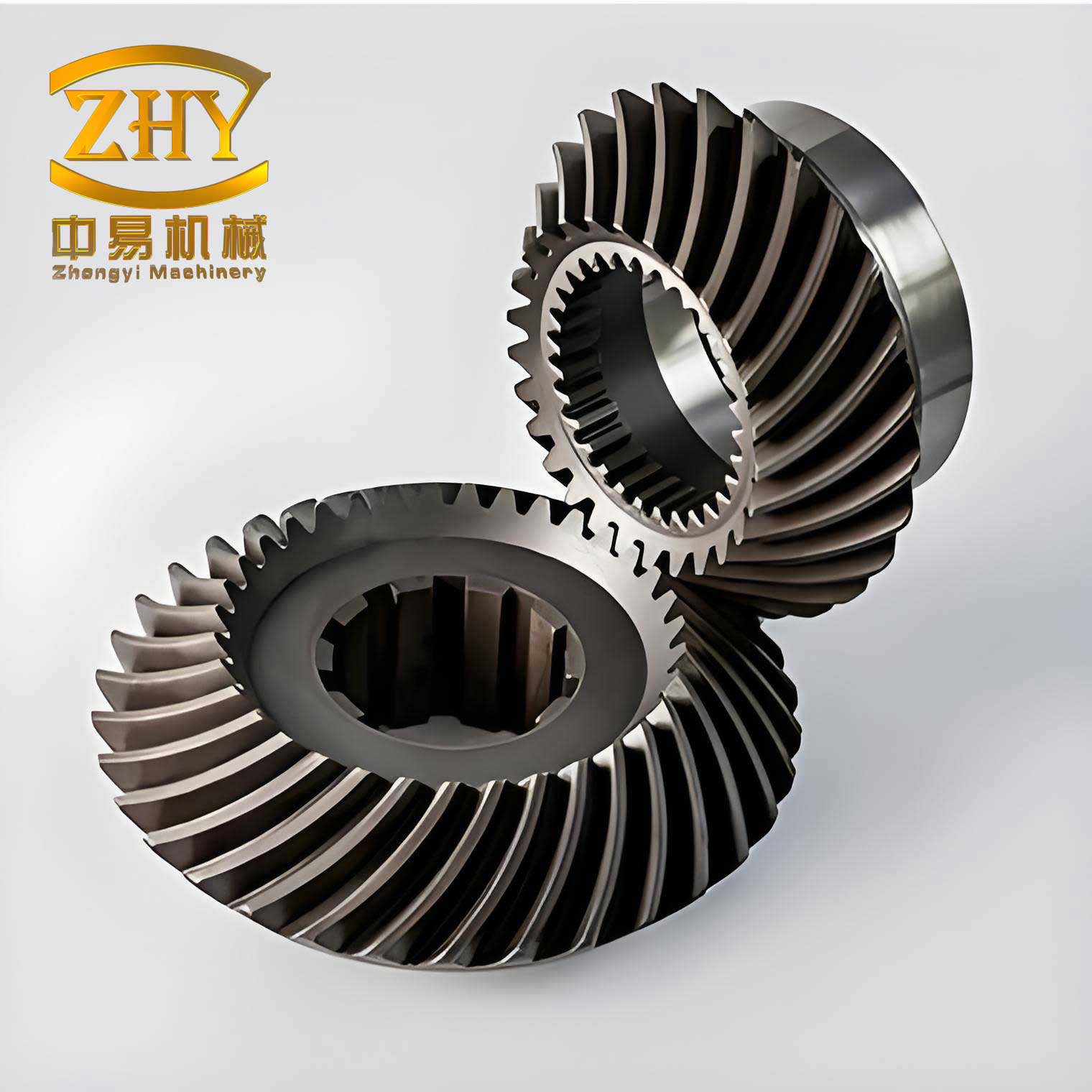
The importance of spiral gears in reducing vibration and noise cannot be overstated. In robotic vacuum cleaners, noise levels directly impact user experience, and gears are a primary source of acoustic emissions. Powder metallurgy allows for the production of spiral gears with consistent geometry and tight tolerances, which enhances meshing smoothness. However, the sintering process often leads to dimensional changes—either expansion or contraction—that affect gear accuracy. Through extensive experimentation, I have developed a methodology to predict and compensate for these changes, primarily by adjusting the pressure angle in the mold cavity. This approach, combined with careful material formulation, has enabled the mass production of high-quality spiral gears with an annual output exceeding one million units.
Structural Analysis of Micro Spiral Gears
The design of spiral gears involves complex geometry defined by parameters such as module, pressure angle, helix angle, and number of teeth. For micro spiral gears, these parameters must be precisely controlled to ensure proper function. The gear discussed here has a pitch diameter of 4.71 mm, addendum diameter of 5.90 mm, and dedendum diameter of 4.07 mm, with a surface roughness of Ra 0.16. The helix angle introduces axial forces during operation, which require robust material properties to withstand wear and fatigue. In powder metallurgy, the gear shape is formed during compaction, making mold design critical. The following table summarizes the key geometric parameters of the spiral gears:
| Parameter | Symbol | Value |
|---|---|---|
| Number of Teeth | Z | 11 |
| Module | m | 0.4 mm |
| Pressure Angle | α | 20° |
| Helix Angle | β | 21° (right-handed) |
| Pitch Diameter | d | 4.71 mm |
| Addendum Diameter | d_a | 5.90 mm |
| Dedendum Diameter | d_f | 4.07 mm |
| Base Circle Diameter | d_b | Calculated as d_b = d \cos α |
The base circle diameter is fundamental for involute gear design, given by the formula: $$d_b = d \cos α$$ where \(d\) is the pitch diameter and \(α\) is the pressure angle. For these spiral gears, \(d_b = 4.71 \cos 20° = 4.71 \times 0.9397 = 4.425 \, \text{mm}\). This parameter influences tooth profile accuracy, especially after sintering. Additionally, the helix angle affects the transverse pressure angle, which can be calculated using: $$α_t = \arctan\left(\frac{\tan α_n}{\cos β}\right)$$ where \(α_n\) is the normal pressure angle (20°) and \(β\) is the helix angle. For our spiral gears, \(α_t = \arctan(\tan 20° / \cos 21°) = \arctan(0.3640 / 0.9336) = \arctan(0.3898) = 21.3°\). This slight increase must be accounted for in mold design to ensure proper meshing.
Powder Metallurgy Process for Spiral Gears
The production of spiral gears via powder metallurgy involves several stages: material selection, mixing, compaction, sintering, and finishing. Each stage must be meticulously controlled to achieve the desired properties. I have optimized this process for iron-based spiral gears, focusing on density, hardness, and dimensional stability.
Material Design and Composition
The base material is iron powder, supplemented with copper for strengthening and graphite for carbon addition. To enhance compactibility, lubricants such as ethylene bis-stearamide are added. The composition is tailored to achieve a sintered density of 6.8–7.0 g/cm³ and a hardness of 50–70 HRB. The table below details the material composition and raw material specifications:
| Component | Purity (%) | Particle Size (µm) | Weight Percentage (%) |
|---|---|---|---|
| Iron Powder (Fe) | ≥99.6 | < 147 | Balance |
| Copper Powder (Cu) | ≥99.8 | < 74 | 3.5 |
| Graphite Powder (C) | ≥99.8 | 238–477 | 1.2 |
| Lubricant (EBS) | – | – | 0.75 |
The iron powder is water-atomized to ensure spherical particles for better flow, while copper is electrolytic for high purity. Graphite, as a natural source, provides carbon for steel formation during sintering. To prevent segregation due to density differences, 0.1% low-viscosity spindle oil is added to the iron powder before mixing. The mixing process uses a double-cone blender for 30 minutes to achieve homogeneity, critical for uniform compaction of spiral gears.
Compaction and Sintering
Compaction is performed on a 20-ton automatic press, where powder is fed into the mold cavity and compressed to form green spirals gears. The pressure is adjusted to achieve a green density of 6.5–6.7 g/cm³, with density variations kept below 0.1 g/cm³ to prevent distortion. The compaction pressure \(P\) can be estimated using the equation: $$P = K \rho^n$$ where \(K\) is a material constant, \(\rho\) is the density, and \(n\) is an exponent typically around 2–3 for iron-based powders. For our spiral gears, a pressure of 600 MPa is applied to attain the desired green density.
Sintering is conducted in a mesh belt furnace with a rapid debinding section. The temperature profile includes a debinding stage at 500°C to remove lubricants, followed by sintering at 1150°C for 25 minutes in a atmosphere of 90% nitrogen and 10% hydrogen. This atmosphere prevents oxidation and controls carbon potential to avoid decarburization. The sintering shrinkage or expansion is influenced by temperature and time, described by the empirical formula: $$\Delta L = A e^{-E_a/RT}$$ where \(\Delta L\) is the dimensional change, \(A\) is a pre-exponential factor, \(E_a\) is activation energy, \(R\) is the gas constant, and \(T\) is temperature. For spiral gears, we observe a slight expansion at lower temperatures but contraction at higher temperatures, with the net change calibrated to achieve final dimensions.
The sintering process transforms the green compact into a dense structure via diffusion mechanisms. The densification rate can be modeled by: $$\frac{d\rho}{dt} = \frac{C}{r^3} \exp\left(-\frac{Q}{RT}\right)$$ where \(C\) is a constant, \(r\) is particle radius, and \(Q\) is activation energy for diffusion. By optimizing particle size and sintering parameters, I ensure that the spiral gears reach a sintered density of 6.95 g/cm³ on average, with minimal porosity to enhance strength.
Post-Sintering Treatments
After sintering, the spiral gears undergo sizing or coining to improve dimensional accuracy. This involves pressing the sintered gear in a precision die to correct any deviations. The gears are then cleaned and inspected for defects. Surface roughness is measured as Ra 0.16, meeting the requirement for smooth operation. Hardness testing yields values of 68 HRB, indicating good wear resistance for spiral gears in robotic applications.
Mold Design for Spiral Gears
The mold design is pivotal for producing accurate spiral gears via powder metallurgy. The challenge lies in compensating for dimensional changes during sintering, particularly in the tooth profile. Based on my research, I employ a variable pressure angle method to design the mold cavity, which effectively controls final gear geometry.
Mold Cavity Design Using Variable Pressure Angle
During sintering, spiral gears may expand or contract, altering the pressure angle. To counteract this, the mold cavity is designed with a modified pressure angle. For a final pressure angle of 20°, the mold cavity uses 20.2°, accounting for elastic recovery and sintering shrinkage. The relationship between mold pressure angle \(α_m\) and final pressure angle \(α_f\) is given by: $$α_f = α_m – \Delta α$$ where \(\Delta α\) is the change due to sintering, typically 0.2° for our conditions. This adjustment ensures that the sintered spiral gears have the correct involute profile.
The gear tooth profile in the mold is generated based on extended involute equations. For a helix angle \(β\), the transverse module \(m_t\) is: $$m_t = \frac{m_n}{\cos β}$$ where \(m_n\) is the normal module (0.4 mm). For our spiral gears, \(m_t = 0.4 / \cos 21° = 0.4 / 0.9336 = 0.428 \, \text{mm}\). The mold cavity dimensions are derived from this, with addendum and dedendum adjusted for compaction and sintering. The table below compares mold and final gear parameters:
| Parameter | Mold Cavity Value | Final Gear Value |
|---|---|---|
| Pressure Angle | 20.2° | 20° |
| Helix Angle | 21.04° | 21° |
| Number of Teeth | 11 | 11 |
| Pitch Diameter | 4.713 mm | 4.71 mm |
| Addendum Diameter | 5.83 ± 0.004 mm | 5.90 mm |
| Dedendum Diameter | 4.01 ± 0.004 mm | 4.07 mm |
| Base Circle Diameter | 4.425 mm (calculated) | 4.425 mm |
The design process involves iterative calculations to optimize cavity geometry. Using CAD software, I simulate the compaction and sintering to verify dimensions. The goal is to achieve spiral gears with JGMA class 3 accuracy, equivalent to AGMA class 8, suitable for high-speed applications.
Mold Structure and Key Components
The mold for spiral gears consists of several critical parts: upper punch, lower punch, die (cavity), core rod, and die plate. These components are made from high-grade tool steels to withstand wear and maintain precision. The materials and hardness requirements are summarized in the table below:
| Component | Material | Hardness (HRC) |
|---|---|---|
| Upper Punch | Cold Work Steel DC53 | 57–59 |
| Lower Punch | Cold Work Steel DC53 | 57–59 |
| Die (Cavity) | Powder High-Speed Steel ASP60 | 60–63 |
| Core Rod | Molybdenum High-Speed Steel SKH-9 | 60–63 (with AlCrN coating) |
| Die Plate | Alloy Steel 40Cr | 45–48 |
The upper and lower punches have helical teeth matching the spiral gear profile, with a clearance fit in the die cavity to allow axial movement. The core rod fits into a 1.98 mm hole in the punches, guiding the compaction of the gear bore. The die plate holds the die and incorporates thrust bearings to enable rotation of punches during compaction and ejection, crucial for maintaining helix angle accuracy.
The mold operation involves three stages: filling, compaction, and ejection. During filling, powder is fed into the die cavity with the lower punch at a fixed position. The upper punch descends, guided by a keyway until it engages the helical teeth of the die, after which it rotates according to the helix angle. Compaction occurs under pressure, with the die floating to ensure uniform density. The ejection phase involves retracting the upper punch while the die moves downward, causing the lower punch to rotate and push the green spiral gear out without damage. This process is automated for high-volume production of spiral gears.
Mathematical Modeling of Mold Performance
To ensure durability, the mold components are analyzed for stress and wear. The compressive stress on the die during compaction can be calculated using: $$\sigma = \frac{P}{A}$$ where \(P\) is the compaction force (20 tons ≈ 196 kN) and \(A\) is the projected area of the spiral gear. For a pitch diameter of 4.71 mm, the area \(A = \pi (d/2)^2 = \pi (2.355)^2 = 17.42 \, \text{mm}^2\), so \(\sigma = 196,000 / 17.42 = 11,250 \, \text{MPa}\). This high stress necessitates high-strength materials like ASP60 steel.
Wear on the helical teeth of the punches is assessed using Archard’s equation: $$V = K \frac{W s}{H}$$ where \(V\) is wear volume, \(K\) is a wear coefficient, \(W\) is load, \(s\) is sliding distance, and \(H\) is hardness. For spiral gears, the sliding distance per cycle depends on helix angle and punch travel. By selecting materials with high hardness and coatings like AlCrN, I minimize wear, extending mold life to over 500,000 cycles for producing spiral gears.
Performance Evaluation of Spiral Gears
The produced spiral gears undergo rigorous testing to validate their performance. Key metrics include density, hardness, dimensional accuracy, and noise levels in application.
Density and Hardness Measurements
Density is measured using the Archimedes method, with results averaging 6.95 g/cm³, within the target range of 6.8–7.0 g/cm³. Hardness is tested on a Rockwell B scale, yielding values of 50–70 HRB, with a typical value of 68 HRB. These properties ensure that the spiral gears have sufficient strength for torque transmission in robotic vacuum cleaners. The relationship between density and hardness can be expressed as: $$H = H_0 \left(\frac{\rho}{\rho_0}\right)^m$$ where \(H_0\) is reference hardness, \(\rho_0\) is theoretical density, and \(m\) is an exponent around 2–3. For our iron-based spiral gears, this correlation holds, confirming good sintering quality.
Dimensional Accuracy and Gear Quality
Gear parameters are measured using coordinate measuring machines (CMM) and gear analyzers. The results show that spiral gears meet JGMA class 3 accuracy, with tooth profile errors within 10 µm. The pressure angle deviation is less than 0.1°, and helix angle accuracy is within ±0.05°. These tolerances are achieved through the variable pressure angle mold design and controlled sintering. The gear noise test in assembled robotic vacuum cleaners shows a reduction of 3–5 dB compared to machined steel gears, highlighting the advantage of powder metallurgy spiral gears in noise-sensitive applications.
Comparative Analysis with Traditional Methods
Powder metallurgy offers significant benefits over conventional gear hobbing for spiral gears. The table below compares key metrics:
| Process | Material Utilization (%) | Energy Consumption (MJ/kg) | Relative Cost (%) |
|---|---|---|---|
| Powder Metallurgy | 95 | 29 | 42 |
| Gear Hobbing (Steel) | 45 | 74 | 100 |
| Casting | 90 | 34 | 53 |
| Forging | 77 | 43 | 72 |
As evident, powder metallurgy spiral gears achieve higher material efficiency and lower energy use, reducing environmental impact. The cost savings are substantial, making it ideal for mass production. Additionally, the ability to form complex shapes like helical teeth in a single press operation enhances productivity.
Advanced Topics in Spiral Gear Powder Metallurgy
To further optimize spiral gear production, I explore advanced concepts such as alloy design, process simulation, and quality control.
Alloy Design for Enhanced Properties
By adjusting copper and graphite content, the mechanical properties of spiral gears can be tailored. For instance, increasing copper to 5% enhances strength but may affect dimensional stability. The effect of alloying on sintered density can be modeled using mixture rules: $$\rho = \sum w_i \rho_i$$ where \(w_i\) and \(\rho_i\) are weight fraction and density of component i. For our spiral gears, the optimal composition balances density and hardness.
Additionally, adding nickel or molybdenum can improve toughness, but cost considerations limit their use. I have conducted experiments with pre-alloyed powders, which offer more uniform properties but require higher sintering temperatures. The results show that for spiral gears, diffusion-bonded powders with copper provide the best combination of performance and cost.
Process Simulation and Optimization
Finite element analysis (FEA) is used to simulate powder compaction and sintering of spiral gears. The Drucker-Prager cap model is employed for powder behavior, with parameters calibrated from experiments. The simulation predicts density distribution, showing that the green density varies from 6.6 g/cm³ at the tooth root to 6.8 g/cm³ at the tip due to friction. This insight guides mold design to minimize gradients.
Sintering simulation uses continuum mechanics equations: $$\frac{\partial \rho}{\partial t} = \nabla \cdot (D \nabla \rho)$$ where \(D\) is diffusion coefficient. By coupling thermal and stress fields, I predict dimensional changes, validating the variable pressure angle approach. These simulations reduce trial-and-error, accelerating development of spiral gears.
Quality Control and Statistical Methods
Statistical process control (SPC) is implemented to monitor spiral gear production. Key parameters like density, hardness, and dimensions are tracked using control charts. The process capability index \(C_pk\) is calculated to ensure consistency. For spiral gears, \(C_pk\) values exceed 1.33, indicating a capable process. Additionally, design of experiments (DoE) techniques optimize sintering temperature and time, with response surface methodology yielding the following model for final pressure angle: $$α_f = 19.8 + 0.05 T – 0.001 t$$ where \(T\) is temperature in °C and \(t\) is time in minutes. This model helps fine-tune conditions for different batches of spiral gears.
Future Directions and Applications
The success of powder metallurgy spiral gears opens avenues for broader applications. In robotics, drones, and medical devices, micro gears are in high demand. Future work includes developing nano-powder based spiral gears for even higher precision, and exploring additive manufacturing hybrid processes. Additionally, sustainable practices like recycling powder waste can further reduce costs.
I am also investigating the use of alternative materials, such as stainless steel or titanium, for corrosion-resistant spiral gears in harsh environments. The mold design principles remain applicable, with adjustments for different shrinkage behaviors. Collaboration with industry partners aims to standardize powder metallurgy spiral gears for various sectors, promoting adoption of this efficient technology.
Conclusion
In summary, the powder metallurgy process for micro spiral gears offers a compelling solution to the limitations of traditional manufacturing. Through meticulous material design, controlled sintering, and innovative mold engineering using variable pressure angle, I have achieved high-quality spiral gears with excellent density, hardness, and accuracy. The mold structure, featuring helical punches and precision components, enables mass production with annual outputs surpassing one million units. Performance tests confirm that these spiral gears meet rigorous standards for robotic applications, reducing noise and enhancing efficiency. This work underscores the potential of powder metallurgy in producing complex components like spiral gears, contributing to sustainable manufacturing practices. Future enhancements in simulation and alloy design will further optimize the process, solidifying the role of powder metallurgy in advanced gear technology.