
The precise manufacturing of gear teeth is a cornerstone of modern mechanical engineering, directly influencing the efficiency, noise, and longevity of power transmission systems. Among various gear types, spiral gears, specifically involute helical gears, are prized for their smooth engagement, high load capacity, and reduced operational noise compared to spur gears. Achieving high-precision tooth flanks on these spiral gears often necessitates a final grinding process. Form grinding, where the profile of the grinding wheel is precisely shaped to match the gear tooth space, is an efficient method for this purpose. This article delves into the mathematical foundation and computational methodology for determining the exact required profile of a disk-shaped grinding wheel to accurately generate an involute helicoid—the complex surface of a helical gear tooth. The core challenge addressed is the derivation of the wheel profile based on the known geometry of the target spiral gear and the kinematics of the grinding process, providing a robust solution that can adapt to wheel wear through parameter modification.
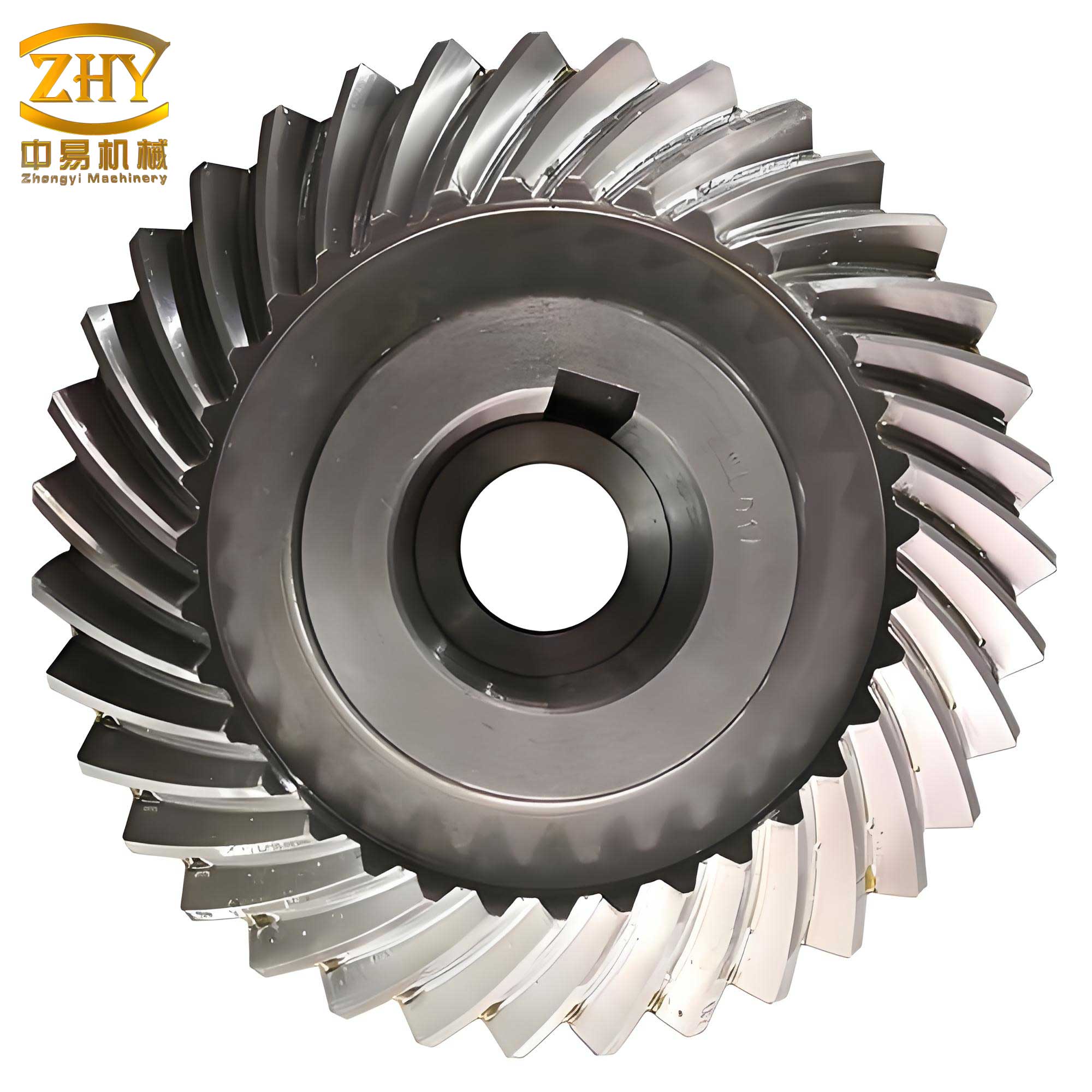
The surface of an involute helical gear, or an involute helicoid, is a type of cylindrical spiral surface. It can be generated by a straight line (the generator) performing a screw motion around an axis. Understanding this generation is key to its mathematical description. Consider a fixed coordinate system (O – x, y, z) with unit vectors $\mathbf{i}$, $\mathbf{j}$, $\mathbf{k}$. A general right-handed helicoid can be expressed parametrically. Let a curve defined by a parameter $u$ in its initial position be given by $\mathbf{r}_0(u) = x_0(u)\mathbf{i} + y_0(u)\mathbf{j} + z_0(u)\mathbf{k}$. If this curve undergoes a screw motion—rotation $\theta$ around the z-axis combined with translation $p\theta$ along it—the resulting helicoid is described by:
$$
\begin{aligned}
x(u, \theta) &= x_0(u) \cos\theta – y_0(u) \sin\theta \\
y(u, \theta) &= x_0(u) \sin\theta + y_0(u) \cos\theta \\
z(u, \theta) &= z_0(u) + p\theta
\end{aligned}
$$
Here, $p$ is the spiral parameter, related to the gear’s lead $P_z$ by $p = P_z / (2\pi)$. For a standard helical gear with normal module $m_n$, number of teeth $z$, and helix angle at the pitch circle $\beta$, it is given by $p = \frac{z m_n}{2 \sin\beta}$.
For the specific case of the involute helicoid, the generating curve is a straight line tangent to the base cylinder of radius $r_b$. Let $\sigma$ be the angle defining the starting point of the involute in the transverse plane, and $\alpha$ be the angle between the generator and the transverse plane. This angle $\alpha$ is constant and equals the lead angle $\gamma$ of the helix on the base cylinder: $\alpha = \gamma = \arctan(p / r_b)$. Let $u$ be the distance along the generator from its point of tangency. The initial position of this generator is:
$$
\begin{aligned}
x_0(u) &= r_b \cos\sigma – u \cos\alpha \sin\sigma \\
y_0(u) &= r_b \sin\sigma + u \cos\alpha \cos\sigma \\
z_0(u) &= u \sin\alpha
\end{aligned}
$$
Substituting this into the general helicoid equation yields the parametric equations for the right-hand flank of a right-handed involute spiral gear:
$$
\boxed{
\begin{aligned}
x(u, \theta) &= r_b \cos(\sigma + \theta) – u \cos\alpha \sin(\sigma + \theta) \\
y(u, \theta) &= r_b \sin(\sigma + \theta) + u \cos\alpha \cos(\sigma + \theta) \\
z(u, \theta) &= u \sin\alpha + p\theta
\end{aligned}}
\qquad \text{(Equation Set 1)}
$$
The unit normal vector $\mathbf{n}$ to this surface at any point $(u, \theta)$ is crucial for subsequent contact analysis and is derived from the partial derivatives $\mathbf{r}_u$ and $\mathbf{r}_\theta$:
$$
\mathbf{n}(u, \theta) = \frac{\mathbf{r}_u \times \mathbf{r}_\theta}{|\mathbf{r}_u \times \mathbf{r}_\theta|}
$$
For the involute helicoid defined above, the components simplify to:
$$
\boxed{
\begin{aligned}
n_x &= \sin\alpha \sin(\sigma + \theta) \\
n_y &= -\sin\alpha \cos(\sigma + \theta) \\
n_z &= \cos\alpha
\end{aligned}}
\qquad \text{(Equation Set 2)}
$$
The setup for form grinding with a disk-shaped wheel involves precise spatial arrangement. The gear workpiece (helicoid) and the grinding wheel (a surface of revolution) are positioned with their axes at a specific center distance $a$ and an inter-axis angle $\Sigma$. For machining a helical gear with helix angle $\beta$, the wheel axis is typically set perpendicular to the helix direction at the pitch point, leading to $\Sigma = 90^\circ – \beta$.
Two coordinate systems are defined: $(O – x, y, z)$ attached to the gear (as above), and $(O’ – X, Y, Z)$ attached to the grinding wheel, with its Z-axis along the wheel spindle. The transformation between these systems, accounting for the center distance $a$ and the crossing angle $\Sigma$, is given by:
$$
\begin{bmatrix} X \\ Y \\ Z \\ 1 \end{bmatrix} =
\begin{bmatrix}
-1 & 0 & 0 & a \\
0 & -\cos\Sigma & -\sin\Sigma & 0 \\
0 & -\sin\Sigma & \cos\Sigma & 0 \\
0 & 0 & 0 & 1
\end{bmatrix}
\cdot
\begin{bmatrix} x \\ y \\ z \\ 1 \end{bmatrix}
$$
Which results in the coordinate transformation equations:
$$
\boxed{
\begin{aligned}
X &= a – x \\
Y &= -y \cos\Sigma – z \sin\Sigma \\
Z &= -y \sin\Sigma + z \cos\Sigma
\end{aligned}}
\qquad \text{(Equation Set 3)}
$$
During the grinding simulation, we consider the gear surface as being generated by the wheel. At any instant, the wheel surface (to be determined) and the gear helicoid (defined by Eq. Set 1) are in line contact. This contact line must satisfy the fundamental condition of meshing: the common surface normal must be perpendicular to the relative velocity vector between the two bodies at all points of contact. Let $\mathbf{v}^{(12)} = \mathbf{v}^{(1)} – \mathbf{v}^{(2)}$ be the relative velocity of the gear (1) relative to the wheel (2). The condition is:
$$
\mathbf{v}^{(12)} \cdot \mathbf{n} = 0
$$
The velocity of a point on the helicoid due to its screw motion (with angular speed $\omega$ and translational speed $\omega p$) is $\mathbf{v}^{(1)} = \omega (\mathbf{k} \times \mathbf{r} + p\mathbf{k})$. The velocity of a point on the wheel due to its rotation (with angular speed $\omega’$) is $\mathbf{v}^{(2)} = \omega’ (\mathbf{k’} \times \mathbf{R})$, where $\mathbf{k’}$ is the unit vector along the wheel axis (O’Z) and $\mathbf{R} = X\mathbf{i’} + Y\mathbf{j’} + Z\mathbf{k’}$ is the position vector in the wheel system. The meshing equation becomes:
$$
[ \omega (\mathbf{k} \times \mathbf{r} + p\mathbf{k}) – \omega’ (\mathbf{k’} \times \mathbf{R}) ] \cdot \mathbf{n} = 0
$$
A key property of a helicoid is that it is a so-called “linear symmetric” surface, meaning its normal is perpendicular to its own velocity in the generating motion: $(\mathbf{k} \times \mathbf{r} + p\mathbf{k}) \cdot \mathbf{n} = 0$. Using this property simplifies the general condition. Furthermore, since we are interested in the geometric shape of the wheel and not the dynamics, we can set the speed ratio to a convenient value (often considering a single instant of time). The essential geometric contact condition reduces to:
$$
(\mathbf{k’} \times \mathbf{R}) \cdot \mathbf{n} = 0
$$
Expressing this in the gear coordinate system components using Eq. Set 3 and the normal vector $\mathbf{n} = (n_x, n_y, n_z)$, we derive the final contact condition for the involute helicoid:
$$
\boxed{Z n_x \sin\Sigma + a n_y \cos\Sigma + [(a – x) \sin\Sigma + p \cos\Sigma] n_z = 0}
\qquad \text{(Equation 4)}
$$
Substituting the expressions for $x$, $n_x$, $n_y$, and $n_z$ from Equation Sets 1 and 2 into Equation 4, and after significant algebraic manipulation, we obtain a scalar equation relating the two surface parameters $u$ and $\theta$:
$$
\boxed{(u + p\theta \sin\alpha)\sin(\sigma+\theta) + \frac{r_b – a\cos(\sigma+\theta)}{\sin\alpha} \cot\Sigma + [a – r_b \cos(\sigma+\theta)]\cos\alpha = 0}
\qquad \text{(Equation 5)}
$$
This is the governing equation that defines the contact line between the grinding wheel and the target spiral gear tooth surface. For a given point on the helicoid (defined by a parameter pair $(u, \theta)$) to be a point of contact, it must satisfy this equation.
The core task of wheel profile determination is now a numerical problem. The grinding wheel is a surface of revolution. Its axial cross-section (the profile we need to manufacture on the wheel) is found by taking the contact line in space and rotating it around the wheel’s axis (O’Z). The coordinates of any point on the contact line in the wheel system $(X, Y, Z)$ are given by Equation Set 3. The radial distance from the wheel axis is $R = \sqrt{X^2 + Y^2}$. Thus, the axial profile is described by a set of points $(R, Z)$.
Equation 5 is implicit and transcendental. An exact closed-form solution for $u$ as a function of $\theta$ (or vice versa) is impractical. Therefore, a numerical discretization approach is adopted. The strategy is as follows:
- Select a range for the parameter $\theta$ that covers the active part of the gear tooth flank.
- For each discrete value $\theta_i$ in this range, solve Equation 5 numerically (e.g., using the Newton-Raphson method) to find the corresponding value $u_i$ that satisfies the contact condition.
- For each pair $(\theta_i, u_i)$, calculate the corresponding point on the gear surface $(x_i, y_i, z_i)$ using Equation Set 1.
- Transform this point to the wheel coordinate system $(X_i, Y_i, Z_i)$ using Equation Set 3.
- Compute the radial coordinate $R_i = \sqrt{X_i^2 + Y_i^2}$.
- The set of points $(Z_i, R_i)$ represents discrete points on the required axial profile of the grinding wheel.
- These discrete points are then fitted with a smooth curve (using cubic splines or polynomial regression) to define the complete wheel profile for CNC dressing.
The beauty of this computational method is its adaptability. As the grinding wheel wears, its effective diameter decreases. In the model, wheel wear corresponds to a change in the center distance $a$. To recalculate the corrected wheel profile for the worn wheel, one simply updates the value of $a$ in the equations and repeats the numerical solution process. This solves the historically difficult problem of wheel profile redress for spiral gears.
To illustrate the results, consider a helical gear with the following parameters:
| Parameter | Symbol | Value | Unit |
|---|---|---|---|
| Normal Module | $m_n$ | 4 | mm |
| Number of Teeth | $z$ | 30 | – |
| Helix Angle | $\beta$ | 15 | ° |
| Pressure Angle | $\alpha_n$ | 20 | ° |
| Face Width | $b$ | 40 | mm |
From these, derived parameters like base radius $r_b$ and spiral parameter $p$ are calculated. Assuming an initial grinding wheel center distance $a_0 = 200$ mm and axis angle $\Sigma = 75^\circ$, the numerical procedure yields a set of $(Z, R)$ points. The calculated axial profile for the fresh wheel is shown as the top curve in the graphical representation below. When the wheel wears, reducing the effective center distance to $a_1 = 195$ mm and $a_2 = 190$ mm, the recalculated profiles are noticeably different, as summarized in the following table of characteristic profile points.
| Wheel State | Center Distance (a) | Profile Point 1 (Z, R) | Profile Point 2 (Z, R) | Profile Point 3 (Z, R) |
|---|---|---|---|---|
| Fresh Wheel | 200 mm | (-14.0, 200.2) | (-10.0, 192.5) | (-6.0, 185.8) |
| Moderately Worn | 195 mm | (-14.0, 195.3) | (-10.0, 187.9) | (-6.0, 181.4) |
| Significantly Worn | 190 mm | (-14.0, 190.5) | (-10.0, 183.4) | (-6.0, 177.1) |
The graphical trend clearly shows that as the grinding wheel diameter decreases (simulated by a reduced center distance $a$), the axial profile curve becomes more curved and shifts radially inward. This underscores the necessity of recalculating and redressing the wheel profile after significant wear to maintain the accuracy of the ground spiral gears. The mathematical model provides a direct way to generate the dressing data for any state of wheel wear.
The implications of this methodology extend beyond basic profile generation. The precision of the model allows for the intentional introduction of modifications into the wheel profile to produce crowned or tip-relieved spiral gears for optimized load distribution and noise reduction. By slightly altering the base geometry parameters (e.g., simulating a variable base radius) in the equations, the corresponding “corrected” wheel profile for generating these modified tooth flanks can be directly computed.
In conclusion, the form grinding of high-precision involute spiral gears is fundamentally governed by the geometry of the involute helicoid and the kinematics of the grinding setup. The process can be distilled into a solvable mathematical model involving:
- The parametric equation of the target involute helicoid (Eq. Set 1).
- The coordinate transformation between gear and wheel systems (Eq. Set 3).
- The geometric contact condition derived from the relative velocity and surface normal (Eq. 5).
The numerical solution of this model, implemented in software, transforms the theoretical derivation into a practical engineering tool. It enables the precise calculation of the grinding wheel’s axial profile and, most importantly, facilitates its efficient and accurate re-calculation to compensate for tool wear. This digital approach replaces traditional trial-and-error or complex manual graphical methods, significantly enhancing the capability to manufacture and maintain high-quality spiral gears consistently and economically. The fusion of classic gear theory with modern computational techniques thus provides a robust and flexible foundation for the advanced manufacturing of these critical mechanical components.