
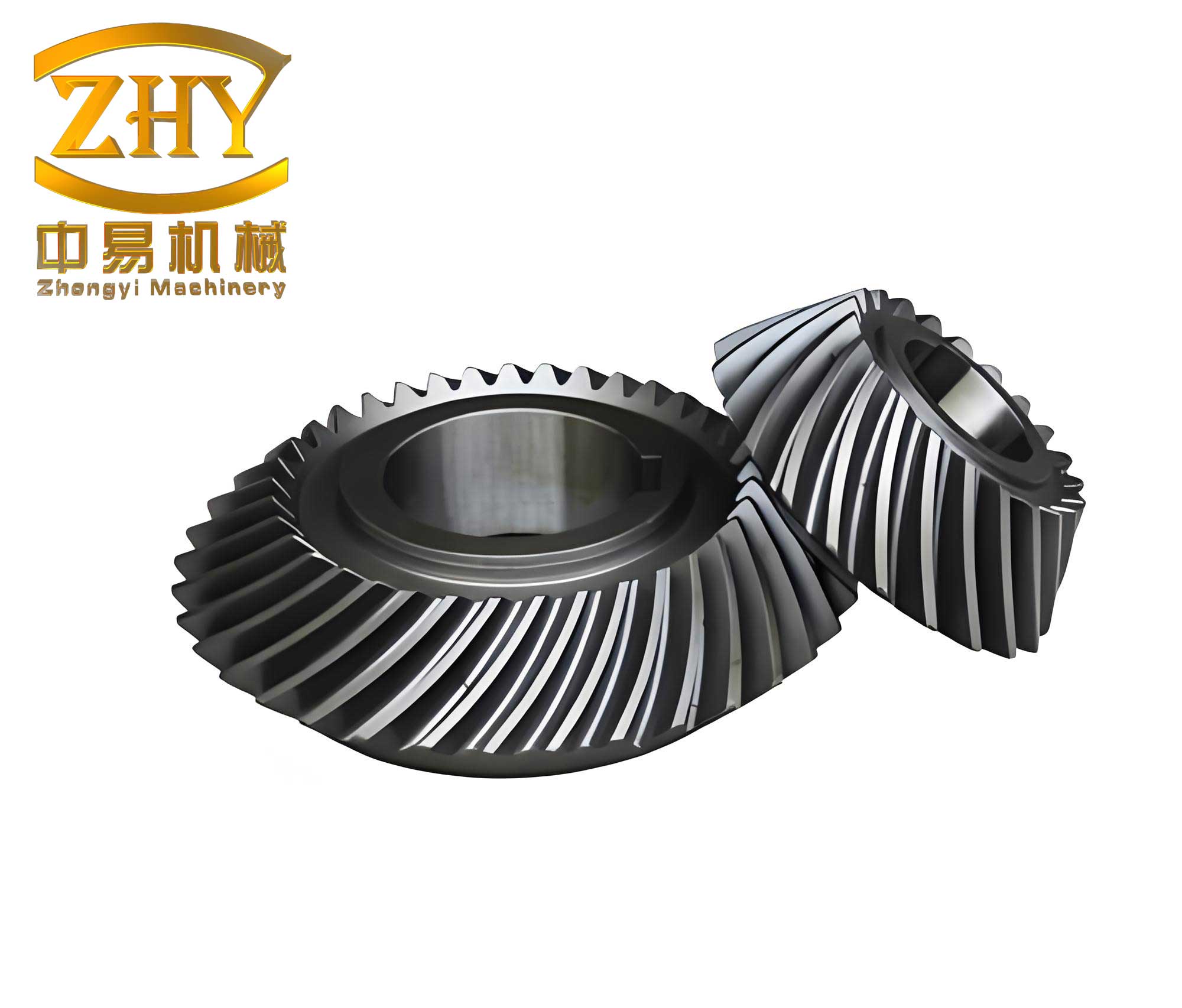
In the automotive and manufacturing industries, powder metallurgy has emerged as a proven technology for producing high-strength components, particularly gears. Spiral gears, with their helical tooth geometry, present unique challenges due to complex stress distributions and demanding performance requirements. Traditionally, these gears are machined from wrought steels like AISI 8620 or AISI 5120, but this approach is costly and material-intensive. Powder metallurgy offers a cost-effective alternative, yet achieving the high densities necessary for spiral gears has been difficult with conventional pressing and sintering methods. In this article, I will explore advanced powder metallurgy techniques that enable the production of high-density spiral gears, focusing on a novel binder-lubricant system, process optimizations, and surface densification methods. The goal is to demonstrate how powder metallurgy can meet the mechanical performance standards of wrought steel gears while reducing production costs.
The core challenge in powder metallurgy for spiral gears lies in achieving sintered densities above 7.4 g/cm³, which are essential for high fatigue strength, wear resistance, and load-bearing capacity. Conventional pre-mixed powders often result in densities around 7.1-7.3 g/cm³, limiting their use in high-stress applications. To address this, a new processing technology, referred to as the AncorMax DTM process, has been developed. This process involves optimizing the binder and lubricant system in pre-mixed powders, allowing for higher green and sintered densities without the need for extensive powder heating. Unlike earlier methods like warm compaction, which require模具 temperatures of 120-150°C, the AncorMax D process only necessitates die temperatures of 60-70°C, simplifying production and reducing energy consumption. The key advantage is an increase in density by 0.05-0.15 g/cm³ compared to standard powders, which translates to significant improvements in mechanical properties.
To understand the impact of this technology, let’s consider the compression behavior of powders. The green density ($\rho_g$) as a function of compaction pressure ($P$) can be modeled using empirical equations. For a typical ferrous powder, the relationship is often expressed as:
$$\rho_g = \rho_0 + k \cdot \ln(P/P_0)$$
where $\rho_0$ is the initial density, $k$ is a material constant, and $P_0$ is a reference pressure. For AncorMax D powders, the value of $k$ is higher, indicating better compressibility at pressures above 550 MPa. This allows for achieving densities closer to the pore-free limit. In practical terms, for a material like FLN2-4405 (a common powder metallurgy steel with nickel and graphite additions), the AncorMax D process enables sintered densities approaching 7.4 g/cm³ with single pressing and sintering, whereas standard powders plateau around 7.3 g/cm³. This density enhancement is critical for spiral gears, as it directly influences tensile strength, fatigue resistance, and elastic modulus.
The mechanical properties of high-density spiral gears are paramount. For instance, the ultimate tensile strength (UTS) and yield strength (YS) scale with density according to power-law relationships. Experimental data shows that for every 0.1 g/cm³ increase in density, UTS and YS improve by approximately 10%. This can be summarized in a formula:
$$\text{UTS} = A \cdot \rho^n$$
where $A$ is a material constant, $\rho$ is the sintered density, and $n$ is an exponent typically around 2-3 for ferrous powders. Similarly, fatigue performance, such as rotating bending fatigue (RBF) limits, benefits from higher densities. The fatigue limit ($\sigma_f$) often correlates with density as:
$$\sigma_f = B \cdot \rho^m$$
with $B$ and $m$ being constants. For spiral gears, which experience cyclic Hertzian contact stresses, even small porosity can drastically reduce rolling contact fatigue life. Therefore, achieving near-full density in critical stress zones is essential. The table below compares the properties of standard and AncorMax D processed FLN2-4405 at different compaction pressures and sintering temperatures.
| Powder Type | Compaction Pressure (MPa) | Sintering Temperature (°C) | Sintered Density (g/cm³) | UTS (MPa) | Fatigue Limit (MPa) |
|---|---|---|---|---|---|
| Standard | 550 | 1120 | 7.12 | 720 | 250 |
| Standard | 830 | 1120 | 7.28 | 760 | 285 |
| AncorMax D | 550 | 1120 | 7.26 | 780 | 270 |
| AncorMax D | 830 | 1120 | 7.45 | 840 | 300 |
| AncorMax D | 830 | 1230 | 7.44 | 850 | 275 |
Note that sintering at higher temperatures (e.g., 1230°C) can further enhance strength but may reduce fatigue limits due to microstructural changes, such as the dissolution of nickel-rich phases that inhibit crack propagation. This trade-off is important when designing spiral gears for specific applications.
In production, spiral gears pose additional challenges due to their helical geometry. The twisting teeth make uniform density distribution difficult during compaction, especially with double-press/double-sinter (DP/DS) processes that are effective for spur gears. The AncorMax D process overcomes this by enabling single pressing to high densities. In a prototype run, spiral gears with a helix angle of 22°, outer diameter of 42.5 mm, and height up to 25 mm were produced. The table below summarizes the green density results for different gear heights and compaction pressures, highlighting the consistency of the AncorMax D powders.
| Gear Height (mm) | Powder Type | Green Density at 550 MPa (g/cm³) | Green Density at 690 MPa (g/cm³) | Green Density at 830 MPa (g/cm³) |
|---|---|---|---|---|
| 12 | Standard | 7.12 | 7.26 | 7.26 |
| 12 | AncorMax D | 7.24 | 7.34 | 7.38 |
| 19 | Standard | 7.13 | 7.25 | 7.28 |
| 19 | AncorMax D | 7.25 | 7.32 | 7.34 |
| 25 | Standard | 7.03 | 7.25 | 7.28 |
| 22.5 | AncorMax D | 7.05 | 7.28 | 7.34 |
The data shows that AncorMax D powders achieve higher densities across all pressures, with less part-to-part variability. For spiral gears, this uniformity is crucial to minimize distortion during sintering and ensure dimensional accuracy. After sintering at 1120°C in a 75% H₂-25% N₂ atmosphere, the gears exhibited sintered densities close to 7.45 g/cm³, with minimal gradient from top to bottom (±0.02 g/cm³). This homogeneity reduces warping and improves gear quality, making spiral gears suitable for high-precision applications.
However, even with high core densities, spiral gears require surface enhancements to withstand Hertzian contact stresses. Surface densification via rolling is a post-sintering process that creates a pore-free layer on the gear teeth, while maintaining a porous core for toughness. The depth of densification ($d$) can be controlled from 0.35 mm to over 0.70 mm, depending on the rolling parameters. The density profile after rolling follows an exponential decay from the surface:
$$\rho(x) = \rho_{\text{core}} + (\rho_{\text{surface}} – \rho_{\text{core}}) \cdot e^{-\alpha x}$$
where $x$ is the depth from the surface, $\rho_{\text{core}}$ is the core density (e.g., 7.4 g/cm³), $\rho_{\text{surface}}$ is the near-full density (e.g., 7.8 g/cm³), and $\alpha$ is a decay constant related to the rolling force. This composite structure enhances rolling contact fatigue life by up to 50% compared to non-densified gears. Additionally, rolling improves gear geometry by reducing lead errors and involute profile deviations, achieving AGMA quality levels of 8-10. For spiral gears, this means better noise, vibration, and harshness (NVH) performance, which is critical in automotive transmissions.
The surface densification process also induces compressive residual stresses ($\sigma_r$) on the gear teeth, which further boost fatigue resistance. The stress distribution can be approximated by:
$$\sigma_r(x) = \sigma_0 \cdot \left(1 – \frac{x}{d}\right)^2$$
where $\sigma_0$ is the maximum compressive stress at the surface. When combined with carburizing heat treatment, which adds carbon to the surface for hardness, the fatigue limit of spiral gears can surpass that of conventional steel gears. Carburizing also forms a hard martensitic case, improving wear resistance. The synergistic effect of high core density, surface densification, and carburizing makes powder metallurgy spiral gears competitive with machined counterparts.
To quantify the benefits, let’s consider the production steps for high-performance spiral gears. The recommended route is: (1) compact using AncorMax D powders to a green density above 7.3 g/cm³, (2) sinter at 1120-1230°C, (3) machine the bore for concentricity if needed, (4) apply surface densification via rolling to a depth of 0.7 mm, (5) carburize and heat treat, and (6) perform finish machining as required. This sequence ensures optimal mechanical properties and geometry. The table below compares the key metrics of powder metallurgy spiral gears versus traditional steel gears.
| Parameter | Powder Metallurgy Spiral Gears (After Densification) | Machined Steel Spiral Gears (AISI 8620) |
|---|---|---|
| Core Density (g/cm³) | 7.4 | 7.85 (full density) |
| Surface Density (g/cm³) | 7.8-7.9 | 7.85 |
| Ultimate Tensile Strength (MPa) | 800-900 | 1000-1200 |
| Fatigue Limit (MPa) | 300-350 | 350-400 |
| Cost Reduction | 40-50% | Baseline |
| AGMA Quality Level | 8-10 | 9-11 |
From my experience, the production of spiral gears using these advanced methods has shown great promise. In a case study, a set of spiral gears for a printer application was manufactured with surface densities of 7.8 g/cm³ and core densities of 7.3 g/cm³. The gears met AGMA Q10 standards, with fatigue strength comparable to carburized steel gears, and achieved over 40% cost savings by replacing two machined gears with a single pressed powder metallurgy component. This demonstrates the viability of powder metallurgy for high-volume spiral gear production.
Looking ahead, further research is needed to optimize the rolling parameters for spiral gears, especially to achieve consistent densification depths on helical teeth. Additionally, studying the effects of alloy composition, such as adding molybdenum or copper, could enhance hardenability and performance. The integration of simulation tools, like finite element analysis (FEA), can help predict stress distributions and gear life, reducing development time. As the demand for lightweight and cost-effective components grows, powder metallurgy spiral gears will play a pivotal role in industries ranging from automotive to aerospace.
In conclusion, the advancements in powder metallurgy, particularly through the AncorMax D process and surface densification, enable the production of high-density spiral gears that rival traditional steel gears in performance. By achieving sintered densities near 7.4 g/cm³ and creating pore-free surface layers, these gears offer excellent mechanical properties, dimensional accuracy, and cost savings. The key lies in the synergistic combination of material innovation, processing techniques, and post-treatments. As we continue to refine these methods, powder metallurgy spiral gears will become increasingly prevalent in high-stress applications, driving efficiency and innovation across manufacturing sectors.
To support ongoing development, I encourage collaboration between material suppliers, gear manufacturers, and end-users. By sharing data and best practices, we can further push the boundaries of what’s possible with powder metallurgy. The future of spiral gears is bright, and with continued investment in research, we can expect even greater achievements in density, strength, and reliability. Whether for electric vehicle transmissions or industrial machinery, high-density powder metallurgy spiral gears are set to redefine performance standards.