
In the development of military off-road vehicles, achieving superior traversability across complex terrains is paramount. Traditional open differentials, while allowing wheels to rotate at different speeds during turns, suffer from a critical flaw: they distribute torque equally regardless of traction conditions. This often leads to wheel spin on low-friction surfaces, severely hampering vehicle mobility. Limited-slip differentials (LSDs) mitigate this by biasing torque toward the wheel with higher traction, but in extreme off-road scenarios—such as when one wheel completely loses grip—even high bias-ratio LSDs may fail. To address this, I have designed a novel spiral gear limited-slip differential integrated with an automatic locking mechanism. This design leverages the inherent properties of spiral gears to provide seamless torque redistribution and, in极限 conditions, fully lock the differential to ensure maximum torque delivery to the grounded wheel. This article details the geometric foundations, parametric modeling, structural design, and functional analysis of this differential, utilizing mathematical formulations, tables, and computational tools to validate the approach.
The core of this design lies in the application of spiral gears, which offer superior load distribution and smooth operation compared to straight-cut gears. Spiral gears, characterized by their helical tooth profile, generate axial forces during meshing that contribute to internal friction, a key factor for torque biasing in limited-slip applications. To model these gears accurately, I begin with the derivation of the spiral surface equation. A spiral surface can be generated by performing a helical motion of a planar curve along the gear axis. Consider a fixed coordinate system \( S_1 \) and a moving coordinate system \( S_a \) that undergoes a helical motion relative to \( S_1 \). The helical motion is defined by a rotation angle \( \psi \) and an axial displacement \( p\psi \), where \( p \) is the helix parameter (pitch), given by:
$$ p = \frac{H}{2\pi} $$
Here, \( H \) is the axial displacement for one complete revolution. Assume a planar curve \( L \) defined in \( S_a \) by the parametric equation:
$$ \mathbf{r}_a(\theta) = \begin{bmatrix} x_a(\theta) \\ y_a(\theta) \\ 0 \end{bmatrix} $$
where \( \theta \) is an independent parameter. The resulting spiral surface in \( S_1 \) is obtained via coordinate transformation:
$$ \mathbf{r}_1(\theta, \psi) = \mathbf{M}_{1a} \cdot \mathbf{r}_a(\theta) $$
The transformation matrix \( \mathbf{M}_{1a} \) represents the helical motion:
$$ \mathbf{M}_{1a} = \begin{bmatrix} \cos\psi & -\sin\psi & 0 & 0 \\ \sin\psi & \cos\psi & 0 & 0 \\ 0 & 0 & 1 & p\psi \\ 0 & 0 & 0 & 1 \end{bmatrix} $$
From this, the explicit equations for the spiral surface coordinates are:
$$ x_1 = x_a(\theta) \cos\psi – y_a(\theta) \sin\psi $$
$$ y_1 = x_a(\theta) \sin\psi + y_a(\theta) \cos\psi $$
$$ z_1 = p\psi $$
For involute spiral gears, the planar curve is an involute of a circle. In \( S_a \), the involute curve is expressed as:
$$ x_a(\theta) = r_b (\cos\theta + \theta \sin\theta) $$
$$ y_a(\theta) = r_b (\sin\theta – \theta \cos\theta) $$
where \( r_b \) is the base circle radius. Substituting into the spiral surface equations yields the parametric form for an involute spiral gear tooth surface:
$$ x_1 = r_b [(\cos\theta + \theta \sin\theta) \cos\psi – (\sin\theta – \theta \cos\theta) \sin\psi] $$
$$ y_1 = r_b [(\cos\theta + \theta \sin\theta) \sin\psi + (\sin\theta – \theta \cos\theta) \cos\psi] $$
$$ z_1 = p\psi $$
This mathematical model is essential for accurate digital modeling and analysis of spiral gears. The geometric parameters of spiral gears include not only standard gear parameters but also the helix angle. Unwrapping the pitch cylinder, the relationship between the helix angle \( \beta \) at the pitch cylinder and the helix angle \( \beta_b \) at the base cylinder is derived from gear geometry. Let \( d \) be the pitch diameter, \( d_b \) the base diameter, and \( \alpha_t \) the transverse pressure angle. Then:
$$ \tan\beta = \frac{\pi d}{P_z} $$
where \( P_z \) is the lead of the helix. Since \( d_b = d \cos\alpha_t \), we have:
$$ \tan\beta_b = \tan\beta \cos\alpha_t $$
These equations govern the fundamental geometry of spiral gears and are critical for designing the gearset in the differential. For the differential application, I selected specific parameters to optimize torque transfer and durability. The spiral gears in this design have a relatively large helix angle to maximize axial forces and internal friction. The key parameters are summarized in Table 1.
| Parameter | Symbol | Value |
|---|---|---|
| Helix Angle | \(\beta\) | 45° |
| Lead | \(P_z\) | 70.6858 mm |
| Transverse Pressure Angle | \(\alpha_t\) | 20° |
| Transverse Module | \(m_t\) | 3.75 mm |
| Number of Teeth | \(Z_t\) | 6 |
| Pitch Diameter | \(d\) | 22.5 mm |
| Base Radius | \(r_b\) | 10.57155 mm |
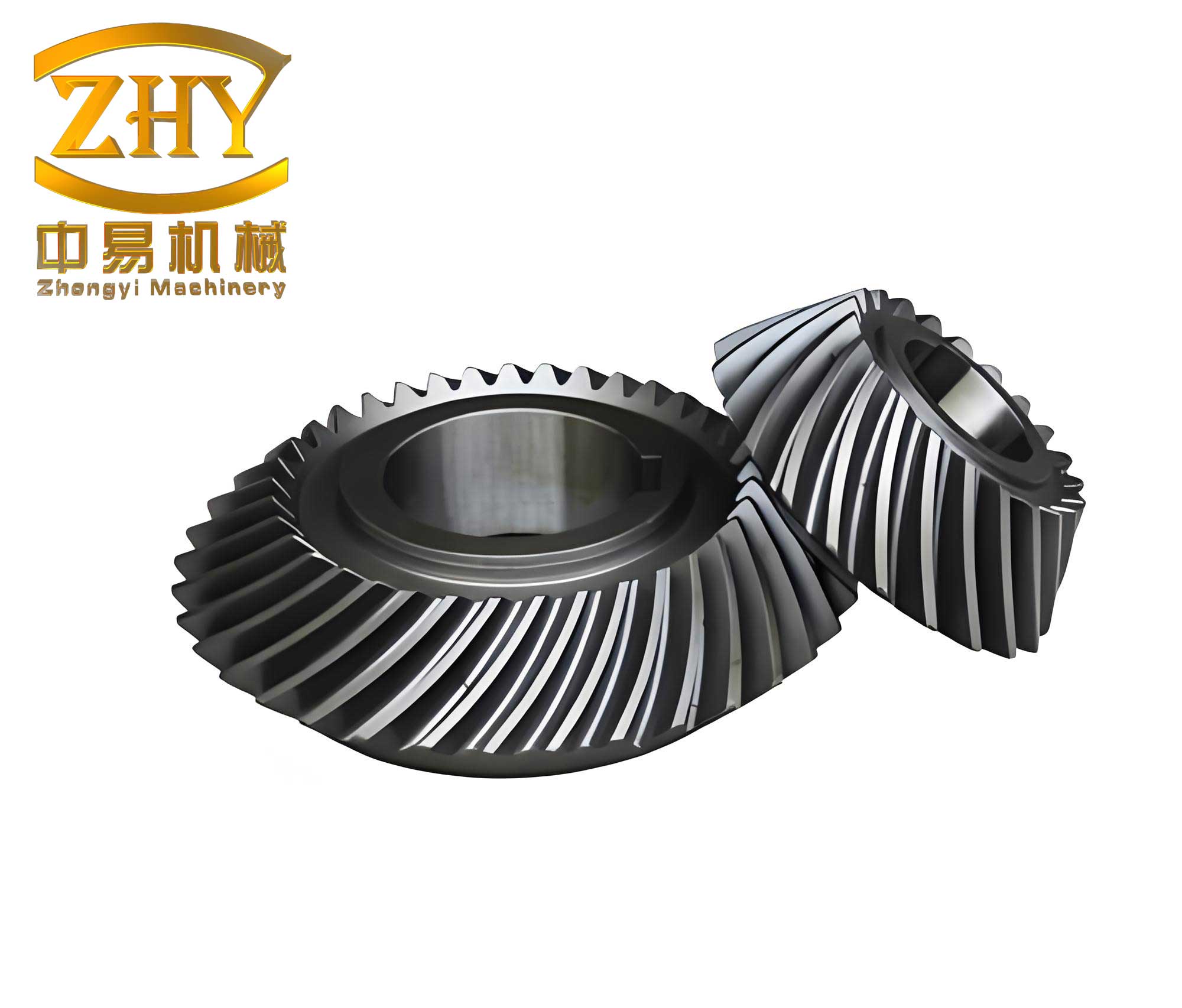
Using these parameters, I performed parametric modeling in SolidWorks. The process involved defining the involute curve in a sketch using equation-driven splines, creating a helix based on the lead, and sweeping the profile along the helix to form a single spiral gear tooth. The complete gear was then generated via circular pattern. This approach ensures precision and facilitates modifications for optimization. The spiral gear set consists of left-hand and right-hand spiral planetary gears meshing with side gears, all designed with the same basic parameters to ensure proper engagement and force distribution. The meshing of spiral gears generates significant axial thrust, which is harnessed in the differential to create frictional resistance for torque biasing.
The locking mechanism is an innovative addition that activates automatically in extreme scenarios. It comprises a cam disk gear, flywheel gears, friction plates, and a centrifugal disengagement system. The cam disk gear engages with a flywheel gear, and both are designed based on gear geometry constraints imposed by the differential housing. The center distance between the cam disk gear and flywheel gear is critical and must fit within approximately 50 mm. Let \( d_1 \) and \( d_2 \) be the pitch diameters, \( z_1 \) and \( z_2 \) the tooth counts, \( m \) the module, and \( a \) the center distance. The design satisfies:
$$ a = \frac{d_1 + d_2}{2} = \frac{m(z_1 + z_2)}{2} $$
To achieve a compact design, I selected fine-module gears. The parameters are detailed in Table 2.
| Component | Pitch Diameter (mm) | Number of Teeth | Module (mm) | Center Distance (mm) |
|---|---|---|---|---|
| Cam Disk Gear | 93.6 | 117 | 0.8 | 50.4 |
| Flywheel Gear | 7.2 | 9 | 0.8 |
The cam disk interfaces with a shaft cam via a helical cam surface, ensuring that relative rotation induces axial displacement. This cam profile is also a spiral surface, with parameters matched to generate the required lift for locking. The locking sequence begins when one wheel loses traction entirely. The differential action causes high-speed rotation of the side gear connected to the spinning wheel, which drives the cam disk gear via the shaft cam. The flywheel gear, meshing with the cam disk gear, accelerates, causing centrifugal weights to extend and engage with a fixed disengagement block. This halts the flywheel, forcing the cam disk to stop. Continued rotation of the shaft cam then pushes the cam disk axially, compressing a friction pack against the differential housing. This effectively locks the side gear to the housing, eliminating speed difference between the wheels and redirecting all available torque to the grounded wheel. Once vehicle speed exceeds a threshold, centrifugal force on the disengagement block releases the flywheel, allowing the cam disk to retract and unlock the differential automatically.
The complete assembly of the spiral gear limited-slip differential with locking function integrates multiple components: the differential case, left and right side gears, planetary gear sets (each comprising three left-hand and three right-hand spiral gears), an isolation ring, shaft cam, cam disk gear, friction pack, upper and lower covers, flywheel mechanism, and disengagement block. The spiral gears are arranged symmetrically to balance axial forces. The differential operates in several modes: during straight-line driving, the case and side gears rotate together; during cornering, the planetary spiral gears facilitate speed differentiation while generating internal friction due to their helix angle; in limited-slip mode, the axial forces from the spiral gears increase friction, biasing torque to the higher-traction wheel; and in locking mode, the mechanism fully engages as described. The transition between these modes is seamless and entirely mechanical, requiring no electronic control.
To validate the design’s practicality, I modeled the differential within the rear axle assembly of a military off-road vehicle. Interference checks confirmed that the design integrates smoothly with existing housing geometries, minimizing modifications. The use of spiral gears not only enhances torque biasing but also improves durability and noise reduction compared to conventional straight-cut gears. The large helix angle of 45° is particularly effective in generating the axial forces necessary for both limited-slip and locking functions. The mathematical models for the spiral gear surfaces ensure that the gears mesh correctly under load, distributing stresses evenly across the tooth faces.
Further analysis involves evaluating the performance metrics of the differential. The torque bias ratio (TBR) is a key indicator of limited-slip effectiveness. For spiral gear differentials, the TBR is influenced by the helix angle, pressure angle, and friction coefficients. An approximate formula for the torque bias ratio in a spiral gear differential can be expressed as:
$$ \text{TBR} \approx \frac{1 + \mu \tan\beta \sec\alpha_t}{1 – \mu \tan\beta \sec\alpha_t} $$
where \( \mu \) is the coefficient of friction between gear teeth and thrust surfaces. For the designed parameters (\( \beta = 45° \), \( \alpha_t = 20° \), and assuming \( \mu = 0.1 \)), the TBR calculates to approximately 2.5, indicating a substantial torque transfer capability. The locking mechanism adds to this by providing a theoretical lock of 100% when engaged. The automatic engagement speed of the lock can be tuned by adjusting the mass and spring constants in the centrifugal system. The disengagement speed is similarly adjustable via the disengagement block design.
In conclusion, the integration of spiral gears with an automatic locking mechanism presents a robust solution for enhancing the off-road performance of military vehicles. The design leverages advanced gear geometry to achieve both limited-slip and locking functions without external controls. The parametric modeling approach allows for easy optimization of gear parameters for specific applications. Future work will involve detailed finite element analysis to validate stress distributions and durability, as well as dynamometer testing to measure actual torque bias ratios and locking thresholds. This spiral gear differential design not only addresses the limitations of conventional differentials but also offers a reliable, mechanical means of ensuring mobility in the most challenging terrains. The repeated focus on spiral gears throughout this design underscores their critical role in achieving the desired performance characteristics, making them a cornerstone of advanced differential technology for off-road vehicles.