
As a leading player in the industrial sector, we have witnessed a transformative era marked by global market integration and technological advancements. Our journey has been driven by a commitment to innovation, quality, and sustainability, allowing us to expand our footprint across domestic and international landscapes. In this article, I will delve into our core initiatives, focusing on key products that exemplify our engineering prowess: oil well pumps, spiral gears-based systems, and nickel-metal hydride batteries. Through detailed analyses, tables, and formulas, I aim to provide a comprehensive overview of how we leverage cutting-edge technology to meet evolving market demands.
Our foray into the oil and gas industry began with the development of high-performance pumping equipment. By capitalizing on our heritage in precision manufacturing, we established a robust product line that has gained recognition in competitive markets, including exports to regions like North America. The success of these products hinges on a meticulous quality assurance framework, which encompasses every stage from material selection to final inspection. For instance, our pumping rods are categorized into multiple grades, each designed for specific operational conditions. The table below summarizes the key characteristics of these grades, highlighting their applications and performance metrics.
| Grade | Material Composition | Tensile Strength (MPa) | Primary Applications | Export Market Penetration |
|---|---|---|---|---|
| Standard Grade | Carbon Steel | 620-750 | Conventional Oil Wells | High in Domestic Regions |
| Enhanced Grade | Alloy Steel | 800-950 | Deep-Well Operations | Growing in North America |
| Premium Grade | High-Strength Composite | 1000-1200 | High-Pressure Environments | Expanding Globally |
| Specialized Grade (e.g., Hollow Rods) | Advanced Alloys | 1100-1300 | Innovative Pumping Systems | Emerging in International Markets |
The mechanical properties of these rods can be modeled using stress-strain relationships, such as the equation for tensile stress: $$\sigma = \frac{F}{A}$$ where \(\sigma\) is the stress, \(F\) is the applied force, and \(A\) is the cross-sectional area. By optimizing these parameters, we ensure durability and efficiency in harsh environments. Our quality system is further reinforced through employee accountability measures and standardized processes, which have enabled us to obtain international certifications, paving the way for exports. The feedback loop from customers is integral to our continuous improvement, as we adapt products like hollow rods to replace imports and fill domestic gaps.
Transitioning to mechanical transmission systems, our focus has shifted to the adoption of hollow shaft spiral gear reducers. These systems are pivotal in achieving compact and lightweight machinery, reducing overall costs, and enhancing safety. The spiral gears, with their unique helical design, offer superior load distribution and smoother operation compared to conventional gears. In Europe, spiral gears have been widely integrated into various industries, and now, their adoption is accelerating across Asia. The advantages of spiral gears are multifaceted, including reduced noise, increased torque capacity, and improved efficiency. To illustrate, the gear ratio for a spiral gear system can be expressed as: $$i = \frac{N_2}{N_1} = \frac{\omega_1}{\omega_2}$$ where \(i\) is the gear ratio, \(N_1\) and \(N_2\) are the numbers of teeth on the driving and driven spiral gears, respectively, and \(\omega_1\) and \(\omega_2\) are their angular velocities. This relationship underscores how spiral gears facilitate precise speed control in compact setups.
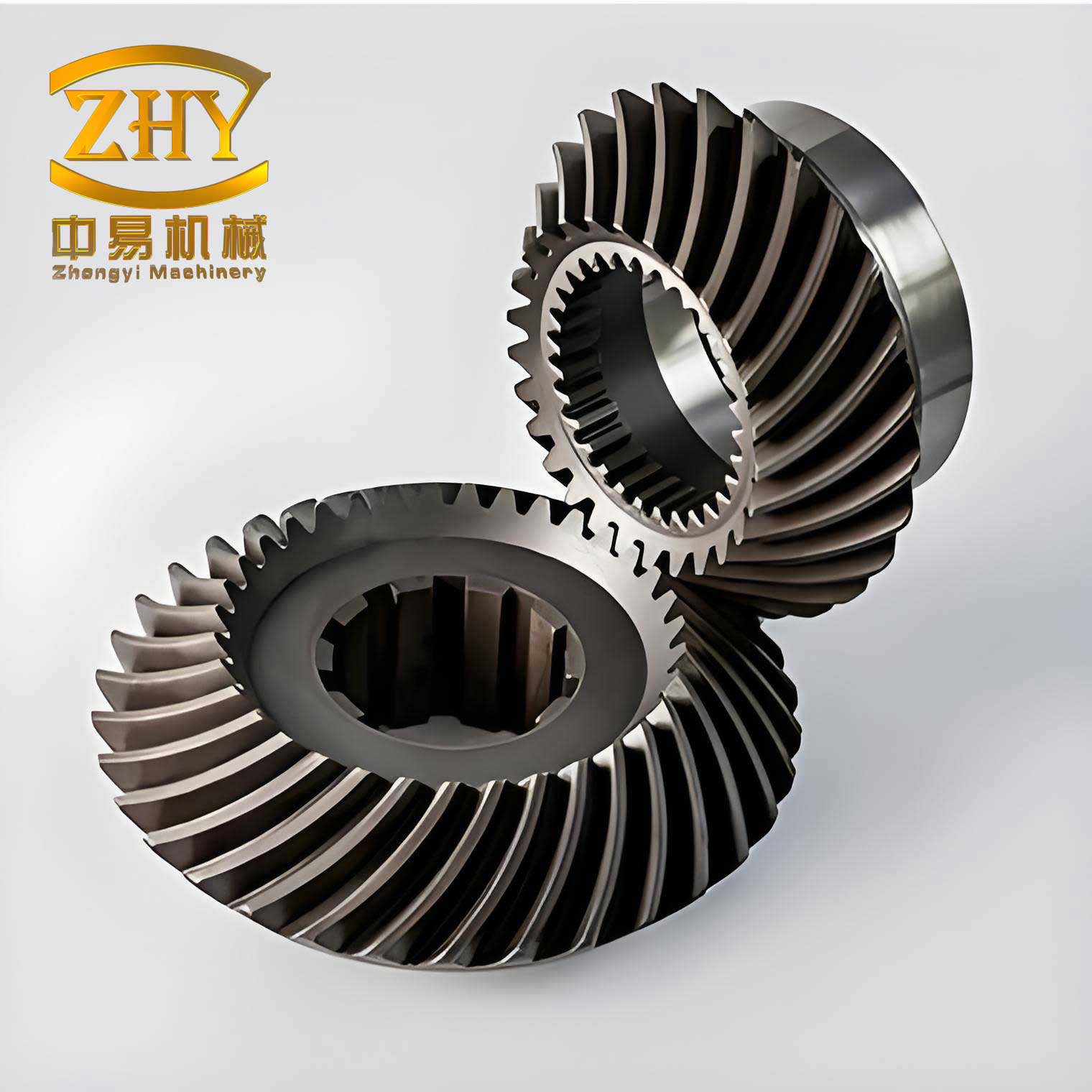
The integration of hollow shaft spiral gear reducers minimizes external protrusions, thereby enhancing operator safety and simplifying maintenance. From a design perspective, the use of spiral gears allows for significant weight reduction, which can be quantified using the formula for mass savings: $$\Delta m = \rho \cdot V \cdot (1 – \frac{d_h}{d_s})$$ where \(\Delta m\) is the mass reduction, \(\rho\) is the material density, \(V\) is the volume, \(d_h\) is the hollow shaft diameter, and \(d_s\) is the solid shaft diameter. This aligns with industry trends toward miniaturization, as evidenced by the growing demand for spiral gears in sectors like robotics, automotive, and renewable energy. The table below compares traditional gear systems with those incorporating spiral gears, highlighting key performance indicators.
| Parameter | Traditional Spur Gears | Spiral Gears Systems | Improvement with Spiral Gears |
|---|---|---|---|
| Noise Level (dB) | 70-85 | 55-70 | ~20% Reduction |
| Torque Capacity (Nm) | Moderate | High | Up to 30% Increase |
| Efficiency (%) | 90-92 | 94-97 | Enhanced by 3-5% |
| Weight per Unit (kg) | Heavier | Lighter | 15-25% Reduction |
| Application in Asia | Declining | Rapidly Growing | Market Expansion |
Our engineering teams are actively researching next-generation spiral gears to further optimize these metrics. For example, the contact stress on spiral gears can be analyzed using the Hertzian contact theory: $$\sigma_c = \sqrt{\frac{F}{\pi \cdot b} \cdot \frac{1}{\frac{1-\nu_1^2}{E_1} + \frac{1-\nu_2^2}{E_2}}}$$ where \(\sigma_c\) is the contact stress, \(F\) is the load, \(b\) is the face width, \(\nu\) is Poisson’s ratio, and \(E\) is the modulus of elasticity. This allows us to design spiral gears that withstand higher loads while maintaining compact dimensions. The proliferation of spiral gears in Asia is driven by their cost-effectiveness and safety benefits, making them a cornerstone of modern mechanical transmissions.
In parallel, we have ventured into the energy storage domain with nickel-metal hydride (NiMH) power batteries. These batteries represent a leap forward in portable power solutions, characterized by small size, high capacity, and environmental friendliness. Our production facility, established through a collaborative effort, features three dedicated lines: one for hydrogen storage alloy powder, another for electrode plates, and a final assembly line. The hydrogen storage alloy, a critical component, is produced by blending rare earth elements with metals like nickel and chromium, followed by vacuum melting and annealing. The capacity of NiMH batteries can be described by the formula: $$C = I \cdot t$$ where \(C\) is the capacity in ampere-hours, \(I\) is the discharge current, and \(t\) is the time. This underscores their ability to deliver sustained power for applications such as electric motorcycles, bicycles, and generators.
The production process involves multiple steps, from slurry coating to welding, ensuring high quality and consistency. Once fully operational, our plant is expected to capture a significant share of the domestic market, contributing to cleaner energy sources. The table below outlines the key specifications of our NiMH batteries, comparing them with traditional alternatives.
| Feature | NiMH Battery (Our Product) | Lead-Acid Battery | Lithium-ion Battery |
|---|---|---|---|
| Energy Density (Wh/kg) | 60-80 | 30-50 | 100-265 |
| Cycle Life (Cycles) | 500-1000 | 200-300 | 500-2000 |
| Charge Time (Hours) | 1-3 | 8-12 | 1-4 |
| Environmental Impact | Low (Recyclable) | High (Toxic) | Moderate |
| Cost per Unit ($) | Moderate | Low | High |
The electrochemical reactions in NiMH batteries can be modeled using equations such as the discharge reaction: $$\text{MH} + \text{NiOOH} \rightarrow \text{M} + \text{Ni(OH)}_2$$ where MH represents the metal hydride. This reaction highlights the reversible energy storage mechanism, enabling quick charging and long lifespan. By investing in this technology, we aim to reduce pollution from机动设备, improve air quality, and support sustainable development. Our innovation pipeline includes enhancements to battery materials, potentially integrating insights from spiral gears research to optimize thermal management systems.
Looking ahead, our strategy revolves around continuous innovation and market adaptation. In the realm of mechanical systems, spiral gears will remain a focal point, as we develop advanced reducers with higher efficiency and broader applications. The mathematical modeling of spiral gears dynamics, such as using the equation for gear meshing frequency: $$f_m = \frac{N \cdot \omega}{60}$$ where \(f_m\) is the meshing frequency in Hz, \(N\) is the number of teeth, and \(\omega\) is the rotational speed in RPM, guides our design iterations. Similarly, for oil well pumps, we are exploring smart monitoring systems that leverage data analytics to predict maintenance needs, thereby reducing downtime.
Our commitment to quality is unwavering, as evidenced by our adherence to international standards and customer-centric approaches. The synergy between our product lines—from pumping equipment to spiral gears and energy storage—creates a holistic ecosystem that addresses global challenges. For instance, the lightweight nature of spiral gears aligns with the portability of NiMH batteries, enabling integrated solutions for mobile machinery. As we scale production, we anticipate further cost reductions and performance gains, solidifying our position in both domestic and international markets.
In conclusion, our journey reflects a dedication to engineering excellence and sustainable growth. Through the strategic application of spiral gears in transmission systems, we have unlocked new possibilities for machinery design, while our advancements in oil well pumps and batteries demonstrate versatility across industries. The future holds promise for expanded adoption of spiral gears in Asia and beyond, driven by their inherent benefits. We invite stakeholders to collaborate in shaping the next wave of industrial innovation, where spiral gears will play a pivotal role in creating efficient, safe, and environmentally responsible technologies.