
In this article, I will delve into the intricate world of spiral gears as applied in disk centrifuge drives. As a critical component in separation machinery, spiral gears offer unique advantages and challenges that I aim to explore in detail. The focus will be on their performance characteristics, design methodologies, and the persistent issue of scoring, all from a first-person perspective based on extensive engineering experience. I will emphasize the term ‘spiral gears’ throughout to maintain thematic consistency, and I will employ numerous tables and formulas to encapsulate key concepts, ensuring a comprehensive resource for designers and engineers. The discussion will be purely in English, adhering to the specified format requirements.
Disk centrifuges are pivotal in industrial separation processes, and their drive systems predominantly utilize spiral gears or belt drives. From my observations, belt drives are less common due to limitations in linear speed and other operational factors. Thus, spiral gear drives, as illustrated in the typical configuration, remain the preferred choice. These systems involve a pair of spiral gears with a shaft angle of 90°, facilitating speed increase to rotate the centrifuge bowl. Transmission ratios generally range from 3 to 5, with start-up times between 3 to 15 minutes. The reliability and efficiency of these spiral gears are paramount, and I will dissect their design and failure modes systematically.
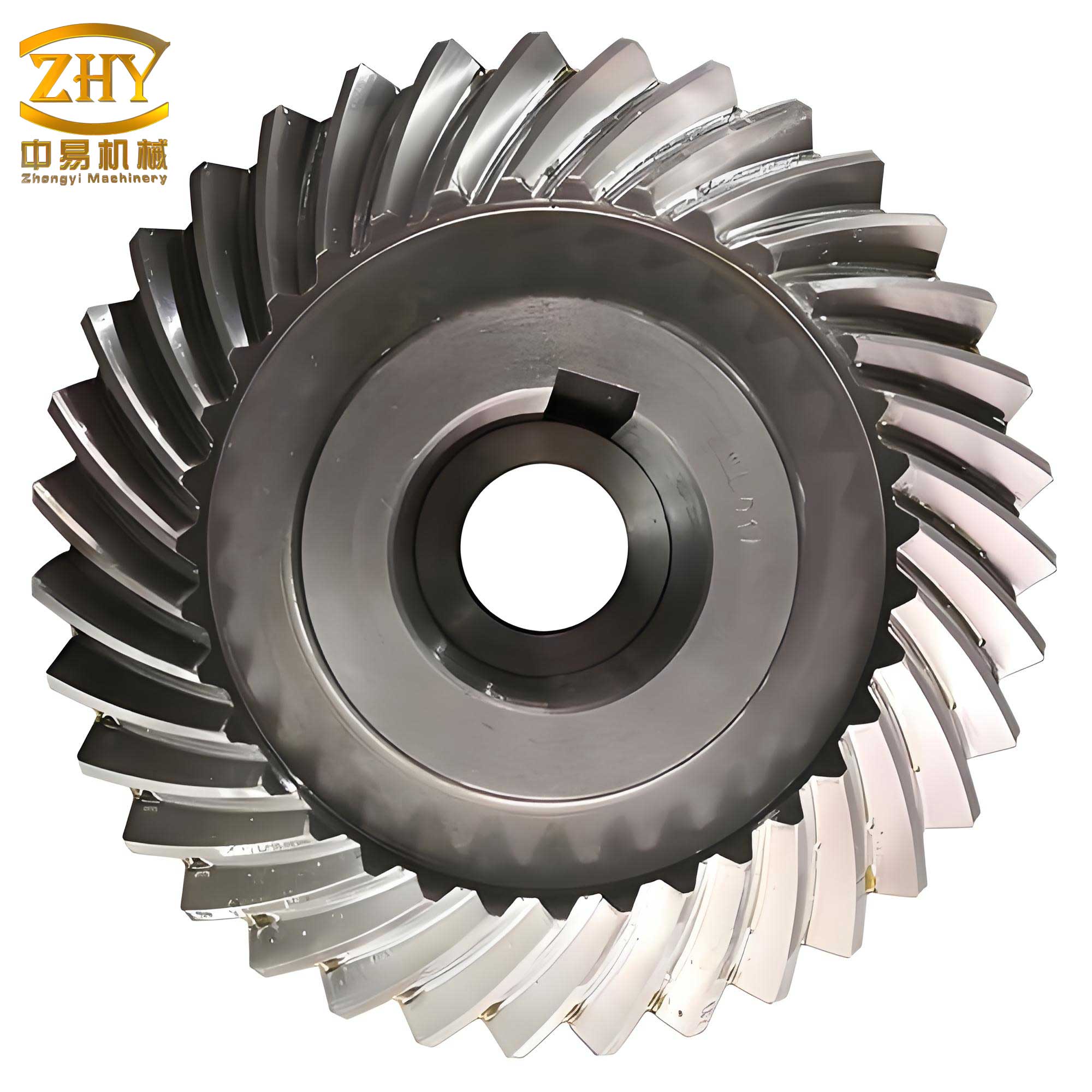
The use of spiral gears in such applications is not arbitrary; their geometry and kinematics offer distinct benefits. However, I must stress that spiral gears are typically suited for lower power transmissions, often not exceeding 45 kW in disk centrifuges, due to inherent contact stresses. In the following sections, I will break down the characteristics, calculations, and scoring analysis of spiral gears, providing a thorough exploration that I hope will serve as a valuable reference.
Characteristics of Cylindrical Spiral Gears
From my engineering standpoint, spiral gears exhibit several defining features that influence their application in disk centrifuges. I will outline these characteristics to set the foundation for deeper analysis.
Point Contact of Meshing Tooth Surfaces: Spiral gears operate with non-parallel, non-intersecting shafts, leading to theoretical point contact between tooth surfaces. In practice, under load, this contact deforms into a small area, but the resulting high contact stress limits spiral gears to moderate power applications. I have often noted that this makes spiral gears ideal for disk centrifuges where compact design is crucial, but it necessitates careful material selection and lubrication.
High Relative Sliding Velocity: A significant aspect of spiral gears is the substantial sliding velocity between tooth profiles. This occurs not only in the height direction but also along the common tangent, exacerbating wear and reducing efficiency. For shaft angles of 90°, the tangential sliding velocity \(V_g\) can be expressed as:
$$V_g = \frac{V_{u1}}{\cos\beta_1} = \frac{V_{u2}}{\cos\beta_2}$$
where \(V_{u1}\) and \(V_{u2}\) are the pitch circle circumferential velocities in m/s, and \(\beta_1\) and \(\beta_2\) are the helix angles. This sliding action is a primary contributor to scoring, a topic I will revisit later.
Effect of Center Distance Variation: Unlike spur or helical gears, spiral gears lack center distance independence. Altering the center distance changes the pitch circle helix angles (\(\beta_{1j}\), \(\beta_{2j}\)) relative to the standard pitch circle angles (\(\beta_1\), \(\beta_2\)). Consequently, the shaft angle \(\delta\) may no longer equal \(\beta_1 + \beta_2\), degrading meshing quality and increasing vibration and noise. In my design practice, I always emphasize precise manufacturing and assembly to mitigate this.
Transmission Ratio: The transmission ratio \(i\) for spiral gears depends solely on the tooth count ratio:
$$i = \frac{Z_1}{Z_2}$$
where \(Z_1\) and \(Z_2\) are the numbers of teeth on the driving and driven gears, respectively. Spiral gears are best for smaller ratios, typically less than 5, which aligns well with disk centrifuge requirements.
Axial Mobility: An advantageous feature is the ability of spiral gears to accommodate slight axial movements without disrupting meshing. This provides buffering during start-up and shutdown, a benefit I have leveraged in many centrifuge designs to enhance durability.
To summarize these characteristics, I present Table 1, which encapsulates key points for quick reference.
| Characteristic | Description | Implication for Design |
|---|---|---|
| Contact Type | Theoretical point contact, deforming to small area under load | Limits power transmission to ≤45 kW; requires high-strength materials |
| Sliding Velocity | High tangential sliding velocity along tooth profiles | Increases wear and scoring risk; necessitates effective lubrication |
| Center Distance Sensitivity | No independence; changes affect meshing geometry | Demands precise manufacturing and assembly tolerances |
| Transmission Ratio | Determined by tooth count ratio; typically i < 5 | Offers flexibility in parameter selection via helix angle adjustments |
| Axial Mobility | Allows slight axial movement without meshing loss | Provides operational buffering; enhances system resilience |
Geometric Dimension Calculations for Spiral Gears
In designing spiral gears, accurate geometric calculations are paramount. I will detail the formulas and considerations I use, emphasizing the interplay between parameters. All dimensions are in millimeters unless specified.
Normal Circular Pitch: The normal circular pitch \(t_n\) must be equal for both gears in mesh:
$$t_n = t_{n1} = t_{n2} = \pi m_n$$
where \(m_n\) is the normal module. Relating to the transverse pitches \(t_{s1}\) and \(t_{s2}\):
$$t_{n1} = t_{s1} \cos\beta_1, \quad t_{n2} = t_{s2} \cos\beta_2$$
For shaft angle \(\delta = 90^\circ\), \(\beta_1 + \beta_2 = 90^\circ\), so \(t_{s1} \neq t_{s2}\) generally.
Module: The normal module is common:
$$m_n = m_{n1} = m_{n2}$$
with transverse modules given by:
$$m_{s1} = \frac{m_n}{\cos\beta_1}, \quad m_{s2} = \frac{m_n}{\cos\beta_2}$$
Thus, \(m_{s1} \neq m_{s2}\) when \(\beta_1 \neq \beta_2\).
Pitch Diameter: For any spiral gear, the pitch diameter \(d\) is:
$$d = m_s Z = \frac{m_n Z}{\cos\beta}$$
where \(Z\) is the number of teeth.
Addendum and Dedendum Diameters: For standard full-depth teeth, the addendum diameter \(D\) and dedendum diameter \(D’\) are:
$$D = \frac{m_n Z}{\cos\beta} + 2m_n, \quad D’ = \frac{m_n Z}{\cos\beta} – 2.5m_n$$
Helix Angle Determination: For a 90° shaft angle, helix angles are interrelated. I often choose \(\beta_2\) to be larger but not exceeding 55° for manufacturability. Alternatively, equal angles (\(\beta_1 = \beta_2 = 45^\circ\)) simplify design. The relationship is:
$$\tan\beta_1 = i \frac{d_1}{d_2}, \quad \beta_2 = 90^\circ – \beta_1$$
This flexibility allows optimizing center distance and ratio.
Center Distance: The center distance \(A\) is simply:
$$A = \frac{d_1 + d_2}{2}$$
Transmission Ratio Revisited: The ratio can also be expressed as:
$$i = \frac{d_1 \cos\beta_1}{d_2 \cos\beta_2}$$
This shows that for spiral gears, the ratio depends on both diameters and helix angles, offering design versatility.
Gear Width: Due to point contact, increasing width has limited benefit. The minimum allowable width \(b\) ensures axial engagement. For \(\delta = 90^\circ\):
- If \(\beta_1 = \beta_2\), \(b = (5 \text{ to } 10) m_n\).
- If \(\beta_1 \neq \beta_2\), the minimum widths are \(B_{\min1} = t_{s2}\) and \(B_{\min2} = t_{s1}\).
To consolidate these formulas, I provide Table 2, which serves as a quick design reference for spiral gears.
| Parameter | Formula | Notes |
|---|---|---|
| Normal Circular Pitch, \(t_n\) | \(t_n = \pi m_n\) | Must be equal for both gears |
| Transverse Circular Pitch, \(t_s\) | \(t_s = \frac{t_n}{\cos\beta}\) | Different for each gear if \(\beta_1 \neq \beta_2\) |
| Normal Module, \(m_n\) | \(m_n = m_s \cos\beta\) | Common value for mating pair |
| Transverse Module, \(m_s\) | \(m_s = \frac{m_n}{\cos\beta}\) | Gear-specific |
| Pitch Diameter, \(d\) | \(d = \frac{m_n Z}{\cos\beta}\) | Function of \(Z\) and \(\beta\) |
| Addendum Diameter, \(D\) | \(D = d + 2m_n\) | For standard full-depth teeth |
| Dedendum Diameter, \(D’\) | \(D’ = d – 2.5m_n\) | For standard full-depth teeth |
| Helix Angles, \(\beta_1, \beta_2\) | \(\tan\beta_1 = i \frac{d_1}{d_2}, \beta_2 = 90^\circ – \beta_1\) | Typically \(\beta_2 > \beta_1\), but ≤55° |
| Center Distance, \(A\) | \(A = \frac{d_1 + d_2}{2}\) | Critical for assembly precision |
| Transmission Ratio, \(i\) | \(i = \frac{Z_1}{Z_2} = \frac{d_1 \cos\beta_1}{d_2 \cos\beta_2}\) | Range usually 3 to 5 |
| Minimum Width, \(b\) | \(b \geq t_s\) of mating gear or (5-10)\(m_n\) | Ensures axial engagement |
Scoring in Spiral Gears: Phenomenology and Analysis
Scoring, or adhesive wear, is a critical failure mode in spiral gears that I have frequently encountered. It occurs when localized overheating disrupts the lubricant film, causing metal-to-metal contact, melting, and tearing of tooth surfaces. In mild cases, scoring manifests as scratches along the profile; in severe cases, it leads to welding, increased vibration, noise, and power loss. Understanding this phenomenon is essential for reliable spiral gear operation.
The high sliding velocities in spiral gears exacerbate scoring risk. Factors include load intensity, lubrication quality, material properties, and surface finish. From my analysis, scoring often initiates at the pitch line where sliding direction changes, but in spiral gears, due to complex kinematics, it can occur across broader areas. I will now explore various methods to calculate scoring resistance.
Scoring Strength Calculations for Spiral Gears
Several approaches exist to assess scoring risk. I will present three methods I utilize, each with its merits and limitations.
Method 1: Wear Condition-Based Allowable Normal Force
This method computes the allowable normal force \(P_N\) based on empirical constants:
$$P_N = k \theta \frac{d_1}{2} \phi$$
where:
– \(k\) is the allowable stress in N/mm², dependent on running-in conditions.
– \(\theta\) is the spiral gear ratio coefficient: \(\theta = \left( \frac{2d_2}{d_1 + d_2} \right)^2\).
– \(\phi\) is the velocity coefficient: \(\phi = \frac{1 + 0.5V_g}{1 + V_g}\).
The actual normal force \(P\) must satisfy \(P \leq P_N\). However, I find this method often yields conservative results, potentially leading to oversized spiral gears.
Method 2: AGMA Scoring Index (SI)
The American Gear Manufacturers Association recommends a scoring index for gear contact. For spiral gears, I adapt it as follows:
$$SI = 9.1 \left( \frac{W_{te}}{b} \right)^{0.75} \frac{n_p^{0.5}}{m_s^{0.25}}$$
where:
– \(W_{te}\) is the effective tangential force in kg (converted to consistent units).
– \(b\) is the face width in mm.
– \(n_p\) is the pinion speed in rpm.
– \(m_s\) is the transverse module in mm.
Scoring is likely if SI exceeds allowable values dependent on lubricant and temperature. Table 3 lists typical allowable SI values based on AGMA and other standards, which I refer to in design checks.
| Lubricant Type | Gear Temperature (°F) and Allowable SI | 100°F | 150°F | 200°F | 250°F | 300°F |
|---|---|---|---|---|---|---|
| AGMA 1 | 9000 | 6000 | 3000 | — | — | |
| AGMA 3 | 11000 | 8000 | 5000 | 2000 | — | |
| AGMA 5 | 13000 | 10000 | 7000 | 4000 | — | |
| AGMA 7 | 15000 | 12000 | 9000 | 6000 | — | |
| AGMA 8A | 17000 | 14000 | 11000 | 8000 | — | |
| MIL-L-6082B, Grade 1065 | 15000 | 12000 | 9000 | 6000 | — | |
| MIL-L-6082B, Grade 1010 | 12000 | 9000 | 6000 | 2000 | — | |
| Synthetic Oil (Turbo 35) | 17000 | 14000 | 11000 | 8000 | 5000 | |
| Synthetic Oil MIL-L-7808D | 15000 | 12000 | 9000 | 6000 | 3000 |
Method 3: Russian Standard-Based Scoring Criterion
A method attributed to N.K.H. Eremezova proposes a scoring parameter check:
$$p V_{ck}^{0.25} \leq [C]$$
where:
– \(p\) is the maximum contact pressure in kg/cm²: \(p = 42 k_p \sqrt[3]{\frac{N_1 E^2}{d_1 n_1}}\).
– \(V_{ck}\) is the sliding velocity at the contact point in cm/s.
– \([C]\) is the allowable value: \([C] = \frac{c}{\phi}\), with \(c\) being a material-lubricant constant (17500 to 19000) and \(\phi\) a reliability factor (1 to 1.5).
– \(k_p\) is a coefficient from a chart (see Figure 3 reference in original, but not included here).
– \(N_1\) is driving power in horsepower.
– \(E\) is Young’s modulus in kg/cm².
– \(d_1\) is driving gear pitch diameter in cm.
– \(n_1\) is driving gear speed in rpm.
This approach integrates pressure and sliding effects, which I find holistic for spiral gears.
To illustrate, I often compute \(V_{ck}\) using the sliding velocity formula earlier, and \(p\) based on Hertzian contact theory adapted for point contact. The product \(p V_{ck}^{0.25}\) must be kept below \([C]\) to avoid scoring.
Design Considerations and Preventive Measures
Based on my experience, preventing scoring in spiral gears involves multifaceted strategies. I will outline key design considerations that I prioritize.
Material Selection: Using hardened steels with high surface hardness reduces adhesion. Case-hardened or nitrided steels are excellent for spiral gears. I also consider material pairs with low affinity, such as steel against bronze in some applications, though for high-speed centrifuges, steel-steel pairs with coatings are common.
Lubrication: Effective lubrication is critical. I specify high-performance lubricants with extreme pressure (EP) additives that form protective films. Viscosity selection must account for operating temperature and sliding speeds. Synthetic oils often offer better scoring resistance, as seen in Table 3.
Surface Finish and Topography: Polishing tooth surfaces to low roughness reduces friction and heat generation. I often specify a surface finish better than 0.4 µm Ra for spiral gears in centrifugal drives.
Thermal Management: Since scoring is thermally driven, I incorporate cooling mechanisms such as oil jets or gearbox cooling fins. In disk centrifuges, the lubricant system often doubles as a coolant.
Geometry Optimization: Adjusting helix angles can mitigate sliding velocities. For instance, increasing \(\beta_2\) reduces \(V_g\) somewhat, but balance with other constraints. I also ensure precise center distance control via tolerance analysis.
Load Distribution: Although spiral gears have point contact, I design for slight crowning or profile modifications to distribute load more evenly, reducing peak pressures.
Table 4 summarizes these preventive measures, which I recommend integrating early in the design phase for spiral gears.
| Measure Category | Specific Actions | Expected Benefit |
|---|---|---|
| Material | Use case-hardened steels, nitriding, or coatings (e.g., DLC) | Increases surface hardness and reduces adhesion |
| Lubrication | Select high-viscosity EP oils or synthetic lubricants; ensure adequate supply | Forms protective film; dissipates heat |
| Surface Finish | Polish teeth to Ra < 0.4 µm; superfinishing if possible | Reduces friction and localized heating |
| Thermal Control | Implement oil cooling jets, heat exchangers, or finned housings | Lowers operating temperature, delaying film breakdown |
| Geometry | Optimize helix angles (e.g., β₂ up to 55°); add slight crowning | Reduces sliding velocity and contact stress concentration |
| Manufacturing Precision | Maintain tight tolerances on center distance and tooth profile | Ensures proper meshing, minimizing abnormal contact |
Application Example: Conceptual Design Calculation
To synthesize the concepts, I will walk through a hypothetical design scenario for spiral gears in a disk centrifuge. Assume: power \(P = 30 \text{ kW}\), driving speed \(n_1 = 1500 \text{ rpm}\), transmission ratio \(i = 4\), shaft angle \(\delta = 90^\circ\), and material steel with \(E = 2.1 \times 10^6 \text{ kg/cm}^2\). I’ll select parameters and perform scoring checks.
Step 1: Initial Parameter Selection
Choose \(Z_1 = 20\), \(Z_2 = i Z_1 = 80\). Let \(\beta_1 = 30^\circ\), so \(\beta_2 = 60^\circ\). Pick normal module \(m_n = 3 \text{ mm}\).
Step 2: Geometric Calculations
Using formulas from Table 2:
– \(d_1 = \frac{m_n Z_1}{\cos\beta_1} = \frac{3 \times 20}{\cos 30^\circ} = \frac{60}{0.866} \approx 69.28 \text{ mm}\).
– \(d_2 = \frac{3 \times 80}{\cos 60^\circ} = \frac{240}{0.5} = 480 \text{ mm}\).
– Center distance \(A = (69.28 + 480)/2 = 274.64 \text{ mm}\).
– Transverse modules: \(m_{s1} = 3/\cos30^\circ \approx 3.464 \text{ mm}\), \(m_{s2} = 3/\cos60^\circ = 6 \text{ mm}\).
– Width: assume \(b = 10 m_n = 30 \text{ mm}\) (since \(\beta_1 \neq \beta_2\), check \(B_{\min1} = t_{s2} = \pi m_{s2} \approx 18.85 \text{ mm}\), so 30 mm is adequate).
Step 3: Force and Velocity Calculations
Driving torque: \(T_1 = \frac{30 \times 10^3}{2\pi \times 1500/60} \approx 191 \text{ Nm} = 1948 \text{ kg·cm}\) (using \(1 \text{ Nm} = 10.2 \text{ kg·cm}\)).
Tangential force: \(W_t = \frac{2T_1}{d_1} = \frac{2 \times 1948}{6.928} \approx 562.5 \text{ kg}\) (since \(d_1 = 6.928 \text{ cm}\)).
Pitch line velocity: \(V_{u1} = \frac{\pi d_1 n_1}{60 \times 1000} = \frac{\pi \times 69.28 \times 1500}{60000} \approx 5.44 \text{ m/s}\).
Sliding velocity: \(V_g = \frac{V_{u1}}{\cos\beta_1} = \frac{5.44}{0.866} \approx 6.28 \text{ m/s}\).
Step 4: Scoring Checks
Method 1: Assume \(k = 50 \text{ N/mm}^2\), \(\theta = (2 \times 480 / (69.28+480))^2 \approx 1.21\), \(\phi = (1+0.5 \times 6.28)/(1+6.28) \approx 0.57\). Then \(P_N = 50 \times 1.21 \times (69.28/2) \times 0.57 \approx 1220 \text{ N}\). Actual normal force \(P = W_t / \cos\alpha_n\) (pressure angle \(\alpha_n\) typically 20°), so \(P \approx 562.5 / \cos20^\circ \approx 598 \text{ kg} \approx 5860 \text{ N}\). This exceeds \(P_N\), indicating risk—but this method is conservative.
Method 2 (AGMA SI): Convert \(W_{te} = W_t = 562.5 \text{ kg}\), \(b = 30 \text{ mm}\), \(n_p = n_1 = 1500 \text{ rpm}\), \(m_s = m_{s1} = 3.464 \text{ mm}\). Then:
$$SI = 9.1 \left( \frac{562.5}{30} \right)^{0.75} \frac{1500^{0.5}}{3.464^{0.25}} \approx 9.1 \times (18.75)^{0.75} \times 38.73 \times 0.76$$
$$(18.75)^{0.75} \approx 9.88, \text{ so } SI \approx 9.1 \times 9.88 \times 38.73 \times 0.76 \approx 2540$$
For AGMA 7 oil at 150°F (allowable SI 12000), SI is well within limit, so scoring unlikely per this method.
Method 3: Compute contact pressure \(p\). First, power in hp: \(N_1 = 30 / 0.746 \approx 40.2 \text{ hp}\). Assume \(k_p \approx 0.8\) from chart. Then:
$$p = 42 \times 0.8 \times \sqrt[3]{\frac{40.2 \times (2.1 \times 10^6)^2}{6.928 \times 1500}}$$
Compute inside cube root: numerator = \(40.2 \times (2.1e6)^2 = 40.2 \times 4.41e12 = 1.773e14\), denominator = \(6.928 \times 1500 = 10392\), so fraction = \(1.773e14 / 10392 \approx 1.706e10\). Cube root = \( \approx 2579\). Then \(p = 42 \times 0.8 \times 2579 \approx 86657 \text{ kg/cm}^2\).
Sliding velocity \(V_{ck} = V_g = 628 \text{ cm/s}\). Then \(p V_{ck}^{0.25} = 86657 \times (628)^{0.25}\). \((628)^{0.25} = (628)^{1/4} \approx 5.0\). So product \( \approx 433285\). Allowable \([C] = c/\phi\), take \(c=18000\), \(\phi=1.2\), so \([C]=15000\). Product exceeds \([C]\), indicating high scoring risk.
This discrepancy highlights the need for multiple checks. In practice, I would refine design: perhaps increase \(m_n\) to reduce pressure, or improve lubrication. This example shows the complexity in spiral gear scoring assessment.
Conclusion
In this comprehensive exploration, I have detailed the intricacies of spiral gears in disk centrifuge drives. From their unique point contact and sliding kinematics to precise geometric design and scoring resistance evaluation, spiral gears present both challenges and opportunities. I emphasize that successful implementation hinges on a holistic approach: meticulous calculation, material and lubrication selection, and thermal management. The scoring analysis methods I discussed—wear-based, AGMA SI, and pressure-velocity criteria—offer complementary insights, though they sometimes conflict, necessitating engineering judgment. As spiral gears continue to be vital in separation technology, I hope this article provides a robust framework for designers. By leveraging tables and formulas, I have aimed to condense complex concepts into actionable knowledge, ensuring that spiral gears perform reliably in demanding centrifugal applications.