
With the rapid development of expressways, the requirements for vehicles in road transportation are increasingly high, necessitating smaller overall axle ratios. In the context of wheel-edge reduction dual-stage axles, such as the Steyr axle, the minimum overall axle ratio currently available is 4.8, achieved with a main driving spiral gear pair ratio of 21/29 and a wheel-edge ratio of 3.478. To further reduce the overall axle ratio while keeping the wheel-edge ratio constant, modifications to the main driving and driven spiral gears are essential. Recent advancements by heavy-duty axle manufacturers, like the development of an overall axle ratio of 4.42 with a gear pair ratio of 26/33 and 4.38 with a ratio of 23/29, highlight the industry’s push toward optimization. This article, from my perspective as a design engineer, focuses on comparing these two small ratio spiral gear sets in terms of geometric design, strength design, and performance analysis. Spiral gears, particularly hypoid or spiral bevel gears, are critical in automotive axles due to their smooth operation, high load capacity, and noise reduction capabilities. Throughout this discussion, I will emphasize the role of spiral gears in achieving efficient power transmission, using tables and formulas to summarize key aspects.
Spiral gears, often implemented as spiral bevel gears in automotive differentials, offer significant advantages over straight bevel gears, including improved meshing characteristics, higher torque capacity, and better resistance to misalignment. These gears typically feature a spiral angle, such as 35 degrees, and a normal pressure angle of 22.5 degrees, as used in the designs discussed here. The primary goal in designing these spiral gears is to achieve a smaller overall axle ratio, which enhances vehicle speed and fuel efficiency on highways. In this analysis, we will delve into the geometric parameters and strength calculations for two specific spiral gear pairs: one with a 26/33 tooth count (overall ratio 4.42) and another with a 23/29 tooth count (overall ratio 4.38). By comparing these designs, we aim to identify optimal configurations for heavy-duty applications.
Geometric Design of Spiral Gears
The geometric design of spiral gears involves calculating key parameters based on input specifications like tooth numbers, module, and spiral angle. For both gear pairs, we use standard formulas for spiral bevel gears, often following the Gleason system, which employs a curved tooth profile for enhanced performance. The design process starts with selecting an appropriate module to ensure durability and minimize size. Below, I present a detailed comparison of the geometric parameters for the two spiral gear sets, derived from calculations using established equations. These parameters include tooth numbers, module, face width, spiral angle, and derived dimensions such as pitch diameter and cone angles.
To illustrate, the geometric parameters are computed using formulas like those for pitch diameter $$d = m \times z$$, where $$m$$ is the module and $$z$$ is the number of teeth. For spiral gears, the spiral angle $$\beta$$ influences the tooth geometry and contact pattern. The table below summarizes the results for both spiral gear pairs, highlighting differences in dimensions due to varying tooth counts and modules.
| Parameter | Symbol | 26/33 Spiral Gears | 23/29 Spiral Gears |
|---|---|---|---|
| Number of Teeth (Driving/Driven) | z1/z2 | 26/33 | 23/29 |
| Module (mm) | m | 8.637 | 10.137 |
| Face Width (mm) | F | 50 (driven), 60 (driving) | 50 (driven), 60 (driving) |
| Spiral Angle (degrees) | β | 35 | 35 |
| Normal Pressure Angle (degrees) | αn | 22.5 | 22.5 |
| Pitch Diameter (driving, mm) | d1 | 224.55 | 233.979 |
| Pitch Diameter (driven, mm) | d2 | 285.01 | 295.017 |
| Pitch Cone Angle (driving, degrees) | δ1 | 38°14′ | 38°25′ |
| Pitch Cone Angle (driven, degrees) | δ2 | 51°46′ | 51°35′ |
| Outer Diameter (driving, mm) | da1 | 238.09 | 249.84 |
| Outer Diameter (driven, mm) | da2 | 292.51 | 303.93 |
| Theoretical Spiral Tooth Thickness (mm) | s | 13.5669 | 15.923 |
From the table, we observe that the 23/29 spiral gears have a larger module and consequently larger dimensions, which may influence strength and weight. The geometric design ensures proper meshing and load distribution, critical for spiral gears in high-torque applications. The spiral angle of 35 degrees is maintained in both designs to balance axial forces and smooth operation. Additionally, the face width is optimized to withstand bending stresses without excessive bulk.
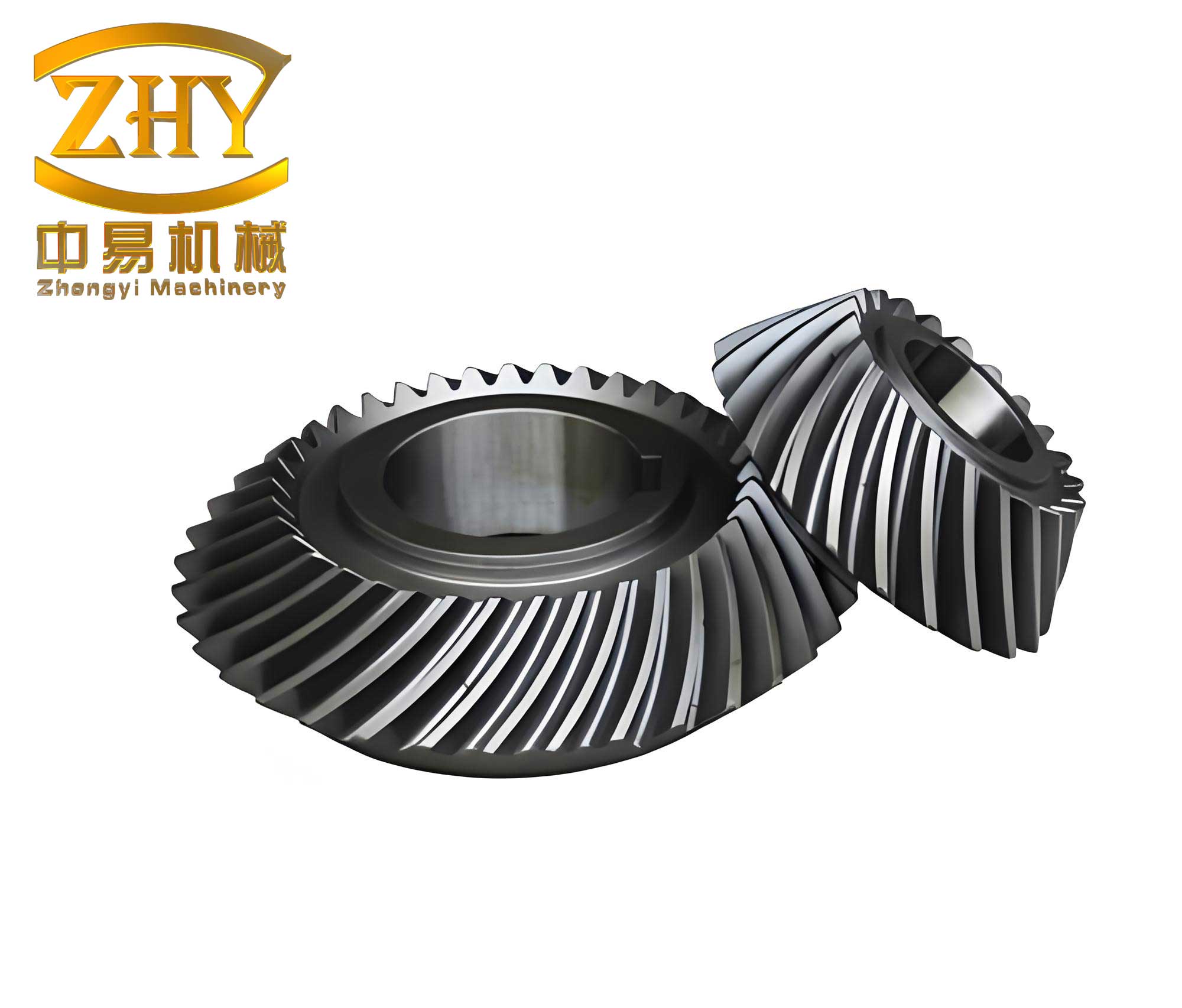
Visualizing these spiral gears aids in understanding their configuration. The driving spiral gear with 26 teeth and the driven spiral gear with 33 teeth exhibit specific tooth profiles tailored for the 4.42 ratio, while the 23/29 pair is designed for the 4.38 ratio. The spiral gear design involves complex calculations to determine parameters like addendum, dedendum, and cone distances, all contributing to the overall performance. For instance, the working tooth height is calculated as $$h = 2 \times m \times (1 + c)$$, where $$c$$ is the clearance coefficient, set at 0.188 for both designs. Such details ensure that the spiral gears operate efficiently within the axle assembly.
Strength Design of Spiral Gears
The strength design of spiral gears focuses on evaluating bending stress and contact stress to ensure reliability under operational loads. Spiral gears, due to their curved teeth, experience complex stress distributions, necessitating thorough analysis. We use standard formulas from gear design handbooks, adapted for spiral bevel gears. The bending stress calculation considers factors like torque, geometry coefficients, and material properties, while contact stress assessment involves Hertzian theory to prevent pitting and wear. In this section, I compare the strength of the two spiral gear sets, assuming identical input torque for fairness.
First, the bending stress $$\sigma_w$$ is computed using the formula:
$$\sigma_w = \frac{2 \times 10^3 T_j K_0 K_s K_m}{K_v F z m^2 J} \, \text{N/mm}^2$$
where:
- $$T_j$$ is the calculation torque (Nm),
- $$K_0$$ is the overload coefficient (assumed 1 for general trucks),
- $$K_s$$ is the size coefficient, given by $$K_s = \sqrt[4]{\frac{m}{25.4}}$$ for $$m \geq 1.6 \, \text{mm}$$,
- $$K_m$$ is the load distribution coefficient (taken as 1 for straddle-mounted gears),
- $$K_v$$ is the quality coefficient (assumed 1),
- $$F$$ is the face width (mm),
- $$z$$ is the number of teeth,
- $$m$$ is the module (mm),
- $$J$$ is the geometry factor for bending, set to 0.36 based on standard values for spiral gears.
Assuming the input torque $$T$$ is the same for both designs, we calculate the bending stresses for driving and driven spiral gears. The results are summarized in the table below, showing that the 23/29 spiral gears generally experience lower bending stress, indicating better resistance to tooth breakage.
| Gear Pair | Gear | Number of Teeth | Calculation Torque $$T_j$$ | Size Coefficient $$K_s$$ | Face Width $$F$$ (mm) | Module $$m$$ (mm) | Bending Stress $$\sigma_w$$ (N/mm²) |
|---|---|---|---|---|---|---|---|
| 26/33 Spiral Gears | Driving | 26 | $$T$$ | 0.766 | 60 | 8.637 | $$0.0366T$$ |
| Driven | 33 | $$\frac{33}{26}T$$ | 0.766 | 50 | 8.637 | $$0.0346T$$ | |
| 23/29 Spiral Gears | Driving | 23 | $$T$$ | 0.796 | 60 | 10.137 | $$0.0309T$$ |
| Driven | 29 | $$\frac{29}{23}T$$ | 0.796 | 50 | 10.137 | $$0.0295T$$ |
Next, the contact stress $$\sigma_j$$ is evaluated to prevent surface fatigue, using the formula:
$$\sigma_j = C_p \sqrt{\frac{2 T_{jz} K_0 K_s K_m K_f \times 10^3}{K_v F d_1 J}} \, \text{N/mm}^2$$
where:
- $$C_p$$ is the elastic coefficient (232.6 N/mm² for steel spiral gears),
- $$T_{jz}$$ is the driving gear calculation torque (Nm),
- $$d_1$$ is the driving gear pitch diameter (mm),
- $$K_f$$ is the surface quality coefficient (assumed 1),
- $$J$$ is the geometry factor for contact, taken as 0.11 based on design practice for spiral gears.
Other coefficients are as defined earlier. The contact stress results, assuming the same input torque $$T$$, demonstrate that the 23/29 spiral gears also exhibit lower contact stress, reducing the risk of pitting and extending service life.
| Gear Pair | Driving Gear Teeth | Calculation Torque $$T_{jz}$$ | Pitch Diameter $$d_1$$ (mm) | Face Width $$F$$ (mm) | Geometry Factor $$J$$ | Contact Stress $$\sigma_j$$ (N/mm²) |
|---|---|---|---|---|---|---|
| 26/33 Spiral Gears | 26 | $$T$$ | 224.55 | 60 | 0.11 | $$9.39 \sqrt{T}$$ |
| 23/29 Spiral Gears | 23 | $$T$$ | 233.979 | 60 | 0.11 | $$8.96 \sqrt{T}$$ |
The strength analysis confirms that the 23/29 spiral gear design, with a larger module and optimized geometry, performs better under both bending and contact stresses. This aligns with practical observations where spiral gears with lower stress levels tend to have lower failure rates in heavy-duty applications. The use of spiral gears in axles is crucial for distributing loads evenly across tooth surfaces, and these calculations help validate design choices. Moreover, factors like spiral angle and pressure angle influence stress concentrations; for instance, a spiral angle of 35 degrees helps mitigate axial forces while maintaining smooth engagement.
Discussion on Spiral Gear Performance and Applications
Beyond geometric and strength aspects, the performance of spiral gears in automotive axles depends on manufacturing precision, material selection, and lubrication. Spiral gears, typically made from case-hardened steels, require precise grinding to achieve the desired tooth profile and surface finish. The Gleason system, commonly used for spiral bevel gears, ensures controlled contact patterns that enhance durability. In our comparison, the 23/29 spiral gears not only show superior strength but also potentially better wear resistance due to lower contact stress. This makes them suitable for high-speed highway applications where reduced axle ratios are demanded.
The design of spiral gears also involves considering dynamic loads and thermal effects. For example, the spiral gear mesh generates heat due to friction, which can affect lubrication viscosity and gear life. Using formulas for flash temperature, we can estimate thermal loads: $$\theta_f = \frac{\mu W v}{k}$$, where $$\mu$$ is the coefficient of friction, $$W$$ is the load, $$v$$ is the sliding velocity, and $$k$$ is the thermal conductivity. While not detailed here, such analyses are integral to comprehensive spiral gear design. Additionally, noise and vibration characteristics of spiral gears are influenced by the spiral angle; a well-chosen angle, like 35 degrees, minimizes excitations and improves ride comfort.
In terms of applications, spiral gears are pivotal in differentials for rear axles, enabling torque splitting while accommodating angular misalignments. The trend toward smaller axle ratios, as seen with the 4.38 and 4.42 designs, reflects the industry’s drive for efficiency. Spiral gears contribute to this by allowing compact designs without sacrificing strength. Future developments may involve advanced materials like powdered metals or composites for spiral gears, further reducing weight and improving performance. Computational tools, such as finite element analysis (FEA), can refine stress predictions for spiral gears, incorporating complex boundary conditions.
Conclusion
In conclusion, the comparison of two small ratio spiral gear designs—26/33 for an overall axle ratio of 4.42 and 23/29 for 4.38—reveals that the latter offers better strength characteristics, with lower bending and contact stresses under identical torque conditions. This makes the 23/29 spiral gear set more reliable for heavy-duty automotive axles, as evidenced by reduced failure rates in field applications. The geometric design, involving parameters like module, spiral angle, and face width, directly impacts performance, and our analysis shows that larger modules can enhance durability without compromising efficiency. Spiral gears, with their curved teeth and smooth operation, remain essential components in modern axles, and ongoing research into their design will continue to push the boundaries of vehicle performance. As we advance, optimizing spiral gear designs through integrated analysis and testing will be key to meeting evolving transportation demands.