
In my extensive experience within precision manufacturing and gear production, the inspection of spiral gears presents a unique set of challenges that demand innovative solutions. Unlike spur gears, spiral gears feature helical teeth that are cut at an angle to the gear axis, which introduces complexities in measuring critical dimensions such as the tooth thickness, pitch, and especially the over-pin measurement (often denoted as M value for even-tooth gears) or related parameters. The accurate verification of these dimensions is paramount for ensuring smooth power transmission, minimal noise, and longevity in applications ranging from automotive transmissions to industrial machinery. The core challenge lies in performing these measurements efficiently and accurately in a high-volume production environment, where traditional methods using vernier calipers, micrometers, or even standard gear measurement instruments can be time-consuming, prone to human error, or simply impractical due to gear geometry.
Traditional methods for inspecting gear tooth dimensions often involve indirect calculations or complex setups. For instance, measuring the chordal tooth thickness or using a span measurement (over a specified number of teeth) with a gear tooth vernier or a micrometric depth gauge requires careful alignment and is sensitive to operator skill. For spiral gears, the helix angle further complicates direct measurement across teeth. The method of using pins or balls (the “over-pin” or “M” measurement) is a recognized standard for indirectly assessing tooth thickness. This method involves placing precision pins or balls in opposite tooth spaces and measuring the distance over them. The measured value, M, is then related to the actual tooth thickness through a series of trigonometric calculations based on gear geometry. However, performing this manually for every spiral gear in a large batch is inefficient. It requires multiple steps: selecting the correct pin diameter, carefully placing the pins, taking the micrometer measurement, and then performing the calculation—each step a potential source of error and delay.
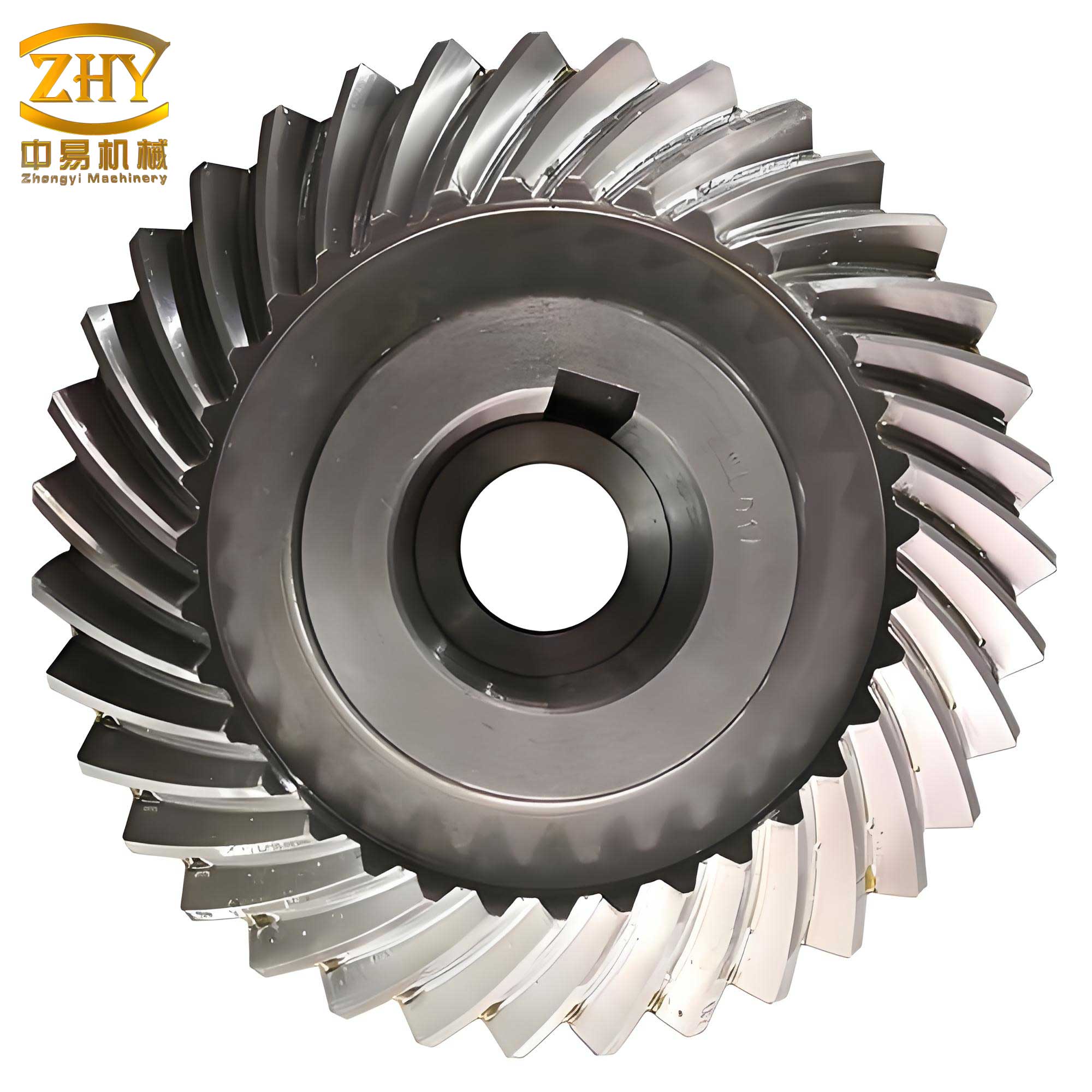
Motivated by the need for speed, accuracy, and operator simplicity in mass inspection, I embarked on designing a dedicated gauge specifically for the M-value measurement of even-tooth spiral gears. The fundamental principle was to transform a comparative measurement into a direct, dial-indicated reading. Instead of an operator calculating the difference between two measurements, the gauge would be pre-set to a master or reference dimension, and any deviation in the workpiece would be directly shown on a dial indicator or a digital gauge. This approach mirrors solutions used for other critical axial or bore dimensions in component manufacturing, where dedicated fixtures eliminate calculation steps and reduce measurement time per part dramatically.
The core geometry of spiral gears must be understood to design any effective measurement tool. The key parameters are defined in the following table, which serves as a foundation for all subsequent calculations and gauge design logic.
| Parameter | Symbol | Description | Typical Units |
|---|---|---|---|
| Number of Teeth | $z$ | Total count of teeth on the gear. | Dimensionless |
| Normal Module | $m_n$ | Module in the plane normal to the tooth helix. | mm |
| Transverse Module | $m_t$ | Module in the plane of rotation. $m_t = \frac{m_n}{\cos\beta}$ | mm |
| Helix Angle | $\beta$ | Angle of tooth inclination relative to gear axis. | Degrees (°) or Radians |
| Pressure Angle (Normal) | $\alpha_n$ | Pressure angle in the normal plane. | Degrees (°) |
| Pressure Angle (Transverse) | $\alpha_t$ | Pressure angle in the transverse plane. $\tan\alpha_t = \frac{\tan\alpha_n}{\cos\beta}$ | Degrees (°) |
| Base Circle Diameter | $d_b$ | $d_b = m_t z \cos\alpha_t$ | mm |
| Reference Diameter | $d$ | $d = m_t z$ | mm |
| Pin Diameter | $d_p$ | Diameter of the measuring pin or ball. | mm |
| Over-Pin Measurement (Even Teeth) | $M$ | Distance over the outer surfaces of two pins placed in opposite tooth spaces. | mm |
The theoretical value of $M$ for an even-tooth spiral gear is given by a derived formula. The calculation involves determining the involute function, accounting for the helix angle, and finding the distance between two opposite pin centers projected onto the measurement plane. The formula is:
$$ M = \frac{d_b}{\cos\alpha_{vt}} + d_p $$
where $\alpha_{vt}$ is the pressure angle at the point where the pin contacts the tooth flank. This angle is found by solving the involute equation involving the tooth thickness. The exact derivation starts with the concept of the involute function. The transverse tooth thickness on the reference circle, $s_t$, is:
$$ s_t = \frac{\pi m_t}{2} $$ (for a standard gear without profile shift).
The half of the tooth thickness angle on the base circle, $\eta$, is related to the transverse pressure angle and tooth thickness by:
$$ \text{inv}\alpha_{vt} = \text{inv}\alpha_t + \frac{d_p}{d_b \cos\alpha_n} + \frac{s_t}{d} – \frac{\pi}{z} $$
Wait, let’s refine this for a spiral gear. A more precise and commonly used series of formulas for calculating the over-pin measurement $M$ for a helical gear (spiral gear) is as follows. First, we calculate the transverse pressure angle $\alpha_t$ from the normal pressure angle $\alpha_n$ and helix angle $\beta$:
$$ \alpha_t = \arctan\left(\frac{\tan\alpha_n}{\cos\beta}\right) $$
The base circle diameter $d_b$ is:
$$ d_b = d \cos\alpha_t = m_t z \cos\alpha_t $$
The lead of the helix, $L$, is:
$$ L = \pi d \cot\beta $$
For the pin measurement, we need to find the pressure angle at the point on the involute where the pin makes contact. This involves an iterative solution or a direct formula using the involute function. The involute function is defined as $\text{inv}\alpha = \tan\alpha – \alpha$ (with $\alpha$ in radians). For a gear with no profile shift, the following relation holds for the transverse plane. The tooth thickness on the reference circle in transverse plane, $s_t$, is standard: $s_t = \frac{\pi m_t}{2}$. However, for calculation of $M$, we often work in the normal plane or use a combined approach. A practical formula set for the pin diameter $d_p$ selection and $M$ calculation is:
1. Ideal Pin Diameter: $d_p \approx 1.728 m_n$ is a common rule of thumb for standard pressure angles, but the exact value should be chosen so the pin contacts the tooth flank near the pitch circle.
2. Pressure Angle at Pin Center: First, find the value $\alpha_{t}’$ from the equation involving the tooth space half-angle. A standard formula is:
$$ \text{inv}\alpha_{t}’ = \text{inv}\alpha_t + \frac{d_p}{d_b \cos\beta} – \frac{\pi}{2z} + \frac{2x_n \tan\alpha_n}{z} $$
where $x_n$ is the normal profile shift coefficient. For a standard gear with $x_n=0$, it simplifies to:
$$ \text{inv}\alpha_{t}’ = \text{inv}\alpha_t + \frac{d_p}{d_b \cos\beta} – \frac{\pi}{2z} $$
Note: $\alpha_{t}’$ is the transverse pressure angle at the point on the involute corresponding to the pin center.
3. Calculation of M (Even Teeth): Once $\alpha_{t}’$ is found (by solving the above equation numerically or using tables), the over-pin measurement $M$ is given by:
$$ M = \frac{d_b}{\cos\alpha_{t}’} + d_p $$
This is a critical result. For odd-numbered teeth, the formula differs slightly, involving a cosine of $90°/z$. However, the dedicated gauge I designed focuses on even-tooth spiral gears, which are common in many power transmission systems. The complexity of these formulas underscores why manual calculation for each part is impractical in a production setting. Even with software, the act of placing pins and measuring with a micrometer remains a bottleneck.
The design philosophy for the dedicated inspection fixture was to create a “go/no-go” style comparator that gives a direct deviation reading. The gauge must accommodate the helix angle of the spiral gears and ensure that the measuring contacts engage the tooth flanks correctly. The main components of the gauge are summarized in the table below, drawing inspiration from modular fixture design principles.
| Component Name | Material & Specification | Function in Gauge | Critical Design Consideration for Spiral Gears |
|---|---|---|---|
| Base or Body | Hardened Tool Steel, ground | Rigid foundation holding all components. Provides reference datums. | Must be massive enough to resist deflection during measurement. Includes precise locators for gear centering. |
| Fixed Anvil (or Target Contact) | Carbide tip, lapped | Provides one fixed point of contact with the gear tooth space. Equivalent to one measuring pin’s position. | Contact profile must match the theoretical contact point of the pin on the tooth flank, considering helix angle. Often shaped as a cylindrical post. |
| Movable Measuring Stylus | Hardened steel, spring-loaded | Provides the second point of contact, opposite the fixed anvil. Its movement is transmitted to the indicator. | Must be free to move along the measurement axis while maintaining contact. The stylus tip is also a cylindrical post matching the pin diameter. |
| Return Spring | Stainless steel compression spring | Ensures positive contact between movable stylus and gear tooth, and retracts the stylus when gear is removed. | Spring force must be sufficient to overcome friction but not deform the gear tooth or cause gauge instability. |
| Dial Indicator (or Digital Probe) | Precision indicator with 0.001mm resolution | Amplifies and displays the linear displacement of the movable stylus relative to the fixed anvil. | Must be mounted rigidly. The measuring axis must be perfectly aligned with the line connecting the two contact points. |
| Master Setting Disc (Reference) | Precision-ground disc with known M dimension | Used to set the gauge to zero. Represents the nominal or upper limit dimension of the gear M value. | Its diameter is calibrated to the theoretical $M$ value for a perfect gear, or to $M + \Delta$, where $\Delta$ is a chosen offset for tolerance zone indication. |
| Clamping Mechanism (optional) | Quick-release lever clamp | Holds the gear in a consistent axial and radial position during measurement. | Must not distort the gear. Often uses a gentle concentric collet or V-block to center the gear bore or outside diameter. |
The operational principle is straightforward but relies on precise mechanical realization. The two contact elements (fixed anvil and movable stylus tip) are essentially substitutes for the two measuring pins. Their centers are spaced exactly at the nominal $M$ distance when the gauge is set with the master disc. When a production spiral gear is placed in the gauge, the actual distance between the tooth spaces engaging these contacts will differ from the nominal. This difference causes the movable stylus to shift from its zero position, and this shift is magnified and shown on the dial indicator. A crucial point, often a source of initial confusion for operators, is that the indicator reading is typically the negative of the actual deviation. If the gear’s actual $M$ dimension is larger than the master (meaning more tooth material, or a positive deviation), the movable stylus is pushed further in, causing the indicator pointer to move in the negative direction (or clockwise). Therefore, the reading sign must be interpreted correctly: $M_{\text{actual}} = M_{\text{master}} – (\text{Indicator Reading})$, assuming the indicator is zeroed on the master. This relationship is vital for correct interpretation.
The mathematical model for the gauge’s operation can be expressed simply. Let $M_0$ be the reference value embodied by the master setting disc. Let $\delta$ be the deviation of the gear’s true over-pin measurement from this reference, so $M_{\text{gear}} = M_0 + \delta$. The gauge is constructed such that when $M_{\text{gear}} = M_0$, the indicator reads zero. The mechanical linkage transmits the displacement $\Delta x$ of the movable contact. For a small deviation $\delta$, the displacement $\Delta x$ is approximately equal to $-\delta$ (minus due to the direction of motion). The indicator amplifies this by its gear ratio $G$, displaying a value $R = G \cdot \Delta x \approx -G \cdot \delta$. For a direct reading gauge, $G$ is often 1:1 or calibrated so that one division on the dial corresponds to one micron of deviation. Thus, the operator sees $R$, and computes $\delta = -R / G$. In practice, the gauge is often calibrated so that the tolerance limits are marked directly on the indicator dial, eliminating any mental calculation.
The design must also account for the helix angle of the spiral gears. The contact posts cannot be simple vertical pins; they must be oriented or profiled to ensure they contact the tooth flank along a line that is consistent with the theoretical pin contact. One effective design, which I employed, uses cylindrical posts of the calculated pin diameter $d_p$, but they are mounted in a fixture that allows them to align automatically with the tooth space due to a floating or pivoting mechanism. An alternative is to use a V-block principle where the gear sits at its helix angle, but this complicates the fixture. A more robust solution is to use spherical tips on the contacts, but this changes the contact geometry and requires recalculation of the master dimension. The chosen design used cylindrical posts with their axes parallel to the gear axis. For a spiral gear, the contact between a cylindrical post and the helical tooth flank is not a point but a complex line. However, if the post diameter $d_p$ is chosen correctly (as per the calculation formulas), the contact will occur in a narrow band near the theoretical point, and the error introduced is negligible for quality control purposes. The following table compares the performance of this dedicated gauge against traditional measurement methods for spiral gears.
| Aspect | Traditional Pin & Micrometer Method | Dedicated Comparator Gauge |
|---|---|---|
| Measurement Time per Gear | High (30-60 seconds): Involves pin insertion, careful micrometer alignment, reading, and calculation. | Low (5-10 seconds): Simply place gear in fixture, close lightly, read dial. |
| Operator Skill Dependency | Very High: Requires training in precise measurement technique and calculation. | Low: Minimal training; focuses on proper placement and reading interpretation. |
| Calculation Required | Yes, always. Formula application or software lookup needed. | No. Deviation is read directly. Tolerance limits can be marked on dial. |
| Risk of Arithmetic Error | High, especially in repetitive batch inspection. | Virtually eliminated. |
| Consistency & Repeatability | Moderate, varies with operator feel and pin placement. | High, due to fixed, repeatable mechanical fixture. |
| Initial Cost & Setup | Low (uses existing mics and pins). | Higher (requires design and manufacture of dedicated fixture). |
| Cost per Measurement (High Volume) | High (labor-intensive). | Very Low (fast, low skill). |
| Suitability for 100% Inspection | Poor, too slow and fatiguing. | Excellent, designed for rapid batch checking. |
The advantages are clear for high-volume production of spiral gears. However, the gauge’s accuracy hinges on proper calibration and handling. The master setting disc must be traceable to a national standard and have a known uncertainty. The gauge itself must be checked periodically for wear, especially on the contact posts. Environmental factors like temperature can affect both the gauge and the gear, but in a controlled workshop, this is manageable. A critical procedural note is that once the gauge is zeroed using the master, the master should be removed and the gauge should not be subjected to impacts or rough handling that could misalign the fixed anvil or the indicator mounting. This is a common precaution for all comparative measuring instruments.
To delve deeper into the metrological theory, let’s consider the sensitivity analysis. How does a change in each gear parameter affect the $M$ value, and consequently, the gauge reading? This is important for diagnosing manufacturing errors from the gauge output. We can use partial derivatives. Assuming the simplified formula $M = \frac{d_b}{\cos\alpha_{t}’} + d_p$, and knowing that $\alpha_{t}’$ itself is a function of $m_n, z, \beta, \alpha_n, d_p$, we can estimate sensitivities. For small changes, the change in $M$, $\Delta M$, due to a change in normal module $\Delta m_n$ is approximately:
$$ \Delta M \approx \frac{\partial M}{\partial m_n} \Delta m_n $$
A more practical approach is to use a table of influences, derived from gear calculation software or numerical methods. Below is a simplified sensitivity table for a typical spiral gear with $z=30$, $m_n=2.5\text{mm}$, $\beta=20°$, $\alpha_n=20°$, and $d_p=4.5\text{mm}$.
| Gear Parameter Change | Effect on Over-Pin Measurement $M$ | Approximate Sensitivity Coefficient (μm per μm or μm per minute of arc) |
|---|---|---|
| Increase in Normal Module $m_n$ by 1μm | $M$ increases significantly. | ~ +2.5 to +3.0 μm/μm (depends on geometry) |
| Increase in Tooth Number $z$ by 1 | $M$ increases. | ~ +15 to +20 μm per tooth (for this size) |
| Increase in Helix Angle $\beta$ by 1 arc-minute | $M$ decreases slightly. | ~ -0.2 to -0.5 μm/arc-min |
| Increase in Pressure Angle $\alpha_n$ by 1 arc-minute | $M$ decreases. | ~ -0.5 to -1.0 μm/arc-min |
| Increase in Tooth Thickness (Profile Shift $x_n$ positive) | $M$ increases. | High sensitivity, ~ + several μm per 0.01 shift coeff. |
| Runout or Eccentricity | $M$ varies sinusoidally as gear is rotated. | Amplitude equals eccentricity * (some factor). |
This sensitivity analysis shows that the $M$ measurement, and thus the dedicated gauge, is most sensitive to errors in module and tooth thickness (profile shift). It can therefore effectively control these critical dimensions. A batch of spiral gears showing a consistent positive deviation on the gauge likely has a slightly larger module or thicker teeth than nominal, while a spread in readings might indicate problems with runout or tooth-to-tooth variation.
The construction and use of such a gauge also involve practical formulas for setting up the master. Suppose the drawing specifies $M = 78.450 \pm 0.025$ mm. One might set the master disc to the nominal value 78.450 mm, zero the indicator, and then any reading within $\pm 0.025$ mm on the dial (with sign reversed) would be acceptable. Alternatively, to avoid sign reversal confusion, a master set to the upper limit (78.475 mm) can be used to set the “zero” at the upper tolerance boundary. Then, acceptable parts would show a negative reading not exceeding -0.050 mm (i.e., down to the lower limit). This is a matter of workshop preference. The mathematical relationship for this second method is:
Let $M_{\text{max}} = M_{\text{nom}} + \text{Tol}_{+}$ be the upper specification limit. The master is made to size $M_{\text{master}} = M_{\text{max}}$. When the gauge is zeroed on this master, a perfect part at the nominal size $M_{\text{nom}}$ will give a reading $R$ where:
$$ R = G \cdot (M_{\text{master}} – M_{\text{nom}}) = G \cdot \text{Tol}_{+} $$
but since the indicator reads opposite, it might show $-\text{Tol}_{+}$. To have the indicator show zero for nominal, the master should be at nominal. So, clarity in procedure is key.
In my implementation, I included a fine-adjustment mechanism for the fixed anvil, allowing for slight compensation of wear or recalibration without remachining the entire body. This adjustment is locked after setting. The movable stylus assembly was designed with a linear ball bearing to minimize friction and hysteresis, which is critical for achieving repeatability better than 2 micrometers. The spring force was calculated to be around 2 Newtons, enough to ensure contact but not cause elastic deformation of the gear teeth, which for steel spiral gears is negligible at this force level.
To further illustrate the application of this gauge across different sizes of spiral gears, consider a family of gears with varying modules and tooth counts but the same normal pressure angle and similar helix angles. A set of interchangeable contact posts (with different diameters $d_p$ appropriate for each module) and adjustable anvil blocks can make the gauge more versatile. However, for dedicated mass production lines, a single-purpose gauge for one specific gear part number is most common and most accurate.
The success of this dedicated inspection approach for spiral gears highlights a broader principle in metrology: when measurement frequency is high and tolerance bands are tight, investing in purpose-built fixturing pays dividends in quality control efficiency and reliability. The mental shift from universal tools to specialized tools is essential for advanced manufacturing. For spiral gears, which are integral to high-performance drivetrains, ensuring each piece meets specification through 100% inspection becomes not just feasible but routine with such tooling.
In conclusion, the journey from grappling with trigonometric formulas for each gear to reading a simple dial deviation exemplifies pragmatic engineering innovation. The dedicated gauge transforms a complex, error-prone inspection task into a rapid, reliable, and operator-friendly process. While the underlying mathematics governing spiral gears remains complex, the act of verifying their critical dimensions need not be. This tool, born from necessity on the shop floor, stands as a testament to the power of applied metrology in mastering the intricacies of precision components like spiral gears. Future developments may integrate wireless digital indicators with SPC software for real-time statistical process control, further enhancing the value of such dedicated inspection systems in the smart manufacturing landscape.