
In the realm of mechanical transmission, spiral gears offer significant advantages, including smooth engagement, high load-bearing capacity, and extended service life. These benefits make them indispensable in various industrial applications. However, machining large prime number spiral gears presents a unique set of challenges, particularly when using gear hobbing machines. The process requires precise adjustment of change gears—specifically, the indexing, feeding, and differential motion gears—to achieve accurate tooth formation and spiral geometry. Traditional methods often introduce errors due to discrepancies between theoretical and actual gear ratios, leading to inaccuracies in the machined gears. In this article, I will delve into an optimized approach that minimizes these errors, focusing on enhancing precision by isolating the error contribution to the differential change gears alone. This method not only simplifies the setup but also significantly improves the overall machining accuracy for spiral gears.
The machining of spiral gears, especially those with large prime numbers of teeth, necessitates a comprehensive understanding of the gear hobbing process. On standard hobbing machines like the Y38 or Y3150E, three sets of change gears are employed: the indexing gears for dividing the tooth spaces, the feeding gears for controlling the axial feed, and the differential gears for compensating the spiral motion and any fractional tooth adjustments. The interdependence of these gears often complicates the selection process, as small deviations in one set can propagate through the system, resulting in cumulative errors. Spiral gears, with their helical teeth, require precise coordination between the rotational motion of the workpiece and the translational motion of the hob to generate the correct spiral lead. Any imbalance can lead to pitch errors or tooth direction deviations, compromising the gear’s performance. Therefore, optimizing the change gear selection is paramount for achieving high-quality spiral gears.
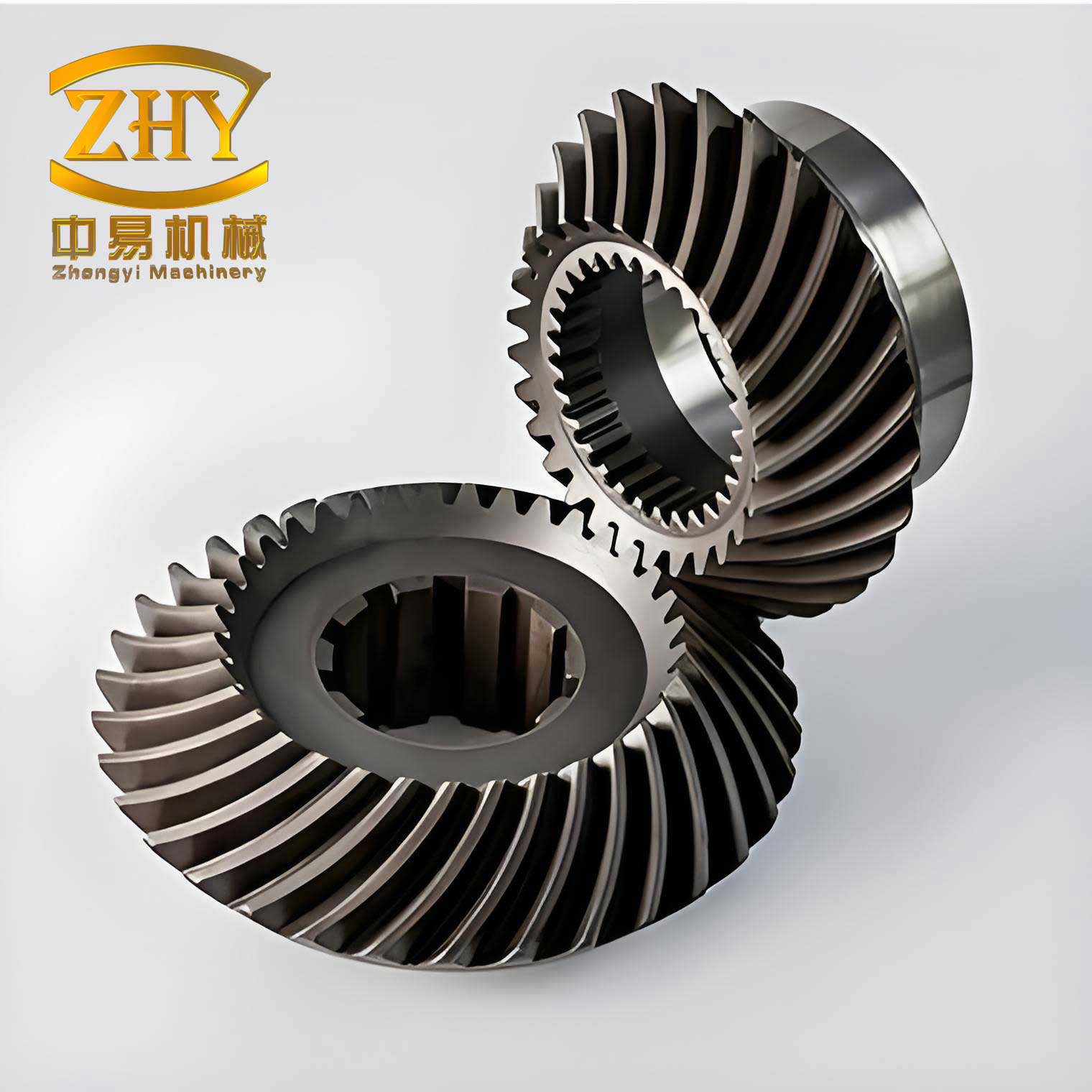
To begin, let’s outline the theoretical formulas for the change gear ratios. The indexing gear ratio, denoted as \( u_x \), is derived from the generating motion chain. For large prime number spiral gears, a compensatory factor \( p \) is introduced to handle the fractional tooth count, typically ranging from \( 1/5 \) to \( 1/50 \). The calculation displacement is: \( Z + p \) rotations of the hob per one rotation of the gear, where \( Z \) is the number of teeth, and \( K \) is the number of hob threads. The indexing gear ratio is given by:
$$ u_x = \frac{k_f \cdot k}{z + p} \approx \frac{a}{b} \times \frac{c}{d} \approx u_x’ $$
Here, \( k_f \) is the indexing constant (e.g., 24 for Y38 and Y3150E machines when \( e/f = 36/36 \), or 48 when \( e/f = 24/48 \)), and \( a, b, c, d \) are the teeth numbers of the indexing gears. The actual ratio \( u_x’ \) may differ from the theoretical \( u_x \), leading to errors.
Next, the feeding gear ratio \( u_s \) controls the axial feed rate \( s_0 \). For the Y3150E machine, it is expressed as:
$$ u_s = \frac{s_0}{0.4608 \cdot \pi} \approx \frac{a_1}{b_1} \times u_{\text{feed box}} \approx u_s’ $$
For the Y38 machine, the formula is:
$$ u_s = s_0 \approx \frac{a_1}{b_1} \times \frac{c_1}{d_1} \times \frac{4}{3} \approx u_s’ $$
where \( a_1, b_1, c_1, d_1 \) are the teeth numbers of the feeding gears. Similarly, \( u_s’ \) represents the actual ratio.
The differential gear ratio \( u_y \) is the most critical, as it compensates for both the fractional tooth adjustment and the spiral motion. It combines two components: one for compensating the extra or reduced hob rotation due to \( p \), and another for generating the spiral lead. The formula is:
$$ u_y = \pm \frac{k_{c2} \cdot \sin \beta (Z + p)}{m_n \cdot Z \cdot k} – \frac{k_{c1} \cdot p}{u_s \cdot k} \approx \frac{a_2}{b_2} \cdot \frac{c_2}{d_2} = u_y’ $$
In this equation, \( k_{c1} \) and \( k_{c2} \) are differential constants (e.g., \( k_{c1} = 25 \), \( k_{c2} = 7.95775 \) for Y38; \( k_{c1} = 625/32 \), \( k_{c2} = 9 \) for Y3150E), \( m_n \) is the normal module, \( \beta \) is the helix angle, and \( a_2, b_2, c_2, d_2 \) are the teeth numbers of the differential gears. The sign depends on the relative spiral direction of the hob and gear: minus for same direction, plus for opposite. The actual ratio \( u_y’ \) may deviate from \( u_y \), contributing to errors.
The core issue in machining spiral gears lies in the error accumulation from all three gear sets. Even minor discrepancies between theoretical and actual ratios can result in pitch errors and tooth direction inaccuracies. To quantify this, I derive the error analysis. Let \( \Delta p \) represent the total error in the compensatory factor per revolution of the workpiece, encompassing both pitch and spiral errors. From the indexing gear, the error \( \Delta p_1 \) is:
$$ \Delta p_1 = \frac{dp}{du_x} \cdot \Delta u_x = -k_f \cdot k \cdot \frac{1}{u_x} (u_x’ – u_x) $$
where \( \Delta u_x = u_x’ – u_x \). From the feeding and differential gears, the error \( \Delta p_2 \) involves partial derivatives with respect to \( u_s \) and \( u_y \). Using implicit differentiation on the differential gear equation, we get:
$$ \frac{\partial p}{\partial u_s} = \frac{u_y \cdot m_n \cdot Z \cdot k \pm k_{c2} \cdot \sin \beta (Z + p)}{-k_{c1} \cdot m_n \cdot Z \pm k_{c2} \cdot \sin \beta \cdot u_s} $$
and
$$ \frac{\partial p}{\partial u_y} = \frac{u_s \cdot m_n \cdot Z \cdot k}{-k_{c1} \cdot m_n \cdot Z \pm k_{c2} \cdot \sin \beta \cdot u_s} $$
The sign conventions follow those in the differential formula: for same spiral direction, the denominator takes minus in \( \partial p / \partial u_s \) and plus in \( \partial p / \partial u_y \); for opposite, vice versa. Then, \( \Delta p_2 \) is:
$$ \Delta p_2 = \frac{\partial p}{\partial u_s} \Delta u_s + \frac{\partial p}{\partial u_y} \Delta u_y $$
where \( \Delta u_s = u_s’ – u_s \) and \( \Delta u_y = u_y’ – u_y \). The total error is \( \Delta p = \Delta p_1 + \Delta p_2 \), which translates to pitch error as \( \Delta p \times \pi \times m_n \). This error analysis highlights how each gear set contributes to inaccuracies in spiral gears, necessitating a refined selection method.
To address this, I propose an optimized gear selection method that eliminates errors from the indexing and feeding gears, leaving only the differential gear error. This approach drastically improves precision for spiral gears. The steps are as follows:
- Calculate the theoretical indexing ratio \( u_x \) from \( u_x = \frac{k_f \cdot k}{z + p} \). Select practical gears to achieve \( u_x’ = \frac{a}{b} \times \frac{c}{d} \), then compute the adjusted compensatory factor \( p’ \) using:
$$ p’ = \frac{k_f \cdot k}{u_x’} – z $$
This step ensures that the indexing error is nullified by incorporating the actual ratio. - Determine the feeding ratio \( u_s \) based on the desired axial feed \( s_0 \), and select feeding gears to obtain \( u_s’ \). Keep \( u_s’ \) fixed for subsequent calculations.
- Substitute \( p’ \) and \( u_s’ \) into the differential gear formula to compute \( u_y \):
$$ u_y = \pm \frac{k_{c2} \cdot \sin \beta (Z + p’)}{m_n \cdot Z \cdot k} – \frac{k_{c1} \cdot p’}{u_s’ \cdot k} $$
This uses actual values, decoupling the differential calculation from prior errors. - Select differential gears such that \( u_y’ = \frac{a_2}{b_2} \cdot \frac{c_2}{d_2} \) closely approximates \( u_y \), with \( |u_y – u_y’| \leq 10^{-5} \). Tools like gear ratio calculators can aid in this selection.
- If precision is inadequate, iterate by adjusting \( p \) and repeating from step 1, but with \( u_s’ \) unchanged. The final error is solely from the differential gear:
$$ \Delta p = \frac{u_s’ \cdot m_n \cdot Z \cdot k}{-k_{c1} \cdot m_n \cdot Z \pm k_{c2} \cdot \sin \beta \cdot u_s’} \Delta u_y $$
where \( \Delta u_y = u_y’ – u_y \). This simplifies error control for spiral gears.
To illustrate, consider a practical example for machining spiral gears. Suppose we need to produce a spiral gear with \( Z = 113 \) teeth, normal module \( m_n = 2 \), single-thread hob (\( k = 1 \)), axial feed \( s_0 = 1 \) mm/rev, and helix angle \( \beta = 30^\circ \), using a Y3150E machine. Traditionally, one might set \( p = 1/35 \). The indexing ratio calculates to \( u_x = 0.4246714 \), and selecting gears \( \frac{53}{48} \times \frac{25}{65} \) gives \( u_x’ = 0.4246795 \), with \( \Delta u_x = 8.0 \times 10^{-6} \). The feeding ratio is \( u_s = 0.690777 \), approximated by gears \( \frac{48}{98} \times \frac{49}{35} \) to yield \( u_s’ = 0.6857143 \) and \( \Delta u_s = -5.06 \times 10^{-3} \). For the differential, assuming a right-hand hob for a right-hand spiral gear, \( u_y = -3.0584070 \), and choosing gears \( \frac{85}{23} \times \frac{48}{58} \) gives \( u_y’ = -3.0584707 \), with \( \Delta u_y = -6.4 \times 10^{-5} \). The total error computes to \( \Delta p = -0.00234 \), equivalent to a pitch error of \( 7.35 \times 10^{-3} \) mm. This error, while small, can affect the performance of spiral gears in precision applications.
Applying the optimized method, we start with the same \( u_x \) and select identical indexing gears to get \( u_x’ = 0.4246795 \), then derive \( p’ = 0.0264116 \). The feeding gears remain as before, so \( u_s’ = 0.6857143 \). Substituting into the differential formula gives \( u_y = -3.002810 \). Selecting differential gears \( \frac{97}{26} \times \frac{33}{41} \) results in \( u_y’ = -3.002814 \), with \( \Delta u_y = 4.3 \times 10^{-6} \). The error is now solely from the differential: \( \Delta p = 1.52 \times 10^{-7} \), translating to a negligible pitch error of \( 9.55 \times 10^{-7} \) mm. This demonstrates a dramatic reduction in error, enhancing the accuracy of the machined spiral gears.
To summarize the formulas and error contributions, I present the following tables. These tables encapsulate key aspects of change gear selection for spiral gears, aiding in practical implementation.
| Gear Set | Theoretical Ratio Formula | Machine Constants | Practical Selection |
|---|---|---|---|
| Indexing Gears | $$ u_x = \frac{k_f \cdot k}{z + p} $$ | \( k_f = 24 \) or 48 | \( u_x’ = \frac{a}{b} \times \frac{c}{d} \) |
| Feeding Gears | Y3150E: \( u_s = \frac{s_0}{0.4608 \pi} \) Y38: \( u_s = s_0 \) |
Depends on feed box | \( u_s’ = \frac{a_1}{b_1} \times \frac{c_1}{d_1} \) |
| Differential Gears | $$ u_y = \pm \frac{k_{c2} \sin \beta (Z+p)}{m_n Z k} – \frac{k_{c1} p}{u_s k} $$ | \( k_{c1}, k_{c2} \) machine-specific | \( u_y’ = \frac{a_2}{b_2} \times \frac{c_2}{d_2} \) |
| Error Source | Error Expression | Impact on Spiral Gears |
|---|---|---|
| Indexing Gear Error | $$ \Delta p_1 = -k_f k \frac{1}{u_x} (u_x’ – u_x) $$ | Causes pitch deviations in spiral gears |
| Feeding Gear Error | Contributes via \( \frac{\partial p}{\partial u_s} \Delta u_s \) | Affects spiral lead accuracy |
| Differential Gear Error | Primary in optimized method: $$ \Delta p = \frac{u_s’ m_n Z k}{-k_{c1} m_n Z \pm k_{c2} \sin \beta u_s’} \Delta u_y $$ | Isolated error source for precision control |
| Step | Action | Purpose |
|---|---|---|
| 1 | Compute \( u_x \), select gears for \( u_x’ \), calculate \( p’ \) | Eliminate indexing error for spiral gears |
| 2 | Determine \( u_s \) and \( u_s’ \) from feed rate | Fix feeding ratio |
| 3 | Use \( p’ \) and \( u_s’ \) to find \( u_y \) | Decouple differential calculation |
| 4 | Select differential gears with minimal \( \Delta u_y \) | Minimize sole remaining error |
| 5 | Iterate if needed, keeping \( u_s’ \) constant | Refine precision for spiral gears |
The advantages of this optimized method are manifold. By neutralizing errors from the indexing and feeding gears, the machining process for spiral gears becomes more predictable and controllable. The differential gear, being the only error contributor, allows for finer adjustments and easier tolerance management. This is particularly beneficial for spiral gears used in high-precision applications, such as aerospace or automotive transmissions, where even micron-level errors can lead to noise, vibration, or premature wear. Moreover, the method reduces the need for repeated trial-and-error setups, saving time and resources in manufacturing environments.
In practice, implementing this approach requires attention to detail. When selecting change gears for spiral gears, it’s essential to use high-quality gear sets with minimal backlash and wear. The calculations should be performed with sufficient precision, often using software tools to handle the complex ratios. Additionally, machine conditions, such as lubrication and alignment, can influence the final outcome, so regular maintenance is advised. For spiral gears with varying helix angles or modules, the formulas can be adapted, but the core principle remains: isolate errors to the differential chain. This adaptability makes the method suitable for a wide range of spiral gears, from small precision instruments to large industrial gearboxes.
Furthermore, the error analysis reveals interesting insights. For instance, the sensitivity of \( \Delta p \) to \( \Delta u_y \) depends on the helix angle \( \beta \) and module \( m_n \). Steeper spiral gears (larger \( \beta \)) may exhibit higher error magnification, underscoring the importance of precise differential gear selection. Similarly, for spiral gears with larger modules, the error impact per revolution might be more pronounced, necessitating tighter tolerances. These factors should be considered during the design phase to ensure manufacturability. By integrating this optimized selection method into the production workflow, manufacturers can achieve consistent quality across batches of spiral gears, enhancing reliability and performance.
In conclusion, the machining of large prime number spiral gears demands meticulous change gear selection to achieve desired accuracy. The traditional approach, while functional, often introduces compounded errors from multiple gear sets. Through the optimized method presented here, which focuses on eliminating indexing and feeding gear errors, the process is streamlined, with only the differential gear contributing to inaccuracies. This not only simplifies error analysis but also enables significant improvements in gear precision. As spiral gears continue to play a vital role in advanced mechanical systems, adopting such refined techniques will be crucial for meeting evolving industry standards. I encourage practitioners to apply this method in their operations, leveraging the formulas and tables provided, to enhance the quality and efficiency of spiral gear production.