
In our machine repair workshop, we often faced significant challenges when it came to repairing and manufacturing spiral gears for equipment like coarse sanders. Historically, machining spiral gears with large helix angles was nearly impossible due to the limitations of standard horizontal milling machines. We could only handle spiral gears with smaller angles, which severely restricted our capabilities. To overcome this hurdle, we embarked on designing and building a rotary tool holder attachment for our milling machine. This innovation has proven highly effective in practice, dramatically expanding the range of spiral gears we can produce. With this attachment installed on our ordinary horizontal mill, we can now successfully machine spiral gears with helix angles up to 45 degrees or more. The ability to process such spiral gears has transformed our repair and manufacturing workflows, enabling us to tackle projects that were previously deemed unfeasible.
The core of our solution is a rotary tool holder attachment, which consists of several key components: the rotary tool holder itself, a base, and a milling cutter arbor. The system is designed to be mounted directly onto the milling machine’s overarm. Power transmission is achieved through a coupling connected to the mill’s main spindle. This drives a series of gears, including bevel gears, to ultimately rotate the cutting tool. A critical feature is the graduated scale on the rotary holder. By loosening a set of U-bolts, the entire tool holder can be manually swiveled to the desired angle relative to the workpiece’s helix, after which it is securely locked in place. This setup allows the tool axis to be aligned perfectly with the helix angle of the spiral gear being cut, which is fundamental for accurate tooth generation.
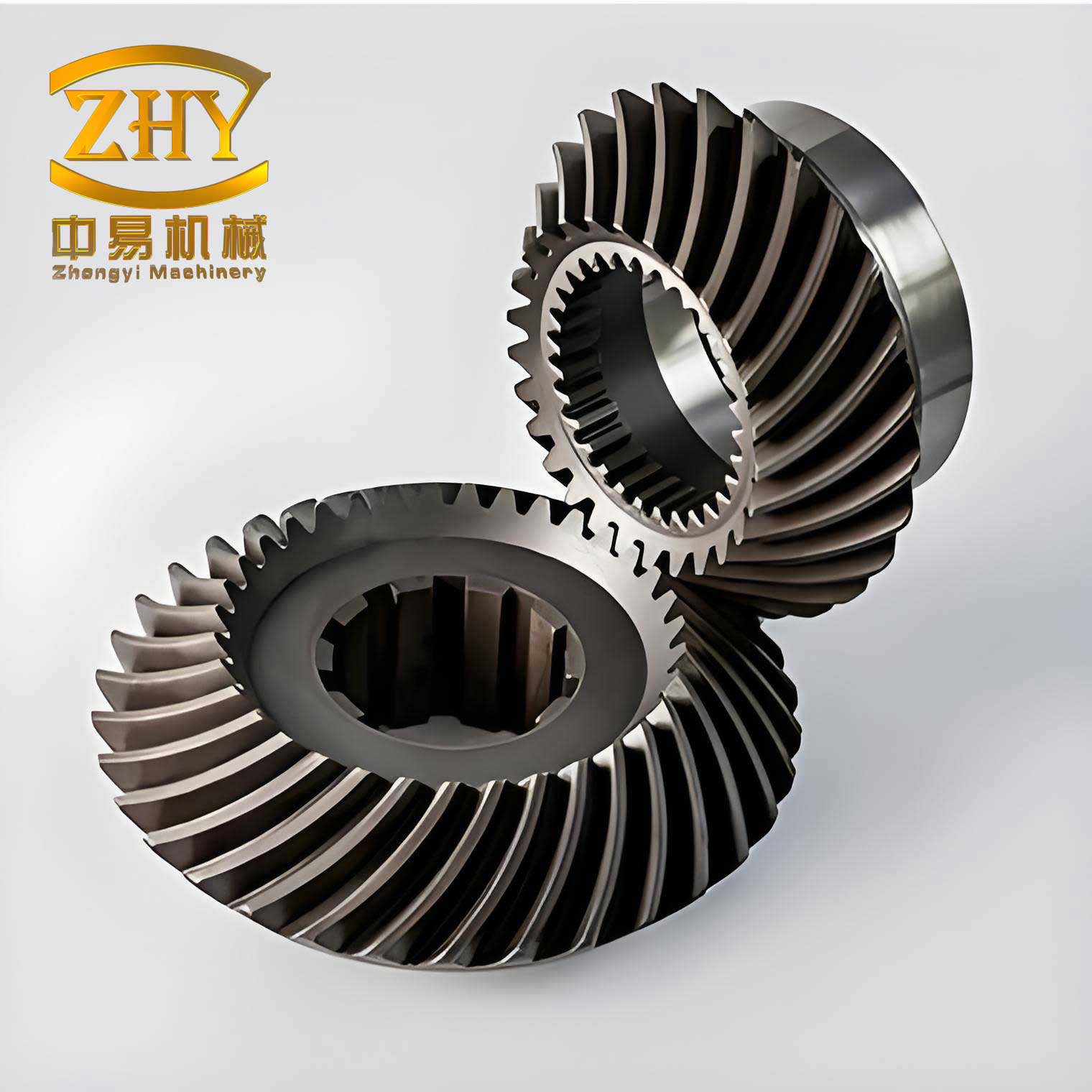
The machining process for spiral gears using this attachment begins with precise calculations for the differential gear train, commonly known as the change gears or “hang gears.” These gears are essential for synchronizing the rotation of the workpiece with its linear feed, thereby generating the required helix. The calculation follows standard principles for milling spiral gears. The fundamental relationship involves the lead of the helix, the pitch of the milling machine’s lead screw, and the gear ratio of the change gears. For a spiral gear, the lead \( L \) is the axial distance required for one complete turn of the helix. It is related to the helix angle \( \beta \), the normal module \( m_n \), and the number of teeth \( z \) by the formula:
$$ L = \frac{\pi \cdot m_n \cdot z}{\sin(\beta)} $$
Alternatively, the helix angle can be expressed as:
$$ \beta = \arctan\left(\frac{\pi \cdot D_p}{L}\right) = \arcsin\left(\frac{\pi \cdot m_n \cdot z}{L}\right) $$
where \( D_p \) is the pitch diameter of the spiral gear. The change gear ratio \( i \) required on a milling machine with a lead screw pitch \( P_{ls} \) is given by:
$$ i = \frac{a}{b} \times \frac{c}{d} = \frac{P_{ls}}{L} $$
Here, \( a, b, c, d \) represent the teeth counts of the four change gears. Selecting the correct combination is crucial for achieving the correct helix on the spiral gear. The table below summarizes key parameters and their relationships in spiral gear machining:
| Parameter | Symbol | Formula or Description | Role in Spiral Gear Machining |
|---|---|---|---|
| Helix Angle | \( \beta \) | \( \beta = \arctan(\pi D_p / L) \) | Defines the slant of teeth on the spiral gear. |
| Lead | \( L \) | \( L = \pi m_n z / \sin \beta \) | Axial travel per one revolution of the gear. |
| Normal Module | \( m_n \) | Standardized tooth size parameter. | Determines tooth dimensions in a plane normal to the helix. |
| Number of Teeth | \( z \) | Count of teeth on the spiral gear. | Directly affects gear diameter and lead. |
| Lead Screw Pitch | \( P_{ls} \) | Fixed machine parameter (e.g., 6 mm). | Base for calculating change gear ratio. |
| Change Gear Ratio | \( i \) | \( i = P_{ls} / L \) | Links machine feed to workpiece rotation for helix generation. |
| Pitch Diameter | \( D_p \) | \( D_p = m_n \cdot z / \cos \beta \) | Reference diameter for the spiral gear. |
Our rotary attachment interfaces with this system. Once the change gears are set, the workpiece is mounted on the dividing head, which is connected to the lead screw via the gear train. The rotary tool holder is then adjusted to match the helix angle \( \beta \) of the spiral gear. This alignment ensures that the milling cutter, which is shaped to the tooth profile (often a module cutter for the normal section), engages the workpiece correctly throughout the helical path. The cutting process involves feeding the workpiece past the rotating cutter, with the differential mechanism causing the workpiece to rotate simultaneously, thereby generating the helical tooth spaces. For spiral gears, this process must be repeated for each tooth, indexing the workpiece precisely using the dividing head after each cut.
The design and construction of the rotary tool holder attachment required careful consideration of mechanical transmission and rigidity. The power path starts from the milling machine’s spindle output coupling. It drives a primary gear, which transmits motion through an idler gear to a secondary gear. This secondary gear is on the same shaft as a small bevel gear, which meshes with a large bevel gear. The large bevel gear drives another bevel gear on a perpendicular axis, which in turn rotates a final gear that drives the cutter arbor. This multi-stage transmission provides the necessary speed reduction and directional change to rotate the cutter effectively. The components must be precisely machined to minimize backlash, which is critical for achieving good surface finish and accuracy on the spiral gears. Below is a breakdown of the main components in our attachment system:
| Component Name | Function | Key Features |
|---|---|---|
| Rotary Tool Holder | Holds the cutter arbor and can be swiveled. | Graduated scale for angle setting, locked by U-bolts. |
| Base | Provides mounting interface to the mill overarm. | Rigid construction to absorb cutting forces. |
| Milling Cutter Arbor | Holds and drives the gear milling cutter. | Precision taper for secure cutter mounting. |
| Gear Train | Transmits power from spindle to cutter. | Includes spur gears, bevel gears, and idlers. |
| Coupling | Connects attachment to the mill spindle. | Allows for easy engagement and disengagement. |
| Bearing Housings | Support rotating shafts. | Equipped with precision bearings for smooth operation. |
From a performance perspective, the attachment has been highly successful. We have achieved gear accuracy consistent with Grade 8 per relevant standards, which is satisfactory for many industrial applications involving spiral gears. However, we observed that the machining efficiency, when compared to milling standard spur gears of the same module, is approximately 60-70%. This reduction is primarily due to the intermittent cutting action and the need for more careful feed control when generating helical teeth. Furthermore, when using larger depths of cut, the setup is prone to vibration. This chatter is likely due to the increased overhang from the rotary head and the dynamic forces inherent in helical cutting. To mitigate this, we recommend using sharp cutters, reducing feed rates, and employing multiple light passes instead of a single heavy cut. These practices are especially important when machining large or hard-to-cut spiral gears.
Delving deeper into the mechanics, the generation of spiral gears on a milling machine is an application of form milling with a helical motion. The cutter profile must match the tooth space profile in the normal section. For a spiral gear with a helix angle \( \beta \), the relationship between the normal module \( m_n \) and the transverse module \( m_t \) (in the plane of rotation) is:
$$ m_t = \frac{m_n}{\cos \beta} $$
The pitch diameter \( D_p \) is then \( D_p = m_t \cdot z = \frac{m_n \cdot z}{\cos \beta} \), as noted earlier. The axial pitch \( P_a \), the distance between corresponding points on adjacent teeth measured parallel to the axis, is:
$$ P_a = \frac{L}{z} = \frac{\pi m_n}{\sin \beta} $$
These parameters are vital for tool selection and setup verification. When setting the rotary holder angle, it is crucial to set it exactly to \( \beta \) so that the cutter’s plane of rotation is aligned with the normal plane of the spiral gear tooth. Misalignment will cause profile errors and incorrect tooth thickness. The formula for the theoretical swivel angle \( \theta \) for the tool head is simply \( \theta = \beta \). In practice, we use the graduated scale and often verify with a precision protractor.
The calculation for change gears can involve approximating ratios, as the exact ratio \( i = P_{ls}/L \) may not be achievable with the available gear set. In such cases, we use the method of continued fractions or standard gear tables to find the closest possible combination. The error in the lead \( \Delta L \) due to an approximate gear ratio \( i’ \) is \( \Delta L = P_{ls} \left( \frac{1}{i’} – \frac{1}{i} \right) \). For precision spiral gears, this error must be kept within tolerable limits, often specified by the helix angle tolerance. The allowable lead error \( \Delta L_{allow} \) can be derived from the helix angle tolerance \( \Delta \beta \) (in radians) using the differential:
$$ \Delta L_{allow} \approx -\frac{L^2}{\pi D_p} \cdot \Delta \beta $$
This highlights the importance of precise change gear selection for high-quality spiral gears.
In our experience, the process for machining a spiral gear involves the following steps, which we have formalized into a procedure:
- Design and Planning: Determine the spiral gear specifications: normal module \( m_n \), number of teeth \( z \), helix angle \( \beta \), face width, and material.
- Calculation: Compute the lead \( L \), pitch diameter \( D_p \), and required change gear ratio \( i \). Select the actual change gears from available inventory.
- Machine Setup: Mount the rotary tool holder attachment onto the milling machine overarm and connect the drive coupling to the spindle. Install the selected change gears on the gear train between the lead screw and the dividing head.
- Tool and Workpiece Setup: Mount the appropriate gear milling cutter (for module \( m_n \)) on the cutter arbor. Set the rotary tool holder angle to \( \beta \) using the scale and lock it. Mount the gear blank on the dividing head, ensuring it is concentric and securely held.
- Alignment: Align the cutter center with the centerline of the gear blank. Set the initial depth of cut based on the whole depth of the tooth.
- Machining: Start the machine. Engage the feed to begin cutting the first tooth space. The differential will rotate the blank as it feeds, generating the helix. After completing one pass, retract, index the dividing head for the next tooth (indexing angle = \( 360^\circ / z \)), and repeat until all teeth are rough-cut.
- Finishing: Often, a finishing pass with a reduced depth of cut is performed to improve surface finish and accuracy on all spiral gear teeth.
- Inspection: Measure the spiral gear for tooth profile, helix angle, pitch, and runout using appropriate instruments like gear roll testers or coordinate measuring machines.
To further illustrate the calculations, consider a practical example of machining a spiral gear. Suppose we need to machine a spiral gear with \( m_n = 3 \, \text{mm} \), \( z = 30 \), and \( \beta = 25^\circ \). Our milling machine has a lead screw pitch \( P_{ls} = 6 \, \text{mm} \). First, we calculate the lead:
$$ L = \frac{\pi \cdot m_n \cdot z}{\sin \beta} = \frac{\pi \cdot 3 \cdot 30}{\sin 25^\circ} \approx \frac{282.743}{0.422618} \approx 668.8 \, \text{mm} $$
The required change gear ratio is:
$$ i = \frac{P_{ls}}{L} = \frac{6}{668.8} \approx 0.008970 $$
This is a very small ratio, which typically requires a compound gear train. In practice, we might use a set of gears to approximate this, such as driving gear teeth \( a=20 \), first driven \( b=60 \), second driving \( c=25 \), and second driven \( d=90 \), giving \( i = (20/60) \times (25/90) = (1/3) \times (5/18) = 5/54 \approx 0.09259 \), which is not correct. This shows that often an intermediate gearbox or different change gear constants are used. Many milling machines have a constant factor \( K \) (e.g., 40 or 60) built into the dividing head mechanism, so the actual formula becomes \( i = \frac{K \cdot P_{ls}}{L} \). Assuming \( K=40 \), then \( i = (40 \times 6) / 668.8 = 240 / 668.8 \approx 0.3589 \). We can then approximate this with gears, say \( a=35 \), \( b=55 \), \( c=40 \), \( d=70 \): \( i = (35/55) \times (40/70) = (7/11) \times (4/7) = 28/77 \approx 0.3636 \), which is close. The resulting lead error can be calculated. This example underscores the iterative nature of change gear selection for spiral gears.
The development of this attachment has not only solved our immediate problem but also provided insights into the broader field of gear manufacturing. Spiral gears, with their angled teeth, offer advantages over spur gears in terms of smoother engagement, higher load capacity, and reduced noise. However, their manufacturing complexity is higher. Our method using a modified horizontal mill with a rotary attachment represents a flexible and cost-effective solution for small-batch or repair work, as opposed to requiring dedicated spiral gear generators or CNC gear hobbers. The table below compares key aspects of machining spiral gears via this attachment versus standard spur gear milling on the same machine:
| Aspect | Spiral Gears (with Attachment) | Spur Gears (Standard Setup) |
|---|---|---|
| Setup Complexity | High (requires change gears, angle setting, alignment) | Low (simple indexing, no helix) |
| Cutting Motion | Helical (workpiece rotates during feed) | Linear (workpiece indexes only between cuts) |
| Tool Alignment | Critical (must match helix angle) | Straightforward (perpendicular to axis) |
| Machining Time | Longer (due to slower feeds, more passes) | Shorter |
| Vibration Tendency | Higher (intermittent cutting, dynamic forces) | Lower |
| Typical Accuracy Achievable | Grade 8-9 (depending on setup care) | Grade 7-8 |
| Efficiency Relative to Spur | ~65% | 100% (baseline) |
Beyond the basic process, several advanced considerations come into play when machining spiral gears. The choice of cutting fluid is important to manage heat and chip evacuation, especially since the helical cut can produce longer, stringy chips. Tool wear is also more pronounced due to the sliding action along the helix. We monitor cutter condition regularly and re-sharpen or replace cutters to maintain profile accuracy on spiral gears. Additionally, for double-helical or herringbone spiral gears, the setup becomes more complex, requiring a method to machine the left-hand and right-hand helices, often involving reversing the rotation of the change gear train or using a special cutter with a central groove.
From a theoretical standpoint, the geometry of spiral gears is rich with mathematical relationships. The normal pressure angle \( \alpha_n \) (typically 20°) is related to the transverse pressure angle \( \alpha_t \) in the plane of rotation by:
$$ \tan \alpha_t = \frac{\tan \alpha_n}{\cos \beta} $$
This affects the tooth strength and contact conditions. The base diameter \( D_b \) is given by \( D_b = D_p \cos \alpha_t \). For inspection, the measurement over pins or balls for spiral gears requires specialized formulas that account for the helix. The virtual number of teeth \( z_v \), used for selecting form cutters, is:
$$ z_v = \frac{z}{\cos^3 \beta} $$
This indicates that a spiral gear with a helix angle behaves like a spur gear with more teeth in the normal plane, which is why cutters are selected based on \( z_v \) for form milling. These formulas are essential for precise manufacturing and quality control of spiral gears.
In conclusion, the design and implementation of the rotary tool holder attachment have been a resounding success for our workshop. It has empowered us to machine spiral gears with large helix angles, up to 45 degrees, which was previously impossible. While the process is less efficient and more prone to vibration than spur gear milling, the achieved accuracy of Grade 8 meets our repair and production needs. The key to success lies in meticulous setup, precise calculation of change gears, careful alignment of the tool angle, and conservative cutting parameters. This project underscores the potential of adapting standard machine tools with creative attachments to expand their capabilities. For any machine shop facing similar challenges with spiral gears, such an attachment offers a viable and economical solution. Future improvements could focus on enhancing rigidity to reduce vibration, incorporating a power swivel mechanism for easier angle adjustment, and developing quick-change gear systems to streamline setup for different spiral gears. The knowledge gained from this endeavor continues to benefit our operations, enabling us to handle a wider array of gear repair tasks confidently.