
In the vast field of power transmission, spiral gears, also known as crossed helical gears, offer a unique solution for connecting non-parallel, non-intersecting shafts. Unlike their parallel-axis counterparts, the contact between spiral gear teeth is primarily a point contact, leading to complex kinematics dominated by substantial sliding along the tooth spiral direction. This inherent sliding action is the principal source of power loss, making the analysis of meshing efficiency not just an academic exercise but a critical factor in their practical application and design. A thorough understanding of the forces, velocities, and resulting efficiency in spiral gears is essential for engineers to optimize performance, predict behavior, and avoid operational issues such as self-locking. This article delves into a systematic analysis of spiral gear meshing, deriving the fundamental efficiency equation, exploring its characteristics, and examining special cases to provide a comprehensive guide for efficient design.
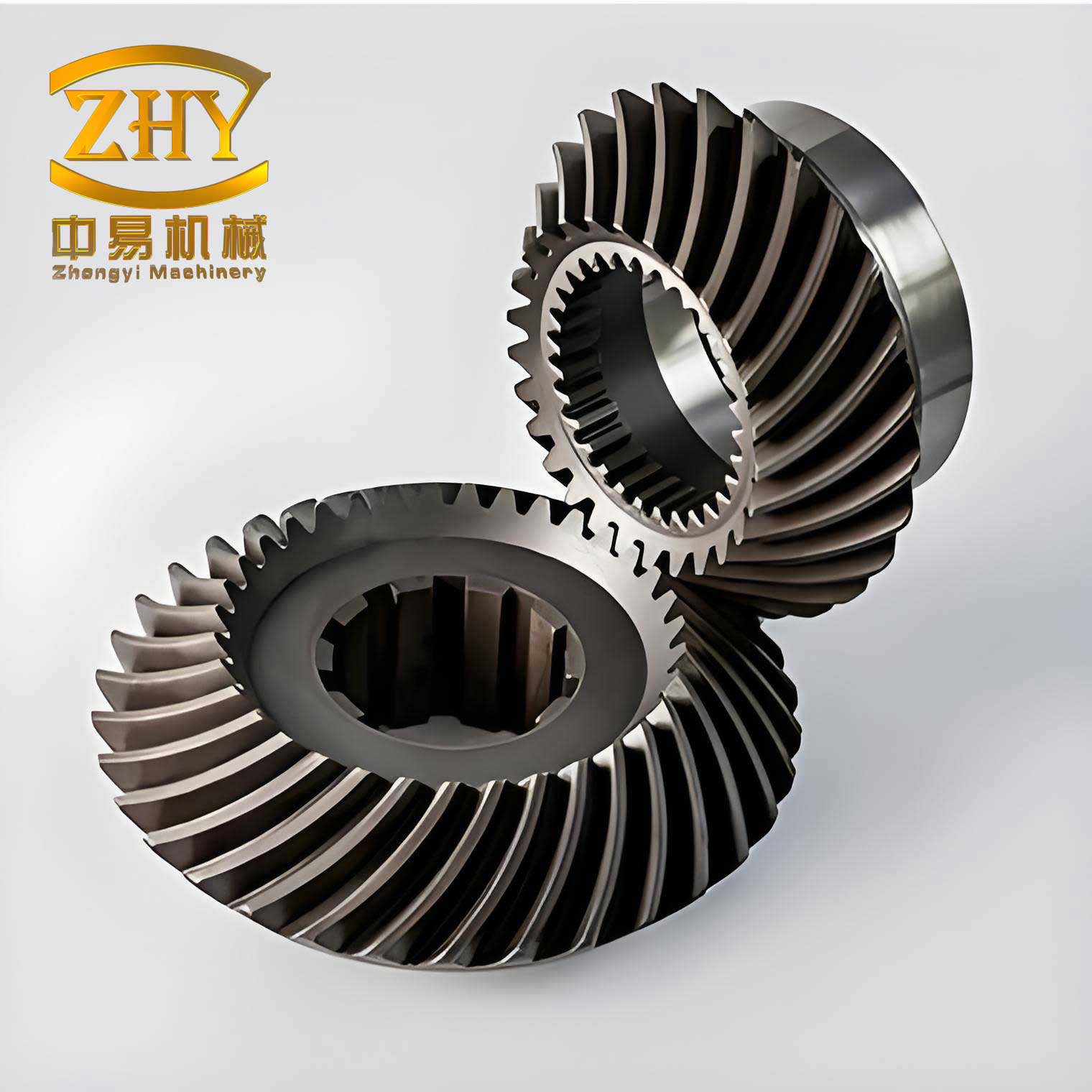
Kinematic and Force Analysis of Spiral Gears
The geometry of a spiral gear pair is defined by the helix angles $\beta_1$ and $\beta_2$ of the two gears. By convention, a right-hand helix is considered positive. The angle between the two shafts, $\Sigma$, is the sum of the absolute values of the helix angles when both gears have the same hand, or the difference if they are of opposite hand. For the common case of gears with the same hand, we have:
$$\Sigma = \beta_1 + \beta_2$$
Consider Gear 1 as the driver, rotating as shown in the figure above. The key to analyzing the efficiency of spiral gears lies in understanding the velocity relationship at the point of contact. The tangential velocity of a point on the pitch cylinder of Gear 1 is $v_1$, and for Gear 2 it is $v_2$. Crucially, due to the crossed axes, there is a significant relative sliding velocity $v_{21}$ along the common tangent to the tooth surfaces. Constructing the velocity polygon reveals the fundamental kinematic relationship:
$$\frac{v_{21}}{\sin(\beta_1 + \beta_2)} = \frac{v_1}{\cos\beta_2} = \frac{v_2}{\cos\beta_1}$$
From this, the sliding velocity magnitude is:
$$|v_{21}| = |v_1 \frac{\sin(\beta_1 + \beta_2)}{\cos\beta_2}|$$
The force analysis starts with the transmitted tangential force $F_t^n$ acting in the common tangent plane at the pitch point. This force is related to the normal force $F_n$ acting perpendicular to the tooth surface by the transverse pressure angle $\alpha_t$: $F_n = F_t^n / \cos\alpha_t$. The sliding friction force $F_f$ opposing the relative motion is then:
$$F_f = F_n \cdot f = \frac{F_t^n}{\cos\alpha_t} \cdot f$$
where $f$ is the coefficient of sliding friction. For analytical convenience, we introduce an equivalent or “virtual” coefficient of friction $f_v$, defined such that $f_v F_t^n$ produces the same frictional effect as $f F_n$. Therefore:
$$f_v = \frac{f}{\cos\alpha_t}$$
Derivation of the Meshing Efficiency Formula
The meshing efficiency $\eta$ is defined as the ratio of output power to input power. The input power $N_d$ supplied to the driving gear (Gear 1) is the product of the tangential force component in the direction of motion and its velocity:
$$N_d = (F_t^n \cos\beta_1) \cdot v_1$$
The power loss $N_f$ due to sliding friction is the product of the friction force and the sliding velocity:
$$N_f = F_f \cdot |v_{21}| = \frac{F_t^n f}{\cos\alpha_t} \cdot |v_1 \frac{\sin(\beta_1 + \beta_2)}{\cos\beta_2}| = F_t^n \cdot f_v \cdot |v_1 \frac{\sin(\beta_1 + \beta_2)}{\cos\beta_2}|$$
Consequently, the output power $N_r$ is:
$$N_r = N_d – N_f = F_t^n \cos\beta_1 v_1 – F_t^n f_v |v_1 \frac{\sin(\beta_1 + \beta_2)}{\cos\beta_2}|$$
The meshing efficiency is therefore:
$$\eta = \frac{N_r}{N_d} = \frac{F_t^n \cos\beta_1 v_1 – F_t^n f_v |v_1 \frac{\sin(\beta_1 + \beta_2)}{\cos\beta_2}|}{F_t^n \cos\beta_1 v_1} = 1 – f_v \left| \frac{\sin(\beta_1 + \beta_2)}{\cos\beta_1 \cos\beta_2} \right|$$
Using the trigonometric identity $\tan A + \tan B = \sin(A+B)/(\cos A \cos B)$, the efficiency formula for spiral gears simplifies to its most compact and insightful form:
$$\eta = 1 – f_v |\tan\beta_1 + \tan\beta_2|$$
This elegant equation is the cornerstone for analyzing the performance of any spiral gear set. It clearly shows that the efficiency depends solely on the virtual friction coefficient $f_v$ and the helix angles $\beta_1$ and $\beta_2$. The term $|\tan\beta_1 + \tan\beta_2|$ represents the kinematic factor governing sliding losses.
Characteristics and Design Implications of the Efficiency Formula
Condition for Positive Efficiency
For the spiral gear drive to transmit power, the efficiency must be greater than zero ($\eta > 0$). This imposes a fundamental constraint on the helix angles:
$$|\tan\beta_1 + \tan\beta_2| < \frac{1}{f_v}$$
This inequality defines the allowable working space for $\beta_1$ and $\beta_2$. For a chosen $\beta_1$, the helix angle $\beta_2$ of the driven spiral gear must lie within the range:
$$\tan^{-1}\left(-\frac{1}{f_v} – \tan\beta_1\right) < \beta_2 < \tan^{-1}\left(\frac{1}{f_v} – \tan\beta_1\right)$$
Achieving a Target Efficiency
In design, one often requires the efficiency to meet or exceed a specific target value $\eta_{target}$. This leads to a more stringent condition:
$$\eta \geq \eta_{target} \quad \Rightarrow \quad |\tan\beta_1 + \tan\beta_2| \leq \frac{1 – \eta_{target}}{f_v}$$
The corresponding permissible range for $\beta_2$, given $\beta_1$ and $\eta_{target}$, is:
$$\tan^{-1}\left(-\frac{1 – \eta_{target}}{f_v} – \tan\beta_1\right) \leq \beta_2 \leq \tan^{-1}\left(\frac{1 – \eta_{target}}{f_v} – \tan\beta_1\right)$$
This formula is an invaluable tool for the initial selection of helix angles in spiral gear design.
The Special Case of Worm Gears
Worm drives are a critically important subset of spiral gears where the shaft angle $\Sigma = 90^\circ$. Substituting $\beta_2 = 90^\circ – \beta_1$ (assuming $\beta_1$ is the worm helix angle) into the general efficiency formula yields the worm gear efficiency equation:
$$\eta = 1 – f_v \left| \frac{\sin 90^\circ}{\cos\beta_1 \cos(90^\circ – \beta_1)} \right| = 1 – \frac{2f_v}{|\sin(2\beta_1)|}$$
The condition for positive efficiency ($\eta > 0$) transforms into the condition to avoid self-locking when the worm is the driver:
$$|\sin(2\beta_1)| > 2f_v \quad \Rightarrow \quad |\beta_1| > \frac{1}{2} \sin^{-1}(2f_v)$$
For small values of $f_v$ (typically $f_v \leq 0.1$ in well-lubricated steel-on-bronze worm gears), we can use the approximations $\sin x \approx x$ and $\sin(2f_v) \approx 2f_v$. This leads to the classic, simplified self-locking criterion often found in handbooks: self-locking is likely to occur if the worm’s lead angle $\lambda$ (where $\lambda = 90^\circ – \beta_1$) is less than or equal to the virtual friction angle $\phi_v = \tan^{-1} f_v$.
The following tables compare the self-locking angles and efficiency values calculated using the exact formula derived for spiral gears and the traditional approximate formulas for worm gears. The close agreement validates the derived formula’s correctness and generality.
| $f_v$ | Exact Condition: $|\beta_1| > \frac{1}{2} \sin^{-1}(2f_v)$ [°] | Approximate: $\beta_1 > \tan^{-1} f_v$ [°] | Relative Error [%] |
|---|---|---|---|
| 0.01 | 0.5730 | 0.5729 | 0.02 |
| 0.02 | 1.1462 | 1.1458 | 0.04 |
| 0.03 | 1.7199 | 1.7184 | 0.09 |
| 0.05 | 2.8696 | 2.8624 | 0.25 |
| 0.10 | 5.7685 | 5.7106 | 1.01 |
| $f_v$ | Efficiency $\eta$ from Spiral Gear Formula | Efficiency from Traditional Worm Formula | Relative Error [%] |
|---|---|---|---|
| 0.01 | 0.9415 | 0.9416 | 0.01 |
| 0.03 | 0.8246 | 0.8255 | 0.11 |
| 0.05 | 0.7076 | 0.7102 | 0.37 |
| 0.08 | 0.5322 | 0.5387 | 1.21 |
| 0.10 | 0.4152 | 0.4254 | 2.40 |
Optimization of Spiral Gear Efficiency
A natural design question arises: for a fixed shaft angle $\Sigma$, what choice of helix angles $\beta_1$ and $\beta_2$ maximizes the meshing efficiency? Substituting the constraint $\beta_2 = \Sigma – \beta_1$ into the efficiency formula gives:
$$\eta = 1 – f_v |\tan\beta_1 + \tan(\Sigma – \beta_1)|$$
To find the maximum, we differentiate with respect to $\beta_1$ and set the derivative to zero. The derivative of the absolute value term is zero when its argument is zero, leading to the condition:
$$\frac{d}{d\beta_1}[\tan\beta_1 + \tan(\Sigma – \beta_1)] = \sec^2\beta_1 – \sec^2(\Sigma – \beta_1) = 0$$
This implies $\sec^2\beta_1 = \sec^2(\Sigma – \beta_1)$, and therefore $\beta_1 = \Sigma – \beta_1$. Hence, the maximum efficiency for a given shaft angle $\Sigma$ is achieved when:
$$\beta_1 = \beta_2 = \frac{\Sigma}{2}$$
The corresponding maximum efficiency is:
$$\eta_{max} = 1 – f_v |2\tan(\frac{\Sigma}{2})| = 1 – 2f_v |\tan(\frac{\Sigma}{2})|$$
This is a powerful result for the design of high-efficiency spiral gears. It shows that symmetry in helix angles minimizes the kinematic sliding factor.
| Worm Helix Angle $\beta_1$ [°] | Efficiency $\eta$ (General Formula) | Drive Configuration |
|---|---|---|
| 2.86 (≈$\tan^{-1}f_v$) | ~0.003 | Near self-locking limit |
| 10 | 0.7076 | Wheel driving (Inefficient) |
| 20 | 0.8444 | Wheel driving |
| 30 | 0.8845 | Wheel driving |
| 45 | 0.8985 | Maximum ($\beta_1=\beta_2$) |
| 60 | 0.8845 | Worm driving |
| 70 | 0.8444 | Worm driving |
| 80 | 0.7076 | Worm driving |
| 87 | ~0.043 | Worm driving, near self-locking |
Practical Design Application and Example
Let’s apply the developed theory to a practical spiral gear design problem. Suppose we need to design a spiral gear pair with the following specifications: shaft angle $\Sigma = 50^\circ$, virtual friction coefficient $f_v = 0.1$, and a required minimum meshing efficiency $\eta_{target} = 0.90$.
Step 1: Check the maximum possible efficiency. Using the optimum condition $\beta_1 = \beta_2 = 25^\circ$, the maximum achievable efficiency is $\eta_{max} = 1 – 2*0.1*|\tan 25^\circ| \approx 0.9067$. This is above our target, so a feasible design exists.
Step 2: Determine the allowable range for $\beta_2$ given different choices of $\beta_1$. We use the condition $\eta \geq 0.90$:
$$|\tan\beta_1 + \tan\beta_2| \leq \frac{1 – 0.90}{0.1} = 1$$
Therefore, $\beta_2$ must satisfy: $-1 – \tan\beta_1 \leq \tan\beta_2 \leq 1 – \tan\beta_1$.
We evaluate several candidate $\beta_1$ values, remembering that $\beta_2 = 50^\circ – \beta_1$.
| Chosen $\beta_1$ [°] | Implied $\beta_2$ [°] ($=50^\circ-\beta_1$) | Allowable $\beta_2$ Range from Eq. [°] | Feasible Design? | Calculated $\eta$ |
|---|---|---|---|---|
| 0 | 50 | [-45.0, 45.0] | No (50 > 45) | 0.8808 |
| 10 | 40 | [-49.6, 39.4] | No (40 > 39.4) | 0.8985 |
| 20 | 30 | [-53.7, 32.4] | Yes (30 in range) | 0.9059 |
| 25 | 25 | [-55.7, 28.1] | Yes (25 in range) | 0.9067 |
| 30 | 20 | [-57.6, 22.9] | Yes (20 in range) | 0.9059 |
| 40 | 10 | [-61.4, 9.1] | No (10 > 9.1) | 0.8985 |
The table demonstrates the practical utility of the derived efficiency constraints. The only feasible designs that meet the 90% efficiency target are those with $\beta_1$ between approximately $20^\circ$ and $30^\circ$, resulting in $\beta_2$ between $30^\circ$ and $20^\circ$. As predicted by the optimization theory, the choice $\beta_1 = \beta_2 = 25^\circ$ yields the highest efficiency of 0.9067.
Conclusion
The analysis of spiral gear meshing efficiency reveals a clear and deterministic relationship governed by the virtual friction coefficient and the helix angles. The fundamental formula $\eta = 1 – f_v |\tan\beta_1 + \tan\beta_2|$ serves as a powerful tool for both analysis and design. Key insights include the specific conditions required to achieve positive efficiency or a desired efficiency target, the direct derivation of worm gear efficiency and self-locking criteria as a special case, and the proven principle that efficiency is maximized when the helix angles are equal. For a designer working with spiral gears, these results provide critical guidance. The helix angles are no longer chosen arbitrarily but can be strategically selected from within a defined permissible range to meet specific performance goals, ensuring the spiral gear drive is not only functional but also efficient. This systematic approach underscores the importance of rigorous kinematic and force analysis in the effective design of mechanical power transmission elements like spiral gears.