
In the field of hydraulic systems, gear pumps are fundamental components widely used for fluid transfer due to their simplicity and reliability. However, traditional gear pumps, especially those with straight-tooth gears, often face significant challenges such as oil trapping, pulsation, and high noise levels. These issues stem from discontinuous engagement and the formation of isolated pockets during gear rotation. To address these drawbacks, I have embarked on designing a novel spiral gear pump that utilizes conjugate tooth profiles and helical angles. This approach ensures continuous meshing, effectively eliminating oil trapping and reducing pulsation and noise. The design process involves sophisticated mathematical modeling, simulation, and experimental validation, with a focus on optimizing the tooth profile curve for spiral gears. The term ‘spiral gears’ is central to this study, as the helical configuration plays a crucial role in enhancing performance. Throughout this article, I will detail the design methodology, present analytical formulas, summarize data in tables, and discuss results, all aimed at advancing low-noise hydraulic systems.
The core problem with conventional gear pumps lies in their use of straight-tooth involute gears. When two such gears mesh, the contact trajectory is a short, discontinuous line, leading to unsteady transmission and periodic pressure fluctuations. This discontinuous engagement creates密闭 pockets where oil becomes trapped, causing pressure spikes and noise. Specifically, as gears rotate, the meshing points alternate between the start and end of the engagement line, resulting in a pulsating flow output. For hydraulic systems requiring smooth and quiet operation, this is a major limitation. The ideal solution is a gear pair that maintains continuous contact without side gaps, thereby preventing oil trapping. This can be achieved through conjugate tooth profiles combined with a helical structure, which forms the basis of my spiral gear design. Spiral gears, with their angled teeth, allow for gradual engagement and disengagement, further mitigating abrupt changes and enhancing stability.
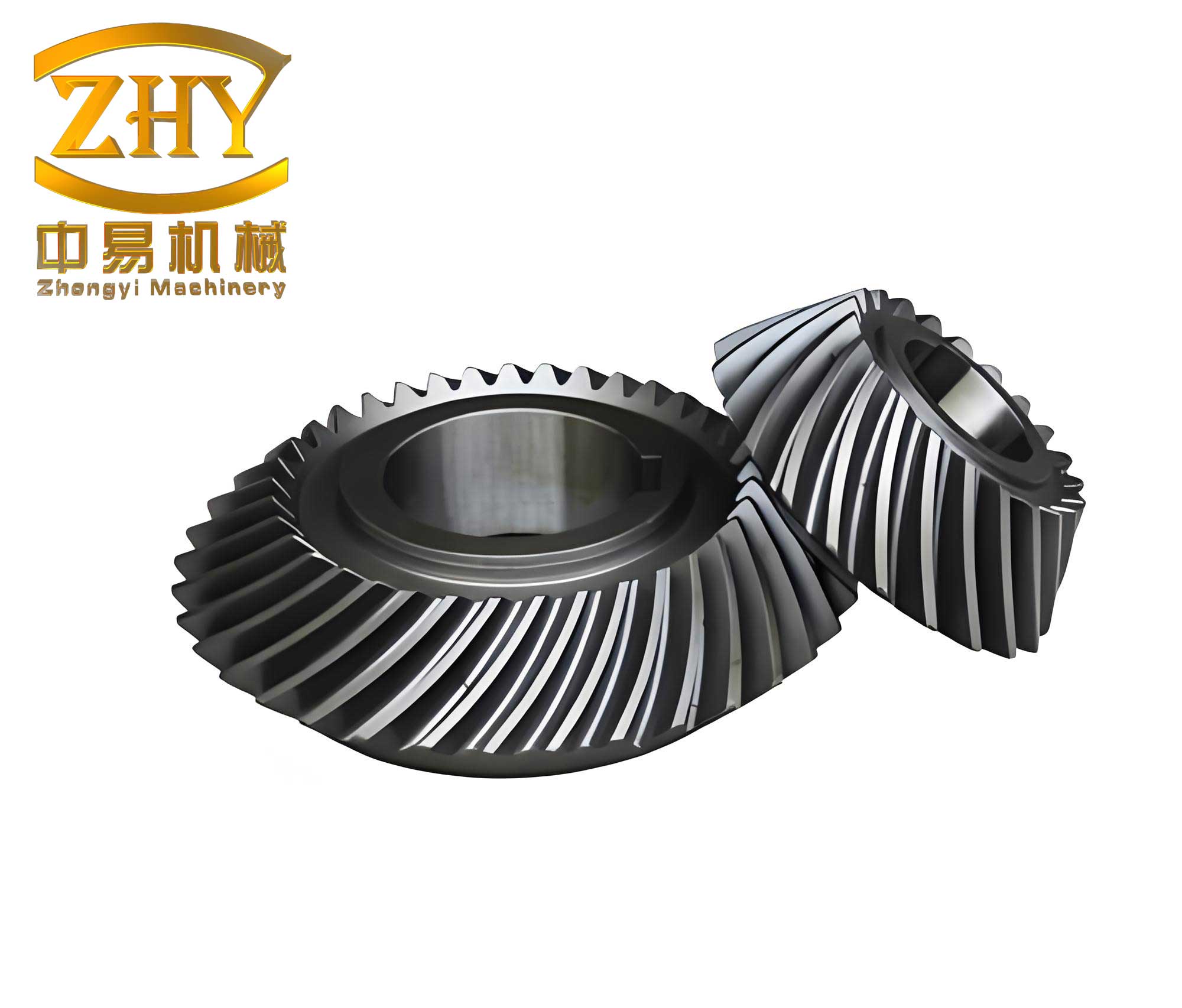
To design a conjugate tooth profile for spiral gears, I developed a curve composed of circular arcs and involute segments. The tooth profile from the root to the tip is divided into sections: a root arc, an involute curve, and a tip arc, with tangency conditions at the junctions. This ensures smooth transitions and continuous meshing. The mathematical derivation begins with defining parameters based on gear geometry. Let the base circle radius be \( r \), and let angles \(\alpha_0\), \(\alpha_1\), and \( T \) represent specific points on the involute relative to a reference axis. The involute curve parametric equations are derived from the geometry of a point on the involute. For any point \( P \) on the involute, with parameter \( \alpha \) (the angle from a reference point), the coordinates are given by:
$$ x_p = r(\cos(\alpha) + \alpha \sin(\alpha)) $$
$$ y_p = r(\sin(\alpha) – \alpha \cos(\alpha)) $$
Here, \( \alpha \) varies, and these equations describe the involute portion of the tooth profile. The circular arcs at the root and tip are designed to be perpendicular to specific radial lines, ensuring proper mating. By imposing tangency conditions, I derived relationships for the root radius \( \rho \) and tip radius \( \Phi \). Using geometric constraints from meshing of two identical spiral gears, the following expressions were obtained:
$$ \frac{\rho}{r} = \sec\left(\alpha_0 – T – \frac{\pi}{7}\right) – \tan\left(\alpha_0 – T – \frac{\pi}{7}\right) + \alpha_0 $$
$$ \frac{\Phi}{r} = \sec(\alpha_1 – T) – \tan(\alpha_1 – T) + \alpha_1 $$
Furthermore, the angle \( T \) is determined by the engagement condition when two gears are in full contact. Through analysis of the meshing process, where gears rotate symmetrically, the relation for \( T \) is:
$$ T = \frac{\alpha_0 + \alpha_1 + \frac{\pi}{7}}{2} – \arctan\left(\frac{\alpha_0 + \alpha_1}{2}\right) $$
These formulas allow calculation of key dimensions based on selected parameters. For practical design, standard gear parameters are also incorporated. The table below summarizes the essential gear parameters used in the design of spiral gears:
| Parameter | Symbol | Formula or Value |
|---|---|---|
| Center Distance | \( a \) | \( a = \frac{z m_n}{\cos \beta} \) |
| Module (Normal) | \( m_n \) | Selected based on pump size |
| Pressure Angle (Normal) | \( \alpha_n \) | Typically 20° |
| Helix Angle | \( \beta \) | Optimized for continuous contact |
| Number of Teeth | \( z \) | Chosen as 14 for this design |
| Base Circle Radius | \( r \) | \( r = \frac{d_b}{2} = \frac{d_t \cos \alpha_t}{2} \) |
| Tip Circle Radius | \( \Phi \) | From equation above |
| Root Circle Radius | \( \rho \) | From equation above |
The design process involves selecting initial values for \( \alpha_0 \) and \( \alpha_1 \), then computing \( T \), \( \rho \), and \( \Phi \). For instance, with a base radius \( r = 13.749 \, \text{mm} \), target tip radius \( \Phi = 19.1 \, \text{mm} \), and root radius \( \rho = 12.7 \, \text{mm} \), solving the equations yields \( \alpha_0 = 0.3312 \, \text{rad} \) and \( \alpha_1 = 0.8300 \, \text{rad} \). These angles define the start and end of the involute segment. The complete tooth profile is generated by revolving this curve around the gear axis and applying a helix angle \( \beta \). The helix angle is critical for spiral gears, as it ensures that multiple teeth are in contact simultaneously, smoothing out the flow. The tooth profile curve is then used to create a spline for gear generation via the generating method. The spline curve is defined by points calculated from the involute equations, and it is symmetric to form a full tooth space. Below is a table showing coordinate points for the tooth profile spline, which are used in CAD software for modeling spiral gears:
| Point Type | X Coordinate (mm) | Y Coordinate (mm) |
|---|---|---|
| B (Involute Start) | 14.4827 | 0.1647 |
| C (Involute End) | 17.6996 | 2.4441 |
| Symmetric B | 12.3736 | 7.5279 |
| Symmetric C | 16.3095 | 5.5942 |
| Additional Points | … (from simulation) | … (from simulation) |
With the mathematical model established, I proceeded to simulation using three-dimensional CAD software. The initial spline curve was extruded with a helix to create a virtual model of the spiral gears. Simulation of meshing revealed minor oil-trapping regions at the tooth tips and roots, indicating the need for curve adjustment. By iteratively modifying \( \alpha_0 \), \( \alpha_1 \), and the arc radii, I optimized the profile to eliminate these pockets. The final simulation showed continuous contact along the tooth flank, with no gaps during rotation. This optimized profile is essential for spiral gears to function effectively in pumps. The simulation also confirmed that the engagement trajectory forms a figure-eight pattern, ensuring at least one point of contact at all times, which is a hallmark of conjugate action. The helix angle \( \beta \) was set to 15° based on simulation results, providing a balance between axial thrust and smooth engagement. The virtual model demonstrated significant reduction in pressure pulsation compared to straight-tooth designs.
Following simulation, a prototype of the spiral gear pump was manufactured. The gears were cut and ground to the optimized profile, with careful attention to the helix angle. The pump had a theoretical displacement of 30 mL/rev, designed for a rated pressure of 20 MPa and maximum pressure of 25 MPa, operating at 2000 rpm. Extensive testing was conducted to evaluate performance. The table below summarizes the test results, highlighting the superiority of the spiral gear design:
| Test Item | Technical Requirement | Test Result | Judgment |
|---|---|---|---|
| Displacement Verification (mL/rev) | 28.5 – 33 | 30.2 | Pass |
| Volumetric Efficiency at Rated Speed | ≥ 91% | 94.7% | Pass |
| Overall Efficiency | ≥ 81% | 87.3% | Pass |
| Sealing Performance | No leakage | No leakage observed | Pass |
| Overspeed Test (2300 rpm, 15 min) | No abnormalities | Stable operation | Pass |
| Overload Test (25 MPa, 1 hour) | No abnormalities | Stable operation | Pass |
| Low-Speed Performance (800 rpm) | Maintain 20 MPa | Stable pressure output | Pass |
| Low-Speed Volumetric Efficiency | ≥ 65% | 70% | Pass |
| High-Temperature Performance (90-100°C) | Operate for 1 hour | Normal operation | Pass |
| High-Temperature Volumetric Efficiency | ≥ 91% | 95.3% | Pass |
| Noise Level at 1500 rpm | ≤ 80 dB | 62 dB | Pass |
The results demonstrate outstanding performance across all criteria. The volumetric efficiency exceeds requirements significantly, indicating minimal internal leakage. Notably, the noise level is drastically reduced to 62 dB, far below the 80 dB limit, which is a direct benefit of the spiral gears’ continuous meshing and elimination of oil trapping. After testing, the pump was disassembled for inspection, and all friction surfaces showed normal wear, confirming the robustness of the design. The success of this spiral gear pump validates the mathematical approach and simulation efforts. The use of spiral gears not only solves traditional issues but also enhances efficiency and durability, making it ideal for modern hydraulic systems demanding low noise and high reliability.
In conclusion, this study presents a comprehensive design and research methodology for spiral gears in hydraulic pumps. By developing a conjugate tooth profile based on involute and circular arcs, and incorporating a helix angle, I have created a gear pair that ensures continuous engagement, effectively eliminating oil trapping and reducing pulsation. The mathematical models, supported by simulations and experimental tests, prove that spiral gears can achieve high efficiency, low noise, and reliable operation. The key formulas and parameters summarized in this article provide a foundation for further optimization. The repeated emphasis on spiral gears underscores their importance in advancing hydraulic technology. Future work may explore different helix angles or materials to further enhance performance. Overall, this innovative design of spiral gears offers a significant step forward in developing quiet and efficient hydraulic systems for various industrial applications.