
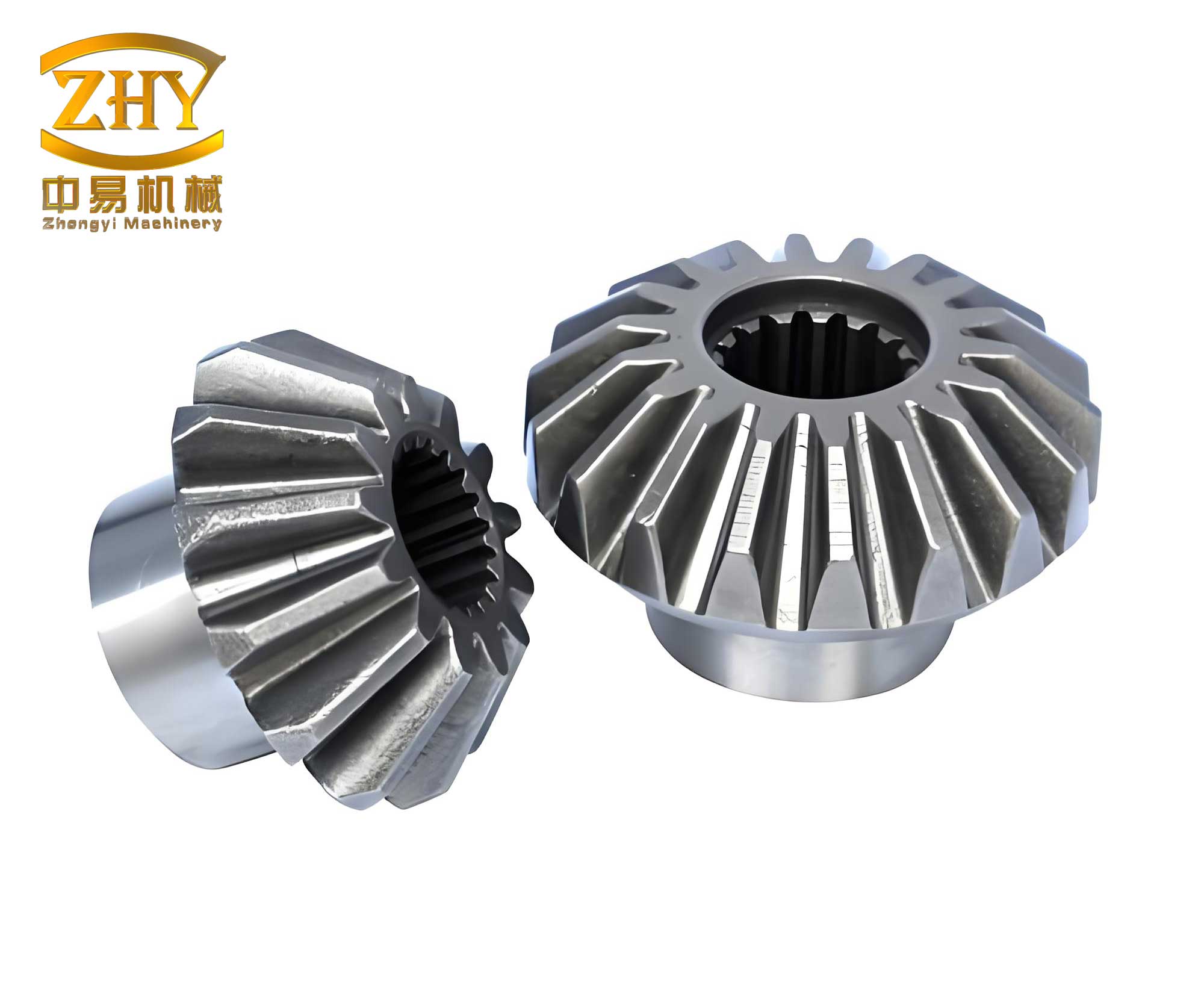
In modern transmission systems, particularly within demanding sectors such as aerospace, the performance, reliability, and longevity of bevel gear pairs are paramount. These components are critical for transmitting power between intersecting axes, and their operational excellence directly influences system efficiency, vibration characteristics, and noise levels. Consequently, the manufacturing and subsequent verification of bevel gear quality require equipment of exceptional precision. The bevel gear comprehensive testing machine stands as the final arbiter of quality, simulating real-world meshing conditions to evaluate crucial parameters like transmission error, contact pattern, and dynamic behavior. The accuracy of this testing machine is therefore non-negotiable. It is a composite metric derived from the precision of its individual kinematic chains and their geometric relationships. Among these, the accuracy of the axial intersection—specifically, the spatial coincidence of the main spindle axes—is a foundational and critical indicator. Any deviation from perfect intersection, arising from minute installation or alignment errors, propagates directly into the simulated installation errors of the tested bevel gear pair, corrupting the validity of the measurement data. Thus, the precise quantification and subsequent compensation of this axial intersection error are essential steps in calibrating these sophisticated machines and ensuring the fidelity of their assessments.
The structural configuration of a typical bevel gear testing machine is designed to replicate the mounting conditions of a mating pair. The core kinematics often involve three linear axes (conventionally X, Y, Z) and a rotary axis (C) for setting the shaft angle. The test bevel gear and the master bevel gear are mounted on two main spindles, designated as the A-axis and B-axis, which are typically oriented parallel to the X and Y linear axes, respectively. The fundamental requirement for accurate testing is the perfect spatial coincidence of the theoretical apex points of the two mounted bevel gears. This apex point must also remain stable relative to the machine’s coordinate system. In an ideal machine, the rotational centerlines of the A-axis and B-axis intersect precisely at a single point in space, which should also be aligned with the central rotation point of the C-axis. However, in reality, manufacturing tolerances and assembly processes introduce微小 deviations. These manifest as two distinct intersection errors: the spatial distance between the A-axis and C-axis centerlines ($D_{AC}$) and the spatial distance between the B-axis and C-axis centerlines ($D_{BC}$). Unlike a machining center where tool paths can be adjusted, the spindle locations on a testing machine are often fixed after assembly, making these intersection errors inherent system errors that must be measured and compensated for digitally.
While various methods exist for measuring axis intersection in multi-axis systems like rotary tables, many are tailored to specific equipment geometries or involve complex, time-consuming procedures with specialized instrumentation like laser trackers or经纬仪. The challenge for the bevel gear tester lies in its unique requirement: the intersection point is a virtual point in space, located at the theoretical extension of the spindles, and is not directly accessible for physical measurement. This study proposes a novel, practical, and highly accurate detection method specifically designed for this context, followed by a sophisticated kinematic compensation strategy to nullify the error’s effect during testing.
The proposed detection method ingeniously extends the machine’s axes into measurable space using high-precision checking rods. These rods are manufactured with exceptional straightness and concentricity and are mounted onto the A, B, and C-axis spindles. They effectively become tangible extensions of the rotational centerlines. The core principle is to create a situation where the cylindrical surfaces of two checking rods are brought into a near-parallel, adjacent configuration, allowing the direct measurement of the spatial gap between them. This gap is directly related to the axis intersection error.
Let us consider the measurement of the error $D_{BC}$ between the B-axis and C-axis. A checking rod is mounted on the C-axis. Another checking rod is mounted on the B-axis. The machine’s linear axes (X, Y, Z) are adjusted to bring the cylindrical surfaces of the C-axis rod and the B-axis rod parallel and close to each other, ensuring they are roughly co-planar. A precision micrometer or a dial indicator with a wide range is then used to measure the perpendicular distance between the two cylindrical surfaces at a specific location. This measured value is not $D_{BC}$ itself, but a combined dimension including the radii of the rods. The key to isolating $D_{BC}$ lies in taking two measurements with the C-axis checking rod rotated by 180 degrees about its own axis.
In the first measurement position, the geometry can be described. Let $R_C$ be the known radius of the C-axis checking rod, and $R_B$ be the known radius of the B-axis checking rod. The measured distance between the outer surfaces is denoted as $L_1$. The relationship is given by:
$$ L_1 = R_C + D_{BC} + R_B $$
This equation simply states that the outer-to-outer distance is the sum of the two radii and the spatial offset $D_{BC}$ of their centerlines.
The C-axis checking rod is then rotated 180°. In this new orientation, the centerline offset $D_{BC}$ is now on the opposite side relative to the fixed B-axis rod. The second measurement, $L_2$, captures this new configuration:
$$ L_2 = R_C + R_B – D_{BC} $$
Subtracting the two equations allows us to solve for the desired intersection error:
$$ L_1 – L_2 = (R_C + D_{BC} + R_B) – (R_C + R_B – D_{BC}) = 2D_{BC} $$
Therefore, the axis intersection error is calculated as:
$$ D_{BC} = \frac{L_1 – L_2}{2} $$
This differential measurement technique is powerful because it inherently cancels out systematic errors related to the exact absolute size of the checking rods and any minor misalignment in the measurement setup, as these factors remain constant between the two readings. The same procedure is repeated to measure $D_{AC}$ by mounting the B-axis checking rod onto the A-axis spindle and re-orienting the C-axis rod appropriately.
The measurement process demands rigor. Each length ($L_1$, $L_2$) should be measured multiple times (e.g., three times) at the same relative point to ensure repeatability. The spread of these readings should be within a tight tolerance, say 2 μm. If the dispersion is larger, the setup must be checked and the measurements retaken. The final value for each length is the average of the stable, repeatable readings. A sample set of measurement data is presented in the table below.
| Measurement Target | Measured $L_1$ (mm) | Measured $L_2$ (mm) | Calculated Error $D$ (mm) | Calculated Error $D$ (μm) |
|---|---|---|---|---|
| A-axis / C-axis ($D_{AC}$) | 90.025 | 89.773 | 0.126 | 126 |
| B-axis / C-axis ($D_{BC}$) | 89.977 | 89.831 | 0.073 | 73 |
Having accurately quantified $D_{AC}$ and $D_{BC}$, the next critical step is compensation. A simple mechanical realignment of the spindles is often impractical. Therefore, a software-based kinematic compensation is employed. The goal is to dynamically adjust the commanded positions of the A and B linear axes during testing such that the apex points of the virtual bevel gears coincide perfectly, regardless of the inherent $D_{AC}$ and $D_{BC}$ errors and the set shaft angle Σ.
The compensation logic derives from the relative geometry of the axes. The errors $D_{AC}$ and $D_{BC}$ are fixed vectors in the plane perpendicular to the C-axis. When the C-axis rotates to set a shaft angle Σ (where Σ is typically the angle between the A and B axes, often around 90° for orthogonal bevel gears but variable for non-orthogonal ones), the required adjustments ΔA and ΔB for the A and B linear axes, respectively, become trigonometric functions of Σ, $D_{AC}$, and $D_{BC}$. The objective is to shift the effective intersection point of the A and B axes to the correct location.
By analyzing the geometry, the compensation values can be derived. The required adjustment for the B-axis position (ΔB) to correct for both errors when the shaft angle is Σ is:
$$ \Delta_B = \frac{D_{AC}}{\sin(\Sigma)} + \frac{D_{BC}}{\tan(\Sigma)} $$
Similarly, the required adjustment for the A-axis position (ΔA) is:
$$ \Delta_A = \frac{D_{BC}}{\sin(\Sigma)} + \frac{D_{AC}}{\tan(\Sigma)} $$
These formulas are pivotal. They show that the compensation is not a constant but varies dynamically with the shaft angle Σ. For a standard orthogonal bevel gear test (Σ = 90°), the terms simplify since sin(90°)=1 and tan(90°) approaches infinity (or is handled as a very large number in practice, making $D/\tan(90°)$ effectively zero in ideal orthogonal compensation models, though a more complete model may include it for non-perfect angles). The key insight is that to compensate for the A/C error ($D_{AC}$), one must primarily adjust the *B-axis* position by an amount proportional to $D_{AC}/sin(Σ)$, and vice versa. This cross-coupling is essential for accurate compensation.
This compensation model is integrated into the machine’s数控 system. After the intersection errors $D_{AC}$ and $D_{BC}$ are determined during machine calibration, they are stored as system parameters. Whenever a new bevel gear pair with a specified shaft angle Σ is programmed for testing, the control software automatically calculates the requisite ΔA and ΔB offsets and applies them to the nominal A-axis and B-axis installation positions. This ensures that the virtual cone apexes of the two bevel gears coincide at the correct point in space for that specific angle.
However, implementing compensation is only half the solution. Verifying its effectiveness is equally crucial. A direct re-measurement of $D_{AC}$ and $D_{BC}$ using the checking rod method post-compensation would yield the same results, as the physical misalignment remains unchanged. A more functional verification method is required. This study proposes an elegant verification technique using a high-precision spherical checking rod (ball-bar).
The spherical checking rod features a highly accurate sphere mounted on a shaft, with the distance from the mounting face to the sphere’s center known to micrometer-level accuracy. After compensation parameters are applied for a given shaft angle Σ, this rod is mounted on the A-axis spindle. Its sphere’s center is now precisely at the *compensated* theoretical apex point. A dial indicator is then mounted on the B-axis spindle, with its probe touching the sphere’s surface. The B-axis is then rotated. If the compensation is perfect, the probe will trace a perfect circle on the sphere, and the dial indicator reading will remain constant. Any residual error will cause the probe to trace an ellipse or a more complex path, resulting in a periodic variation in the dial indicator reading. The magnitude of this variation can be used to quantify any remaining apex misalignment. This process is then repeated by mounting the spherical rod on the B-axis and the indicator on the A-axis, and it should be performed at several different shaft angles Σ to validate the compensation algorithm across the machine’s working range. This verification method directly tests the functional outcome—apex coincidence—making it a robust and practical acceptance test for the compensated bevel gear testing machine.
The pursuit of precision in bevel gear testing is an ongoing endeavor driven by the escalating demands of high-performance applications. The method outlined in this study provides a comprehensive and systematic approach to tackling one of the most fundamental geometric error sources: axial intersection error. The detection technique, leveraging differential measurements with precision checking rods, is both accurate and practical, eliminating the need for extremely complex metrology systems. The derived kinematic compensation model is sophisticated, accounting for the dynamic interplay between the fixed intersection errors and the variable shaft angle. Finally, the proposed verification method using a spherical artifact offers a direct and convincing proof of the compensation’s efficacy. Together, these steps form a闭环 calibration and assurance process that significantly enhances the intrinsic accuracy of a bevel gear comprehensive testing machine. By ensuring that the fundamental geometry of the test setup is correct, we lay a trustworthy foundation for all subsequent measurements of contact patterns, transmission error, and dynamic performance, ultimately contributing to the development and validation of more reliable, quieter, and longer-lasting bevel gear transmissions for critical industries like aerospace.