
Bevel gears are fundamental and critical components within the accessory gearbox of modern aero-engines. They are primarily responsible for altering the direction of power transmission, efficiently routing torque from the engine’s central shaft to various auxiliary systems such as fuel pumps, hydraulic pumps, and electrical generators. The reliable and smooth operation of these bevel gear pairs is therefore paramount to the overall performance and safety of the aircraft propulsion system.
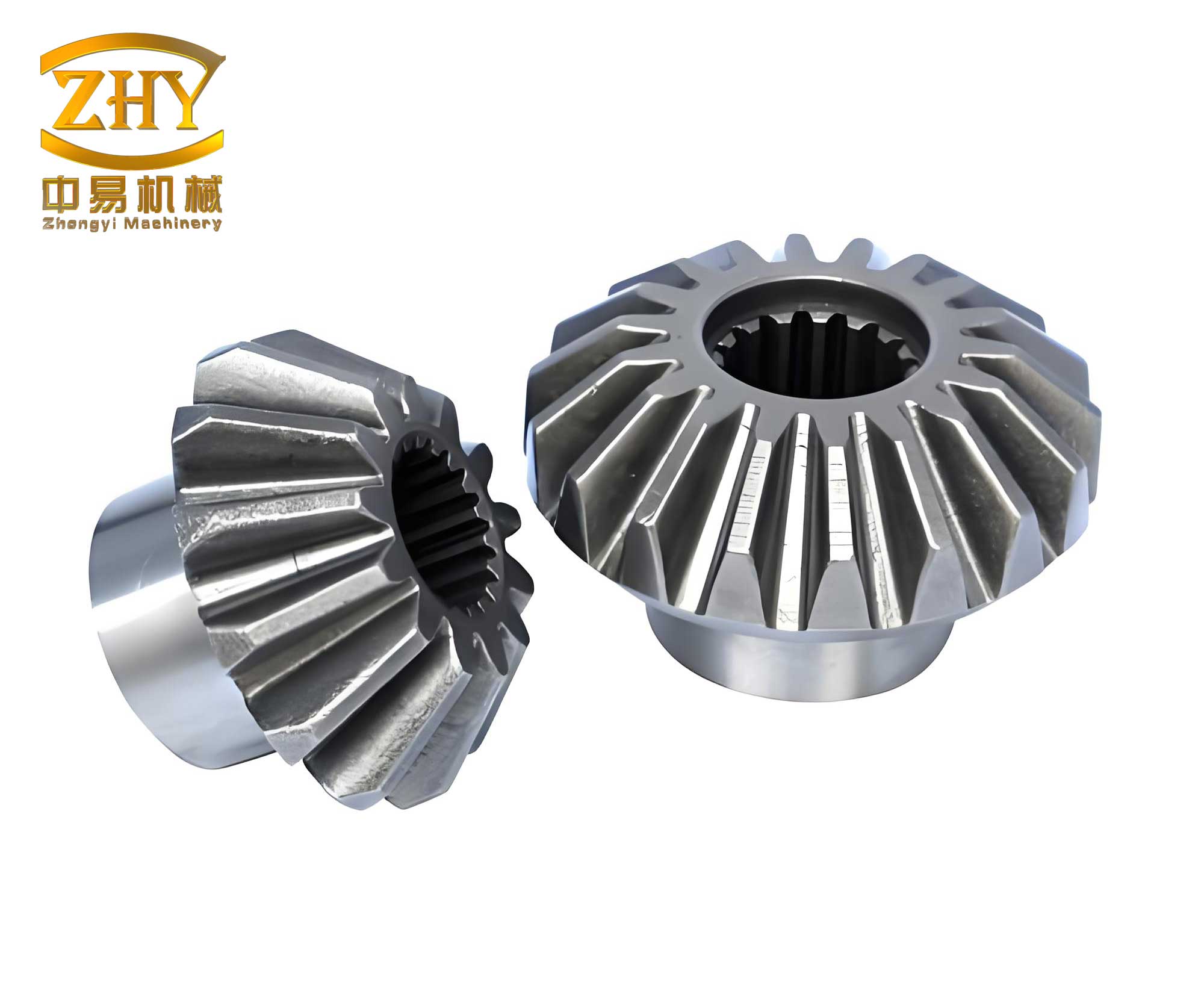
During service, these bevel gears are subjected to a harsh operating environment characterized by high rotational speeds, significant dynamic loads, and wide temperature variations. This, combined with inherent factors such as machining errors, assembly misalignments, and the inevitable micro-geometrical impacts during meshing, can lead to various surface degradation modes. Common failure modes include surface wear, pitting, spalling, and scuffing (or scoring). These defects compromise the gear’s geometric accuracy, load distribution, and transmission stability. This degradation often manifests as increased vibration and noise, and in severe cases, can progress to tooth fracture, leading to catastrophic engine failure. Traditional maintenance philosophies, often erring on the side of caution, may condemn bevel gears with surface damage that is technically repairable, leading to significant economic waste and loss of the high embedded value in these precision components. Consequently, developing and implementing a robust bevel gear remanufacturing technology is of immense practical and economic importance for the aviation industry, promoting sustainability by extending service life, conserving resources, and reducing lifecycle costs.
Failure Modes and Mechanisms in Bevel Gears
A comprehensive understanding of the failure mechanisms is the first step towards developing an effective remanufacturing strategy. The primary failure modes for aero-engine bevel gears are surface-initiated.
| Failure Mode | Description & Visual Characteristics | Primary Root Causes |
|---|---|---|
| Scuffing (Scoring) | Localized welding and subsequent tearing of surface material between mating teeth. Appears as rough, scratched, or dragged surfaces, often in the direction of sliding. | Breakdown of lubricant film due to high contact pressure/sliding velocity, insufficient lubrication, high operating temperature, poor surface finish. |
| Abrasive Wear | Progressive loss of material from the tooth flanks due to mechanical action of hard particles. Leads to changed tooth profile and increased backlash. | Contaminated lubrication (foreign particles, wear debris), inadequate filtration, poor lubrication. |
| Pitting | Formation of small surface cavities (pits) due to subsurface fatigue cracks. Initiated near the pitch line where contact stresses are high and sliding is minimal. | Cyclic Hertzian contact stresses exceeding material endurance limit, material imperfections, inadequate surface hardness, misalignment. |
| Spalling | Flaking off of larger, macroscopic pieces of material from the surface or subsurface. More severe than pitting. | Subsurface inclusions, improper heat treatment causing high residual stresses, severe overloading. |
The underlying mechanics for pitting and spalling are rooted in contact fatigue theory. The maximum shear stress $ \tau_{max} $ occurs slightly below the surface. Repeated loading can initiate cracks at this location, which propagate to the surface. The pressure in entrapped lubricant can accelerate crack growth. The classic Hertzian contact stress for gear teeth can be approximated, though exact calculation for bevel gears is complex. The principle is governed by:
$$ \sigma_H = Z_E \sqrt{ \frac{F_t}{b d_1} \cdot \frac{u \pm 1}{u} \cdot Z_H Z_\epsilon Z_\beta } $$
Where $ \sigma_H $ is the contact stress, $ Z_E $ is the elasticity factor, $ F_t $ is the tangential load, $ b $ is the face width, $ d_1 $ is the pinion reference diameter, $ u $ is the gear ratio, and $ Z_H, Z_\epsilon, Z_\beta $ are factors for zone, contact ratio, and helix angle, respectively. Failure occurs when $ \sigma_H $ exceeds the allowable stress limit of the case-hardened material over a critical number of cycles (often $ 10^7 $ for design life).
Feasibility Analysis for Bevel Gear Remanufacturing
Remanufacturing, as defined here, is the process of restoring a used bevel gear with surface damage to a condition where its performance meets or exceeds that of a new part, without altering its core geometry or material composition. The feasibility is assessed on technical, economic, and temporal grounds.
1. Technical Feasibility: The core technology for bevel gear remanufacturing is precision profile modification (or re-grinding). Since the damage is typically superficial (within microns to a few tens of microns), a controlled amount of material can be removed from the active tooth flanks to eliminate defects and re-establish a correct, albeit modified, tooth geometry. The process must ensure that:
- The remaining case depth after material removal is sufficient ($\geq$ minimum specified, e.g., 0.7 mm).
- The core mechanical properties (hardness, microstructure) are unaffected as the process does not involve re-heat treatment.
- The new tooth geometry maintains proper meshing characteristics (contact pattern, backlash).
2. Life Cycle Considerations: A new bevel gear is designed for a fatigue life far exceeding the engine’s time-between-overhaul (TBO). A gear removed for surface distress has consumed only a fraction of its potential fatigue life. The remanufacturing process, by removing the damaged layer and potentially introducing a more favorable surface stress state, can effectively “reset” the surface fatigue clock, allowing the gear to comfortably meet the next overhaul interval.
3. Surface Enhancement: To compensate for not re-carburizing and to potentially improve performance, surface enhancement techniques like shot peening are integral to the remanufacturing process. Shot peening induces a layer of compressive residual stress on the tooth surface, which significantly retards the initiation and propagation of fatigue cracks. The improvement in fatigue strength can be quantified, though it is material and process-specific. The Almen intensity and coverage are critical controlled parameters.
4. Economic & Temporal Feasibility: The cost of a new aerospace bevel gear is dominated by the “value-added” processes (forging, machining, heat treatment, grinding) rather than the raw material. Remanufacturing preserves this high embedded value. The lead time for a remanufactured gear is also drastically shorter than for a newly procured one, alleviating supply chain pressures and reducing aircraft on-ground time.
The Core Technology: Profile Modification Theory and Application
Profile modification is the deliberate deviation of the actual tooth profile from the theoretical involute or conjugate form. It is the cornerstone of high-performance gear manufacturing and, by extension, bevel gear remanufacturing. Its primary purpose is to compensate for deflections and errors that cause non-ideal meshing.
Mechanism of Interference: Under load, teeth deflect elastically. This deflection, combined with manufacturing inaccuracies (like base pitch error $ \Delta f_{pb} $), causes a phenomenon known as tip and root interference. During meshing-in, the tip of the driven gear can dig into the flank of the driving gear before reaching the theoretical line of action. During meshing-out, the tip of the driving gear can scrape along the flank of the driven gear, delaying disengagement. This interference generates impact loads, noise, and can scrape away the protective lubricant film, leading directly to scuffing and accelerated wear.
Purpose of Modification: Profile modification removes a small amount of material from the tip and/or root regions of the tooth, creating a slight “ease-off.” This provides clearance to accommodate the deflection and errors, allowing the teeth to enter and exit mesh smoothly. This minimizes impact, reduces dynamic loads, lowers vibration and noise, improves load distribution across the face width, and enhances scuffing resistance.
Modification Parameters: Three key parameters define a profile modification:
- Modification Amount (Cα): The maximum depth of material removed, typically in micrometers. It should ideally compensate for the total composite deflection and error: $$ C_{\alpha max} \approx \delta_{elastic} + \Delta f_{pb} $$ where $ \delta_{elastic} $ is the calculated tooth pair deflection under load.
- Modification Length (Lα): The distance from the start of the modification (near the pitch line) to the tip or root, measured along the profile.
- Modification Curve: The shape of the modification zone (linear, parabolic, circular). A parabolic or tangential curve is often used for smooth transitions. A general form is: $$ \Delta(x) = C_{\alpha max} \left( \frac{x}{L_\alpha} \right)^n $$ where $ \Delta(x) $ is the modification depth at a distance $ x $ from the start, and $ n $ defines the curve shape (e.g., n=2 for parabolic).
For spiral bevel gears, modification is applied not just along the profile but also along the lengthwise (face) direction to optimize contact patterns under load. The parameters are carefully determined based on load analysis, deflection calculations, and empirical standards (like ISO guidelines). For a remanufacturing application, the modification amount is minimal, often in the range of 0.015-0.025 mm, just sufficient to clean up damage and apply a controlled ease-off.
Establishing a Remanufacturing Discriminating Standard
A critical step in a viable remanufacturing process is the establishment of clear, objective criteria to determine whether a used bevel gear is a suitable candidate. This standard prevents the attempted remanufacture of gears with damage too severe to be economically or reliably repaired. The following table outlines a proposed discriminating standard based on common failure modes.
| Failure Mode | Remanufacturable Criteria | Reject Criteria (Scrap) |
|---|---|---|
| Wear | Cumulative wear depth (sum of both flanks) ≤ 10% of module (m). | Wear depth > 10% of m, or severe profile distortion. |
| Scuffing | Scuffed area ≤ 20% of total active flank area AND maximum scuffing groove depth ≤ 10% of m. Both conditions must be met. | Area > 20% OR depth > 10% of m. |
| Pitting/Spalling | Pitted area ≤ 50% of flank area. For area >20%, maximum pit dimension ≤ 20% of m AND maximum pit depth ≤ 10% of m. | Area > 50%, OR deep pits exposing core material, OR spalling. |
| Other Defects | Minor nicks, scratches, or discoloration that can be polished out with minimal material removal (e.g., < 0.05 mm). | Cracks (any size), severe overheating/oxidation, case crushing, plastic deformation, broken teeth. |
Application of this standard requires visual and dimensional inspection, often aided by non-destructive testing (NDT) like magnetic particle inspection (MPI) to definitively rule out cracks.
The Bevel Gear Remanufacturing Process Flow
The remanufacturing process is a sequence of precision operations designed to transform a qualified used bevel gear into a functionally equivalent or superior product. The following flow chart details the key steps, contrasting it with the new gear manufacturing process to highlight the value recovery.
1. Initial Cleaning & Inspection: The candidate gear is thoroughly cleaned to remove grease and contaminants. A detailed visual inspection and 100% NDT (MPI) are performed against the discriminating standard to confirm suitability and ensure no cracks are present.
2. Preliminary Polishing/Deburring: Minor surface imperfections like light scratches, burrs, or slight ridges are carefully removed using fine-grade stones or abrasive paper. The goal is to remove minimal material (typically < 0.05 mm) to smooth transitions without altering the core profile.
3. Precision Profile Modification (Regrinding): This is the core technical step. The gear is mounted on a high-precision CNC bevel gear grinding machine (e.g., Gleason). Using a proprietary or optimized program, the active tooth flanks are ground to remove the damaged layer and simultaneously impart the designed profile and lead modifications. The modification amount is precisely controlled to be just enough to achieve a clean, sound surface while maintaining adequate case depth. The gear geometry after grinding must be verified.
4. Post-Grinding Finishing & Enhancement:
- Polishing: A light polishing may follow grinding to achieve the required surface finish (e.g., Ra ≤ 0.4 µm).
- Shot Peening: The gear is subjected to a controlled shot peening process on all tooth surfaces. This critical step induces beneficial compressive residual stresses, enhancing fatigue performance. Parameters (shot size, intensity, coverage) are specified based on the gear material and design.
5. Final Inspection & Verification: The remanufactured gear undergoes a battery of inspections equivalent to those for a new gear:
- Geometry Check: Profile and lead traces are verified on a gear measuring machine or coordinate measuring machine (CMM).
- Hardness & Case Depth: Micro-hardness surveys are conducted to confirm surface and core hardness meet specifications. A metallographic section may be taken to verify effective case depth remains above the minimum required threshold (e.g., >0.7 mm).
- NDT: Final magnetic particle inspection to ensure no defects were introduced during processing.
- Dimensional Checks: Critical dimensions, chordal tooth thickness, and runout are measured.
6. Assembly Validation: The gear is not considered finished until validated in assembly. The pinion and gear are assembled into their housing, and key parameters are checked:
- Backlash: Measured to ensure it is within the specified tight tolerance.
- Tooth Contact Pattern (TCP): Using precision marking compound (bluing), the static contact pattern on the flanks is checked under light load. The pattern must be centrally located, of appropriate size and shape, confirming correct alignment and gear geometry.
Case Study: Application and Performance Validation
The efficacy of the remanufacturing process is best demonstrated through a real-world application and rigorous validation.
Scenario: An aero-engine exhibited excessive vibration during a test cell run. Vibration signal analysis pointed towards the accessory gearbox. Spectral analysis revealed elevated amplitudes at the gear mesh frequency and its harmonics, along with sidebands spaced at the shaft rotational frequency. The time-domain signal showed periodic impulses. This signature is classic for localized gear tooth damage, such as pitting or spalling, causing impacting and slight misalignment. The diagnosis was a faulty bevel gear pair in the vertical power take-off section.
Root Cause & Remanufacturing: Upon disassembly, the suspected bevel gear pair showed distress in the form of pitting and scoring near the pitch line on several teeth. The gears were inspected against the discriminating standard and deemed suitable for remanufacturing. They underwent the complete process flow: cleaning, MPI, precision regrinding with profile modification, shot peening, and final inspection. Post-regrinding, the case depth was measured at 0.93 mm (within the 0.7-1.1 mm specification), and surface hardness was HRC 62.6, exceeding the minimum requirement.
Validation Testing: The remanufactured gear set was assembled into a test engine gearbox. Backlash and static tooth contact pattern were perfect. The engine was then subjected to a full test cell run. The results were conclusive:
- Vibration levels returned to normal, baseline values. The previously observed mesh frequency harmonics and sidebands were significantly reduced.
- No abnormal noises were detected from the gearbox.
- All engine performance parameters (speeds, pressures, temperatures) were nominal.
Post-test inspection revealed a uniform, well-centered wear pattern (metal shine) on the tooth flanks, indicating optimal load distribution and smooth meshing throughout the test cycle. This validated that the remanufactured bevel gears performed indistinguishably from new gears.
Economic and Environmental Impact Analysis
The benefits of bevel gear remanufacturing extend far beyond technical performance, offering substantial economic and environmental advantages.
| Aspect | New Gear Manufacturing | Gear Remanufacturing | Advantage of Remanufacturing |
|---|---|---|---|
| Resource Consumption | Requires new raw material (alloy steel), energy for melting, forging, and all primary machining. | Utilizes the existing gear body, saving ~95% of the raw material and the energy for its primary production. | Material Savings: ~78% Energy Savings: ~86% |
| Process Value-Added | Cost includes all value-added steps: forging, rough machining, carburizing, hardening, finish grinding. | Cost is primarily for the precision regrinding, finishing, and inspection steps. The high value of the forged and heat-treated blank is preserved. | Preserves ~85% of the embedded component value. |
| Direct Cost | High unit cost (e.g., $8,500 per gear set as a baseline). | Significantly lower cost (e.g., $960 per gear set, or ~11.3% of new cost). | Cost Reduction: ~89% |
| Lead Time | Long, subject to forging and heat treatment shop schedules (months). | Short, focused on machining and inspection (weeks). Supports faster engine turnaround. | Improved logistics and asset availability. |
| Environmental Footprint | High CO2 emissions from material production and extensive machining. | Dramatically reduced CO2 emissions and waste generation. Aligns with circular economy principles. | Reduced carbon footprint and industrial waste. |
The quantitative benefits are compelling. For the case study engine, applying the discriminating standard allowed approximately 62.5% of previously scrapped bevel gears to be recovered. The successful implementation of this technology across a fleet can lead to multi-million dollar savings in maintenance costs, reduce dependency on new part supply chains, and contribute significantly to the environmental sustainability goals of the aviation industry.
Conclusion
The development and implementation of a systematic bevel gear remanufacturing technology, centered on precision profile modification, represents a significant advancement in aero-engine maintenance practices. The process is founded on a clear understanding of gear failure mechanics, a stringent discriminating standard to select viable cores, and a controlled, inspection-intensive process flow that ensures restored geometric and metallurgical integrity. The integration of surface enhancement techniques like shot peening not only compensates for the lack of re-heat treatment but can improve the fatigue performance beyond the original state.
Technical validation through vibration analysis, rigorous inspection, and engine test cell runs confirms that remanufactured bevel gears exhibit performance characteristics—in terms of transmission smoothness, noise, vibration, and contact patterns—that are fully equivalent to, and in some aspects superior to, new gears. The economic and environmental advantages are unequivocal, with demonstrated cost savings of nearly 90%, material savings of 78%, and energy savings of 86% compared to manufacturing new gears. By extending the service life of high-value components, this technology reduces waste, conserves resources, lowers operational costs, and enhances supply chain resilience. It is a pragmatic and powerful embodiment of sustainable engineering within the demanding context of aerospace propulsion.