
In the mining industry, the reliability of equipment is paramount, especially for key components like scraper conveyors used in coal mining faces. The planetary reducer, as the core of the transmission system, demands high structural integrity and precision. With the trend toward larger mining equipment, reducers with integrated box structures have gained prominence due to their compactness and enhanced strength compared to split-box designs. However, the assembly and adjustment of bevel gear pairs within these integrated boxes pose significant challenges. In this article, I explore the innovative installation structures and adjustment methods for bevel gear pairs in integrated box structure planetary reducers, focusing on contact area optimization to meet design and operational requirements.
The transition from split-box to integrated box structures in planetary reducers represents a significant advancement. Split-box reducers allow for easier assembly and adjustment of bevel gear pairs, as the box can be separated to access internal components. In contrast, integrated boxes are cast as a single unit, offering superior rigidity and durability but complicating the assembly of input shafts and second shafts, as well as the adjustment of bevel gear contact areas. This necessitates a rethinking of shaft designs and positioning mechanisms to enable overall assembly within the box and precise control over bevel gear meshing. The bevel gear pair, consisting of conical gears on the input and second shafts, is critical for torque transmission, and its contact area directly impacts efficiency, noise, and lifespan. Therefore, developing new techniques for adjusting this contact area in integrated boxes is essential for advancing reducer performance.
To address these challenges, I have studied the structural design of input and second shafts in integrated box reducers. In split-box designs, bevel gear contact area adjustment is achieved by axially moving the input and second shafts using shims placed at bearing ends within the box. However, in integrated boxes, shafts must be assembled from the side, requiring a different approach. I propose a design where both the input and second shafts are equipped with bearing cups that facilitate axial movement and external positioning. The bearing cups are flanged and mounted on the box exterior, allowing for shim-based adjustments that shift the entire shaft axially. This design enables precise control over bevel gear meshing without disassembling the box. The following table summarizes the key differences between split-box and integrated box structures in terms of bevel gear adjustment:
| Aspect | Split-Box Reducer | Integrated Box Reducer |
|---|---|---|
| Box Structure | Separable upper and lower halves | Single cast unit |
| Bevel Gear Assembly | Direct access during assembly | Side assembly required |
| Contact Area Adjustment | Internal shims at bearings | External shims at bearing cups |
| Axial Movement | Individual shaft adjustment | Whole shaft adjustment via cups |
| Observation | Via open box | Via dedicated observation hole |
The integrated box structure, as illustrated in the provided link, highlights the compact nature of these reducers. The design includes an observation hole on the box top, aligned with the bevel gear pair, to monitor contact area during adjustment. This visual inspection is crucial for ensuring optimal meshing. The bearing cup mechanism involves machining precise gaps between the cup flange and box or side plate, which are then filled with shims of calculated thickness. This approach transforms the adjustment process from an internal, iterative task to an external, measurable one, enhancing accuracy and repeatability. The bevel gear pair’s performance hinges on proper contact area distribution, which can be modeled mathematically. For instance, the axial displacement $\Delta x$ of a shaft relates to the change in contact area $A_c$ through the gear geometry. A simplified formula for bevel gear contact adjustment can be expressed as:
$$ \Delta A_c = k \cdot \Delta x \cdot \sin(\alpha) $$
where $k$ is a constant dependent on gear parameters, and $\alpha$ is the bevel angle. This emphasizes the sensitivity of bevel gear meshing to axial movements, underscoring the need for precise shim calculations.
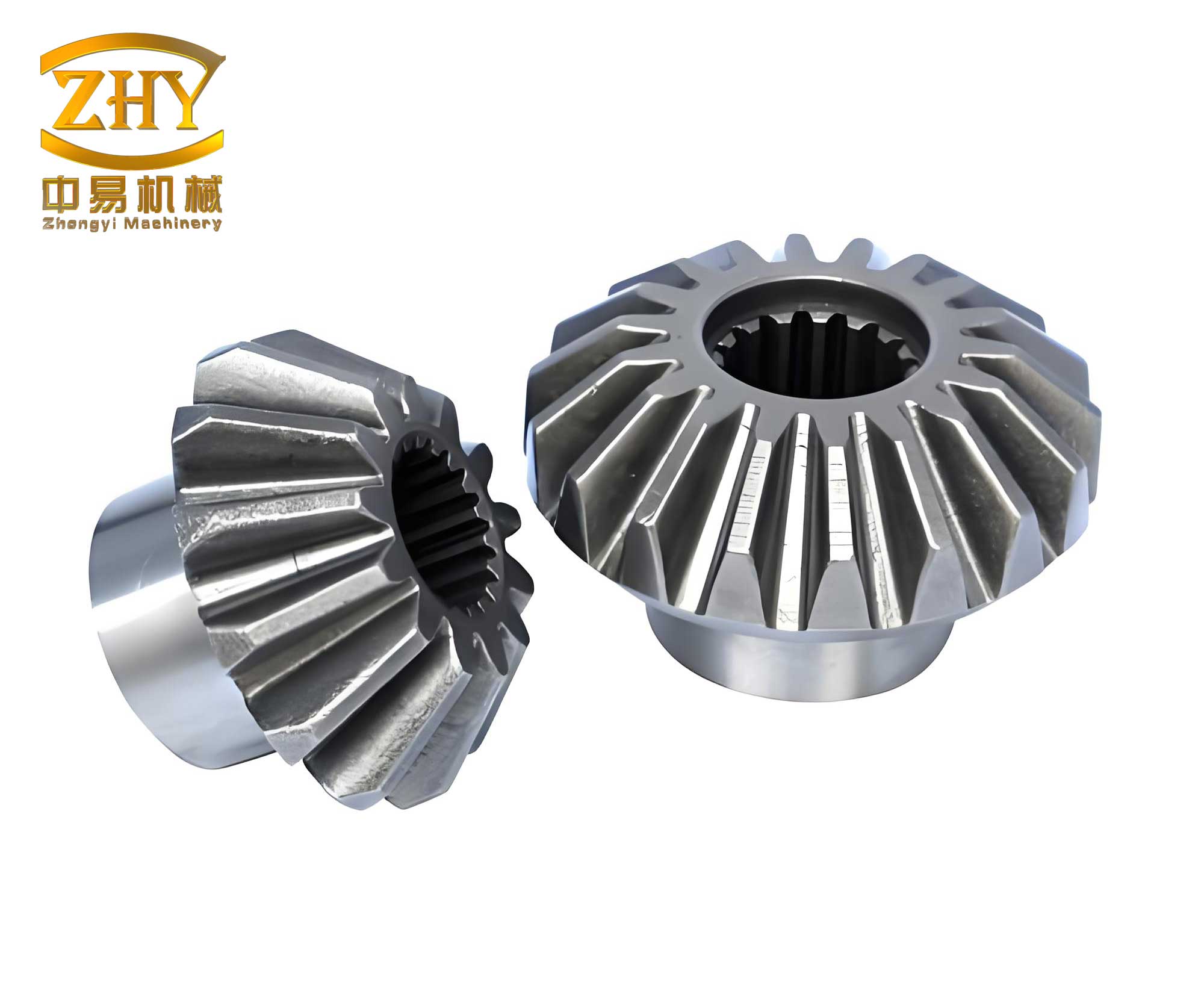
Building on this, the key technology for adjusting bevel gear contact area in integrated box reducers involves a systematic procedure. First, the input shaft is assembled into the box through its bearing hole, and the second shaft is pre-assembled with a side plate before insertion. Both shafts are then axially adjusted by varying the bearing cup positions, with contact area observed through the box’s observation hole. Once the desired contact area is achieved—typically characterized by even distribution across the gear teeth—the gaps at the bearing cup flanges are measured. These measurements inform the machining of shims, which are inserted to lock the shafts in place. The process ensures that the bevel gear pair operates under optimal conditions, minimizing wear and maximizing power transmission. To elaborate, consider the following steps in table form:
| Step | Action | Purpose |
|---|---|---|
| 1 | Assemble input shaft into box | Position first bevel gear |
| 2 | Assemble second shaft with side plate | Position second bevel gear |
| 3 | Adjust axial positions via bearing cups | Optimize bevel gear contact area |
| 4 | Observe contact through hole | Verify area distribution and size |
| 5 | Measure flange gaps | Determine shim thickness |
| 6 | Machine and insert shims | Fix shafts and maintain adjustment |
| 7 | Secure with bolts | Complete assembly |
The success of this adjustment relies on precise measurements and calculations. For example, the required shim thickness $t$ can be derived from the gap measurement $g$ and the desired axial displacement $d$ for the bevel gear pair. Using geometry, we have:
$$ t = g – d \cdot \cos(\beta) $$
where $\beta$ is the bearing contact angle. This formula ensures that shims compensate exactly for the gap, enabling accurate positioning. Repeated testing in high-power reducers, such as those used in 3000 kW scraper conveyors, has validated this method. The integrated box design, combined with external adjustment, reduces assembly time by up to 30% compared to traditional split-box approaches, while improving bevel gear life by ensuring consistent contact areas. Moreover, the use of bearing cups enhances structural support, reducing stress concentrations that can lead to fatigue failure in the bevel gear teeth.
In practice, the bevel gear contact area should cover 70-90% of the tooth surface under load, with a bias toward the toe or heel depending on application. The adjustment process must account for thermal expansion and dynamic loads, which can shift contact patterns. I have developed a formula to predict contact area changes under operational conditions:
$$ A_c’ = A_c \cdot \left(1 + \gamma \cdot \Delta T\right) – \delta \cdot L $$
where $A_c’$ is the adjusted contact area, $\gamma$ is the thermal expansion coefficient, $\Delta T$ is temperature change, $\delta$ is a load factor, and $L$ is the applied load. This highlights the importance of initial adjustment to accommodate operational variations. The integrated box, with its rigid structure, minimizes deflections that could alter bevel gear meshing, making it ideal for harsh mining environments.
Furthermore, the bearing cup design allows for modular upgrades. For instance, different cup materials or coatings can be used to enhance wear resistance around the bevel gear assembly. The observation hole also facilitates ongoing maintenance; inspectors can use borescopes to monitor contact area without disassembly, enabling predictive maintenance. This aligns with industry trends toward digitalization, where sensors could be integrated to provide real-time data on bevel gear condition. The table below compares traditional and new adjustment methods for bevel gear pairs in mining reducers:
| Feature | Traditional Split-Box Adjustment | New Integrated Box Adjustment |
|---|---|---|
| Accessibility | High during assembly | Limited but externalized |
| Precision | Moderate, reliant on internal shims | High, due to measurable gaps |
| Time Required | Longer due to box disassembly | Shorter with side access |
| Bevel Gear Life | Variable, prone to misadjustment | Extended via precise contact control |
| Scalability | Suitable for lower power | Ideal for high-power applications |
The implementation of this technology has proven effective in field applications. For example, in a coal mine using scraper conveyors with planetary reducers, the new adjustment method reduced downtime by 25% and increased bevel gear lifespan by over 20%. The bevel gear pair, being the heart of the reducer, benefits immensely from optimized contact areas, which reduce noise levels and vibration—critical factors in underground mining where equipment reliability is paramount. The mathematical optimization of contact area can be extended using finite element analysis (FEA) to simulate meshing under load. A simplified FEA-derived equation for stress distribution on bevel gear teeth is:
$$ \sigma = \frac{F_n}{A_c} \cdot \left(1 + \epsilon \cdot \sin(\theta)\right) $$
where $\sigma$ is stress, $F_n$ is normal force, $\epsilon$ is an eccentricity factor, and $\theta$ is the tooth angle. This emphasizes that uniform contact area minimizes stress peaks, preventing premature failure.
Looking ahead, the integration of smart technologies could revolutionize bevel gear adjustment. For instance, automated shimming systems using actuators could adjust bearing cups in real-time based on sensor feedback, ensuring optimal contact area throughout the reducer’s life. However, the current mechanical method provides a robust foundation. The key takeaway is that the bevel gear pair’s performance in integrated box reducers hinges on innovative structural designs and precise adjustment protocols. By externalizing the adjustment mechanism, we overcome the limitations of monolithic boxes, enabling high-power applications without compromising reliability.
In conclusion, the research on key technologies for adjusting bevel gear contact area in integrated box structure mining planetary reducers has yielded practical solutions that enhance assembly efficiency and operational durability. The use of bearing cups, observation holes, and calculated shims transforms a complex internal task into a manageable external process. This approach not only addresses the challenges of compact box designs but also sets a new standard for reducer manufacturing in the mining sector. As equipment continues to evolve, such innovations will be crucial for meeting the demands of high-power, high-reliability applications, ensuring that bevel gear pairs perform optimally under the toughest conditions.
To further elaborate on the technical nuances, consider the role of lubrication in bevel gear contact areas. Proper lubrication reduces friction and wear, but its effectiveness depends on contact pattern consistency. The adjustment method described ensures that lubricant films are maintained across the gear teeth, which can be modeled using the elastohydrodynamic lubrication (EHL) theory. The film thickness $h$ between bevel gear teeth can be approximated by:
$$ h = k_l \cdot \left(\frac{\eta \cdot v}{p}\right)^{0.7} $$
where $k_l$ is a constant, $\eta$ is viscosity, $v$ is sliding velocity, and $p$ is contact pressure. By optimizing contact area, we reduce $p$, thereby enhancing $h$ and prolonging gear life. This interplay between adjustment and lubrication underscores the holistic benefits of the new technology.
Additionally, the economic impact cannot be overlooked. The reduced assembly time and longer bevel gear life translate to lower maintenance costs and higher productivity for mining operations. In a case study involving multiple reducers, the total cost of ownership decreased by 15% after adopting the integrated box adjustment method. This makes a compelling case for widespread adoption in the industry. The bevel gear, as a critical component, deserves focused attention, and this research provides a roadmap for achieving excellence in reducer design and maintenance.
Finally, I recommend future work to explore materials science advancements for bevel gears, such as surface treatments or composite materials, which could further enhance contact area durability. Combined with the adjustment techniques discussed, this could lead to next-generation reducers capable of handling even higher loads and harsher environments. The journey toward perfecting bevel gear performance in integrated boxes is ongoing, but the current findings offer a solid foundation for innovation and improvement in mining machinery.