
In the realm of mechanical engineering, the bevel gear stands as a pivotal component, extensively utilized in automotive transmissions, machine tools, and various power transmission systems. Among the diverse types of bevel gears, the straight bevel gear, though widely applied, presents significant manufacturing challenges. In contrast, the spiral bevel gear offers superior performance characterized by smoother operation, reduced noise, enhanced load-bearing capacity, and extended service life. The Oerlikon cycloidal bevel gear, in particular, represents a sophisticated variant where tooth profiles are generated based on cycloidal principles, demanding high-precision machining. The production of these bevel gears heavily relies on imported specialized machine tools, with the milling cutter head being the quintessential tool for their generation. Prior to machining a bevel gear, the cutter head must undergo precise sharpening, adjustment, and inspection. The accuracy of the cutter head’s technical parameters directly governs the final tooth form and overall precision of the bevel gear. Therefore, the research and application of adjustment methodologies for Oerlikon system milling cutter heads are of paramount importance for the machining of cycloidal bevel gears and their broader promotion within the field of mechanical transmission. This article, from my first-person perspective as a practitioner in mechanical manufacturing, delves into the structural analysis of the Oerlikon cutter head and its adjustment apparatus, culminating in a detailed exposition of a proven adjustment method that has been successfully implemented in production to meet the stringent demands of manufacturing high-quality Oerlikon bevel gears.
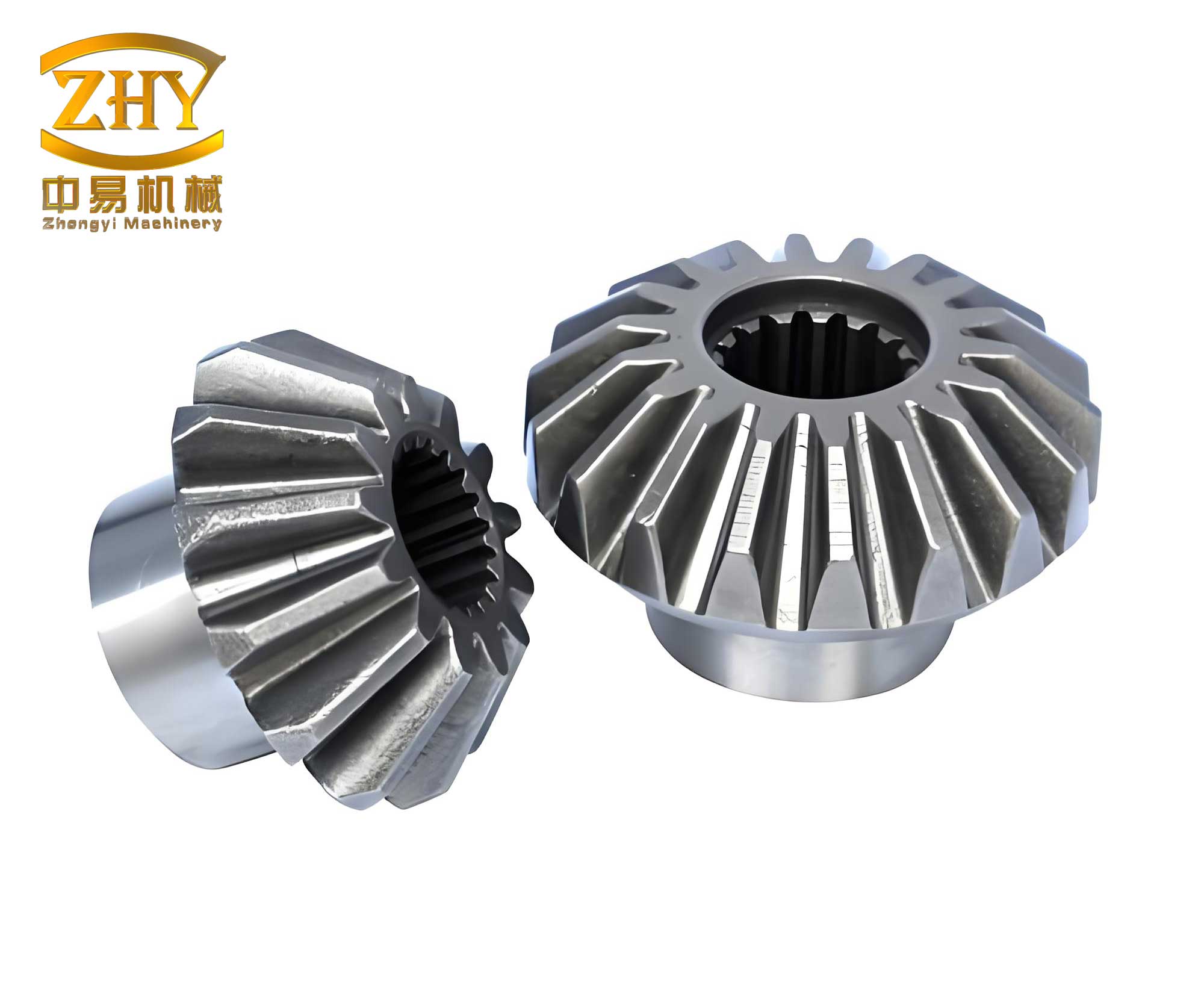
The focus of this discussion is the adjustment of the EN-type cutter head within the Oerlikon bevel gear system. This specific cutter head is designed for high-speed operation, which significantly improves the surface finish of the bevel gear teeth and overall machining efficiency. The arrangement of cutting inserts within the EN-type head follows a specific sequence: roughing inserts, outer finishing inserts, and inner finishing inserts. The structural integrity and precise assembly of this cutter head are fundamental to achieving the desired bevel gear geometry.
The EN cutter head is a complex assembly comprising several critical components. A comprehensive understanding of its structure is essential for effective adjustment.
| Component | Description | Function |
|---|---|---|
| Cutter Head Body | The main disc-shaped structure. | Provides the base and mounting platform for all other components. |
| Cutting Inserts | Hardened tool steel bits: Roughing, Outer Finishing, Inner Finishing. | Perform the actual material removal to generate the bevel gear tooth flank. |
| Insert Seat (Tool Holder) | Precision-machined slots or pockets on the cutter body. | Securely locates and supports each individual cutting insert. |
| Adjusting Screw | Fine-pitch screw adjacent to the insert seat. | Enables micro-adjustment of the insert’s radial and height positions. |
| Clamping Screw | High-torque screw. | Locks the insert firmly in place within its seat after adjustment. |
| Flat Shim | Thin, precisely ground metal washer. | Used for coarse adjustment of the insert’s tangent radius position. |
| Wedge Shim (Tapered Shim) | Thin shim with a slight taper. | Used for fine, micro-adjustment of the insert’s tangent radius. |
Following the sharpening process, which restores the cutting edges, the cutter head must undergo a rigorous adjustment and inspection procedure to ensure it meets all technical specifications for bevel gear cutting. This process is performed on a dedicated adjustment and inspection device, often referred to as a cutter head setting gauge or “调刀仪”. The precision of this device is critical for accurately setting the parameters that define the cutting action on the bevel gear blank.
The adjustment apparatus typically consists of several key elements: a robust cutter head base mount, a height measuring scale, a tangent radius indicator dial, a measuring head with an adjustable contact point height, a mechanism for adjusting and displaying the cutter head eccentricity value, an adjustment handwheel, and a calibrated scale for the tangent radius. The interaction between these components allows for the precise positioning of each cutting insert.
Before commencing the adjustment, the inserts must satisfy strict pre-adjustment inspection criteria. These criteria are non-negotiable for producing a high-precision bevel gear.
| Inspection Parameter | Tolerance Specification | Rationale |
|---|---|---|
| Surface Roughness of Ground Insert Flank | Not less than Ra 0.4 µm | Ensures a sharp, clean cutting edge for superior bevel gear tooth surface finish and reduced cutting forces. |
| Height Run-out (Axial Run-out) of Inserts | ≤ 0.01 mm | Guarantees uniform depth of cut for all teeth of the bevel gear, critical for proper tooth engagement and load distribution. |
| Radial Run-out (Tangent Radius Run-out) of Inserts | ≤ 0.004 mm | Ensures all inserts cut on the same theoretical circle, defining the accurate tooth profile and spacing of the bevel gear. |
The adjustment procedure is systematic and can be divided into two primary phases: the setup of fundamental machine parameters and the meticulous adjustment of individual insert parameters. These adjustments are guided by a cutter head adjustment card, which provides specific numerical values derived from the geometry of the target bevel gear.
Phase 1: Adjustment of Fundamental Parameters
The first phase involves configuring the adjustment apparatus itself according to the data from the adjustment card. These parameters create the reference framework for all subsequent insert adjustments.
1. Cutter Head Height Scale Setting (hw): This value represents the distance from the insert’s tooth tip (or reference point) to the base plane of the cutter head. The height measuring scale on the apparatus is set to this value.
$$ h_{w} = \text{Value from adjustment card} $$
2. Measuring Head Contact Point Height (hw – hf): This is the distance from the cutter head base plane to the so-called “nodal point” on the insert, which is typically the working point involved in generating the active tooth flank of the bevel gear. It is calculated as the difference between the tip height (hw) and the dedendum (tooth root height, hf) of the bevel gear.
$$ h_{contact} = h_{w} – h_{f} $$
The measuring head’s vertical position is adjusted to match this calculated height value.
3. Cutter Head Eccentricity Value (Ebw): This parameter accounts for and corrects any inherent eccentricity in the cutter head mounting or the adjustment apparatus spindle. The corresponding handwheel is set to the value Ebw provided on the adjustment card. A crucial step is to first rotate the handwheel to a mechanical zero to eliminate any backlash before setting the final value.
$$ E_{bw} = \text{Prescribed eccentricity compensation value} $$
4. Cutter Tangent Radius (r): This is the nominal cutting radius for the inserts. Different values are specified for the outer finishing, inner finishing, and roughing inserts (often for the inner cutting edge of the roughing insert). The tangent radius adjustment handle is used to pre-set the apparatus to these respective values for each insert group.
$$ r_{outer}, r_{inner}, r_{rough} = \text{Prescribed tangent radii} $$
With the fundamental parameters established, the precise adjustment of each individual cutting insert can begin. This phase is iterative and requires patience and a delicate touch.
Phase 2: Adjustment of Individual Insert Parameters
The adjustment is performed sequentially for each insert group: first the roughing inserts, then the outer finishing inserts, and finally the inner finishing inserts. The process for each insert follows a strict, repeated sequence. I will outline the generalized procedure applicable to any single insert.
Step 1: Positioning and Preliminary Alignment. The cutter head is rotated on the apparatus until the insert to be adjusted is positioned directly beneath the measuring head. A reference straightedge or “靠尺” on the apparatus is then swung into position, aligned with the measuring head. The measuring head is lowered, and the cutter head is gently rotated to bring the insert’s flank into light contact with the straightedge. An indicator gauge on the side of the measuring head is observed; its fluctuation must be within a minimal allowable error. Once this preliminary lateral alignment is confirmed, the locking bolt on top of the cutter head mounting is tightened to secure its rotational position during the adjustment of that specific insert.
Step 2: The Adjustment Sequence Cycle. The straightedge is retracted, and the measuring head is raised. The adjustment for the insert now follows a three-part cycle: Height Adjustment → Tangent Radius Adjustment → Height Verification. This cycle is repeated until both parameters fall within the specified tolerances.
a) Height Adjustment: The cutter head is rotated to bring the insert to a designated “height adjustment position” (often indicated as the right side). The measuring head, now functioning as a height gauge, is lowered onto the insert’s reference surface. By carefully turning the height adjusting screw for that particular insert seat—while simultaneously managing the clamping screw—the height reading is brought to the precise zero mark on the indicator. The theoretical relationship governing the required height adjustment (Δh) for an insert is based on its deviation from the nominal height hw:
$$ \Delta h = h_{actual} – h_{nominal} $$
The adjusting screw is turned until Δh ≈ 0.
b) Tangent Radius Adjustment: The cutter head is then rotated to the “radius adjustment position” (often the left side). The measuring head is again lowered, but now it acts as a radial gauge. The indicator for tangent radius is observed. To change the radius, the clamping screw for the insert is loosened slightly. The insert’s radial position is altered by changing the pack of shims (flat and wedge shims) behind it in its seat. The effective change in tangent radius (Δr) can be related to the shim thickness (s) and the geometry of the wedge:
$$ \Delta r \approx k \cdot s $$
where \( k \) is a geometric factor dependent on the insert seat angle. The flat shim provides coarse adjustment, while the tapered wedge shim allows for fine-tuning. The adjusting screw may also be used in conjunction to achieve the precise movement. The goal is to adjust until the radial run-out indicator reads a variation of less than 0.004 mm.
c) Height Verification: After the radius adjustment, the cutter head is rotated back to the height check position. The height is measured again. Due to potential interactions between radial and height adjustments, the height value may have shifted. It must be re-adjusted if it exceeds the 0.01 mm tolerance. This iterative process continues until both the height and radius indicators show readings within the specified limits simultaneously for that insert.
| Step | Insert Position | Parameter Adjusted/Checked | Tool Used | Tolerance Goal |
|---|---|---|---|---|
| 1 | Right (Height Position) | Insert Height (h) | Height Adjusting Screw, Clamping Screw | Δh ≤ 0.01 mm |
| 2 | Left (Radius Position) | Tangent Radius (r) | Shim Pack, Adjusting Screw | Δr (run-out) ≤ 0.004 mm |
| 3 | Right (Height Position) | Height Verification | Height Indicator | Re-check Δh ≤ 0.01 mm |
Step 3: Special Considerations for Different Insert Groups. The procedure is fundamentally the same for all inserts, but with specific nuances. For the outer finishing inserts, the measuring head contacts the outer cutting edge (the edge that will generate the convex side of the bevel gear tooth). For the inner finishing inserts, it contacts the inner edge (generating the concave side of the bevel gear tooth). The adjustment of roughing inserts may focus on their inner cutting edges for profile control. The process is identical for both left-hand and right-hand cutter heads or insert sets used for generating different spiral directions on the bevel gear.
Step 4: Finalizing the Adjustment. A critical rule during the entire process is to avoid any impact or hammering on the inserts, as this can dislodge them or damage the precision edges. Once an insert is successfully adjusted, its clamping screw is finally and securely tightened to its specified torque. After all inserts in the head have been adjusted, the entire cutter head is carefully cleaned of any debris or fingerprints, dismounted from the adjustment apparatus, and is then ready for installation on the bevel gear cutting machine.
The successful application of this detailed adjustment methodology has profound implications. In my experience, a correctly adjusted Oerlikon cutter head is the single most important factor in achieving the desired tooth contact pattern, noise level, and load capacity in the final spiral bevel gear. The geometric accuracy of the bevel gear is directly traceable to the precision of the tangent radius (r) and height (h) settings of each insert. The formulas and relationships governing these settings, while sometimes approximated in practice, are rooted in the fundamental geometry of the cycloidal tooth form. For instance, the relationship between the cutter radius and the generated tooth curvature can be expressed through the basic principle of gear generation. The cutting action simulates the rolling of a plane (the cutter head) on a pitch cone, and the insert’s tangent radius defines the generating circle. A simplified kinematic relationship can be illustrated as follows, where the machine setting parameters (like cradle angle, ratio of roll) interact with the cutter radius to produce the bevel gear tooth flank.
Consider the basic generation equation for a spiral bevel gear, which relates the workpiece rotation (φ) to the cutter head (cradle) rotation (ψ):
$$ \frac{d\phi}{d\psi} = \frac{R_c}{R_w} \cdot \frac{\sin \beta}{\cos \Gamma} $$
Where \( R_c \) is the nominal cutter radius, \( R_w \) is the workpiece pitch radius, \( \beta \) is the spiral angle, and \( \Gamma \) is the pitch angle. While this is a simplified version, it underscores that \( R_c \) (the effective tangent radius of the cutter inserts) is a fundamental input variable. Any error Δr in this radius propagates into an error in the tooth flank geometry (ΔS) of the manufactured bevel gear:
$$ \Delta S \propto m \cdot \Delta r $$
where \( m \) is a sensitivity coefficient dependent on the specific machine kinematics and gear design. Similarly, errors in insert height (Δh) lead to errors in tooth depth and the positioning of the contact pattern along the face width of the bevel gear.
The stringent tolerances for radial and height run-out (0.004 mm and 0.01 mm, respectively) are not arbitrary. They are derived from the allowable cumulative pitch error and tooth profile error specifications for high-grade bevel gears. For example, the AGMA (American Gear Manufacturers Association) standards for spiral bevel gears specify tight tolerances for tooth-to-tooth composite error and total composite error. The adjustment methodology described here is designed to keep the cutter-induced errors well within the limits required to meet such standards. The table below correlates typical bevel gear quality requirements with the necessary cutter head adjustment precision.
| Bevel Gear Quality Metric (AGMA) | Typical Tolerance Range | Primary Cutter Head Parameter Influencing It | Required Adjustment Precision |
|---|---|---|---|
| Tooth-to-Tooth Composite Error | 0.015 – 0.025 mm | Insert Tangent Radius Run-out (Δr) | ≤ 0.004 mm (ensures minimal pitch variation) |
| Total Composite Error | 0.030 – 0.050 mm | Combined effect of Δr and Δh | Δh ≤ 0.01 mm (controls cumulative profile & alignment) |
| Tooth Profile Error | 0.010 – 0.020 mm | Tangent Radius Setting (r) & Insert Edge Geometry | Accurate r setting per adjustment card |
| Surface Finish (Ra) | 0.8 – 1.6 µm | Insert Flank Roughness & Cutting Edge Condition | Ra ≤ 0.4 µm on ground insert |
In conclusion, the meticulous adjustment of an Oerlikon cycloidal bevel gear milling cutter head is a critical and non-negotiable step in the manufacturing chain for high-performance spiral bevel gears. The method I have detailed—involving the precise setup of fundamental parameters like height scale, contact point height, eccentricity, and nominal tangent radius, followed by the iterative, cyclical adjustment of each insert’s height and radial position—forms a robust and reliable procedure. The use of dedicated adjustment instrumentation, adherence to strict pre-adjustment inspection criteria, and the application of the iterative cycle are all essential. This methodology, grounded in the principles of gear generation geometry, ensures that the cutter head becomes a true and accurate representation of the theoretical tool required to produce the designed bevel gear. When applied consistently in production, as it has been in my practice, this adjustment process directly translates into superior bevel gear quality, characterized by optimal tooth contact patterns, quiet operation, high load capacity, and longevity. It thereby fulfills the core production needs for advanced Oerlikon system bevel gears and contributes significantly to the reliability and efficiency of the mechanical transmission systems in which these bevel gears are deployed. The continuous refinement of such adjustment techniques remains a key area for advancing bevel gear manufacturing technology.