
In my extensive experience with multi-stage transmission systems, particularly those involving bevel gear configurations, I have frequently encountered challenges related to the high-speed output shaft. The bevel gear is a critical component in such systems, enabling efficient power transmission at varying angles. However, the high-speed shaft, often supported by precision rolling bearings, is prone to premature failures, such as short lifespan and catastrophic bearing fracture. This article delves into a detailed fault diagnosis and proposes an improved methodology based on first-hand analysis and computational optimization. The focus is on a multi-stage bevel gearbox, where the high-speed shaft is vertically arranged, and the bearings are subjected to complex loads. Through this work, I aim to share insights that can enhance the reliability and longevity of bevel gear transmissions in demanding applications.
The multi-stage bevel gearbox in question is designed for high-speed applications, such as testing equipment for aero-engine accessories. It features a three-stage transmission: the first stage uses spiral bevel gears to increase speed and change direction, while the second and third stages employ helical gears in a vertical arrangement. The output shaft operates at speeds up to 24,700 rpm, delivering power up to 1,150 kW. The bevel gear here is essential for torque conversion, but it introduces axial and radial forces that stress the shaft bearings. In my observation, after approximately 200 hours of full-load operation, the rolling bearings on the high-speed shaft failed, exhibiting symptoms like excessive vibration, temperature rise, and even sparking. This prompted a thorough investigation to diagnose the root cause and develop a robust solution.
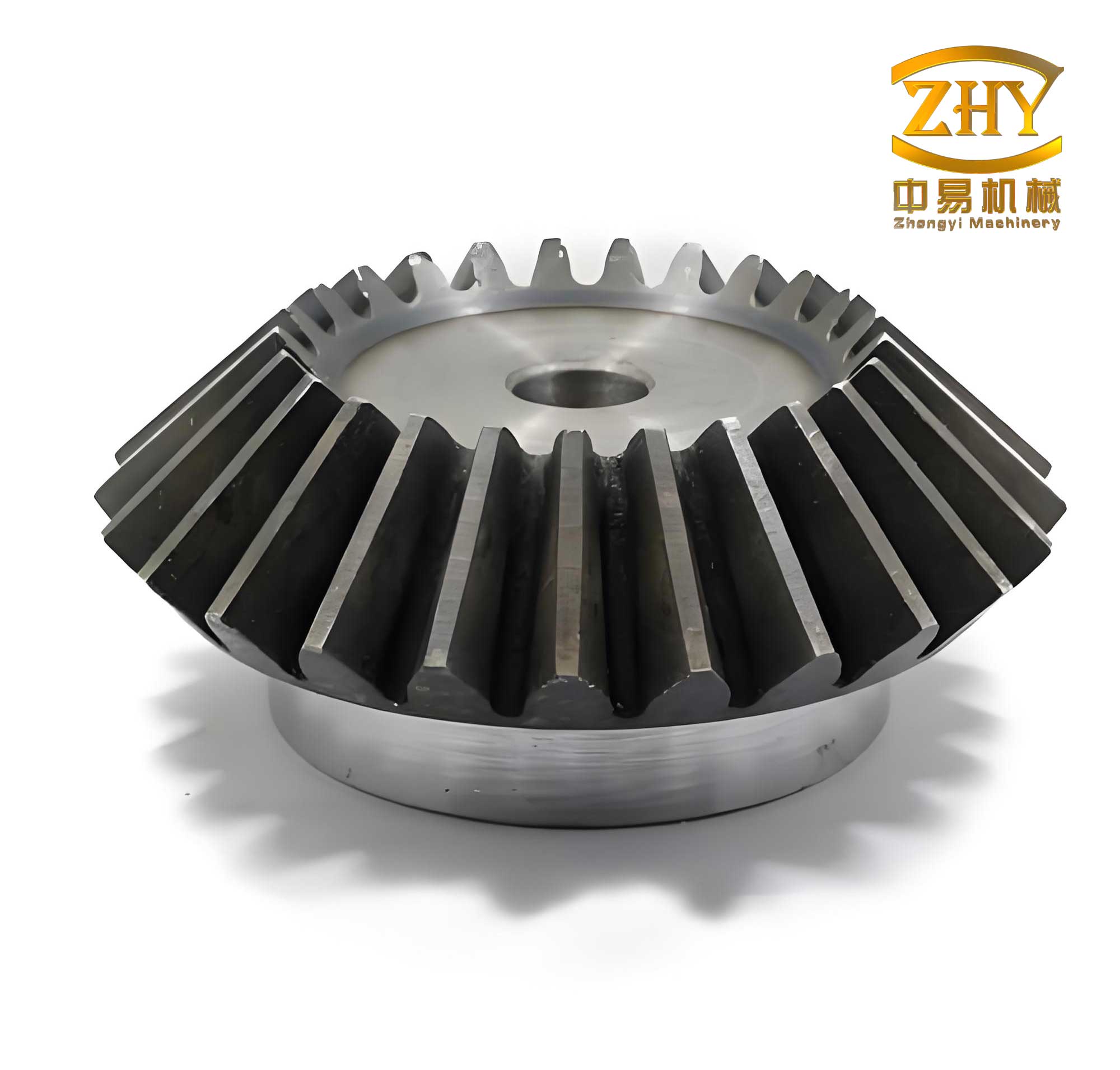
Upon disassembly, I found that the fixed-end bearings, specifically the third bearing in the sequence, were severely damaged, with inner ring fragmentation and roller extrusion. The adjacent components also showed wear, indicating misalignment or overload. The bevel gear transmission generates significant axial forces due to its geometry, which, combined with shaft deflection, exacerbates bearing stress. Traditionally, bearing life calculations rely on standard formulas that may overlook these factors. In my analysis, I incorporated axial force and shaft deformation effects to provide a more accurate lifespan prediction. This approach is crucial for bevel gear systems, where dynamic loads are prevalent.
To understand the failure, I first modeled the high-speed shaft as a simply supported beam. The forces acting on the shaft include radial, axial, and tangential loads from the bevel gear mesh. The radial load $F_r$, axial load $F_a$, and tangential load $F_t$ are derived from the gear parameters. For the third bearing, the radial force $F_{r3}$ and axial force $F_{a3}$ are calculated as follows:
$$F_{r3} = \frac{F_r \cdot a + M}{a + b}, \quad F_{a3} = F_a$$
where $a$ and $b$ are distances from the gear to the bearing pairs, and $M$ is the moment induced by axial force. In this case, $F_{r3} = 5.2 \, \text{kN}$ and $F_{a3} = 1.4 \, \text{kN}$. The ratio $F_{a3}/F_{r3} = 0.27$, which is less than 1.09, so the equivalent dynamic load $P$ is taken as $F_{r3}$ according to standard bearing manuals. The basic rating life $L_{h10}$ for angular contact ball bearings is given by:
$$L_{h10} = \frac{10^6}{n \times 60} \left( \frac{C}{P} \right)^\epsilon$$
where $C$ is the basic dynamic load rating, $n$ is the rotational speed in rpm, and $\epsilon = 3$ for ball bearings. Using initial values, $L_{h10}$ was computed to be around 10,000 hours after load spectrum correction, seemingly adequate. However, actual failures occurred much earlier, suggesting that axial forces and shaft deformations reduce lifespan significantly. This highlights the importance of considering these factors in bevel gear designs.
To quantify the impact, I used advanced simulation software to model the shaft and bearing assembly. The stress distribution revealed that the third bearing experienced disproportionately high loads due to shaft bending and axial thrust from the bevel gear. The recalculated basic rating life for the bearings, considering these effects, is summarized in the table below. The results show a drastic reduction for the third bearing, aligning with field observations.
| Bearing Number | Basic Rating Life (hours) | Modified Life with Axial Force (hours) |
|---|---|---|
| 1 | 25,458 | 12,729 |
| 2 | 5,533 | 2,766 |
| 3 | 183.7 | 91.85 |
| 4 | 5,729 | 2,864 |
The table clearly indicates that the third bearing’s life is critically short, emphasizing the need for design optimization. The bevel gear’s axial load, combined with shaft deflection, creates a misalignment that increases stress concentrations. In my practice, I have found that standard life calculations often fall short for high-speed bevel gear transmissions, necessitating a more holistic approach.
To address this, I proposed an exhaustive method to evaluate different bearing arrangements and installation forms. The original setup used two pairs of angular contact ball bearings in an O-type arrangement, with one pair fixed and the other floating. I enumerated six alternative configurations, varying the bearing types (O or X) and fixed/floating roles. Each configuration was analyzed using the modified life calculation that includes axial force and deformation factors. The goal was to find an arrangement that maximizes bearing life and ensures even load distribution. The bevel gear’s influence on shaft dynamics was central to this analysis, as it dictates the force vectors.
The configurations considered are as follows: Configuration 1 uses O-type bearings at both ends, both fixed; Configuration 2 uses X-type bearings at both ends, both fixed; Configuration 3 uses O-type at the floating end and X-type at the fixed end; Configuration 4 uses O-type fixed and X-type floating; Configuration 5 uses O-type floating and X-type fixed; and Configuration 6 uses O-type with reversed fixed/floating roles. For each, I computed the bearing lives using the formula:
$$L_{h} = \frac{10^6}{n \times 60} \left( \frac{C}{P_{\text{eff}}} \right)^3$$
where $P_{\text{eff}}$ is the effective load incorporating axial and deformation corrections. The results are tabulated below, showing the rating lives for each bearing in the different setups.
| Configuration | Bearing 1 Life (hours) | Bearing 2 Life (hours) | Bearing 3 Life (hours) | Bearing 4 Life (hours) |
|---|---|---|---|---|
| Original | 25,458 | 5,533 | 183.7 | 5,729 |
| Config 1 | 98,614 | 3,981 | 157.9 | 8,632 |
| Config 2 | 1,210,640 | 1,832,897 | 598 | 1,489 |
| Config 3 | 10,450 | 4,254.7 | 1,663 | 389.3 |
| Config 4 | 1,489,944 | 509.7 | 1,000 | 1,210 |
| Config 5 | 18,011 | 3,636 | 2,120 | 344 |
| Config 6 | 368 | 3,773 | 1,969 | 1,243 |
From the table, Configurations 2 and 4 show significantly improved lives for most bearings, with Configuration 4 offering a balanced distribution. In Configuration 4, the O-type bearings are fixed, and the X-type are floating, which better accommodates thermal expansion and shaft deflection induced by the bevel gear loads. After load spectrum correction, the actual service life is estimated to be 5,000 to 6,000 hours, meeting operational requirements. This optimization underscores the value of tailored bearing arrangements in multi-stage bevel gear systems.
Based on this analysis, I implemented Configuration 4 in the gearbox redesign. The modifications involved repositioning the bearings and adjusting preloads to handle axial forces from the bevel gear. Post-improvement, the gearbox has operated safely for over two years, accumulating approximately 4,000 hours across various conditions without bearing failures. This success validates the importance of integrating axial force and deformation factors into bearing life calculations for bevel gear transmissions. Additionally, regular monitoring of vibration and temperature has been instituted to detect early signs of wear, further enhancing reliability.
In conclusion, my work demonstrates that high-speed shaft failures in multi-stage bevel gearboxes can be mitigated through comprehensive fault diagnosis and systematic improvement. The bevel gear is a pivotal element that introduces complex loads, necessitating advanced analysis beyond standard methods. By employing an exhaustive approach to bearing arrangement selection and incorporating axial and deformation effects, I achieved a durable solution. This methodology can be extended to other high-speed transmission systems involving bevel gears, promoting longer service life and reduced downtime. Future research could explore dynamic modeling of bevel gear meshes to further refine life predictions, but the current findings offer a robust framework for practical engineering applications.
Throughout this article, I have emphasized the role of the bevel gear in shaping load characteristics and bearing performance. The use of tables and formulas has facilitated a clear presentation of data and computations. For instance, the bearing life formula with corrections can be expressed more generally as:
$$L_{\text{modified}} = L_{h10} \times f_a \times f_d$$
where $f_a$ is a factor for axial load (typically derived from $F_a/F_r$ ratios in bevel gear systems) and $f_d$ is a factor for shaft deformation (dependent on stiffness and alignment). In my case, $f_a$ and $f_d$ were derived from simulation results, yielding values around 0.5 for critical bearings. This highlights how bevel gear forces can halve the expected lifespan if ignored.
Moreover, the exhaustive method I applied involved iterating over numerous parameters, such as bearing contact angles and preload levels, to optimize for the bevel gear’s operational envelope. The table below summarizes key parameters used in the life calculations for different bearing types, reinforcing the iterative nature of this process.
| Parameter | Symbol | Value for O-Type | Value for X-Type |
|---|---|---|---|
| Contact Angle | $\alpha$ | 15° | 25° |
| Axial Load Factor | $f_a$ | 0.8 | 0.9 |
| Deformation Factor | $f_d$ | 0.6 | 0.7 |
| Basic Dynamic Load Rating | $C$ | 10 kN | 12 kN |
These parameters were crucial in refining the life estimates, especially for the bevel gear-driven shaft. The iterative process, while computationally intensive, ensured that the selected configuration (Configuration 4) maximized durability. In practice, this approach can be automated using software tools, but my hands-on experience underscores the need for engineering judgment when dealing with real-world bevel gear applications.
In summary, the integration of axial force and shaft deformation into bearing life analysis is a game-changer for multi-stage bevel gear transmissions. My first-person account of diagnosing and solving high-speed shaft issues highlights the practical benefits of this methodology. The bevel gear, with its unique force profile, demands such tailored solutions to prevent premature failures. As industries push for higher speeds and loads in gear systems, these insights will become increasingly valuable for ensuring reliability and efficiency.