
In the field of power tools and mechanical transmissions, powder metallurgy bevel gears have gained widespread adoption due to their suitability for mass production and cost advantages over steel bevel gears. However, inherent limitations in density compared to wrought materials often result in inferior strength, posing challenges for demanding applications. As market competition intensifies, especially in mid-to-low-end segments, enhancing the strength of powder metallurgy bevel gears while maintaining cost-effectiveness has become a critical focus. This article, from a first-person perspective, explores comprehensive methodologies to achieve high-strength powder metallurgy bevel gears through material selection, structural design optimization, and advanced processing techniques. The insights provided aim to serve as a practical guide for manufacturers and engineers seeking to improve the performance of these critical components.
The fundamental issue with conventional powder metallurgy bevel gears lies in their porosity and density gradients, which directly impact mechanical properties such as tensile strength, fatigue resistance, and wear durability. To address this, a holistic approach is necessary, encompassing every stage from raw material preparation to final heat treatment. In the following sections, we will delve into specific strategies, supported by data tables and mathematical models, to systematically enhance the strength of powder metallurgy bevel gears. The term ‘bevel gear’ will be frequently referenced to maintain focus on the specific component under discussion.
Material Selection for Enhanced Strength
The foundation of a high-strength powder metallurgy bevel gear is its material composition. Iron-based powder metallurgy systems allow for the incorporation of various alloying elements to tailor mechanical properties. Key elements include Nickel (Ni) and Carbon (C), each playing a distinct role. Nickel, when added within optimal ranges, enhances toughness and strength by solid solution strengthening and improving hardenability. Carbon, crucial for forming pearlitic or martensitic structures during sintering and heat treatment, significantly influences hardness and wear resistance. However, for bevel gears subjected to high impact loads (requiring high toughness) and severe friction (requiring high wear resistance), a balanced approach is needed. Often, a lower carbon content is preferred to maintain core toughness, while surface properties are later enhanced through heat treatment.
The uniformity of the powder blend is equally critical. Simple mixing can lead to segregation of alloying elements, resulting in inconsistent properties in the final sintered bevel gear. Therefore, for high-strength applications, advanced powder production techniques are recommended. These include diffusion-bonded pre-alloyed powders and hybrid mixes designed for homogeneity. The choice directly affects the density achievable during compaction and the subsequent sintered microstructure.
To quantify the impact of material choice, consider the following relationship between density and mechanical properties. The tensile strength ($\sigma_t$) of a sintered powder metallurgy part can be empirically related to its density ($\rho$) and material constants:
$$ \sigma_t = \sigma_0 \cdot \left( \frac{\rho}{\rho_{th}} \right)^m $$
where $\sigma_0$ is the theoretical strength of the pore-free material, $\rho_{th}$ is the theoretical density, and $m$ is an exponent typically between 2 and 3 for ferrous materials. This highlights the paramount importance of achieving high and uniform density in the bevel gear, especially in the tooth region which is the primary load-bearing area.
The table below summarizes the influence of key alloying elements and processing routes on the properties relevant to bevel gears.
| Alloying Element/Process | Primary Effect on Bevel Gear | Typical Range (wt.%) | Considerations for High Strength |
|---|---|---|---|
| Nickel (Ni) | Increases toughness, strength, and hardenability. | 1.0 – 4.0 | Reduces notch sensitivity; improves impact resistance of the bevel gear teeth. |
| Copper (Cu) | Increases strength and hardness via solid solution and precipitation. | 1.5 – 5.0 | Can promote dimensional growth during sintering; must be controlled. |
| Carbon (C) | Fundamental for hardening; increases hardness and wear resistance. | 0.3 – 0.8 | Lower levels (e.g., 0.3-0.5%) favor core toughness. Surface carbon can be increased via carburizing. |
| Molybdenum (Mo) | Enhances hardenability and high-temperature strength. | 0.5 – 1.5 | Often used in pre-alloyed powders for more uniform distribution. |
| Powder Type: Simple Mix | Cost-effective but prone to segregation. | N/A | Not recommended for critical, high-strength bevel gears. |
| Powder Type: Diffusion Alloyed | Good homogeneity, reduced segregation. | N/A | Preferred for consistent performance in bevel gear teeth. |
| Powder Type: Pre-alloyed | Excellent homogeneity, superior mechanical properties. | N/A | Ideal for the most demanding high-strength bevel gear applications. |
Structural Design Optimization of the Bevel Gear
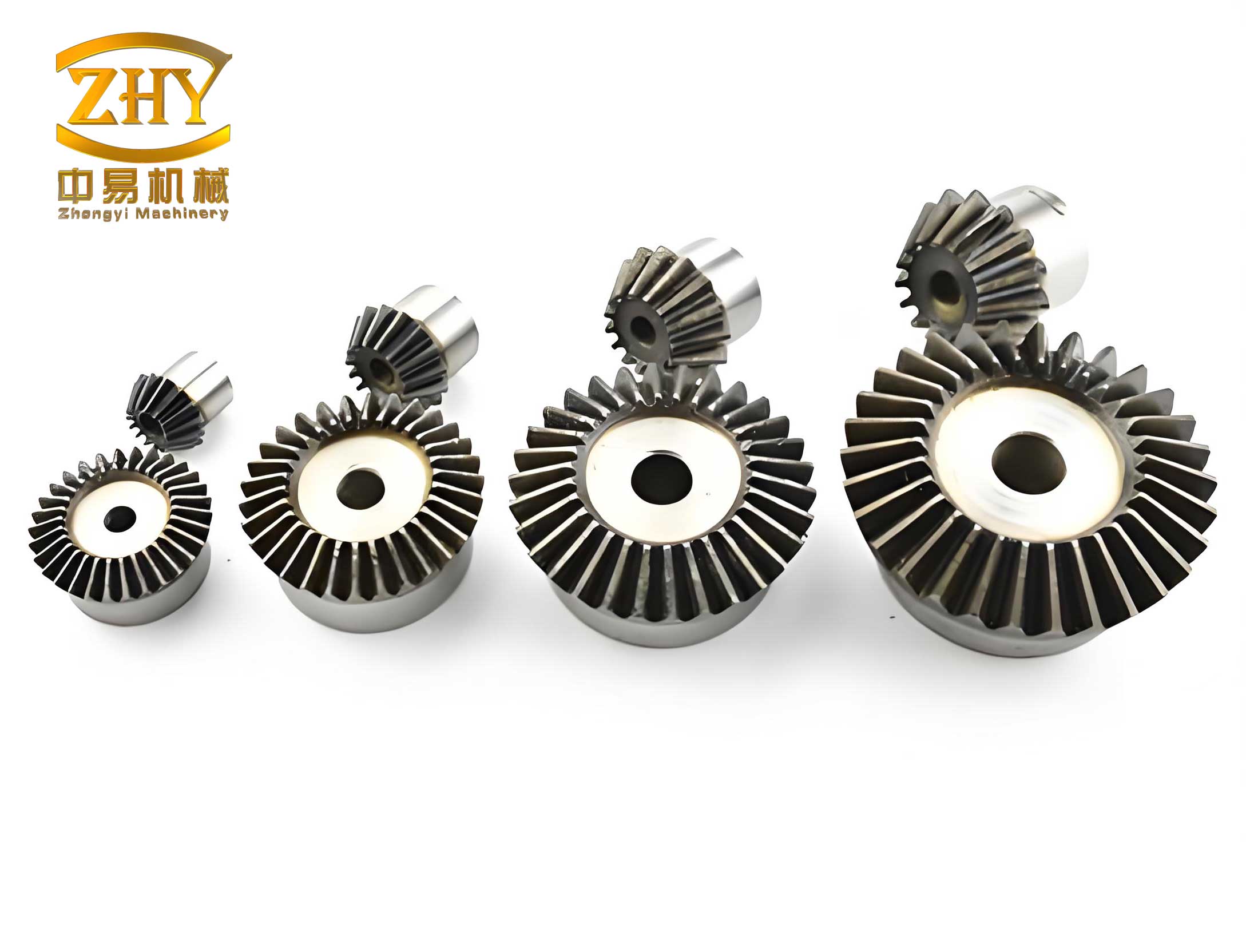
The unique geometry of a bevel gear, characterized by tapered teeth and significant height variation between the tooth tip and root, presents a major challenge for powder compaction. During the pressing operation, powder flow is primarily vertical with minimal lateral movement. Consequently, regions with greater fill height (like the tooth tip on the larger end of the bevel gear) experience lower compaction pressure, leading to lower local density and weaker mechanical properties. This inherent density gradient can be the Achilles’ heel of a powder metallurgy bevel gear under load.
To mitigate this, the design of the bevel gear must be optimized for powder metallurgy manufacturing. The goal is to minimize the fill height difference across the tooth profile. In a conventional design, the tooth flank, when projected, shows a large disparity in height from the tip to the root. An optimized design modifies the tooth root geometry and potentially the backside of the gear to create a more uniform powder fill height during pressing. This results in a more homogeneous density distribution throughout the tooth, significantly enhancing its load-carrying capacity and bending fatigue strength.
The optimization can be guided by analytical models. The local density ($\rho_l$) after compaction is a function of the applied pressure ($P$) and the fill height ($h$), following a constitutive model like:
$$ \rho_l = \rho_{max} – (\rho_{max} – \rho_0) \cdot \exp(-k \cdot P / h) $$
where $\rho_{max}$ is the maximum achievable density, $\rho_0$ is the apparent fill density, and $k$ is a material constant. By designing the bevel gear tooling to ensure that the ratio $P/h$ is as constant as possible across the tooth, density variations are minimized. This principle is crucial for producing a high-strength bevel gear.
Processing Technology Optimization
Beyond material and design, the manufacturing processes themselves offer significant levers for enhancing the strength of powder metallurgy bevel gears. Three key areas are warm compaction, sintering, and heat treatment.
Warm Compaction
Conventional room-temperature compaction of powder metallurgy parts typically achieves densities up to about 7.1 g/cm³ for ferrous materials. Warm compaction involves heating the powder and, sometimes, the dies to temperatures in the range of 130-150°C prior to and during pressing. This reduces the yield strength of the powder particles and lowers friction, enabling higher green densities—often exceeding 7.2 g/cm³ or even reaching 7.4 g/cm³. The increase in density has a profound effect on strength, as indicated by the power-law relationship mentioned earlier. For a bevel gear, achieving a density of 7.4 g/cm³ versus 7.0 g/cm³ can improve dynamic load capacity by 30% or more. The process parameters for warm compaction must be carefully controlled, as shown in the table below.
| Parameter | Typical Range | Effect on Bevel Gear |
|---|---|---|
| Powder Temperature | 130°C – 150°C | Higher temperature reduces compaction pressure needed for a given density, improving tool life and part uniformity. |
| Die Temperature | 60°C – 100°C | Prevents heat loss from powder, maintains lubricity, and ensures consistent density in complex bevel gear shapes. |
| Compaction Pressure | 600 – 800 MPa | Applied pressure must be optimized with temperature to achieve target density without causing defects like lamination in the bevel gear. |
| Lubricant Type | Specialized warm-compaction grades | Essential for reducing friction and ejecting the high-density green bevel gear from the die. |
Sintering Process
Sintering is the thermal process that bonds powder particles into a cohesive solid. For high-strength bevel gears, standard sintering cycles (e.g., 1120°C for 30 minutes in a 90% N₂ / 10% H₂ atmosphere) may be insufficient. Enhanced sintering involves increasing the temperature and/or time. Higher temperatures (e.g., 1150°C or 1180°C) promote better diffusion and pore rounding, leading to higher strength and ductility. Longer sintering times also improve homogenization and bonding. However, these benefits come with increased risk of distortion and grain growth, which can be detrimental to the precision of the bevel gear.
The sintering process can be modeled using master sintering curve concepts or kinetic equations. The degree of sintering ($\Psi$), related to density or neck growth, can be expressed as a function of a combined time-temperature parameter:
$$ \Theta = \int_0^t \frac{1}{T} \exp\left(-\frac{Q}{RT}\right) dt $$
where $Q$ is the apparent activation energy, $R$ is the gas constant, $T$ is absolute temperature, and $t$ is time. Optimizing the sintering cycle for a bevel gear involves finding the $\Theta$ value that maximizes strength while keeping distortion ($\Delta D$) below a critical tolerance. An empirical relationship might be:
$$ \Delta D = \alpha \cdot (T – T_0)^\beta \cdot t^\gamma $$
where $\alpha, \beta, \gamma$ are constants, and $T_0$ is a reference temperature. The table below illustrates the trade-offs.
| Sintering Condition | Transverse Rupture Strength (MPa) | Dimensional Change (%) | Impact on Bevel Gear Performance |
|---|---|---|---|
| 1120°C, 30 min | 850 | ±0.2 | Adequate for standard applications; bevel gear meets basic strength requirements. |
| 1150°C, 30 min | 950 | ±0.3 | Significant strength increase; bevel gear can handle higher torque but requires tighter process control for distortion. |
| 1120°C, 45 min | 900 | ±0.25 | Improved homogeneity; beneficial for consistency across a batch of bevel gears. |
| 1150°C, 45 min | 1050 | ±0.4 | Maximum strength achievable via solid-state sintering; bevel gear suitable for severe duty but may need calibration. |
Heat Treatment Process
To meet the dual requirements of a tough core and a hard, wear-resistant surface, powder metallurgy bevel gears often undergo heat treatment. Case hardening processes like carburizing or carbonitriding are particularly suitable. The goal is to develop a specified case depth on the tooth flanks while retaining a ductile core to withstand impact loads. For a bevel gear, the effective case depth (ECD) is critical and is often defined as the depth where hardness reaches a specific value, such as 550 HV.
The case depth ($d$) in a powder metallurgy part during gas carburizing can be approximated by a parabolic growth law, albeit modified for porosity:
$$ d = \Phi \cdot \sqrt{D \cdot t} $$
where $D$ is the effective diffusivity of carbon in austenite (which is influenced by density and alloy content), $t$ is time, and $\Phi$ is a factor accounting for surface condition and carbon potential. A common guideline is to set the case depth for a bevel gear as 0.25 to 0.4 times the module ($m_n$) of the gear:
$$ d_{recommended} = (0.25 \text{ to } 0.4) \times m_n $$
Surface hardness is typically targeted between 650 HV0.1 and 820 HV0.1 to resist pitting and wear. Furthermore, to optimize meshing and life, the larger bevel gear in a pair is often heat-treated to a surface hardness about 50 HV0.1 lower than the smaller pinion. This compensates for the difference in number of load cycles. The following table outlines key heat treatment parameters for a high-strength bevel gear.
| Heat Treatment Parameter | Target Value / Range | Rationale for Bevel Gear |
|---|---|---|
| Process Type | Gas Carburizing or Vacuum Carburizing | Provides controlled carbon infusion into the surface of the bevel gear teeth. |
| Carbon Potential | 0.7 – 0.9% C | Balances case hardness and risk of brittle carbides on the bevel gear surface. |
| Case Depth (ECD at 550 HV) | 0.25*mn to 0.40*mn | Ensures sufficient load-bearing capacity for the bevel gear teeth without compromising core properties. |
| Surface Hardness | 650 – 820 HV0.1 | Provides excellent wear and contact fatigue resistance for the bevel gear. |
| Core Hardness | 25 – 40 HRC | Maintains adequate toughness and strength in the bevel gear web and root areas. |
| Differential Hardness (Gear vs. Pinion) | Pinion harder by ~50 HV | Equalizes wear and fatigue life in the bevel gear pair. |
Conclusion
The pursuit of high-strength powder metallurgy bevel gears is a multi-faceted endeavor requiring synergistic optimization across materials, design, and processing. Starting with the selection of homogeneous, pre-alloyed or diffusion-alloyed powders with balanced Ni and C content lays a strong foundation. Redesigning the bevel gear geometry to minimize fill height variations during compaction is a critical step that directly addresses the inherent weakness in the tooth region. Subsequently, employing advanced manufacturing techniques such as warm compaction to push density boundaries, precisely controlled high-temperature sintering to enhance particle bonding, and tailored case hardening heat treatment to achieve optimal surface and core properties, collectively transform a standard powder metallurgy bevel gear into a high-performance component. Each of these strategies contributes to closing the strength gap with wrought steel counterparts while preserving the economic advantages of powder metallurgy. By systematically applying these methods, manufacturers can produce bevel gears capable of thriving in the demanding environments of modern power tools and mechanical systems, ensuring reliability and longevity. The continuous refinement of these processes, guided by empirical data and theoretical models, will further solidify the position of powder metallurgy as a premier manufacturing route for high-strength bevel gears.