
The precision assembly of power transmission systems, particularly those involving bevel gear pairs, is paramount for achieving optimal performance, longevity, and noise characteristics. In critical applications such as helicopter tail rotors, the final assembled state of the spiral bevel gear pair—defined primarily by its contact pattern (or imprint) and backlash—is not solely a function of the gear geometry and manufacturing quality. It is profoundly influenced by the elastic deformation of the entire structural system induced during the assembly process. Among various assembly parameters, bearing preload stands out as a crucial, yet often empirically adjusted, factor. This article delves into a systematic methodology for analyzing the influence of bearing preload on the meshing characteristics of a spiral bevel gear pair within a reducer assembly, leveraging a system-level finite element approach combined with precise contact analysis.
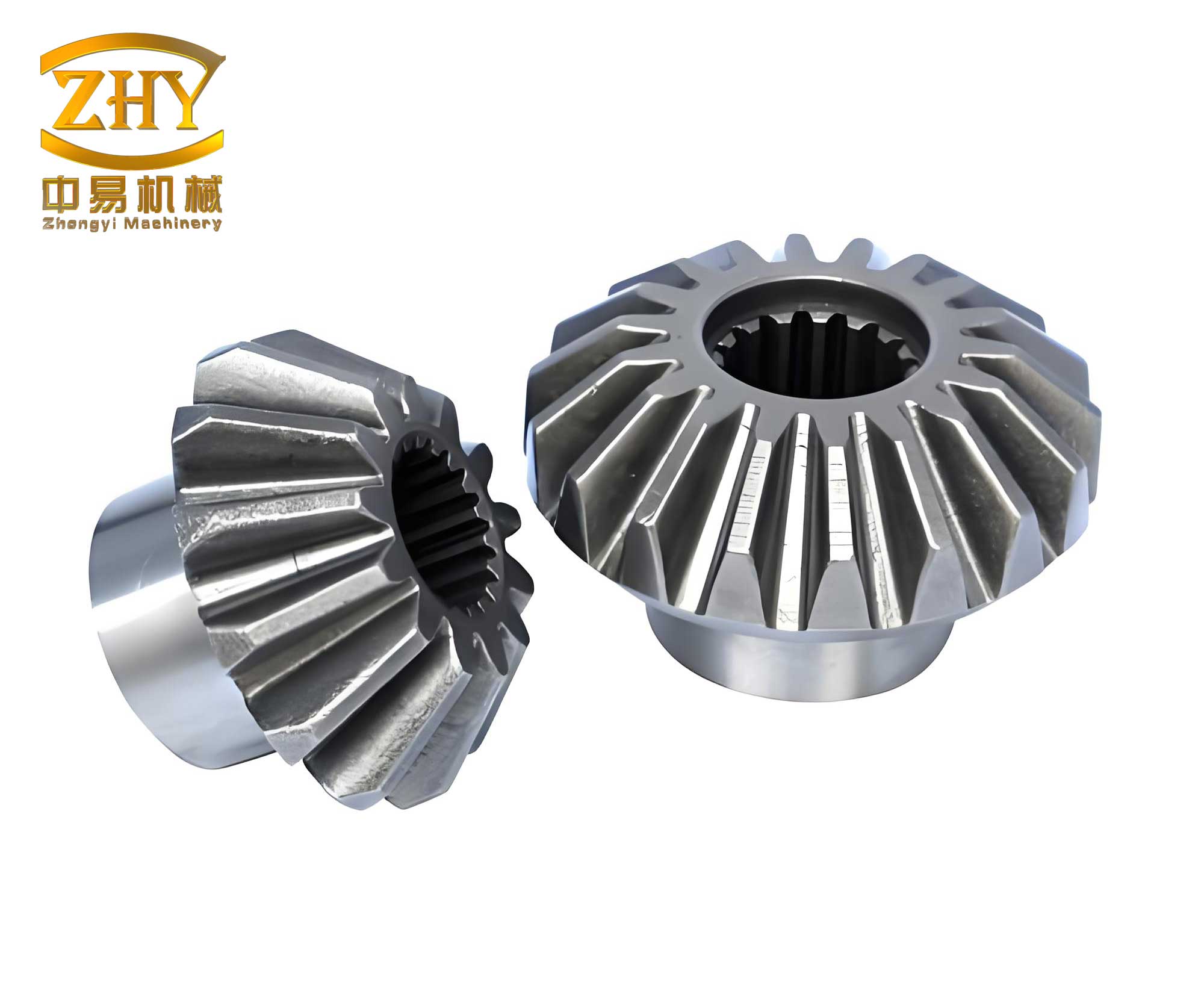
The core challenge lies in translating a macroscopic assembly parameter, such as a nut tightening torque, into quantifiable changes in the relative position and orientation of the gear axes—the installation errors. These errors then directly dictate how the conjugate tooth surfaces interact under no-load conditions. The relationship between the applied preload force and the resulting structural deformation is the first critical link in this chain. For a threaded fastener, the tightening torque \( M_p \) required to achieve an axial preload force \( F \) is governed by the well-known relationship:
$$ M_p = K \cdot F \cdot d $$
where \( d \) is the nominal bolt diameter and \( K \) is the tightening torque coefficient. This coefficient accounts for friction in the threads and under the nut’s bearing surface. A more detailed model decomposes the total torque into the component needed to overcome thread friction \( M_1 \) and the component needed to overcome nut face friction \( M_2 \):
$$ M_p = M_1 + M_2 = F \cdot \frac{d}{2} \cdot \tan(\phi + \rho) + \frac{1}{3} F \mu_n \left( \frac{d_w^3 – d_i^3}{d_w^2 – d_i^2} \right) $$
In this formulation, \( \phi \) is the thread lead angle, \( \rho \) is the thread friction angle defined by \( \rho = \arctan(\mu / \cos \beta’) \) (with \( \mu \) as the thread friction coefficient and \( \beta’ \) the thread profile angle in the normal plane), \( \mu_n \) is the friction coefficient under the nut face, and \( d_w \) and \( d_i \) are the effective outside and inside diameters of the nut bearing surface, respectively. For practical engineering analysis, a consolidated \( K \)-factor between 0.18 and 0.21 is often used for unlubricated, normally finished surfaces. Applying this model allows for the calculation of the axial force \( F \) applied to the bearing assembly for any specified tightening torque \( M_p \). This axial force is the primary load input for the subsequent system deformation analysis.
The next step involves constructing a comprehensive finite element model of the entire reducer assembly. This model must accurately represent the geometry, material properties, and contact interactions between all critical components: the housing, input and output shafts, the spiral bevel gears, bearings (including their rollers, races, and cages), preload nuts, and various spacers. A hybrid meshing strategy is typically employed; complex geometries like the housing are discretized with tetrahedral elements for flexibility, while simpler, more regular components like shafts and gears are meshed with structured hexahedral elements for better accuracy and computational efficiency. Defining appropriate contact interactions is crucial. Bearing roller-to-race contacts are often modeled as frictionless, while other interfaces like gear shaft-to-bearing inner ring or housing-to-bearing outer ring may be modeled with frictional contact or tied constraints, depending on the specific assembly conditions being simulated. The axial preload forces calculated from the torque analysis are applied as pressure loads over the appropriate contact areas of the preload nuts and adjacent components.
Submitting this model for a static structural analysis yields the deformed state of the entire assembly under the specified preload condition. The key outputs of interest are the displacements and rotations of the nodes along the theoretical axes of the input and output shafts. However, the shafts are no longer perfectly straight or ideally positioned due to system deformation. To extract the effective installation errors of the bevel gear pair, a post-processing method is employed. This method involves selecting cross-sectional circles on the deformed shaft models, fitting their centers, and constructing the best-fit lines representing the actual, deformed axes of the input and output shafts. From these actual axes, the four fundamental installation errors for a spiral bevel gear pair are calculated:
| Installation Error Symbol | Description |
|---|---|
| \( \Delta P \) | Pinion axial error (deviation from theoretical axial position). |
| \( \Delta G \) | Gear axial error (deviation from theoretical axial position). |
| \( \Delta E \) | Offset error (change in the shortest distance between the two axes). |
| \( \Delta \Sigma \) | Shaft angle error (deviation from the nominal 90° or other designed angle). |
The extracted error set \( [\Delta P, \Delta G, \Delta E, \Delta \Sigma] \) for a given preload condition completely defines the relative position and orientation of the gear pair in its mounted state. These errors are then applied to the perfect, nominal 3D CAD models of the spiral bevel gears in a dedicated contact analysis software environment. A numerical rolling simulation is performed: the pinion is rotated in small increments, and for each position, the gear is rotated to find the point of initial tooth contact (zero clearance). This process maps out the contact path and calculates the minimum distance between non-contacting flanks—the operational backlash. The pattern formed by the points of contact on the tooth surface is the predicted contact imprint.
To investigate the influence law, multiple finite element analyses are run with varying bearing preload torques. The calculated installation errors and the resulting contact characteristics from the gear contact analysis are compiled for comparison. The table below summarizes hypothetical results from such a study for three different preload levels applied to both the input and output shaft bearings of a tail reducer.
| Preload Level | Preload Torque Input/Output (N·mm) | Calculated Installation Errors [ΔP, ΔG, ΔE, ΔΣ] (mm, °) | Predicted Backlash (mm) | Contact Pattern Trend (on Gear Tooth) |
|---|---|---|---|---|
| Low | 830,000 / 1,700,000 | [0.019, 0.368, 0.000, -0.0003] | 0.93 | Centered, slightly towards heel. |
| Medium | 865,000 / 1,800,000 | [0.020, 0.369, 0.0001, -0.0004] | 0.90 | Shifts moderately towards the toe. |
| High | 900,000 / 1,900,000 | [0.019, 0.369, 0.0001, -0.0002] | 0.88 | Distinctly biased towards the toe. |
The data reveals a clear trend: as the bearing preload torque (and thus the axial preload force) increases, the system deformation changes in a way that reduces the operational backlash of the spiral bevel gear pair. Concurrently, the contact pattern on the tooth surface exhibits a systematic shift from a more central or heel-side position towards the toe (the outer edge) of the gear tooth. This movement can be explained by the complex interaction of housing distortion, bearing stiffness variation with preload, and shaft bending, which collectively alter the \(\Delta G\) (gear axial) and \(\Delta E\) (offset) errors in a specific manner. The relationship between preload force \(F\) and the resulting change in an installation error, say \(\Delta G\), can be conceptually represented as a system stiffness function:
$$ \Delta G = f(F, K_{housing}, K_{bearing}, K_{shaft}) $$
where the overall change is a non-linear function of the preload force and the stiffness matrices of the housing, the preloaded bearing set, and the shaft.
The validity of this integrated numerical approach must be established through physical experimentation. In a typical validation case, a reducer is assembled with precisely controlled preload torques (e.g., 830 N·m input / 1700 N·m output). The actual no-load backlash is measured using dial indicators, and the contact pattern is obtained via paint marking or precision bluing. The experimental results are then compared directly with the predictions from the finite element and contact analysis workflow.
| Characteristic | Experimental Result | Numerical Prediction | Agreement |
|---|---|---|---|
| Backlash | 0.89 – 0.93 mm | 0.93 mm | Excellent (within range) |
| Gear Contact Pattern: Toe Distance (A1) | ~17.0 mm | 17.62 mm | Good (~3.6% deviation) |
| Gear Contact Pattern: Heel Distance (C1) | ~2.5 mm | 2.21 mm | Good (~12% deviation) |
| Pattern Width (D1) | ~2.5 mm | 1.92 mm | Reasonable (23% deviation) |
The strong correlation between the experimental measurements and the numerical predictions confirms the fidelity of the methodology. The model successfully captures the primary mechanical effects of bearing preload on the final bevel gear alignment. The minor discrepancies in contact pattern dimensions can be attributed to simplifications in the friction coefficients, material models, and the inherent variability in physical assembly and measurement.
In conclusion, the assembly performance of a spiral bevel gear pair is highly sensitive to bearing preload conditions. An integrated analysis methodology, which combines classical preload mechanics, system-level finite element analysis for deformation prediction, precise extraction of installation errors, and detailed tooth contact analysis, provides a powerful and accurate tool for understanding this sensitivity. The established规律—decreasing backlash and a toe-ward shift of the contact pattern with increasing preload—offers valuable guidance for assembly process design and troubleshooting. This physics-based, virtual approach moves beyond trial-and-error, enabling the pre-determination of optimal preload parameters to achieve desired gear meshing characteristics. It enhances the reliability and performance of final products while reducing the time and cost associated with physical prototyping and adjustment. This general framework is not limited to helicopter tail reducers but is universally applicable to the design and assembly analysis of any precision gearbox utilizing bevel gears or other gear types where system deformation significantly influences meshing quality.