
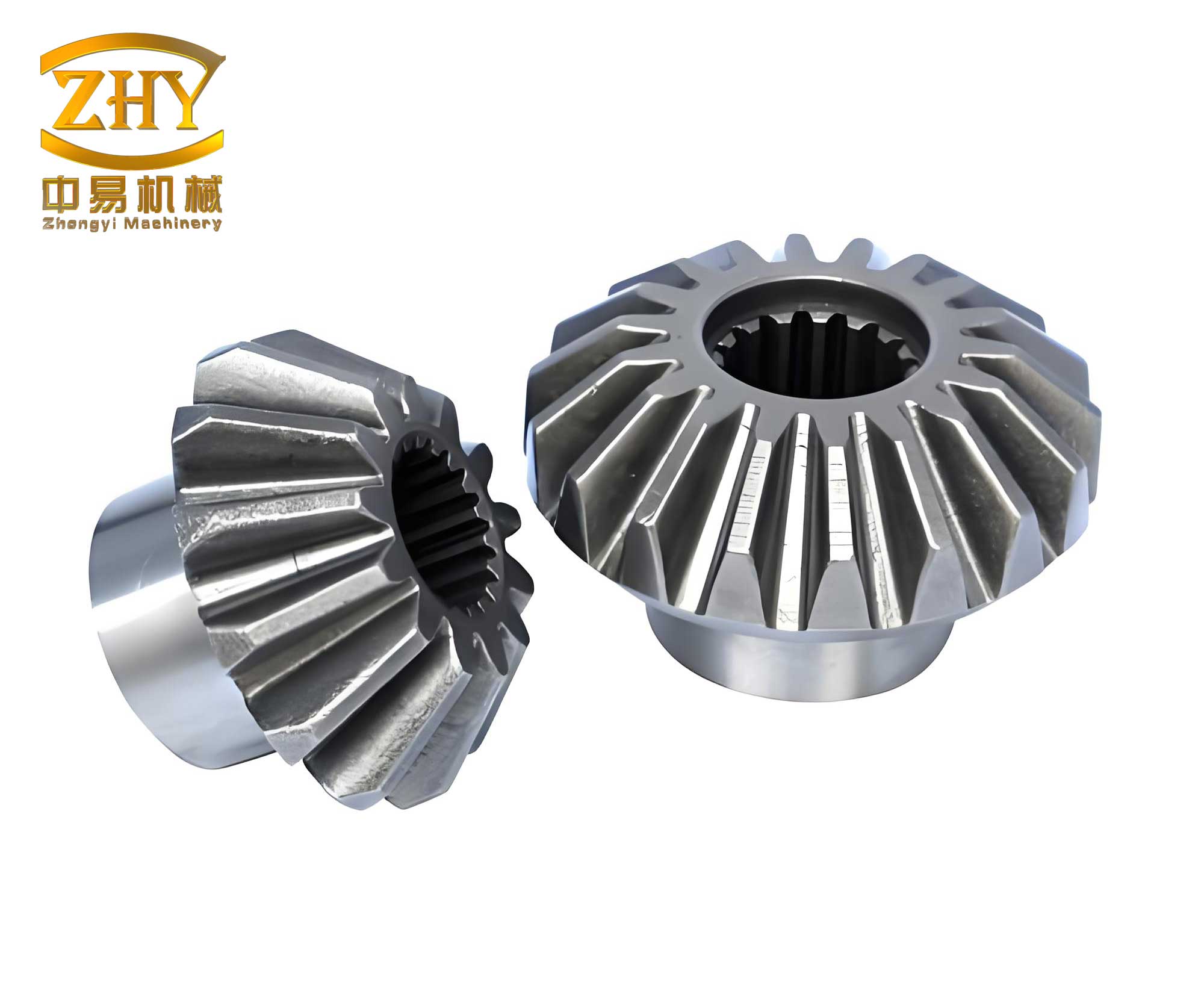
In the final quality inspection and packaging stage for a batch of approximately 320 active bevel gears intended for a 7-ton truck rear axle assembly, a significant failure was detected. Fifteen units exhibited prominent longitudinal surface cracks. These cracks originated in the shaft region and propagated axially towards the gear teeth, presenting as long, relatively straight fissures with minimal branching. This type of failure in new, unserviced components represents a critical manufacturing defect, necessitating a thorough root cause investigation to prevent recurrence. The active bevel gears were manufactured from 20CrMoH carburizing steel, following a standard sequence: cutting → forging → normalizing → rough turning → finish turning → gear hobbing → carburizing → quenching → finish grinding → inspection. This analysis details the systematic failure investigation performed to identify the underlying causes of cracking in these bevel gears.
The initial step involved a macroscopic examination of the cracked bevel gear. The primary crack measured approximately 161.0 mm in length and 0.3 mm in width, extending into the tooth fillet region to a depth of about 17.0 mm. The fracture surface exhibited a uniform silver-gray appearance. A key macroscopic feature was the presence of distinct “chevron” or “herringbone” patterns, which are classic markers pointing back to the crack initiation site. The convergence of these patterns was identified at a subsurface location, approximately 5 mm radially inward from the outer contour surface of the bevel gear shaft. This area was therefore designated as the suspected crack origin.
Material Composition and Microstructural Conformance Assessment
To rule out gross material non-conformity, the chemical composition of the failed bevel gear was analyzed using Optical Emission Spectrometry (OES). The results are summarized in Table 1.
| Element | C | Cr | Mn | Si | Mo | P | S |
|---|---|---|---|---|---|---|---|
| Measured Value | 0.22 | 0.99 | 0.83 | 0.34 | 0.22 | 0.013 | 0.009 |
| GB/T 5216-2004 Requirement for 20CrMoH | 0.17-0.23 | 0.85-1.25 | 0.60-1.00 | 0.17-0.37 | 0.15-0.25 | ≤0.035 | ≤0.035 |
The data confirms that the chemical composition of the bevel gear material is fully compliant with the specifications for 20CrMoH steel. Next, the microstructure resulting from the carburizing and quenching heat treatment was evaluated. Transverse samples were taken from the tooth section, prepared using standard metallographic techniques, etched with 4% Nital, and examined. The case microstructure, as shown in the provided micrograph, consisted of fine acicular martensite with retained austenite. The core microstructure consisted of low-carbon lath martensite with some dispersed free ferrite. Both structures were rated as Level 3 according to GB/T 25744-2010, which falls within the acceptable range for this grade of steel after carburizing and quenching.
Detailed Fractography and Microanalysis of the Crack Origin
A sample containing the identified crack origin zone was carefully extracted, cleaned ultrasonically in acetone, and examined using Scanning Electron Microscopy (SEM) coupled with Energy Dispersive X-ray Spectroscopy (EDS). The SEM micrograph revealed the origin area as a distinct, bright, elongated band measuring approximately 1.415 mm in length and 0.345 mm in width. Fracture propagation markings radiated outward from this band. Point EDS analysis was performed directly on this band, and the results are presented in Table 2.
| Element | C | O | F | Mg | Al | S | Ca | Cr | Mn | Fe |
|---|---|---|---|---|---|---|---|---|---|---|
| Concentration | 3.67 | 13.21 | 0.30 | 2.40 | 19.55 | 0.39 | 4.78 | 0.66 | 0.56 | 54.48 |
The significantly elevated levels of Oxygen (O), Aluminum (Al), Calcium (Ca), and Magnesium (Mg) are unmistakable indicators of non-metallic inclusions. These are typical of oxidic slag inclusions, such as alumina (Al2O3) and calcium aluminates, formed during steelmaking and casting processes. To confirm the spatial distribution, elemental mapping for Al and O was conducted. The maps clearly showed a dense, band-like segregation of both aluminum and oxygen signals coinciding precisely with the morphologically distinct crack origin band, providing conclusive evidence that the crack initiated at a cluster of oxidic inclusions.
Investigation of Microstructural Banding and Segregation
Although the quenched microstructure appeared acceptable, the possibility of underlying chemical segregation from the original cast ingot was investigated. A longitudinal sample was taken from the shaft core of the bevel gear, away from the carburized case. This sample was subjected to an isothermal annealing treatment (930°C for 60 minutes, followed by 660°C for 120 minutes) to reveal the ferrite-pearlite structure indicative of segregation. The resulting microstructure, as shown in the corresponding micrograph, exhibited severe banding. Alternating bands of ferrite (light) and pearlite (dark) were pronounced. According to GB/T 13299-1991, this banded structure was rated as Level 4, where Levels 1-3 are generally considered acceptable. This indicates a significant degree of microsegregation, primarily of manganese and other elements, which was not eliminated by the prior forging and normalizing processes.
The presence of severe banding has several detrimental effects on the mechanical properties and heat treatment response of the bevel gear:
- Local Variation in Austenitization: During heating for carburizing (~920°C) or quenching (~830°C), the pearlitic bands, richer in carbon and alloying elements, fully austenitize at a lower temperature (Ac3) compared to the ferritic bands. This can be conceptualized by the local shift in the phase boundary. The effective undercooling ($\Delta T$) for austenite formation differs:
$$ \Delta T_{\text{pearlite band}} = T_{\text{process}} – A_{c3,\text{pearlite}} $$
$$ \Delta T_{\text{ferrite band}} = T_{\text{process}} – A_{c3,\text{ferrite}} $$
Since $A_{c3,\text{ferrite}} > A_{c3,\text{pearlite}}$, $\Delta T_{\text{ferrite}} < \Delta T_{\text{pearlite}}$ at the same process temperature. This differential undercooling can lead to inhomogeneous austenite grain size. - Hall-Petch Effect and Property Inhomogeneity: The relationship between yield strength ($\sigma_y$) and grain size ($d$) is given by the Hall-Petch equation:
$$ \sigma_y = \sigma_0 + k_y d^{-1/2} $$
where $\sigma_0$ is the friction stress and $k_y$ is the strengthening coefficient. Inhomogeneous grain size resulting from banding leads to local variations in yield strength. Under applied or residual stress, deformation will concentrate in the softer, potentially coarser-grained regions, acting as stress concentrators. - Differential Martensite Start (Ms) Temperature: The Ms temperature is primarily a function of the austenite composition. The empirical equation by Andrews is often used:
$$ M_s (^\circ\text{C}) = 539 – 423C – 30.4Mn – 17.7Ni – 12.1Cr – 7.5Mo $$
Austenite in the former pearlite bands, having higher carbon and alloy content after diffusion, will have a significantly lower Ms temperature than austenite in the former ferrite bands or in the low-carbon core regions. During quenching, this leads to non-simultaneous martensitic transformation.
Stress State Analysis at the Failure Location
The convergence of several geometric and transformational factors created a critical stress state at the specific location where the bevel gear crack initiated.
1. Subsurface Crack Origin and Transformational Stresses: The crack origin was identified at a depth of ~5 mm from the surface. The effective case depth after carburizing was measured to be ~2 mm. Therefore, the crack initiated in the “sub-case” or core region, not in the high-carbon case. The carbon content in this region is substantially lower than in the case. According to the Ms equation above, this region has a higher Ms temperature. During quenching, martensite formation would begin first in this subsurface core region (higher Ms) while the higher-carbon case was still austenitic and relatively plastic. The volumetric expansion associated with the martensitic transformation ($\Delta V/V \approx 0.04 – 0.05$) in the core creates compressive stresses in the core and tensile stresses in the still-soft case. Later, when the case transforms at a lower temperature, its expansion is constrained by the already-transformed, rigid core. This generates high tensile stresses in the case and compressive stresses in the core. However, at the interface between these two zones undergoing transformation at different times, complex triaxial stress states develop. The superposition of thermal stresses (from cooling) and these transformational stresses can create a localized maximum tensile stress zone in the sub-case region, precisely where the crack origin was found.
2. Stress Concentration at a Geometric Discontinuity: The axial location of the crack origin corresponded to a shoulder or a step on the bevel gear shaft—a change in diameter. Such geometric discontinuities are potent stress concentrators. The theoretical stress concentration factor ($K_t$) for a shoulder fillet depends on the ratio of the diameters (D/d) and the fillet radius (r). Under the combined influence of residual quenching stresses and any incidental handling or contact stresses, the local stress ($\sigma_{\text{local}}$) at this feature is magnified:
$$ \sigma_{\text{local}} = K_t \cdot \sigma_{\text{nominal}} $$
This elevated stress acts on the material at the sub-case depth.
3. Role of Inclusions as Stress Raisers: The cluster of hard, brittle oxidic inclusions identified at the crack origin acts as a severe internal stress concentrator. These inclusions have a different coefficient of thermal expansion (CTE) and elastic modulus compared to the steel matrix. For example, Al2O3 has a CTE of about $8 \times 10^{-6} /K$, while steel is about $12 \times 10^{-6} /K$. During cooling from the austenitizing temperature, this mismatch leads to the development of localized stresses around the inclusion. More critically, under an applied tensile stress field, these inclusions disrupt the continuity of the matrix. They cannot deform plastically to accommodate the strain, leading to extremely high local stress intensities. The stress intensity factor ($K_I$) for a crack-like defect (which the inclusion cluster effectively is) is given by:
$$ K_I = Y \sigma \sqrt{\pi a} $$
where $Y$ is a geometric factor, $\sigma$ is the applied stress, and $a$ is the defect size. The large size (~1.4 mm) of the inclusion band means even a moderate applied stress can result in a $K_I$ value exceeding the material’s fracture toughness ($K_{IC}$), leading to crack initiation. The presence of severe banding in this region further weakens the matrix’s ability to resist crack propagation from the inclusion.
Synthesis of the Failure Mechanism for the Bevel Gear
The longitudinal cracking of the bevel gear is a classic example of a failure resulting from the synergistic interaction of material imperfections, heat treatment-induced stresses, and geometric design. The causal chain can be summarized as follows:
- Pre-existing Material Deficiencies: The steel billet used for forging the bevel gear contained two critical flaws:
- Severe Centerline Segregation (Banding): This led to anisotropic and inhomogeneous mechanical properties, reduced fracture resistance, and promoted non-uniform transformation behavior during quenching.
- Large Oxidic Inclusion Clusters: A macro-inclusion band, rich in Al, Ca, Mg, and O, was present in the sub-surface region of the shaft. This band acted as a potent internal crack starter.
- Stress State Creation during Quenching: The heat treatment of the bevel gear generated a complex residual stress field:
- The differential timing of martensitic transformation between the high-carbon case (low Ms) and the lower-carbon sub-case/core (higher Ms) created high tensile stresses at their interface.
- The geometric stress concentrator (shaft step) further amplified the local tensile stress magnitude at this specific axial location.
- Crack Initiation and Unstable Propagation: The superposition of the high local tensile stress (from factors 2a and 2b) onto the severe internal stress concentrator (the inclusion band – factor 1b) caused the stress intensity at the tip of this effective defect to exceed the local fracture toughness of the material. The local fracture toughness was itself compromised by the surrounding segregated and banded microstructure (factor 1a). Once initiated, the crack propagated rapidly in an unstable manner along the path of least resistance, likely influenced by the anisotropic properties of the banded structure, resulting in the observed long, straight longitudinal crack. The bevel gear failed before ever entering service.
Corrective Actions and Preventive Recommendations for Bevel Gear Manufacturing
To prevent recurrence of such failures in future production of bevel gears, a multi-faceted approach targeting the root causes is essential.
| Root Cause Category | Specific Issue | Recommended Corrective & Preventive Actions |
|---|---|---|
| Material Quality | Severe Microstructural Banding |
|
| Large Oxidic Inclusion Clusters |
|
|
| Heat Treatment & Design | Stress Concentration & Transformational Stresses |
|
| Process Control | General Quality Assurance |
|
Quantitative Perspectives on Critical Factors
The failure analysis can be further supported by considering some quantitative relationships. The critical defect size ($a_c$) for crack initiation under a given stress ($\sigma$) and material fracture toughness ($K_{IC}$) is a key concept:
$$ a_c = \frac{1}{\pi} \left( \frac{K_{IC}}{Y \sigma} \right)^2 $$
For a typical quenched and tempered low-alloy steel like 20CrMoH, $K_{IC}$ might be in the range of 50 – 80 MPa√m. Assuming an applied stress ($\sigma$) of 500 MPa (plausible for residual + stress concentration effects) and a geometry factor $Y \approx 1$, the critical defect size calculates to approximately 0.6 – 1.6 mm. The observed inclusion band (~1.4 mm long) falls squarely within this range, demonstrating its potency as a crack initiator.
Furthermore, the effect of banding on transformation can be modeled. The difference in Ms temperature ($\Delta M_s$) between two regions with different carbon contents ($C_1$ and $C_2$) can be approximated from the Andrews equation:
$$ \Delta M_s \approx 423 \cdot (C_2 – C_1) $$
If the banding causes a local carbon difference of, for example, 0.1 wt.%, the Ms difference would be about 42°C. This significant difference is more than enough to cause the sequential transformation behavior that leads to high interfacial stresses during the quenching of the bevel gear.
In conclusion, the longitudinal failure of the subject bevel gears was not due to a single error but a confluence of deficiencies. The primary root causes were the presence of a large subsurface inclusion cluster and severe microstructural banding in the raw material. These intrinsic flaws, when subjected to the inevitable high stresses generated during quenching—particularly concentrated at a geometric discontinuity—created the necessary conditions for catastrophic crack initiation and propagation. Ensuring the integrity of future bevel gear production requires stringent control over steel cleanness and homogeneity, coupled with design and process optimizations to manage transformational stresses.