
In the realm of aviation propulsion, bearings serve as critical components whose reliability directly impacts the safety and performance of both engines and aircraft. As engine technology advances, the operational conditions for bearings become increasingly severe, leading to a higher probability of failures. Historical data from international engine development and domestic usage indicate that bearings are among the most failure-prone parts in engines, necessitating significant attention. This article delves into a specific case of cracking in the outer ring of a bevel gear bearing within a turboshaft engine. Through comprehensive analysis covering design, manufacturing processes, assembly, and metallurgy, the root cause is identified, and improvement measures are proposed. Furthermore, field replacement procedures are established to ensure operational safety. The insights gained from this study offer valuable reference for troubleshooting similar bevel gear bearings in aviation applications.
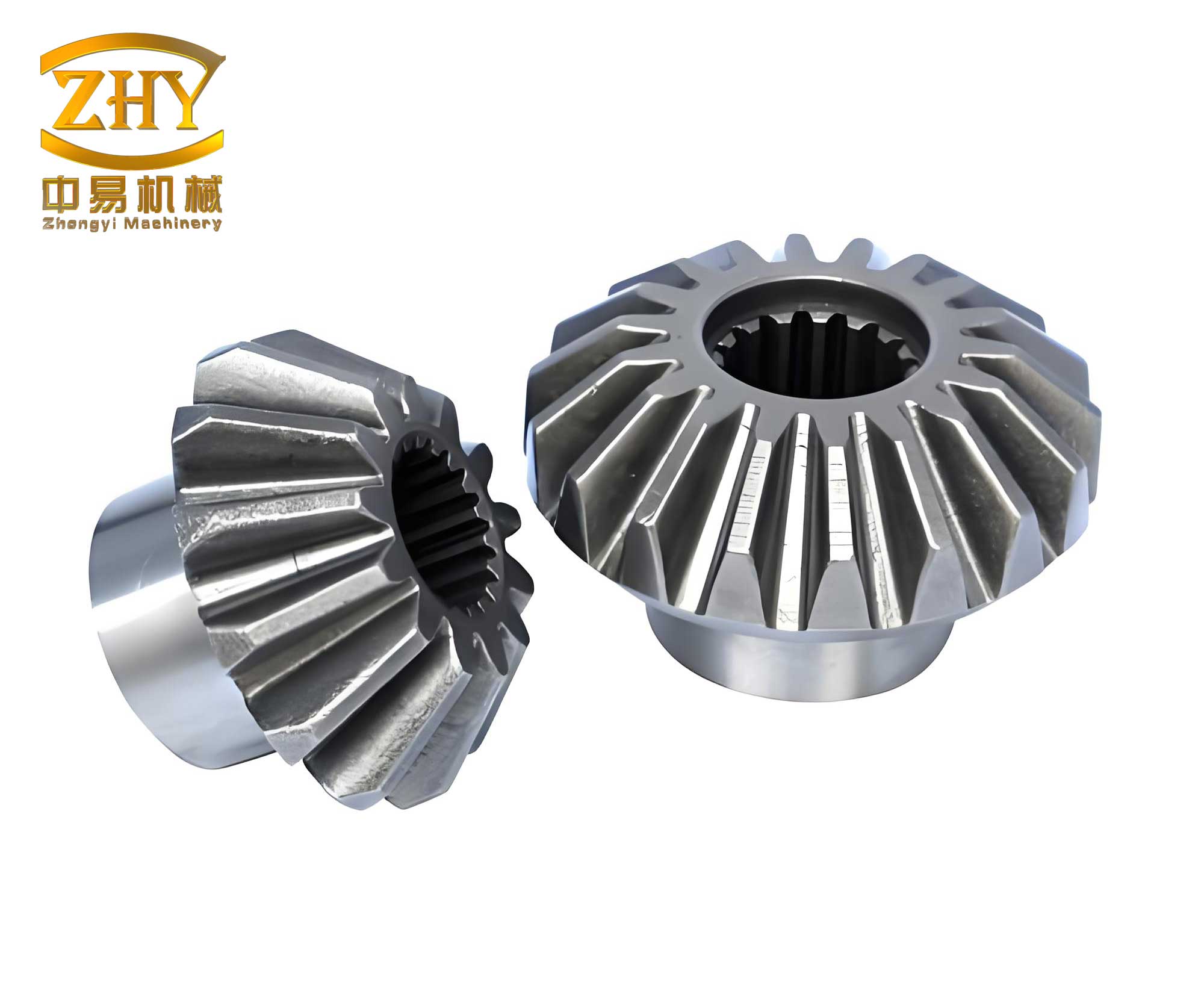
The bevel gear bearing in question is a double-row, double-inner-ring angular contact ball bearing. It forms an assembly with the intermediate driven bevel gear, secured via a large nut, and is mounted onto the intake casing using pins and studs for positioning. This bevel gear bearing supports the intermediate driven bevel gear in a cantilevered manner, transmitting power through splines from the central drive shaft. The mating intermediate driving bevel gear is attached to the engine’s gas generator rotor. The bevel gear bearing is subjected to complex loading conditions, including radial, axial, and moment loads, as well as vibrational shocks from gear meshing. During engine operation, the bevel gear experiences meshing forces that can be decomposed into radial force \( F_r \), tangential force \( F_t \), and axial force \( F_x \). At engine start-up, the directions of these forces reverse relative to normal operation. The force distribution on the bevel gear bearing can be represented as follows:
$$ F_r = F_m \cdot \cos(\alpha) \cdot \sin(\beta) $$
$$ F_t = F_m \cdot \sin(\alpha) $$
$$ F_x = F_m \cdot \cos(\alpha) \cdot \cos(\beta) $$
Where \( F_m \) is the meshing force, \( \alpha \) is the pressure angle, and \( \beta \) is the spiral angle of the bevel gear. These forces induce significant stress concentrations, particularly at transition regions such as fillets (R areas) on the bearing outer ring. The dynamic nature of these loads, combined with high-frequency vibrations, makes the bevel gear bearing susceptible to fatigue failures.
During a test run of the engine, a metal chip warning was triggered. Subsequent disassembly revealed cracking in the outer ring of the bevel gear bearing at the transition fillet (R area) between the installation flange and the outer cylindrical surface. Metallurgical analysis indicated that the crack propagated axially through the entire wall thickness. Notably, a remelted layer with a maximum thickness of approximately 20 µm was found on the surface of the fillet area, along with evident wire electrical discharge machining (EDM) marks on the outer surface and crack initiation zone. This remelted layer, characterized by high hardness and brittleness, acted as a stress concentrator and initiation site for fatigue cracks.
To understand the manufacturing origins, a review of the production process was conducted. Initially, due to the complex geometry of the bearing outer ring, manual filing was employed (referred to as the “filed state”) to remove burrs and ensure proper fit. However, this method sometimes left minor imperfections. To enhance the appearance and surface quality of non-working surfaces, a sandblasting process was introduced (referred to as the “sandblasted state”). The process flow before and after optimization is summarized below:
| Process Step (Before Optimization) | Process Step (After Optimization) |
|---|---|
| Cut R22 arc surface | Cut R22 arc surface |
| File R22 arc surface | Cut forming (two inclined surfaces and R25) |
| Cut forming (two inclined surfaces and R25) | Sandblasting |
| Grind two inclined surfaces | Grind outer diameter |
| File R25 | Final grind outer and inner diameters |
| Grind outer diameter | Final grind outer raceway |
| Final grind outer and inner diameters | — |
| Final grind outer raceway | — |
The key change was the replacement of manual filing after EDM with sandblasting. While sandblasting improved surface appearance, it was ineffective at removing the remelted layer left by EDM, especially in shielded areas like fillets. This residual remelted layer, with its micro-cracks and rough texture, significantly reduced fatigue resistance.
To validate the failure mechanism, strength and vibration tests were performed. First, dynamic stress measurements on the bevel gear bearing outer ring during operation showed that vibration stresses were primarily driven by the gas generator rotor’s harmonics (1x to 4x frequency), with no significant resonance observed. The vibration environment is characterized by the following equation for forced vibration response:
$$ \sigma_{vib} = \sum_{n=1}^{4} A_n \cdot \sin(2\pi f_n t + \phi_n) $$
Where \( \sigma_{vib} \) is the vibrational stress, \( A_n \) is the amplitude, \( f_n \) is the frequency harmonic, and \( \phi_n \) is the phase angle. The stress levels remained within design limits under normal conditions.
High-cycle fatigue (HCF) tests were then conducted on outer ring samples under different surface conditions. The results are tabulated below, illustrating the fatigue performance:
| State | Batch ID | Frequency (Hz) | Stress Level (MPa) | Cycles to Failure | Crack Observed? | Fatigue Limit (MPa) |
|---|---|---|---|---|---|---|
| Repaired State (remelted layer removed, fillet R0.5–0.8) | 1/1 | 1557 | 1100 | 1.0×10⁷ | No | 1194–1250 |
| 1/1 | 1557 | 1200 | 7.34×10⁶ | Direct fracture | ||
| 1/2 | 1584 | 1100 | 1.0×10⁷ | No | ||
| 1/2 | 1584 | 1200 | 1.0×10⁷ | No | — | |
| Sandblasted State (same batch as faulty part) | 1/3 | 1615 | 800 | 4.01×10⁶ | Direct fracture | 793–895 |
| 1/4 | 1557 | 800 | 1.0×10⁷ | No | ||
| 1/4 | 1557 | 900 | 5.89×10⁶ | Yes | ||
| 1/5 | 1660 | 800 | — | Crack during loading | ||
| — | — | — | — | — | ||
| Sandblasted State (different batch from faulty part) | 2/1 | 1604 | 800 | 3.81×10⁶ | Yes | 720–979 |
| 2/2 | 1644 | 900 | 0.197×10⁶ | Yes | ||
| 2/3 | 1611 | 800 | 0.29×10⁶ | Yes | ||
| 2/4 | 1610 | 800 | 9.93×10⁶ | Yes | ||
| 2/5 | 1606 | 900 | 1.0×10⁷ | No | ||
| 2/5 | 1606 | 1000 | 1.54×10⁶ | Yes |
The data clearly shows that the sandblasted state, which retains the remelted layer, has a lower and more scattered fatigue limit compared to the repaired state. For instance, the fatigue limit for sandblasted samples ranges from 720 MPa to 979 MPa, whereas repaired samples achieve 1194 MPa to 1250 MPa. This reduction in fatigue strength can be quantified using the Goodman relation for combined mean and alternating stresses:
$$ \frac{\sigma_a}{S_e} + \frac{\sigma_m}{S_u} = 1 $$
Where \( \sigma_a \) is the alternating stress amplitude, \( \sigma_m \) is the mean stress, \( S_e \) is the endurance limit, and \( S_u \) is the ultimate tensile strength. The presence of the remelted layer effectively lowers \( S_e \), increasing the risk of fatigue failure under operational stresses. The fatigue safety factor \( n_f \) is given by:
$$ n_f = \frac{S_e}{\sigma_a} $$
Under normal conditions, a safety factor of 2.5 is required. However, with a thick remelted layer and elevated engine vibrations, \( \sigma_a \) may increase or \( S_e \) decrease, potentially driving \( n_f \) below the threshold. In the faulty bevel gear bearing, the remelted layer thickness reached 20 µm, leading to crack initiation and propagation under cyclic loading. Eventually, the crack caused a step formation, leading to localized spalling and metal chip generation.
Based on this analysis, improvement measures were implemented. For the bevel gear bearing outer ring, the remelted layer at the transition fillet (R area) between the installation flange and the R22 cylindrical surface must be thoroughly removed. The fillet radius is controlled to 0.4–0.8 mm, ensuring a smooth transition without grinding burns or cracks. The revised process involves filing plus polishing for the R22 outer cylindrical surface, and grinding wheel dressing plus polishing for the fillet at the junction between the R22 arc and the installation plane. This approach enhances surface integrity and fatigue strength. Validation through vibration fatigue tests demonstrated a 50% improvement in fatigue strength, with the enhanced endurance limit \( S_e’ \) expressed as:
$$ S_e’ = 1.5 \times S_e $$
Where \( S_e \) is the original endurance limit. This improvement significantly boosts the safety margin for the bevel gear bearing in service.
To support field maintenance, a detailed operational procedure for replacing the bevel gear bearing was developed. This procedure was refined through component tests on three engine front-section assemblies (10 trials) and whole-engine tests on eight engines. The tests confirmed that replacing the bevel gear bearing does not adversely affect key parameters such as the meshing backlash and engagement of the intermediate driving and driven bevel gears, engine vibration levels, or gas generator rundown time. The selection criteria for replacement bevel gear bearings include dimensional tolerances, surface quality checks for absence of remelted layers, and verification of fillet geometry. The field replacement procedure is outlined in the flowchart below, which integrates into maintenance workflows:
| Step | Action | Tools and Criteria |
|---|---|---|
| 1 | Engine shutdown and isolation | Follow safety protocols; ensure zero energy state. |
| 2 | Disassembly of intake casing | Remove pins, studs, and nuts; document orientation. |
| 3 | Extraction of bevel gear bearing assembly | Use专用 pullers; avoid damage to adjacent bevel gears. |
| 4 | Inspection of bearing and seating surfaces | Check for cracks, wear, remelted layers; measure fillet R. |
| 5 | Selection of replacement bearing | Verify process state (repaired); confirm dimensions per spec. |
| 6 | Preparation of mounting surfaces | Clean and degrease; ensure no debris in fillet areas. |
| 7 | Installation of new bevel gear bearing | Align pins and studs; torque nuts to specified values. |
| 8 | Assembly and functional testing | Reassemble casing; conduct ground run to check vibrations and metal chip sensors. |
This procedure ensures that field replacements are performed consistently, minimizing downtime and maintaining engine reliability. Additionally, for ongoing engine operation, two recommendations are proposed: First, tighten the response protocols for metal chip warnings, including immediate inspection and potential bearing replacement. Second, during flight, if a metal chip warning light illuminates, pilots should follow the flight manual: reduce collective pitch to lower engine power, monitor parameters for anomalies such as elevated oil temperature or torque fluctuations, and shut down the engine if severe abnormalities occur.
In conclusion, the cracking failure in the bevel gear bearing outer ring was primarily attributed to the presence of a remelted layer at the transition fillet, resulting from process changes that replaced manual filing with sandblasting. This layer acted as a fatigue initiator under the complex loading conditions inherent to bevel gear bearings. The implemented improvements—filing plus polishing for outer surfaces and grinding plus polishing for fillets—effectively eliminate the remelted layer and enhance fatigue resistance. The field replacement procedure provides a reliable method for maintenance, while operational guidelines help mitigate risks. This case underscores the importance of meticulous process control in manufacturing critical components like bevel gear bearings, and the findings are applicable to similar bearings in turboshaft and other aviation engines. Future work could explore advanced non-destructive testing techniques for detecting surface anomalies in bevel gear bearings, as well as modeling approaches to predict fatigue life under combined loading scenarios. By integrating these insights, the aviation industry can enhance the durability and safety of bevel gear transmission systems.
From a broader perspective, the study highlights the interplay between manufacturing processes, material science, and mechanical design in ensuring component reliability. For bevel gear bearings, which are integral to power transmission in helicopters and other rotary-wing aircraft, even minor surface defects can lead to catastrophic failures. Therefore, continuous monitoring and improvement of production techniques are essential. The use of analytical methods such as finite element analysis (FEA) can further optimize fillet geometries to reduce stress concentrations. For example, the stress concentration factor \( K_t \) for a fillet can be expressed as:
$$ K_t = 1 + \frac{2t}{r} $$
Where \( t \) is the thickness and \( r \) is the fillet radius. By increasing \( r \) within design constraints, \( K_t \) decreases, lowering peak stresses. Additionally, residual stresses from polishing can be beneficial; compressive residual stresses \( \sigma_{res} \) improve fatigue life by offsetting tensile applied stresses:
$$ \sigma_{eff} = \sigma_{applied} + \sigma_{res} $$
Where \( \sigma_{eff} \) is the effective stress, and compressive \( \sigma_{res} \) is negative. These principles can be applied to future bevel gear bearing designs to achieve higher performance margins.
In summary, this comprehensive analysis of bevel gear bearing cracking not only resolves a specific fault but also contributes to the broader knowledge base on bearing failures in aerospace applications. The solutions presented—process refinements and field procedures—are practical and validated, ensuring that bevel gear bearings continue to meet the demanding requirements of modern turboshaft engines.