
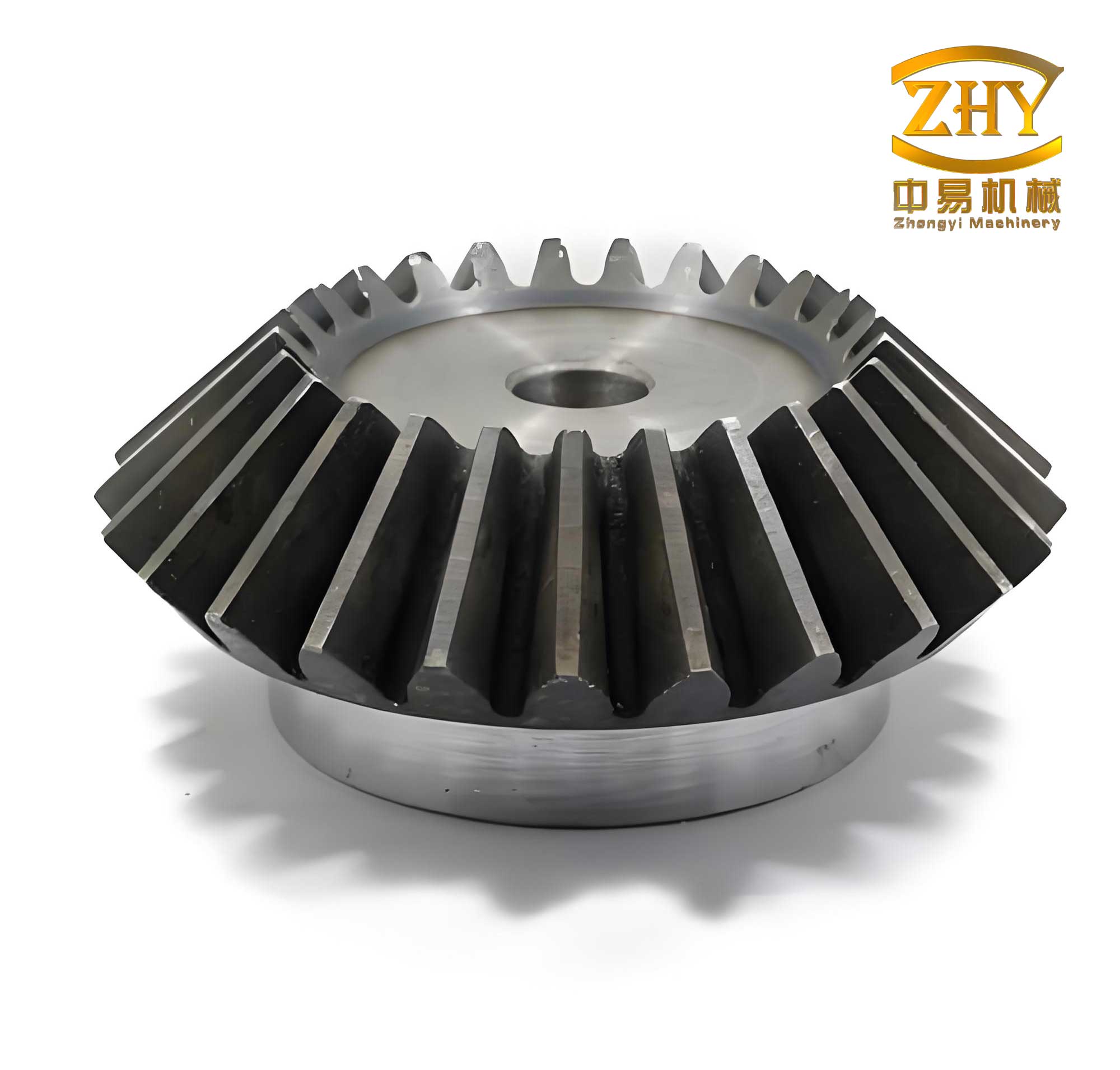
As a mechanical transmission component, bevel gears are widely used in various applications, enabling the conversion between different forms of motion through gear pairing. Bevel gears are typically employed for transmitting power between intersecting shafts, altering the direction of motion compared to coaxial gears. During service, bevel gears often experience failures such as tooth root fracture. To enhance material strength and prolong the lifespan of bevel gears, quenching is commonly applied as a heat treatment method. Heat treatment involves heating, holding, and cooling metal materials under specific conditions to modify their microstructure and control properties. By altering the microstructure through temperature changes, materials achieve desired strength, and the residual stresses induced by quenching can improve the fatigue resistance of gear components. However, during quenching, the combined effects of thermal and transformation stresses can lead to issues like cracking and distortion in bevel gears, impacting their performance. Traditional experimental methods for studying quenching, such as metallographic analysis, are often time-consuming and influenced by numerous hard-to-control factors. In this study, I employ the finite element software Ansys to simulate the quenching process of a bevel gear, investigating temperature and stress field variations to provide insights for thermal processing of bevel gears, with validation through comparative analysis.
The quenching process generally excludes external forces, focusing solely on the effects of temperature changes during cooling. The heat exchange between the component and quenching medium is typically nonlinear. Upon cooling from an austenitizing temperature, the material transforms from austenite to martensite or bainite, followed by tempering to enhance mechanical properties. The fundamental equation governing heat conduction is the Fourier heat conduction equation, which in three dimensions can be expressed as:
$$\frac{\partial}{\partial x}\left(k \frac{\partial T}{\partial x}\right) + \frac{\partial}{\partial y}\left(k \frac{\partial T}{\partial y}\right) + \frac{\partial}{\partial z}\left(k \frac{\partial T}{\partial z}\right) + q = \rho c \frac{\partial T}{\partial t}$$
where \(T\) represents temperature, \(c\) is specific heat capacity, \(\rho\) is material density, \(q\) denotes latent heat due to phase transformation, \(t\) is time, and \(k\) is thermal conductivity. For bevel gear quenching, boundary conditions often fall into three categories: known surface temperature, known surface heat flux, or known convection with the surrounding medium. In this analysis, I adopt the third type:
$$-\lambda \left. \frac{\partial T}{\partial n} \right|_s = H_k (T_w – T_c)$$
where \(H_k\) is the heat transfer coefficient, \(T_w\) is the surface temperature of the bevel gear, and \(T_c\) is the temperature of the quenching medium. The initial condition is defined as:
$$T|_{t=0} = T_0$$
To model the bevel gear, I used Pro/E software to create the solid geometry, which was then imported into Ansys for meshing. Given the symmetry of the bevel gear, I simplified the model by analyzing a single tooth to reduce computational effort, applying symmetric boundary conditions on the cut faces. The finite element model is shown in the figure above. For the analysis, I utilized direct coupling with Ansys’s coupled field elements (e.g., COMPLED FIELD) to simulate the thermo-mechanical behavior during quenching of the bevel gear. The material selected is 20CrMoH, with properties summarized in Table 1.
| Property | Value | Units |
|---|---|---|
| Thermal Conductivity | 44 | W·m⁻¹·°C⁻¹ |
| Elastic Modulus | 210 × 10⁹ | Pa |
| Specific Heat Capacity | 460 | J·kg⁻¹·°C⁻¹ |
| Density | 7840 | kg·m⁻³ |
| Poisson’s Ratio | 0.278 | – |
| Coefficient of Thermal Expansion | 1.27 × 10⁻⁵ | °C⁻¹ |
The choice of quenching medium is critical in the quenching process. Ideally, cooling should be slow initially to avoid rapid transformation of austenite, fast in the intermediate stage to prevent pearlite formation, and slow again later to mitigate stresses from martensitic expansion. The heat transfer coefficient, representing heat exchange between the bevel gear surface and the medium, is key for simulation accuracy. Empirical formulas often yield significant errors, so I used data from literature for oil and water quenching, as shown in Tables 2 and 3.
| Temperature (°C) | Heat Transfer Coefficient (W·m⁻²·°C⁻¹) |
|---|---|
| 50 | 224.5 |
| 100 | 250.4 |
| 200 | 270.6 |
| 300 | 459.5 |
| 400 | 1757.4 |
| 500 | 4358.6 |
| 600 | 3872.6 |
| 700 | 2189.9 |
| 860 | 947 |
| Temperature (°C) | Heat Transfer Coefficient (W·m⁻²·°C⁻¹) |
|---|---|
| 50 | 1000 |
| 100 | 3800 |
| 200 | 6000 |
| 300 | 13500 |
| 400 | 12500 |
| 500 | 7000 |
| 600 | 4200 |
| 755 | 1000 |
| 860 | 500 |
For temperature field analysis, I simulated quenching of the bevel gear from an initial temperature of 860°C into oil and water media, with an ambient temperature of 50°C. Three points on the bevel gear were monitored: Point A at the tooth core, Point B on the flank between teeth, and Point C at the tooth tip. The cooling curves are plotted in Figure 1. In water quenching, the bevel gear reaches near ambient temperature in about 150 seconds, whereas oil quenching takes approximately 600 seconds. Oil cooling exhibits a more gradual temperature decline, which is beneficial for controlling distortion in bevel gears. The tooth tip cools fastest, while the tooth core cools slowest, highlighting the non-uniform cooling behavior in bevel gears.
To quantify the temperature distribution, the Fourier equation was solved numerically. The temperature gradient \(\nabla T\) influences stress development, as described by the thermal strain \(\epsilon_{th} = \alpha \Delta T\), where \(\alpha\) is the coefficient of thermal expansion. For the bevel gear, the temperature field at different times in oil quenching shows that after 5 seconds, the tooth tip drops to around 500°C, while the tooth core remains near 800°C. By 200 seconds, the tooth tip is at 130°C and the tooth core at 160°C, converging over time. This non-uniform cooling can lead to significant thermal stresses in the bevel gear.
For stress field analysis, I focused on oil quenching and compared conventional quenching with stepped quenching (where cooling switches to air at 300°C). Air quenching parameters include a heat transfer coefficient of 50 W·m⁻²·°C⁻¹, thermal conductivity of 49.3 W·m⁻¹·°C⁻¹, and specific heat capacity of 466 J·kg⁻¹·°C⁻¹. The Mises stress evolution was monitored at Points A, B, and C. In conventional oil quenching, the maximum Mises stress occurs at Point B (the flank between teeth), reaching peaks during cooling, while Point C (tooth tip) shows the fastest stress changes. This stress disparity can cause cracking or distortion in bevel gears. The Mises stress \(\sigma_{Mises}\) is calculated as:
$$\sigma_{Mises} = \sqrt{\frac{(\sigma_1 – \sigma_2)^2 + (\sigma_2 – \sigma_3)^2 + (\sigma_3 – \sigma_1)^2}{2}}$$
where \(\sigma_1, \sigma_2, \sigma_3\) are principal stresses. For the bevel gear, thermal stresses arise from constrained thermal expansion, given by \(\sigma_{th} = E \alpha \Delta T / (1 – \nu)\), where \(E\) is Young’s modulus and \(\nu\) is Poisson’s ratio. In stepped quenching, the stress curves for Points A and B become more aligned after 150 seconds, reducing stress gradients. This approach minimizes the risk of cracking in bevel gears by promoting more uniform stress distribution. The thermal deformation at Point C is also smoother in stepped quenching, though it requires longer cooling times—around 2200 seconds to reach ambient temperature versus 600 seconds for conventional oil quenching.
To further analyze the bevel gear behavior, I considered the phase transformation effects. The latent heat \(q\) in the Fourier equation accounts for energy release or absorption during austenite-to-martensite transformation. For 20CrMoH, the transformation kinetics can be modeled using the Koistinen-Marburger equation for martensite fraction \(f_m\):
$$f_m = 1 – \exp[-k(M_s – T)]$$
where \(k\) is a material constant and \(M_s\) is the martensite start temperature. This transformation induces volumetric expansion, contributing to residual stresses. In the bevel gear simulation, the combined thermal and transformation stresses were computed using the coupled field analysis. The results indicate that the tooth root region of the bevel gear is particularly prone to high tensile stresses, which can initiate cracks if not managed properly.
In terms of practical implications for bevel gear manufacturing, the simulation suggests that oil quenching is preferable for reducing thermal shock, but stepped quenching offers better stress uniformity. For high-precision bevel gears used in aerospace or automotive applications, controlling quenching parameters is essential. The heat transfer coefficients play a pivotal role; for instance, using polymer quenchants with adjustable properties could optimize cooling for complex bevel gear geometries. Additionally, the finite element model can be extended to include multi-tooth interactions or full gear sets to assess systemic effects.
To summarize the findings, I have compiled key observations in Table 4, comparing different quenching methods for bevel gears.
| Aspect | Oil Quenching | Water Quenching | Stepped Quenching (Oil to Air) |
|---|---|---|---|
| Cooling Time to Ambient | ~600 s | ~150 s | ~2200 s |
| Maximum Cooling Rate | Moderate | High | Low after 300°C |
| Stress Uniformity | Moderate | Low | High |
| Risk of Cracking | Medium | High | Low |
| Distortion Control | Good | Poor | Excellent |
| Suitability for Bevel Gears | High for general use | Low due to rapid cooling | High for critical applications |
The mathematical modeling of quenching for bevel gears can be enhanced by incorporating more precise phase transformation models. For example, the Leblond-Devaux model accounts for diffusion-controlled transformations, with the rate equation:
$$\frac{df}{dt} = \frac{f_{eq}(T) – f}{\tau(T)}$$
where \(f\) is the phase fraction, \(f_{eq}\) is the equilibrium fraction at temperature \(T\), and \(\tau\) is a temperature-dependent time constant. This adds complexity but improves accuracy for bevel gears made of alloy steels. Furthermore, the heat transfer coefficient can be modeled as a function of surface temperature and medium agitation, using correlations like:
$$H_k = a + b \cdot T + c \cdot T^2$$
where \(a, b, c\) are empirical constants derived for specific quenching setups. In my simulation, I used tabulated data for simplicity, but future work on bevel gears could involve dynamic coefficient adjustments.
Regarding the finite element methodology, I employed a transient analysis with time increments adjusted based on temperature change rates. The governing equation for stress analysis includes the equilibrium condition:
$$\nabla \cdot \sigma + F = 0$$
where \(\sigma\) is the stress tensor and \(F\) is body force (neglected here). The thermal strain contributes to the total strain \(\epsilon_{total} = \epsilon_{elastic} + \epsilon_{thermal} + \epsilon_{plastic}\). For the bevel gear material, plasticity was not considered in this study, but it could be included for more realistic simulations of bevel gears under high stress.
In conclusion, the finite element analysis of bevel gear quenching using Ansys provides valuable insights into temperature and stress field evolution. Oil quenching offers a smoother cooling curve favorable for bevel gears, while water quenching is faster but riskier. Stepped quenching significantly improves stress uniformity and reduces distortion in bevel gears, though at the cost of longer process times. The tooth tip and inter-tooth flank are critical zones requiring attention during bevel gear heat treatment. This simulation approach serves as a reliable tool for optimizing quenching parameters, thereby enhancing the durability and performance of bevel gears in mechanical systems. Future studies could explore advanced materials or multi-physics couplings for bevel gears in extreme environments.