
In mechanical engineering, bevel gears are crucial components used for transmitting motion and power between intersecting shafts, typically at a 90-degree angle. They are widely employed in various applications such as automotive differentials, industrial machinery, and aerospace systems. Traditional design methods for bevel gear transmissions often rely on empirical formulas and safety factors, which, while ensuring strength requirements, can lead to over-design with excessive material usage and non-optimal parameters. This results in larger sizes, increased weight, and higher costs. As an engineer focused on efficiency and sustainability, I aim to explore advanced optimization techniques to address these limitations. In this article, I will present a comprehensive study on optimizing bevel gear transmission parameters using a genetic algorithm (GA), a global optimization method inspired by natural selection and evolution. By formulating a mathematical model that minimizes the volume of the bevel gear pair while satisfying strength constraints, and implementing it via MATLAB’s Genetic Algorithm Toolbox, I demonstrate a more efficient design approach. This method not only reduces material waste but also enhances performance, offering a robust solution for modern mechanical design challenges. Throughout this discussion, I will emphasize the importance of bevel gears in transmission systems and how optimization can revolutionize their design.
Genetic algorithms are a class of evolutionary algorithms that mimic the process of natural selection to solve optimization problems. They are particularly effective for complex, non-linear, and multi-modal functions where traditional gradient-based methods may fail. As a designer, I find GAs advantageous due to their ability to explore a wide search space and avoid local optima, making them ideal for engineering applications like bevel gear optimization. The basic steps of a genetic algorithm include initialization, selection, crossover, mutation, and termination. Initially, a population of candidate solutions (encoded as chromosomes) is randomly generated. Each solution is evaluated using a fitness function that reflects the optimization objective—in this case, the volume of the bevel gear pair. Selection mechanisms, such as roulette wheel or tournament selection, choose fitter individuals to reproduce. Crossover operators combine pairs of chromosomes to create offspring, while mutation operators introduce random changes to maintain diversity. This process iterates over generations until a termination criterion is met, such as a maximum number of generations or convergence to an optimal solution. The flow can be summarized in a step-by-step manner, but for clarity, I will outline it in a table below.
| Step | Description | Key Operations |
|---|---|---|
| 1. Initialization | Generate an initial population of random solutions encoded as chromosomes. | Define design variables (e.g., gear parameters) and bounds. |
| 2. Fitness Evaluation | Compute the fitness value for each chromosome using the objective function and constraints. | Calculate volume and check strength conditions for bevel gears. |
| 3. Selection | Select parents from the population based on fitness scores for reproduction. | Use methods like roulette wheel or tournament selection. |
| 4. Crossover | Combine parent chromosomes to produce offspring, exchanging genetic material. | Apply operators such as single-point or uniform crossover. |
| 5. Mutation | Randomly alter some genes in the offspring to maintain genetic diversity. | Use bit-flip or Gaussian mutation for real-coded chromosomes. |
| 6. Termination | Repeat steps 2-5 until a stopping condition is satisfied. | Maximum generations reached or fitness improvement stalls. |
This iterative process ensures that the population evolves toward better solutions, making genetic algorithms suitable for optimizing bevel gear designs where multiple parameters interact non-linearly. In the context of bevel gear transmission, the GA helps find the optimal combination of gear parameters that minimize volume without compromising strength, a task that is challenging with conventional methods.
To apply genetic algorithms to bevel gear optimization, I first establish a mathematical model. The primary goal is to minimize the total volume of the bevel gear pair, which directly correlates with material usage and weight. For a straight bevel gear set with a shaft angle of 90 degrees, the volume can be derived from geometric considerations. The bevel gears are modeled as truncated cones, and their volumes depend on parameters such as the number of teeth, module, and face width. Let me define the objective function formally. Consider a bevel gear pair consisting of a pinion (gear 1) and a gear (gear 2). The design variables are the pinion tooth count \( z_1 \), the module \( m \) (at the large end), and the face width coefficient \( \phi_R \). The volume \( V \) of the gear pair is given by:
$$ V = V_1 + V_2 = \frac{\pi}{3} b \cos \delta_1 \left[ \left( \frac{m z_1}{2} \right)^2 + \frac{m z_1}{2} \cdot \frac{R – b}{R} \cdot \frac{m z_1}{2} + \left( \frac{R – b}{R} \cdot \frac{m z_1}{2} \right)^2 \right] + \frac{\pi}{3} b \cos \delta_2 \left[ \left( \frac{m z_2}{2} \right)^2 + \frac{m z_2}{2} \cdot \frac{R – b}{R} \cdot \frac{m z_2}{2} + \left( \frac{R – b}{R} \cdot \frac{m z_2}{2} \right)^2 \right] $$
where:
- \( z_2 = u z_1 \) is the gear tooth count, with \( u \) as the gear ratio.
- \( R = \frac{m}{2} \sqrt{z_1^2 + z_2^2} = \frac{m z_1}{2} \sqrt{1 + u^2} \) is the cone distance.
- \( b = \phi_R R \) is the face width, typically constrained by \( 0.25 \leq \phi_R \leq 0.35 \).
- \( \delta_1 \) and \( \delta_2 \) are the pitch angles: \( \delta_2 = \arctan(u) \) and \( \delta_1 = 90^\circ – \delta_2 \).
Thus, the design vector is \( \mathbf{X} = [z_1, m, \phi_R]^T = [x_1, x_2, x_3]^T \). The optimization aims to minimize \( V(\mathbf{X}) \) subject to constraints that ensure the bevel gear transmission meets strength requirements. For bevel gears, the primary failure modes are contact fatigue and bending fatigue, so constraints are derived from gear strength criteria. The contact stress constraint based on the Hertzian theory ensures that the surface durability is within allowable limits:
$$ g_1(\mathbf{X}) = [\sigma_H] – 949 \sqrt{ \frac{K T_1}{\phi_R (1 – 0.5 \phi_R)^2 d_1^3 u } } \geq 0 $$
where:
- \( [\sigma_H] \) is the allowable contact stress for the gear material.
- \( K \) is the load factor, accounting for dynamic effects and load distribution.
- \( T_1 \) is the torque on the pinion, calculated as \( T_1 = 9.55 \times 10^6 \frac{P_1}{n_1} \), with \( P_1 \) as power and \( n_1 \) as speed.
- \( d_1 = m z_1 \) is the pitch diameter of the pinion.
The bending stress constraint prevents tooth breakage under load:
$$ g_2(\mathbf{X}) = [\sigma_F] – \frac{4 K T_1 Y_{FS}}{ \phi_R (1 – 0.5 \phi_R)^2 z_1^2 m^3 \sqrt{1 + u^2} } \geq 0 $$
where:
- \( [\sigma_F] \) is the allowable bending stress.
- \( Y_{FS} \) is the composite tooth form factor, which depends on the virtual number of teeth \( z_v = \frac{z}{\cos \delta} \). For bevel gears, it can be approximated as \( Y_{FS} = \frac{z_v}{0.269118 z_v – 0.840687} \).
Additionally, boundary constraints are imposed to ensure manufacturability and functionality:
- To avoid undercutting in bevel gears, the pinion tooth count must satisfy \( z_1 \geq 17 \cos \delta_1 \).
- The module is limited to standard values: \( m \geq 2 \) mm, with an upper bound based on design context.
- The face width coefficient is bounded: \( 0.25 \leq \phi_R \leq 0.35 \).
This optimization problem is a constrained non-linear programming task. To handle it with a genetic algorithm, I convert constraints into a penalty function, constructing a fitness function that guides the search. The fitness function \( F(\mathbf{X}) \) is defined as:
$$ F(\mathbf{X}) = V(\mathbf{X}) + P(\mathbf{X}) $$
where \( P(\mathbf{X}) \) is a penalty term applied when constraints are violated. Since bevel gear transmissions are typically closed systems, contact fatigue is prioritized over bending fatigue. Thus, I assign penalty factors: \( r_1 = 1 \) for the contact constraint and \( r_2 = 0.5 \) for the bending constraint. The penalty function is:
$$ P(\mathbf{X}) = \begin{cases}
0 & \text{if } g_1(\mathbf{X}) \geq 0 \text{ and } g_2(\mathbf{X}) \geq 0 \\
r_1 [\min(0, g_1(\mathbf{X}))]^2 + r_2 [\min(0, g_2(\mathbf{X}))]^2 & \text{otherwise}
\end{cases} $$
This formulation ensures that infeasible solutions are penalized, steering the GA toward feasible regions. The genetic algorithm then evolves a population of solutions to minimize \( F(\mathbf{X}) \), effectively finding the optimal bevel gear parameters that balance minimal volume with strength requirements.
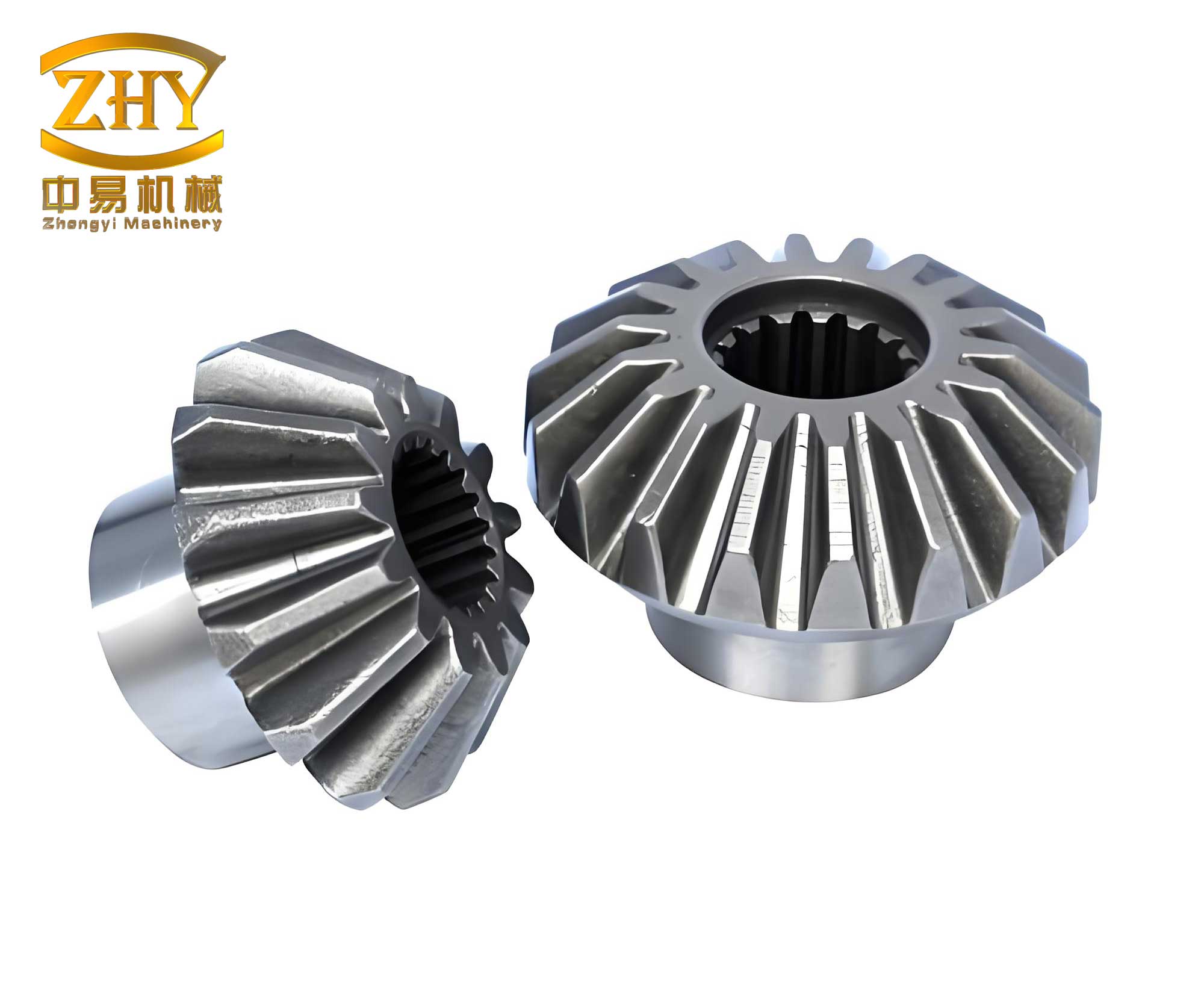
To validate this approach, I consider a practical example: designing a bevel gear transmission for an industrial application. The specifications are as follows: shaft angle \( \Sigma = 90^\circ \), closed system, pinion power \( P_1 = 9.2 \, \text{kW} \), pinion speed \( n_1 = 970 \, \text{rpm} \), gear ratio \( u = 3 \), 7-grade accuracy, motor drive with steady load, pinion overhung, gear straddle-mounted, design life of 10,000 hours. The pinion is made of 40Cr steel, heat-treated to 260 HB, and the gear is 45 steel, heat-treated to 230 HB. Allowable stresses are \( [\sigma_H] = 640 \, \text{MPa} \) and \( [\sigma_F] = 250 \, \text{MPa} \), with a load factor \( K = 2.0 \) estimated from design conditions. The torque is \( T_1 = 9.55 \times 10^6 \times \frac{9.2}{970} \approx 90.6 \times 10^3 \, \text{Nmm} \).
I implement the genetic algorithm using MATLAB’s Global Optimization Toolbox. The design variables are encoded as real numbers: \( z_1 \) (continuous, but rounded to integers post-optimization), \( m \), and \( \phi_R \). The bounds are set as: \( z_1 \in [17, 35] \), \( m \in [2, 10] \, \text{mm} \), and \( \phi_R \in [0.25, 0.35] \). A population size of 30 is chosen to balance diversity and convergence, with evolution over 100 generations. The fitness function is programmed in an M-file, incorporating the volume calculation and penalty terms. Key parts of the code include the objective function evaluation and constraint checks. For instance, the volume computation uses the formulas above, and the constraints are evaluated to apply penalties. The GA operators—selection, crossover, and mutation—are set to default values in MATLAB, such as tournament selection, scattered crossover, and Gaussian mutation.
After running the optimization, the algorithm converges around generation 72, yielding an optimal solution. The results are: \( z_1^* = 18.87 \) (rounded to 19 for practicality), \( m^* = 5.00 \, \text{mm} \), and \( \phi_R^* = 0.25 \). The minimized volume is \( V^* = 7.6992 \times 10^5 \, \text{mm}^3 \). For comparison, a traditional design using standard methods—often starting with contact strength to find \( d_1 \) and then selecting \( z_1 = 24 \), \( m = 4 \, \text{mm} \), and \( \phi_R = 0.3 \)—gives a volume of \( 9.1969 \times 10^5 \, \text{mm}^3 \). The optimization reduces the volume by approximately 16.3%, demonstrating significant material savings. Below, I summarize the comparison in a table.
| Design Method | Pinion Teeth \( z_1 \) | Gear Teeth \( z_2 \) | Module \( m \) (mm) | Face Width Coefficient \( \phi_R \) | Gear Pair Volume \( V \) (mm³) |
|---|---|---|---|---|---|
| Traditional Design | 24 | 72 | 4 | 0.3 | 9.1969 × 10⁵ |
| Genetic Algorithm Optimization | 19 | 57 | 5 | 0.25 | 7.6992 × 10⁵ |
This table highlights the efficiency of the genetic algorithm in optimizing bevel gear parameters. The optimized bevel gear pair not only meets strength requirements but also achieves a compact design. The reduction in volume translates to lower material costs, reduced weight, and potentially improved dynamic performance. In practice, the pinion tooth count is rounded to 19, which is acceptable as it still satisfies the undercut constraint \( z_1 \geq 17 \cos \delta_1 \approx 17 \times 0.9487 = 16.13 \). The module increase to 5 mm compensates for the lower tooth count, maintaining strength while reducing overall size.
The success of this optimization hinges on the genetic algorithm’s ability to explore the design space thoroughly. Unlike gradient-based methods that might get stuck in local minima, the GA navigates the non-linear constraints effectively. For bevel gears, where parameters like module and face width interact complexly, this global search capability is invaluable. Moreover, the use of penalty functions allows handling constraints without simplifying the problem, ensuring that the final design is both optimal and feasible. In this example, the contact and bending stress constraints are satisfied, as verified by recalculating the stresses with the optimized parameters. For instance, the contact stress \( \sigma_H \) is computed to be below 640 MPa, and the bending stress \( \sigma_F \) is under 250 MPa, confirming the design’s reliability.
Beyond this specific case, the genetic algorithm approach can be extended to other types of bevel gears, such as spiral or hypoid bevel gears, by adapting the objective function and constraints. The mathematical model can incorporate additional factors like lubrication conditions, thermal effects, or noise reduction goals. As a designer, I see great potential in integrating GAs with finite element analysis (FEA) for more accurate stress evaluations, or with multi-objective optimization to balance volume, efficiency, and cost. The flexibility of genetic algorithms makes them a powerful tool for advancing bevel gear design in industries ranging from automotive to robotics.
In conclusion, optimizing bevel gear transmission parameters using genetic algorithms offers a superior alternative to traditional design methods. By minimizing the volume of the bevel gear pair while adhering to strength constraints, this approach reduces material usage and improves design efficiency. The genetic algorithm’s global optimization capabilities ensure that the solution is not only feasible but also near-optimal, overcoming the limitations of conventional trial-and-error techniques. Through the example provided, I have demonstrated a 16.3% reduction in volume, highlighting the tangible benefits of this method. For engineers and designers working with bevel gears, adopting genetic algorithm-based optimization can lead to lighter, more cost-effective, and high-performance transmissions. Future work could explore hybrid algorithms or real-time optimization for adaptive manufacturing. Ultimately, as mechanical systems evolve, such advanced optimization strategies will be key to sustainable and innovative engineering solutions.