
The helicopter main gearbox stands as the critical core of the power transmission system, tasked with the efficient transfer of engine power to the main and tail rotors. Within this system, the bevel gear stage responsible for redirecting the power flow is particularly susceptible to complex dynamic excitations. The meshing process of the bevel gear pair is inherently affected by factors such as time-varying mesh stiffness due to elastic tooth deformation, manufacturing errors, and uneven load distribution. This introduces parametric excitation, a fundamental source of vibration. Furthermore, internal friction damping forces generated at interfaces like spline couplings and locating surfaces can, under certain conditions, trigger self-excited instability. This phenomenon is characterized by a漂移 (drift) of the system’s resonant frequency with operational conditions, rendering conventional vibration control methods, which often assume fixed resonance points, largely ineffective. Persistent and fluctuating vibration amplitudes not only compromise the reliability and service life of the drivetrain, leading to accelerated fatigue and increased noise, but also pose a significant threat to flight safety. Therefore, developing effective vibration control strategies specifically for the shafting of the helicopter’s main reduction directional bevel gear transmission is of paramount importance.
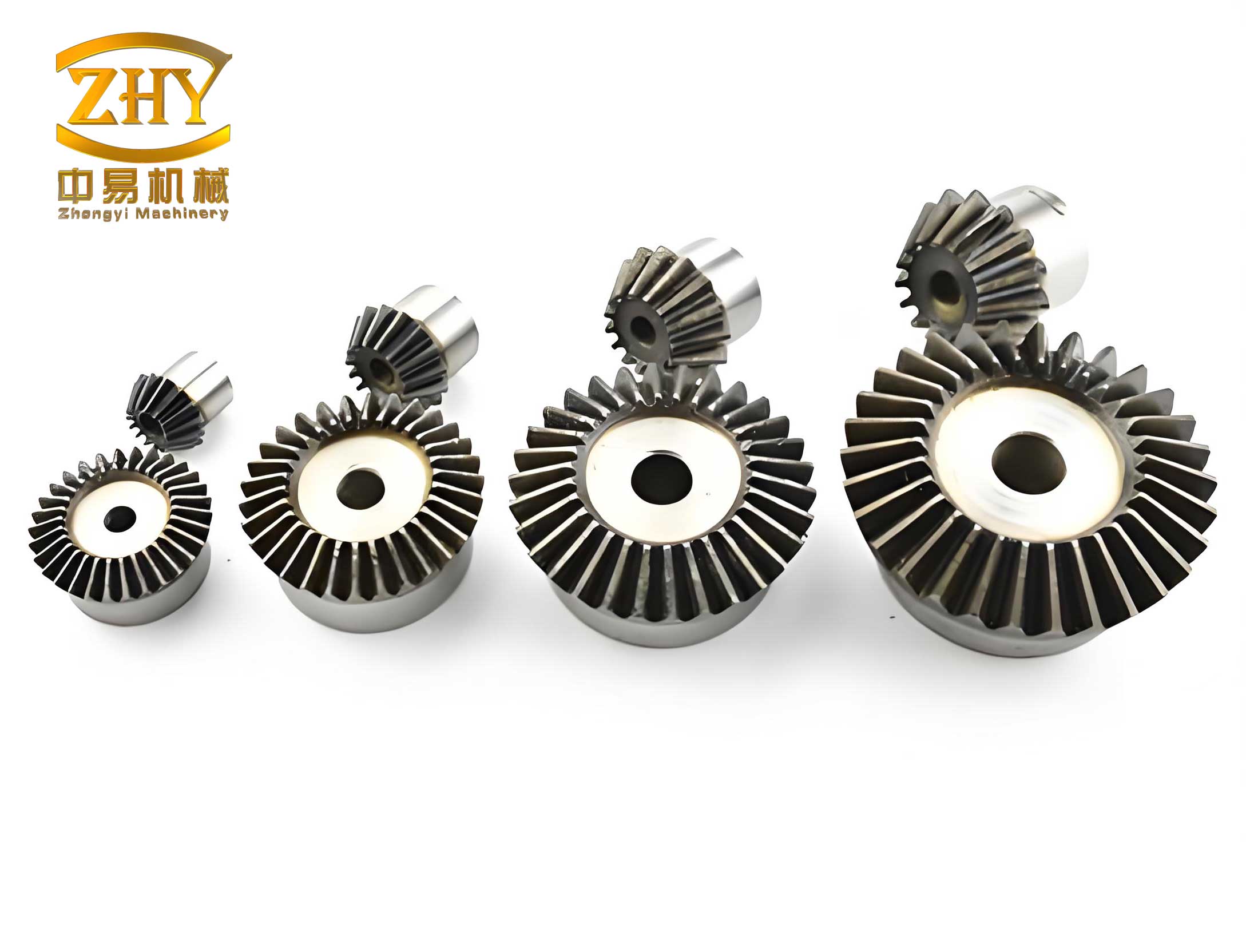
This article presents a targeted methodology for the vibration control of this critical subsystem. The core of the approach lies in accurately characterizing the self-excited instability and dynamically quantifying the resultant resonance point drift. The calculated parameters are then used as precise inputs for tuning a specialized torsional vibration damper, enabling adaptive and effective vibration suppression across the operational envelope.
1. Dynamic Analysis and Self-Excited Instability Frequency
The rotor system within the main reduction bevel gear assembly, influenced by initial disturbances and operational loads, can experience relative sliding at fitted interfaces such as floating splines and locating faces. This sliding motion generates internal friction forces that act as damping forces on the shaft system. When these internal friction damping forces reach a critical level, they can induce self-excited unstable vibration, a hazardous condition detrimental to stability.
Based on tribological principles, the friction force is related to the relative motion state. The internal friction force \( F_q \) at the配合面 (mating surfaces) can be modeled as:
$$ F_q = F(|\dot{\zeta}|) \cdot \frac{\dot{\zeta}}{|\dot{\zeta}|} $$
where \( \dot{\zeta} \) is the relative sliding velocity and \( F(|\dot{\zeta}|) \) represents the interfacial friction load as a function of the sliding speed magnitude, determinable through empirical testing.
Applying rotor dynamics principles in a rotating coordinate frame and considering inertial, elastic, linear damping, and the internal friction force \( F_q \), an equivalent damping coefficient \( c \) for the rotor can be derived from force balance (Newton’s second law):
$$ c = \frac{m \epsilon \Omega^2 – m \dot{\zeta} – k \zeta + m \Omega^2 \zeta – F_q}{\dot{\zeta}} $$
Here, \( m \) is the rotor mass, \( \epsilon \) is the eccentricity, \( k \) is the rotor stiffness, and \( \Omega \) is the rotational speed.
For a simplified single-degree-of-freedom linear system under unbalance excitation, the system’s natural frequency is \( \omega_n = \sqrt{k/m} \). The vibration response amplitude \( A \) is given by:
$$ A = \frac{\epsilon \Omega^2}{|\omega_n^2 – \Omega^2 + i c \Omega / m|} $$
The self-excited vibration of the shafting, initiated by disturbances, can be described by a complex exponential representing the orbit perturbation. The perturbed trajectory of the shaft center is expressed as:
$$ z = A B e^{(\xi + i \omega) t} $$
where \( B \) is the perturbation amplitude, \( \omega \) is the subsynchronous whirl frequency, and \( \xi \) is a stability判定参数 (judgment parameter). The system is in an unstable state when \( \xi = 0 \). Under this condition, where internal damping dominates external damping, pronounced self-excited vibration occurs. Consequently, the frequency of the self-excited instability state \( \omega’ \) for the drivetrain shafting can be formulated as:
$$ \omega’ = H_1 \cdot e^{\xi} \cdot \omega_n \cdot z $$
Here, \( H_1 \) is the perturbation response amplitude under typical instability conditions, and \( z \) encompasses system-specific structural and operational parameters. This expression describes the characteristic frequency associated with the unstable state.
2. Quantification of Resonance Point Drift: Equivalent Misalignment
The self-excited instability causes the system’s resonant frequency to漂移 (drift) dynamically. Merely identifying the instability frequency \( \omega’ \) is insufficient for control, as the instantaneous resonant point is constantly shifting. To address this, the concept of an “Equivalent Misalignment” is introduced to量化 (quantify) the instantaneous positional offset of the resonant point. This quantity, stemming from the combined effects of axial offset, center distance error, and shaft angle error in the bevel gear pair, serves as the critical input coefficient for the torsional damper.
The calculation is performed within the global coordinate system attached to the helicopter airframe. Points on the bearing bore cross-section are denoted as \( P_i(x_i, y_i, z_i) \). The axis direction is defined by parameters \( p \) and \( q \), and its position by \( a \) and \( b \). The ideal radius of the bevel gear is \( r_0 \). The distance \( L \) from a contour point on the gear to its axis is:
$$ L = \sqrt{ [x_i – (p z_i + a)]^2 + [y_i – (q z_i + b)]^2 } $$
The optimal cylindrical contour for the self-excited resonance point is found by minimizing the least squares objective function \( J \):
$$ J(a, b, p, q, r_0) = \min \left( \sum (H_1′ \cdot L – r_0)^2 \right) $$
where \( H_1′ \) is a scaling factor related to the instability state. The angle \( \theta \) between the input and output shafts of the bevel gear transmission in the global coordinate system is:
$$ \cos \theta = \frac{x_1 x_2 + y_1 y_2 + z_1 z_2}{\sqrt{x_1^2 + y_1^2 + z_1^2} \sqrt{x_2^2 + y_2^2 + z_2^2}} $$
Finally, the Equivalent Misalignment \( n \) for the self-excited resonance point of the shafting is calculated as:
$$ n = \frac{L \cdot \cos \theta \cdot H_1′}{J(a, b, p, q, r_0)} $$
This value \( n \) encapsulates the effective geometric error driving the resonant漂移.
3. Torsional Vibration Damper Tuning and Control Implementation
A torsional vibration damper is installed on the shafting of the helicopter main reduction bevel gear transmission device. The calculated Equivalent Misalignment \( n \) is used as the primary input to determine the damper’s optimal parameters, enabling targeted vibration control.
Let \( \omega_a \) and \( \omega_b \) represent the resonant frequencies of the shafting system after damper installation. A larger damper moment of inertia \( G_d \) leads to a greater separation between \( \omega_a \) and \( \omega_b \). The design must consider spatial constraints. The inertia ratio \( \chi \) is defined as:
$$ \chi = \frac{n \cdot G_d}{G_e} $$
where \( G_e \) is the effective rotational inertia of the drivetrain.
The “fixed-points theory” is employed for damper parameter tuning. This method utilizes invariant points in the frequency response function, which are independent of the damper’s damping value, to optimize performance. For a system with two fixed points (E and N) of equal amplitude, the optimal natural frequency \( \omega_b \) of the torsional damper is:
$$ \omega_b = \frac{\omega_a}{1 + \chi} $$
where \( \omega_a \) is the undamped resonant frequency of the drivetrain. From \( \omega_b \), the required torsional stiffness \( C_d \) and damping coefficient \( K \) of the damper are derived:
$$ \begin{cases} K = 2 \xi_p \cdot G_d \cdot \omega_b \\ C_d = G_d \cdot \omega_b^2 \end{cases} $$
Here, \( \xi_p \) is the optimal damping ratio. Using these parameters minimizes the shafting vibration amplitude. The final control outcome, representing the optimized system response, can be expressed as:
$$ \gamma = \frac{\omega_p \cdot n}{C_d \cdot K \cdot \xi_p \cdot J(a, b, p, q, r_0)} $$
where \( \gamma \) signifies the controlled state and \( \omega_p \) is a performance frequency. The process ensures the damper is precisely tuned to counteract the self-excited vibrations induced by the internal friction in the bevel gear pair.
4. Experimental Validation and Analysis
To validate the proposed method’s efficacy in vibration control for the helicopter main reduction directional bevel gear transmission shafting, it was applied to a specific transmission unit. The input power was set to 135.85 kW. Key parameters of the bevel gear pair are summarized in Table 1.
| Parameter | Pinion | Gear |
|---|---|---|
| Number of Teeth | 25 | 87 |
| Module | 5.945 mm | 5.945 mm |
| Shaft Angle | 53.15° | 53.15° |
| Pressure Angle | 18° | 18° |
| Spiral Angle | 32° | 32° |
| Face Width | 48.954 mm | 48.954 mm |
| Tip Clearance | 0.75 mm | 0.75 mm |
| Hand of Spiral | Left | Right |
Using the described methodology, the Equivalent Misalignment for the shafting’s self-excited instability resonance point was determined, as detailed in Table 2.
| Parameter | Value |
|---|---|
| Axial Misalignment | |
| Pinion | -0.0254 mm |
| Gear | 0.0316 mm |
| Shaft Angle Misalignment | 0.1024° |
| Center Distance Misalignment | 0.1158 mm |
The results confirm the method’s capability to accurately determine the Equivalent Misalignment, providing a reliable basis for vibration control and thereby enhancing operational stability.
The vibration characteristics of the shafting often manifest as self-excited, periodic motion. In steady-state, the phase portrait converges to a limit cycle, whose size and shape reflect the vibration amplitude and nonlinearity. The vibration velocity phase portraits of the shafting, before and after the installation of the tuned torsional damper, demonstrate a dramatic reduction in the orbital envelope post-installation. This visually confirms the effectiveness of the damper tuned with the calculated parameters, significantly lowering vibration amplitude and improving stability.
The time-domain vibration signals for both the driving and driven shafts in the horizontal direction were analyzed before and after control implementation. The comparative plots show a substantial reduction in vibration amplitude after control. Prior to control, the shafting exhibited significant periodic fluctuations with large amplitudes and high-frequency harmonics. After implementing the control method, the waveform became markedly smoother, peak amplitudes were greatly attenuated, and high-frequency components were effectively suppressed.
Frequency-domain analysis further corroborates these findings. The amplitude spectra for both the driving and driven shafts show a pronounced decrease in vibration amplitude across a broad frequency range after the application of the proposed control method. This demonstrates the method’s effectiveness in mitigating the self-excited unstable vibrations induced by internal friction damping in the bevel gear pair.
5. Conclusion
Vibration in the shafting of the helicopter’s main reduction directional bevel gear transmission is a critical issue impacting flight stability, safety, and component longevity. The proposed methodology addresses the core challenge of resonance point漂移 (drift) caused by self-excited instability. By calculating the internal friction forces, deriving the self-excited instability frequency, and crucially, quantifying the instantaneous resonance point漂移 through the Equivalent Misalignment, this approach provides a precise input for tuning a torsional vibration damper. Experimental validation confirms that this method effectively reduces shafting vibration levels, leading to a more stable and reliable drivetrain operation.
However, certain limitations remain. Under extreme operating conditions such as high speed and heavy load, the accuracy of the Equivalent Misalignment calculation may be influenced by factors like nonlinear material properties of the bevel gear and variations in lubrication state, necessitating further research into refined models. The response speed of the torsional damper might also pose a risk of coupling with瞬态 (transient) shaft vibrations under sudden strong impact conditions, suggesting a need for future integration with real-time monitoring for adaptive control optimization. Furthermore, the method’s parameters are calibrated for a specific transmission model; its generalizability to drivetrains with different layouts or materials requires validation through expanded testing. Subsequent research could focus on multi-physics coupled modeling to enhance prediction accuracy under complex conditions and develop adaptive control algorithms to improve system robustness.