
In my years of experience maintaining and repairing agricultural machinery, I have consistently observed that the central drive bevel gears in tractors are critical components whose premature failure can lead to significant operational disruptions. These bevel gears, specifically the small and large bevel gears in the central transmission, serve to reduce speed, increase torque, and change the direction of power transmission. When early damage occurs, it manifests as abnormal noises, excessive heat generation, oil leaks, and overall performance degradation. Understanding the root causes of this premature wear and implementing proactive measures is essential for ensuring tractor longevity and reliability. This article delves into the multifaceted reasons behind early bevel gear damage and provides comprehensive, practical prevention strategies.
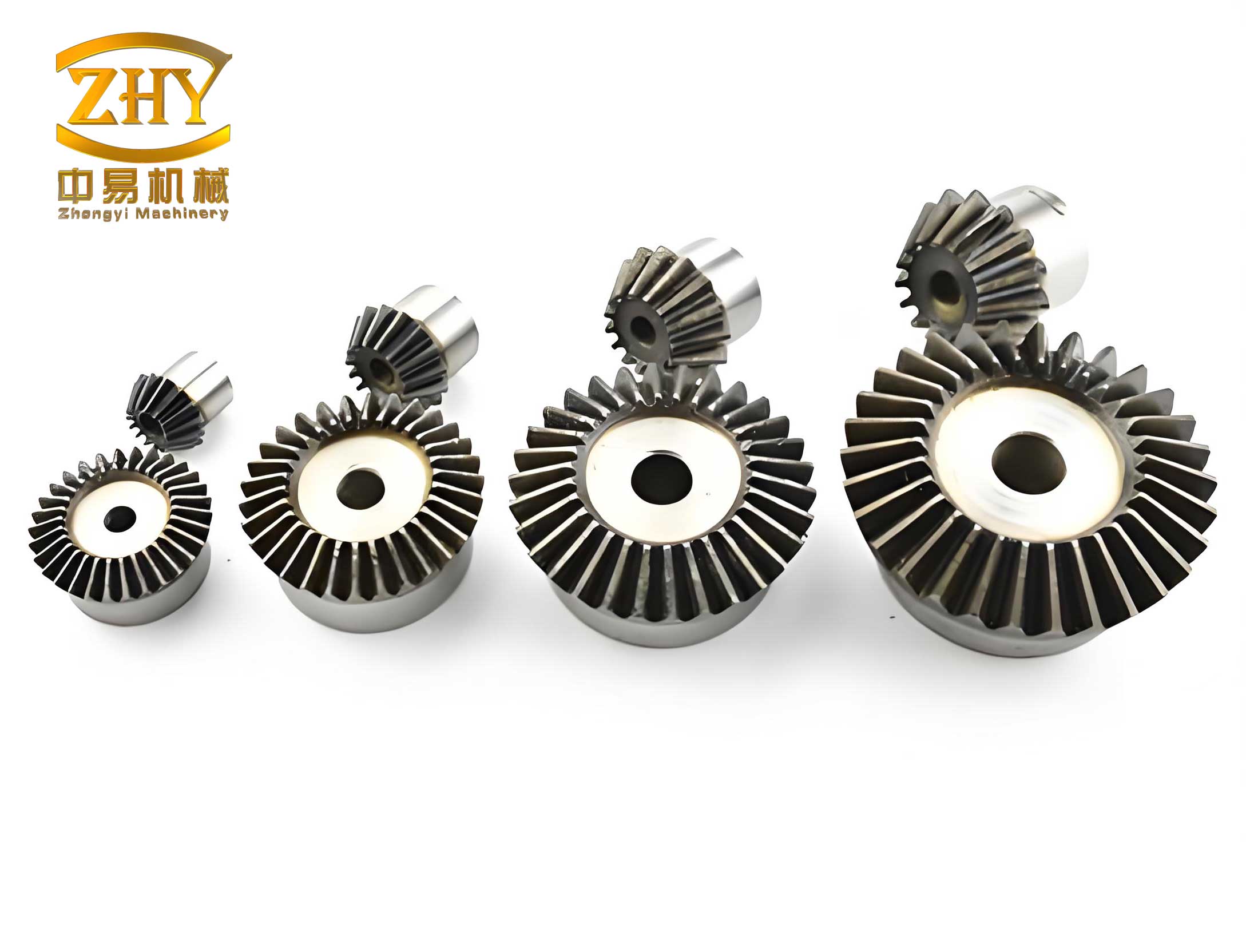
The central drive system, housing the bevel gear pair, is subjected to immense stresses during fieldwork. The small bevel gear, typically with fewer teeth, engages with the large bevel gear, which has a higher tooth count. For instance, in a common configuration, a 14-tooth small bevel gear drives a 44-tooth large bevel gear, resulting in a gear ratio that demands the small bevel gear’s concave surface to work harder than the large bevel gear’s convex surface. This inherent mechanical relationship makes the small bevel gear more susceptible to wear, pitting, and spalling. While catastrophic tooth breakage does occur, the predominant mode of early failure is surface fatigue, leading to pitting and spalling. From my perspective, addressing this issue requires a systematic approach encompassing lubrication, precise adjustment, proper operation, and vigilant maintenance.
1. Inadequate Lubrication and Its Detrimental Effects
Lubrication is the lifeblood of any gear system. For bevel gears, poor lubrication directly induces semi-dry or abrasive friction, accelerating wear and surface damage. The factors contributing to lubrication failure are multifaceted.
Firstly, using substandard or incorrect gear oil is a primary culprit. The selection of gear oil must align with the bevel gear’s operational demands. The oil’s quality level (e.g., GL-4, GL-5) depends on gear type, load intensity, and sliding velocity. Simultaneously, the viscosity grade must suit the ambient operating temperature range. The relationship between viscosity (η), temperature (T), and load can be conceptually represented by modified Arrhenius-type equations and pressure-viscosity coefficients, though for practical selection, reference tables are paramount. A fundamental formula underscoring the importance of adequate film thickness is the Elastohydrodynamic Lubrication (EHL) minimum film thickness equation for gears:
$$ h_{min} \propto (\eta_0 \cdot u)^{0.7} \cdot (E’)^{0.03} \cdot (R)^{0.43} \cdot (W)^{-0.13} $$
where \( h_{min} \) is the minimum lubricant film thickness, \( \eta_0 \) is the dynamic viscosity at operating temperature, \( u \) is the rolling speed, \( E’ \) is the equivalent Young’s modulus, \( R \) is the equivalent radius of curvature, and \( W \) is the load per unit width. Inadequate \( \eta_0 \) directly leads to diminished \( h_{min} \), promoting metal-to-metal contact and wear on the bevel gear surfaces.
Secondly, lubricant contamination with abrasive particles creates a grinding paste effect. This three-body abrasion drastically increases the wear rate, which can be modeled by a simplified abrasive wear equation:
$$ V = K \cdot \frac{L \cdot s}{H} $$
Here, \( V \) is the volume of material worn away, \( K \) is a wear coefficient dependent on particle hardness and shape, \( L \) is the normal load, \( s \) is the sliding distance, and \( H \) is the hardness of the bevel gear material. Contaminated oil significantly increases the effective \( K \) value.
Thirdly, insufficient oil volume starves the bevel gears of lubrication, leading to instant overheating and scoring. Regular checks are non-negotiable. The table below summarizes the key aspects of lubrication management for bevel gears:
| Lubrication Factor | Consequence for Bevel Gears | Preventive Measure & Specification |
|---|---|---|
| Oil Quality | Inadequate film strength, increased wear, micropitting | Use API GL-5 or equivalent for high-load hypoid bevel gears. Select viscosity per SAE J306 (e.g., SAE 80W-90 for wide temp range). |
| Oil Cleanliness | Abrasive wear, accelerated surface degradation | Implement strict cleanliness protocols during assembly/refill. Use recommended oil filters and change oil at intervals specified, considering dust exposure. |
| Oil Level | Starved lubrication, thermal overload, seizure | Check level weekly via dipstick or sight glass. Investigate and seal any leaks from seals, gaskets, or loose plugs immediately. |
From my practice, I emphasize that a proactive lubrication regime, tailored to the specific bevel gear system, is the first and most cost-effective defense against premature failure.
2. Improper Installation and Maladjustment
Even with perfect lubrication, incorrect installation or failure to maintain proper adjustments will doom the bevel gear set. The precise meshing relationship between the small and large bevel gears is paramount. Maladjustment alters the contact pattern, increases backlash, and concentrates stress, leading to localized pitting and spalling.
The critical adjustments involve axial play of the shafts and the meshing pattern (contact imprint) of the bevel gears. The permissible axial play for the differential (large bevel gear) shaft is typically very small, often in the range of 0.15 to 0.30 mm. Excessive play, due to worn bearings (e.g., taper roller bearings like 7312, 7612 series) or loose bearing cap bolts, allows the large bevel gear to oscillate axially. This increases dynamic backlash (\( \Delta B \)), which amplifies impact forces during torque reversal. The impact force \( F_{impact} \) can be related to the kinetic energy of the rotating components:
$$ F_{impact} \approx \frac{J \cdot (\Delta \omega)^2}{2 \cdot \delta} $$
where \( J \) is the polar moment of inertia of the gear assembly, \( \Delta \omega \) is the sudden change in angular velocity (exacerbated by large backlash), and \( \delta \) is the deformation distance. Larger \( \Delta B \) contributes to a larger effective \( \Delta \omega \), raising \( F_{impact} \) and fatigue stress on the bevel gear teeth.
The meshing pattern is equally crucial. Ideal contact should be centered on the tooth flank, avoiding toe (thin end) or heel (thick end) contact. Incorrect pinion depth or excessive backlash leads to edge loading. The contact stress \( \sigma_H \) at the tooth surface, approximated by the Hertzian contact stress formula for curved surfaces, skyrockets with poor contact:
$$ \sigma_H = \sqrt{ \frac{F_t}{b \cdot d_1} \cdot \frac{u+1}{u} \cdot \frac{E’}{2\pi \cdot (1-\nu^2)} \cdot \frac{1}{\cos \alpha \cdot \sin \alpha} } $$
Here, \( F_t \) is the tangential force, \( b \) is the face width, \( d_1 \) is the pinion pitch diameter, \( u \) is the gear ratio, \( E’ \) is the equivalent modulus, \( \nu \) is Poisson’s ratio, and \( \alpha \) is the pressure angle. Edge contact drastically reduces the effective contact area, increasing \( F_t/b \), and thus \( \sigma_H \), promoting early pitting.
Furthermore, wear in the pinion shaft’s front bearing allows the small bevel gear to migrate axially, destroying the meticulously set mesh. After replacing any related bearing (e.g., a 700409-type bearing), a full readjustment of backlash and pattern is mandatory. The following table outlines the key adjustment parameters and consequences of neglect:
| Adjustment Parameter | Ideal Specification | Effect of Maladjustment on Bevel Gears | Corrective Action |
|---|---|---|---|
| Axial Play of Diff. Shaft | 0.15 – 0.30 mm | Increased backlash, impact loads, noisy operation, uneven wear. | Adjust bearing preload via shims or adjusting nuts. Replace worn bearings. |
| Bevel Gear Backlash | 0.20 – 0.35 mm (varies) | Too small: binding & overheating. Too large: hammering & pitting. | Adjust via pinion shims or differential carrier offset. Use dial indicator. |
| Meshing Contact Pattern | Centered on flank, ~60% area | Edge contact (toe/heel): high stress concentration, rapid spalling. | Adjust pinion depth and/or differential position. Use gear marking compound. |
| Bearing Preload (Pinion) | Specified torque or drag | Loose: gear wobble, misalignment. Over-tight: bearing overheating, premature failure. | Set using crush sleeve or preload shim pack per manufacturer spec. |
I cannot overstate the importance of using proper tools and following the manufacturer’s step-by-step procedure when adjusting these bevel gears. A rushed job here guarantees a premature return to the workshop.
3. Operational Practices and Driving Habits
How a tractor is operated daily has a profound cumulative effect on bevel gear life. Abusive or inappropriate driving directly translates into shock loads and abnormal wear patterns.
Frequent and aggressive clutch engagement, commonly known as “dropping the clutch,” subjects the bevel gears to severe torsional shock. The instantaneous torque \( T_{shock} \) can far exceed the engine’s rated torque. This shock load factor \( K_{shock} \) multiplies the steady-state tangential force \( F_t \) in the contact stress equation. Similarly, abrupt braking, especially with heavy implements, induces high inertial loads through the driveline onto the bevel gears.
Fieldwork patterns also matter. Consistently plowing using only “headland turns” in one direction (e.g., always turning right with the inner brake) means the differential and its associated bevel gear thrust bearings are loaded more heavily on one side. This leads to asymmetrical wear in the thrust bearing (e.g., the 7612 bearing on one side), eventually increasing axial play and misaligning the bevel gear mesh. The wear volume on a specific bearing race can be conceptualized by a modified Archard’s wear law integrated over time with a directional load component \( L(\theta) \):
$$ V_{bearing} = \int_{0}^{t} K_b \cdot \frac{L(\theta(t)) \cdot v}{H} \, dt $$
where \( \theta(t) \) represents the turning direction profile during operation. Alternating between left and right turns (e.g., using consecutive and contour plowing) helps distribute this wear more evenly.
Other detrimental practices include chronic overloading, sustained high-speed transport on rough roads, and operating in conditions that require constant, sharp turning (small plots). Each of these increases the cyclical stress amplitude on the bevel gear teeth, accelerating fatigue. The table below correlates poor operational habits with their mechanical impact on bevel gears:
| Operational Habit | Physical Mechanism | Impact on Bevel Gear System | Recommended Practice |
|---|---|---|---|
| Aggressive Clutch Release | High torsional shock, rapid acceleration | Peak stresses exceed fatigue limit, initiating micro-cracks at tooth root or surface. | Smooth, controlled engagement. Use creeper gears for high-draft starts. |
| Abrupt Braking | Negative torque shock, driveline reversal | Reversal of loading on non-drive side of gear teeth, promoting backlash-related impact. | Anticipate stops, brake gradually. Use implement for gentle slowing where possible. |
| Unidirectional Field Turns | Asymmetric thrust bearing loading | Uneven bearing wear, leading to axial play misalignment and abnormal bevel gear contact. | Alternate turning directions. Plan fieldwork to balance left/right brake usage. |
| Chronic Overloading | Sustained high tooth root bending stress | Progressive bending fatigue, potentially leading to tooth breakage, not just pitting. | Match implement size to tractor capability. Use appropriate gear to avoid lugging. |
| Small Plot, Frequent Turning | High cycle count of engagement/shock | Accumulation of low-cycle and high-cycle fatigue damage on bevel gear surfaces. | Consolidate plots if possible. Use wider implements to reduce number of passes. |
In my view, operator education is as crucial as mechanical maintenance. A skilled, gentle operator can double the life of a bevel gear set compared to a rough one.
4. Deformation, Looseness, and Failure of Associated Components
The central transmission housing and its supporting structures form the foundational geometry for the bevel gear set. If this foundation warps or weakens, perfect gear alignment becomes impossible, no matter how well the gears themselves are adjusted.
A bent or cracked main frame (chassis) or deformed axle housings can introduce static misalignment between the transmission output shaft (carrying the small bevel gear) and the differential input axis (large bevel gear). This misalignment \( \Delta \gamma \) introduces a parasitic bending moment on the pinion shaft. The resulting additional bending stress \( \sigma_b \) on the pinion teeth root adds to the normal bending stress from power transmission:
$$ \sigma_{b, total} = \sigma_{b, power} + \sigma_{b, misalignment} = \frac{F_t \cdot h}{b \cdot s^2} + \frac{E \cdot I \cdot \Delta \gamma}{L \cdot (s/2)} $$
where \( h \) is the tooth height factor, \( s \) is the tooth root thickness, \( E \) is Young’s modulus, \( I \) is the area moment of inertia of the shaft, and \( L \) is a characteristic length. This increased stress accelerates root fatigue.
Loose fasteners, such as those connecting the transmission case to the rear axle housing, allow relative movement under load. This dynamic misalignment constantly changes the bevel gear contact pattern, leading to fretting, wear, and rapid failure. The integrity of these bolts must be checked regularly with a calibrated torque wrench. The effect of a loose joint can be modeled as a reduction in the system’s overall stiffness \( k_{system} \), lowering the natural frequency and potentially allowing resonant vibrations that exacerbate wear. The natural frequency \( f_n \) of a shaft-gear system is given by:
$$ f_n = \frac{1}{2\pi} \sqrt{\frac{k_{system}}{J_{eq}}} $$
A decrease in \( k_{system} \) lowers \( f_n \), making it more likely to coincide with excitation frequencies from engine or field irregularities.
Furthermore, failed or degraded rubber mounts for the engine/transmission can allow excessive movement, transmitting unwanted vibrations and shocks directly into the bevel gear housing. Regular visual and physical inspections of the chassis, brackets, and bolts are essential. The following checklist table is useful for preventing bevel gear issues stemming from structural problems:
| Component | Failure Mode | Diagnostic Symptom | Preventive Maintenance Action |
|---|---|---|---|
| Main Chassis Frame | Bending, cracking, fatigue | Visible cracks, misaligned body panels, persistent gear misadjustment. | Periodic visual inspection, especially after heavy impacts. Weld repair or reinforcement as needed. |
| Axle Housing / Final Drive Case | Distortion from overload | Oil leaks from distorted seams, difficulty setting bearing preload. | Avoid overloading. Check housing alignment with straight edges during major service. |
| Transmission-to-Differential Bolts | Loosening due to vibration | Oil seepage at joint, changing gear noise with load, visible gap. | Torque check during every major service (e.g., annual). Use thread-locking compound if specified. |
| Engine/Transmission Mounts | Deterioration, cracking, collapse | Excessive engine rock, changed vibration feel, driveline clunks. | Inspect mounts for cracks and compression. Replace in sets if any are faulty. |
| Differential Bearing Caps & Seats | Wear, fretting, cracking | Inability to hold bearing adjustment, metallic debris in oil. | Inspect during overhaul. Repair caps/seats or replace housing if damaged. |
From my workshop experience, a failure traced back to a cracked bracket or a set of loose bolts is a stark reminder that the bevel gears do not operate in isolation; their health depends on the entire structure’s integrity.
5. Neglecting Re-adjustment After Component Replacement
A common and critical oversight I frequently encounter is the replacement of a single component in the central drive without subsequent system re-adjustment. This is particularly perilous when dealing with bevel gears.
The classic example is replacing the pinion shaft’s front bearing (e.g., a 700409 ball bearing). This bearing’s precise inner and outer race positions directly determine the axial location of the small bevel gear. A new bearing, even of the same part number, will have slight dimensional tolerances. Installing it without adjusting the pinion depth shims will alter the pinion’s position relative to the large bevel gear. The change in pinion position \( \Delta A \) directly affects the backlash \( B \) and the contact pattern. The relationship can be approximated for a spiral bevel gear set as:
$$ \Delta B \approx -2 \cdot \Delta A \cdot \tan \alpha \cdot \sin \gamma $$
where \( \alpha \) is the pressure angle and \( \gamma \) is the spiral angle. Even a small \( \Delta A \) of 0.1 mm can change backlash by several hundredths of a millimeter, potentially moving it outside the acceptable range and shifting the contact pattern to the toe or heel.
The same principle applies after replacing the differential side bearings, the differential carrier, or even the entire axle housing. Any part that influences the relative position or orientation of the two bevel gear axes necessitates a complete check and likely readjustment of the mesh. The procedure is non-negotiable and must be viewed as an integral part of the replacement job, not an optional add-on. The table below outlines common replacement scenarios and the required follow-up actions for the bevel gear set:
| Replaced Component | Why Re-adjustment is Critical | Mandatory Post-Replacement Checks |
|---|---|---|
| Pinion Shaft Front Bearing | Determines small bevel gear axial position (pinion depth). | 1. Check and adjust pinion depth using shims. 2. Re-check backlash and contact pattern. 3. Set pinion bearing preload. |
| Differential Side Bearings | Determine large bevel gear axial position and thus backlash. | 1. Adjust differential bearing preload/shims. 2. Check and adjust backlash. 3. Verify contact pattern. |
| Complete Differential Assembly | The entire gear set relationship is new/unknown. | 1. Full setup from scratch: pinion depth, bearing preloads, backlash, pattern. |
| Axle Housing / Transmission Case | May have different machining tolerances affecting gear alignment. | 1. Check alignment of bearing bores. 2. Perform full bevel gear setup procedure. |
| Shims or Crush Sleeves | These are adjustment devices; new ones have nominal dimensions. | Always requires measurement of preload and gear mesh after installation. |
I always advise technicians to consider the bevel gear mesh as the final, master adjustment that supersedes all individual component installations. Never assume a “bolt-on” replacement will automatically yield correct gear engagement.
Comprehensive Preventive Strategy and Conclusion
Preventing early damage to tractor central drive bevel gears is not about a single silver bullet but a holistic, disciplined maintenance philosophy. It intertwines correct material selection (oil, parts), precision mechanical adjustment, intelligent operation, and systematic structural inspection. The bevel gear pair is the heart of the driveline’s directional torque conversion, and its care must be proportionate to its importance.
To synthesize the discussion, a truly robust prevention program incorporates the following pillars, all focused on the health of the bevel gears:
- Proactive Lubrication Management: Use high-quality, clean oil of the correct specification. Monitor level and condition religiously. Employ oil analysis if possible to track wear metals and contamination.
- Precision Adjustment Protocols: Establish and follow strict procedures for setting bearing preload, bevel gear backlash, and contact pattern. Use the right tools (dial indicators, torque wrenches, marking compound). Document settings for future reference.
- Operator Training and Awareness: Educate drivers on the impact of harsh operation. Encourage smooth control inputs and balanced fieldwork patterns to distribute loads evenly.
- Structural Integrity Checks: Integrate inspections of the chassis, brackets, and fasteners into routine service schedules. Address any looseness or deformation immediately.
- Systemic Approach to Repairs: Any repair affecting the central drive must conclude with a verification of the bevel gear mesh. Never skip the re-adjustment step.
The economic argument is clear: the cost of premium lubricants, the time for precise adjustments, and the investment in operator training are negligible compared to the downtime and expense of replacing a destroyed bevel gear set and potentially the surrounding components damaged by its failure. By adopting this comprehensive, first-person perspective on care and prevention, we can ensure these vital bevel gears deliver their full, designed service life, keeping tractors running smoothly and productively in the field.