
The transmission of motion and power between intersecting shafts is a fundamental requirement in numerous mechanical systems, from automotive differentials and marine propulsion to the critical flight control and engine auxiliary drives in aerospace applications. In these demanding fields, bevel gear pairs are the component of choice. Unlike their cylindrical counterparts, bevel gears exhibit heightened sensitivity to mounting misalignments. Minute deviations in their relative installation position can drastically alter the size, shape, and location of the contact pattern on the tooth flanks. This, in turn, directly governs performance metrics such as transmission error (a primary source of vibration and noise), load distribution, stress concentrations, and ultimately, the service life and reliability of the gearbox. Consequently, the final quality assurance for a bevel gear pair is not concluded at the machining stage but extends to a crucial post-manufacturing process known as rolling inspection or “roll testing.”
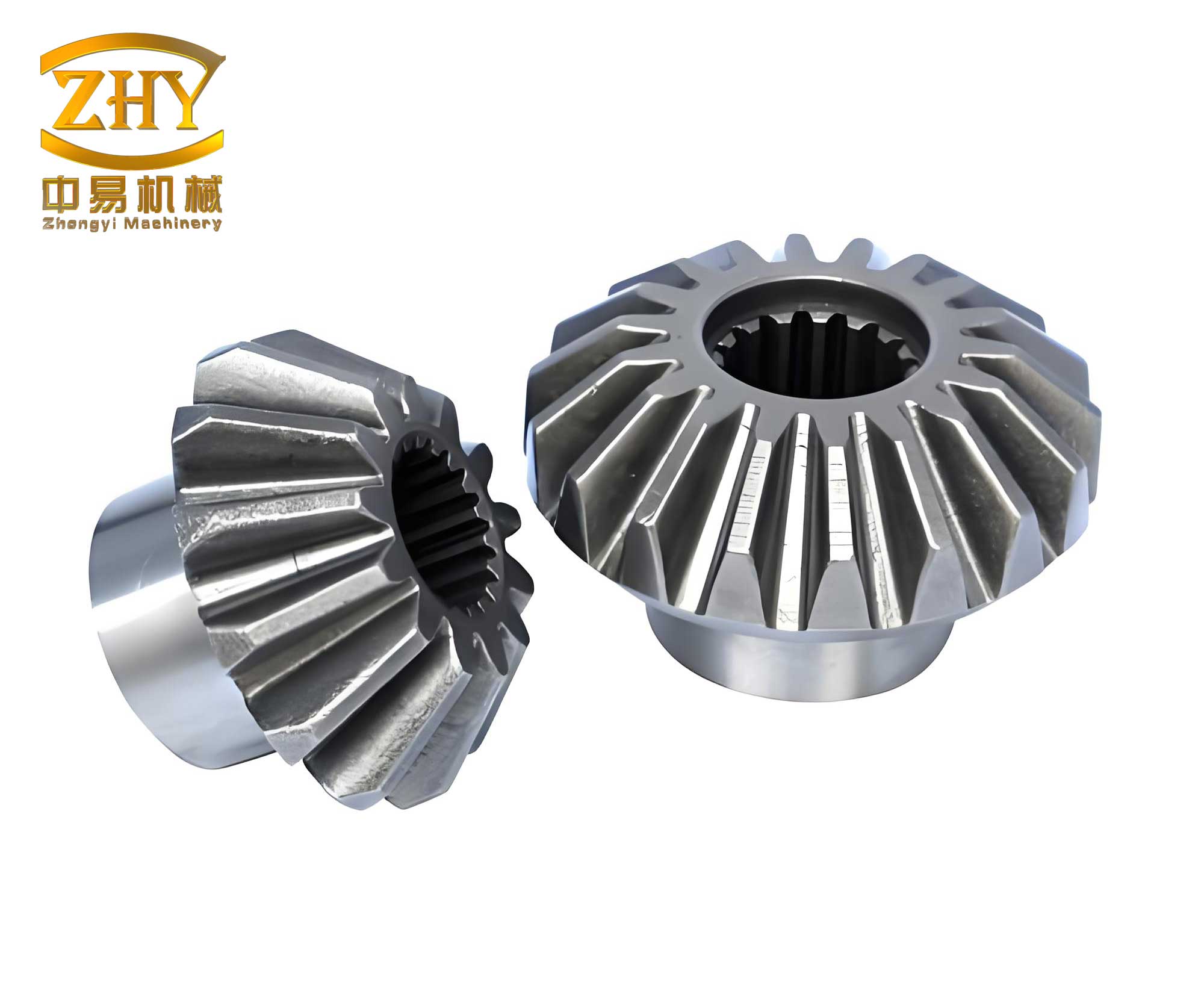
Specialized bevel gear Rolling Testers (RTs) are designed for this purpose. Their core function is to simulate the operational meshing of a pinion and gear under controlled, adjustable conditions. By precisely manipulating the relative position and orientation of the two gears—defined by parameters such as pinion mounting distance, gear mounting distance, offset (for hypoid gears), and shaft angle—technicians can “roll” the gear pair, observe the developed contact pattern, measure transmission error, and even conduct endurance or vibration tests. The objective is to identify the optimal installation setting that yields a centered, well-proportioned contact pattern and minimal transmission error, thereby ensuring peak performance in the final assembly. The accuracy with which the tester can position and orient the test gears is, therefore, paramount. Any geometric or kinematic error inherent in the tester’s own structure will be superimposed onto the intended test positions, corrupting the measurement results and potentially leading to incorrect assembly adjustments.
The pursuit of higher power density, lower noise, and extreme reliability, especially in aviation, has driven the performance requirements for bevel gears ever upward. This demand cascades directly onto the capabilities of rolling testers. State-of-the-art international RTs now boast astonishing precision: shaft angle positioning accuracy within 10 arcseconds, linear adjustment resolutions in the micrometer range, and integrated functionalities for fatigue life testing and vibration noise analysis. Developing a domestic RT that meets these benchmarks presents a significant engineering challenge. A critical aspect of this challenge is managing the machine’s own geometric errors. Simply tightening tolerances on every component is neither economical nor necessarily effective. A systematic approach is required to understand how each potential error source propagates through the machine’s kinematic chains to affect the final position of the bevel gear apex and the axis orientation. This paper establishes a comprehensive geometric error model for a high-precision bevel gear rolling tester. Utilizing multi-body system kinematics and homogeneous coordinate transformation, we simulate the impact of individual errors. By analyzing their influence on the critical output parameters—gear apex location and inter-shaft angle—we can identify key sensitivity factors and provide a rational basis for error allocation during the design and manufacturing phases, ensuring the final machine meets its stringent accuracy goals.
Structural Configuration of the Bevel Gear Rolling Tester
The rolling tester under study is designed to provide the necessary degrees of freedom for aligning and testing a wide range of bevel gear types, including hypoid and spiral bevel gears. Its mechanical structure is comprised of several stacked linear and rotary axes. The core function requires positioning the apex of each test gear’s pitch cone at a specific point in space and aligning their axes at a precise included angle.
The machine’s foundation is a rigid base upon which a rotary table (C-axis) is mounted. This C-axis provides rotational adjustment, primarily used to set the nominal shaft angle between the two gear axes. Mounted on the C-axis table is the carriage for the Y-axis linear motion. The spindle housing for the test Gear B is fixed to the Y-axis carriage. Therefore, Gear B’s position is controlled by a combination of the C-axis rotation ($\theta_C$) and the Y-axis linear translation ($Y_{mov}$). Its spindle, designated Spindle B, is oriented parallel to the Y-axis direction.
On the machine base, independent of the C-axis assembly, is the carriage for the X-axis linear motion. Mounted on the X-axis carriage is the carriage for the Z-axis linear motion. The spindle housing for the test Gear A is fixed to the Z-axis carriage. Consequently, Gear A’s position is controlled by the X-axis ($X_{mov}$) and Z-axis ($Z_{mov}$) linear translations. Its spindle, Spindle A, is oriented parallel to the X-axis direction. The two kinematic chains converge at the machine’s test center where the gear pair meshes.
Kinematic Modeling Based on Multi-Body System Theory
To rigorously analyze error propagation, a precise mathematical model of the machine’s ideal and erroneous kinematics is essential. The machine is treated as a multi-body system consisting of rigid bodies (beds, carriages, spindles) connected by ideal and erroneous kinematic pairs (slides, rotary joints). The topological structure describes the connectivity between these bodies. For error modeling, we define coordinate systems (CS) attached to each major body along the kinematic chain from the machine base (reference) to the tool point (gear apex).
Let the world coordinate system $\{W\}$ be fixed to the machine base. The transformation from one CS $\{i\}$ to the next $\{j\}$ is described by a 4×4 homogeneous transformation matrix $^{i}\mathbf{T}_{j}$. This matrix encapsulates both the rigid body transformation (rotation $\mathbf{R}$, translation $\mathbf{t}$) and, later, the associated errors.
The kinematic chain for Gear B is as follows: World $\{W\}$ → C-axis Rotary Table $\{C\}$ → Y-axis Carriage $\{Y\}$ → Spindle B $\{S_B\}$ → Gear B Apex $\{G_B\}$. The ideal transformation matrices are constructed sequentially:
1. C-axis Rotation: A pure rotation about the Z-axis of the world frame by angle $\theta_C$.
$$ ^{W}\mathbf{T}_{C}^{ideal} = \begin{bmatrix}
\cos\theta_C & -\sin\theta_C & 0 & 0\\
\sin\theta_C & \cos\theta_C & 0 & 0\\
0 & 0 & 1 & 0\\
0 & 0 & 0 & 1
\end{bmatrix} $$
2. Y-axis Translation: The Y-axis carriage translates along the Y-direction of the $\{C\}$ frame. Its zero position is offset from the C-axis center by $(0, L_{01y}, L_{01z})$.
$$ ^{C}\mathbf{T}_{Y}^{ideal} = \begin{bmatrix}
1 & 0 & 0 & 0\\
0 & 1 & 0 & L_{01y} + Y_{mov}\\
0 & 0 & 1 & L_{01z}\\
0 & 0 & 0 & 1
\end{bmatrix} $$
3. Spindle B Mounting: Spindle B is fixed to the Y-carriage with a static offset $(0, L_{hby}, L_{hbz})$.
$$ ^{Y}\mathbf{T}_{S_B}^{ideal} = \begin{bmatrix}
1 & 0 & 0 & 0\\
0 & 1 & 0 & L_{hby}\\
0 & 0 & 1 & L_{hbz}\\
0 & 0 & 0 & 1
\end{bmatrix} $$
4. Gear B Apex: The apex of Gear B is located at a distance $L_{by}$ along the spindle (Y) axis from the spindle nose.
$$ ^{S_B}\mathbf{T}_{G_B}^{ideal} = \begin{bmatrix}
1 & 0 & 0 & 0\\
0 & 1 & 0 & L_{by}\\
0 & 0 & 1 & 0\\
0 & 0 & 0 & 1
\end{bmatrix} $$
The position of the Gear B apex $\mathbf{p}_{G_B}^W$ in the world frame is found by concatenating these transformations:
$$ \begin{bmatrix} \mathbf{p}_{G_B}^W \\ 1 \end{bmatrix} = ^{W}\mathbf{T}_{C}^{ideal} \cdot ^{C}\mathbf{T}_{Y}^{ideal} \cdot ^{Y}\mathbf{T}_{S_B}^{ideal} \cdot ^{S_B}\mathbf{T}_{G_B}^{ideal} \cdot \begin{bmatrix} 0\\0\\0\\1 \end{bmatrix} $$
The orientation vector of Gear B’s axis (initially along the Y-axis of $\{G_B\}$) in the world frame is:
$$ \begin{bmatrix} \mathbf{a}_{G_B}^W \\ 0 \end{bmatrix} = ^{W}\mathbf{T}_{C}^{ideal} \cdot ^{C}\mathbf{T}_{Y}^{ideal} \cdot ^{Y}\mathbf{T}_{S_B}^{ideal} \cdot ^{S_B}\mathbf{T}_{G_B}^{ideal} \cdot \begin{bmatrix} 0\\1\\0\\0 \end{bmatrix} $$
The kinematic chain for Gear A is: World $\{W\}$ → X-axis Carriage $\{X\}$ → Z-axis Carriage $\{Z\}$ → Spindle A $\{S_A\}$ → Gear A Apex $\{G_A\}$. The ideal transformations are:
1. X-axis Translation: The X-axis carriage translates along the X-direction. Its zero has an offset $(x_{offset}, y_{offset}, 0)$ from the world origin.
$$ ^{W}\mathbf{T}_{X}^{ideal} = \begin{bmatrix}
1 & 0 & 0 & x_{offset} + X_{mov}\\
0 & 1 & 0 & y_{offset}\\
0 & 0 & 1 & 0\\
0 & 0 & 0 & 1
\end{bmatrix} $$
2. Z-axis Translation: The Z-axis carriage translates along the Z-direction relative to the X-carriage.
$$ ^{X}\mathbf{T}_{Z}^{ideal} = \begin{bmatrix}
1 & 0 & 0 & 0\\
0 & 1 & 0 & 0\\
0 & 0 & 1 & Z_{mov}\\
0 & 0 & 0 & 1
\end{bmatrix} $$
3. Spindle A Mounting: Spindle A is fixed to the Z-carriage with a static offset $(L_{hax}, L_{hay}, 0)$.
$$ ^{Z}\mathbf{T}_{S_A}^{ideal} = \begin{bmatrix}
1 & 0 & 0 & L_{hax}\\
0 & 1 & 0 & L_{hay}\\
0 & 0 & 1 & 0\\
0 & 0 & 0 & 1
\end{bmatrix} $$
4. Gear A Apex: The apex of Gear A is located at a distance $L_{ax}$ along the spindle (X) axis.
$$ ^{S_A}\mathbf{T}_{G_A}^{ideal} = \begin{bmatrix}
1 & 0 & 0 & L_{ax}\\
0 & 1 & 0 & 0\\
0 & 0 & 1 & 0\\
0 & 0 & 0 & 1
\end{bmatrix} $$
The position $\mathbf{p}_{G_A}^W$ and axis orientation $\mathbf{a}_{G_A}^W$ for Gear A are computed similarly by concatenating its chain transformations. The shaft angle $\Phi$ between the two bevel gears is derived from the dot product of their unit axis vectors: $\Phi = \arccos(\mathbf{a}_{G_A}^W \cdot \mathbf{a}_{G_B}^W)$.
Geometric Error Identification and Classification
Deviations from the ideal kinematics are modeled as geometric errors. These are small displacement errors (linear and angular) associated with each degree of freedom and the static relationships between bodies. For the rolling tester, a total of 51 geometric error components are identified. They are effectively categorized into two groups for analysis and potential compensation strategies: Position-Dependent Geometric Errors (PDGEs) and Position-Independent Geometric Errors (PIGEs).
Position-Dependent Geometric Errors (PDGEs): These errors vary as a function of the axis command position. They are primarily associated with the linear and rotary motions themselves. For a linear axis (e.g., X, Y, Z), there are 6 PDGEs: one positioning error (δx(x), δy(y), δz(z)), two straightness errors (e.g., δy(x), δz(x) for the X-axis), and three angular error motions (roll εx(x), pitch εy(x), yaw εz(x)). For a rotary axis (C-axis), the PDGEs include two radial error motions, one axial error motion, two tilt error motions, and a positional error (often called “scale error”). Spindle error motions (runout) are also considered PDGEs relative to their rotation.
Position-Independent Geometric Errors (PIGEs): These are constant errors that do not change with axis motion. They represent the static misalignments between the intended and actual geometric relationships of machine components. Key PIGEs for the rolling tester include: the perpendicularity error between the Y-axis and C-axis rotation axis, the squareness error between the X-axis and C-axis, the squareness error between the X and Y axes in the horizontal plane, the parallelism error between Spindle B’s axis and the Y-axis guideway, the parallelism error between Spindle A’s axis and the X-axis guideway, and the offset errors defining the initial position of axis zeros or spindle centers.
The complete set of 51 errors is listed and categorized in the following tables.
| Error ID | Description | Error ID | Description |
|---|---|---|---|
| E1, E2, E3 | C-axis radial (X,Y) and axial (Z) error motions. | E16, E17, E18 | X-axis positioning, Y-straightness, Z-straightness. |
| E4, E5 | C-axis tilt errors (roll, pitch). | E19, E20, E21 | X-axis angular errors (roll, pitch, yaw). |
| E6 | C-axis rotational positioning error. | E22, E23, E24 | Z-axis X-straightness, Y-straightness, positioning. |
| E7, E8, E9 | Y-axis X-straightness, positioning, Z-straightness. | E25, E26, E27 | Z-axis angular errors (roll, pitch, yaw). |
| E10, E11, E12 | Y-axis angular errors (pitch, roll, yaw). | E28, E29, E30 | Spindle A: Axial runout, radial runout (two directions). |
| E13, E14, E15 | Spindle B: Axial runout, radial runout (two directions). |
| Error ID | Description | Error ID | Description |
|---|---|---|---|
| E31 | Y-axis zero position offset error. | E42 | Squareness between X and Y axes (in XY plane). |
| E32 | Perpendicularity of Y-axis to C-axis axis. | E43, E44 | Parallelism of Z-axis to C-axis (two directions). |
| E33, E34, E35 | Spindle B center offset errors (X,Y,Z). | E45, E46, E47 | Spindle A center offset errors (X,Y,Z). |
| E36, E37 | Spindle B axis parallelism to Y-axis (two tilts). | E48, E49 | Spindle A axis parallelism to X-axis (two tilts). |
| E38, E39 | Gear B axis alignment to Spindle B axis. | E50, E51 | Gear A axis alignment to Spindle A axis. |
| E40 | X-axis zero position offset error. | ||
| E41 | Perpendicularity of X-axis to C-axis axis. |
Error-Integrated Kinematic Model and Sensitivity Simulation
The ideal transformation matrix $^{i}\mathbf{T}_{j}^{ideal}$ between two bodies is modified to include the relevant geometric errors. A general form for the erroneous transformation matrix $^{i}\mathbf{T}_{j}^{err}$ from frame {i} to {j}, accounting for three small linear error displacements ($\delta_x, \delta_y, \delta_z$) and three small angular errors ($\epsilon_x, \epsilon_y, \epsilon_z$), is given by:
$$ ^{i}\mathbf{T}_{j}^{err} \approx \begin{bmatrix}
1 & -\epsilon_z & \epsilon_y & \delta_x \\
\epsilon_z & 1 & -\epsilon_x & \delta_y \\
-\epsilon_y & \epsilon_x & 1 & \delta_z \\
0 & 0 & 0 & 1
\end{bmatrix} \cdot ^{i}\mathbf{T}_{j}^{ideal} $$
This error matrix is inserted into the kinematic chain at the appropriate location corresponding to each error component. For example, the error-augmented transformation from the C-axis to the Y-axis becomes:
$$ ^{C}\mathbf{T}_{Y}^{err} = \mathbf{E}_{Y}(Y_{mov}) \cdot ^{C}\mathbf{T}_{Y}^{ideal} $$
where $\mathbf{E}_{Y}(Y_{mov})$ is a 4×4 matrix containing the six PDGEs of the Y-axis (E7-E12) as functions of $Y_{mov}$, plus any relevant PIGE like the zero offset (E31).
By substituting all error-augmented transformations into the full kinematic chains for Gear A and Gear B, we obtain the final expressions for the actual gear apex positions $\tilde{\mathbf{p}}_{G_A}^W$, $\tilde{\mathbf{p}}_{G_B}^W$ and axis orientations $\tilde{\mathbf{a}}_{G_A}^W$, $\tilde{\mathbf{a}}_{G_B}^W$. The resultant errors in setup are then:
$$ \Delta \mathbf{P} = \tilde{\mathbf{p}}_{G_B}^W – \tilde{\mathbf{p}}_{G_A}^W – \mathbf{P}_{ideal} $$
$$ \Delta \Phi = \arccos(\tilde{\mathbf{a}}_{G_A}^W \cdot \tilde{\mathbf{a}}_{G_B}^W) – \Phi_{ideal} $$
where $\Delta \mathbf{P}$ represents the error vector in the relative positioning of the two bevel gear apexes (affecting mounting distance and offset), and $\Delta \Phi$ is the error in the actual shaft angle.
To analyze the sensitivity and allocate tolerances, a simulation is performed. Each of the 51 geometric errors is assigned a plausible value based on general high-precision manufacturing capabilities. For instance:
- Spindle runout errors (E13-E15, E28-E30): 2 µm.
- Linear positioning/straightness and offset errors (e.g., E8, E16, E31, E33-E35, E40, E45-E47): 5 µm.
- Angular PIGEs like perpendicularity and parallelism (e.g., E32, E36-E39, E41-E44, E48-E51): 0.005/200 rad (≈ 5 arcseconds over 200 mm).
- C-axis positional error (E6): 1 arcsecond.
- Axis angular error motions (PDGEs like E10-E12, E19-E21, E25-E27): 0.003/1000 rad.
The model is then evaluated with only one error active at a time at its nominal worst-case value, while all others are set to zero. This isolates the contribution of each individual error source to the overall bevel gear positioning error $\Delta \mathbf{P}$ (magnitude) and shaft angle error $\Delta \Phi$. The results of this sensitivity analysis are summarized below, highlighting the most influential errors.
| Error ID & Description | Assigned Value | Impact on Apex Position Error $\|\Delta \mathbf{P}\|$ (mm) | Impact on Shaft Angle Error $\Delta \Phi$ (arcseconds) | Classification |
|---|---|---|---|---|
| E32: Y⊥C Perpendicularity | 0.005/200 rad | 0.0158 | ~0 | PIGE (Critical for Position) |
| E41: X⊥C Perpendicularity | 0.005/200 rad | 0.0270 | ~0 | PIGE (Critical for Position) |
| E42: X⊥Y Squareness | 0.005/200 rad | 0.0290 | 5.15 | PIGE (Critical for Both) |
| E37: Spindle B ∥ Y-axis | 0.005/200 rad | < 0.005 | 5.15 | PIGE (Critical for Angle) |
| E49: Spindle A ∥ X-axis | 0.005/200 rad | < 0.005 | 5.15 | PIGE (Critical for Angle) |
| Typical Linear Positioning Error | 0.005 mm | ~0.007 | ~0 | PDGE/PIGE (Less Critical) |
The simulation clearly identifies critical error sources. For the relative position of the bevel gear apexes, the squareness and perpendicularity errors between the major axes (E32, E41, E42) are dominant. For the shaft angle accuracy, the parallelism errors of the spindles to their respective guideways (E37, E49) and the squareness between X and Y axes (E42) are the most sensitive. An error of 5 arcseconds (0.005/200 rad) in these angular PIGEs directly translates to approximately a 5 arcsecond error in the setup shaft angle, which is a significant fraction of the total 10 arcsecond budget for a high-precision tester.
Precision Allocation and Error Budgeting
The sensitivity analysis provides a quantitative foundation for precision allocation. The goal is to meet the overall machine accuracy targets (e.g., shaft angle error < 10″, positioning error < 0.02 mm) in a cost-effective manner. The root-sum-square (RSS) method is often used to combine the effects of multiple independent error sources. The resultant total error is estimated as:
$$ \Delta \Phi_{total} \approx \sqrt{\sum_{i=1}^{n} (S_{\Phi,i} \cdot \delta_i)^2} $$
$$ \Delta P_{total} \approx \sqrt{\sum_{i=1}^{n} (S_{P,i} \cdot \delta_i)^2} $$
where $S_{\Phi,i}$ and $S_{P,i}$ are the sensitivity coefficients for error $\delta_i$ on angle and position, respectively.
Under the initial “general capability” error assignments, the RSS of all 51 errors yields a predicted total shaft angle error of about 10.17″ and a total position error of 0.0584 mm. The angle error is at the limit, and the position error exceeds a typical micron-level goal. To improve this, tolerances on the identified critical errors must be tightened, as they contribute disproportionately. For example, by improving the manufacturing and alignment of the machine to reduce the key PIGEs (E32, E37, E41, E42, E49) from 0.005/200 rad to 0.003/200 rad, their individual contributions are reduced by 40%.
Recalculating the RSS with these tightened tolerances for the critical items yields a new predicted performance:
| Condition | Predicted Total Shaft Angle Error $\Delta \Phi_{total}$ | Predicted Total Apex Position Error $\Delta P_{total}$ |
|---|---|---|
| Initial General Tolerances | 10.17 arcseconds | 0.0584 mm |
| With Tightened Critical PIGEs | 7.25 arcseconds | 0.0473 mm |
| Improvement | 28.7% Reduction | 19.0% Reduction |
This targeted approach allows the design and manufacturing team to focus resources on controlling the most impactful errors. Errors with low sensitivity can be assigned looser, more economical tolerances without significantly compromising the final bevel gear testing accuracy. Furthermore, the model identifies which errors (like specific PIGEs) are prime candidates for software-based error compensation, as they are constant and can be mathematically neutralized once measured.
Conclusion
The development of high-precision bevel gear rolling testers is a complex endeavor requiring a systems-level approach to accuracy. This work demonstrates the critical importance of establishing a comprehensive geometric error model early in the design process. By applying multi-body system kinematics and homogeneous coordinate transformation, a complete mathematical representation of the tester’s structure is developed. This model seamlessly integrates the 51 identified geometric error components, comprising both position-dependent and position-independent errors.
The subsequent simulation and sensitivity analysis transform this model into a practical engineering tool. It quantitatively reveals the varying influence of each error source on the ultimate parameters of concern: the relative position of the bevel gear pitch cone apexes and the angle between their axes. The results decisively show that a small set of angular PIGEs—specifically the squareness between major machine axes and the parallelism of the spindles—dominate the error budget for a high-accuracy tester.
Therefore, the pathway to achieving stringent accuracy goals like shaft angle control within single-digit arcseconds does not lie in universally demanding ultra-high tolerances. Instead, it relies on a rational precision allocation strategy informed by sensitivity data. This strategy directs manufacturing effort and cost towards tightly controlling the identified critical geometric errors, while allowing more relaxed tolerances on less sensitive parameters. The presented methodology provides the essential data-driven foundation for this strategy, enabling the efficient design and manufacture of rolling testers capable of validating the next generation of high-performance bevel gear transmissions for aerospace and other advanced applications.