
In the evolving landscape of power tool and precision drive systems, the demand for high-performance, cost-effective gearing solutions has intensified. Powder metallurgy (PM) has emerged as a pivotal manufacturing route for bevel gears, offering significant advantages in near-net-shape production, material utilization, and suitability for high-volume manufacturing runs. However, the inherent porosity of sintered components presents a fundamental challenge in achieving mechanical properties comparable to their wrought steel counterparts, particularly strength and fatigue resistance. This exploration delves into a comprehensive methodology for manufacturing high-strength powder metallurgy bevel gears, analyzing critical factors from raw material selection and structural design to advanced processing techniques. The ultimate goal is to bridge the performance gap while maintaining the economic benefits of the PM process, thereby expanding the application envelope of the powder metallurgy bevel gear into more demanding operational regimes.
The pursuit of strength in a powder metallurgy bevel gear begins at the atomic and microstructural level with the strategic selection and formulation of the powder feedstock. The base iron powder is typically alloyed with various elements to enhance specific properties. The role of carbon is paramount; it is the primary hardening agent in ferrous systems. The hardness and ultimate tensile strength of the sintered component are highly sensitive to carbon content, following trends that can be modeled. However, for a bevel gear subjected to high impact loads (requiring toughness) and surface wear (requiring hardness), a balanced approach is necessary. Often, a lower initial carbon content is preferred in the mix, with final carbon levels and microstructure controlled through subsequent carburizing heat treatment.
Other alloying elements play crucial roles. Nickel is a common additive that enhances strength and toughness by solid solution strengthening and by promoting a fine, favorable microstructure. Copper is another frequent addition, which melts during sintering, creating a liquid phase that enhances particle bonding and density, thereby improving strength. Molybdenum contributes to hardenability and high-temperature strength. The combined effect of these elements can be approximated using a rule of mixtures for certain properties, but the complex interactions during sintering necessitate empirical optimization. The choice between an elemental blend, a diffusion-alloyed powder, or a fully pre-alloyed powder significantly impacts homogeneity and final performance. Pre-alloyed powders, where alloying elements are atomized into each powder particle, offer the most uniform distribution, minimizing micro-segregation and leading to more consistent and predictable mechanical properties in the finished bevel gear.
The following table summarizes the influence of key alloying elements and powder types on properties relevant to a high-strength bevel gear:
| Element / Powder Type | Primary Role/Mechanism | Key Impact on Bevel Gear Properties |
|---|---|---|
| Carbon (C) | Interstitial solid solution former, forms carbides. | Dramatically increases hardness and wear resistance. Excess can reduce ductility and toughness. Optimal content is often 0.3-0.7% for core properties before surface hardening. |
| Nickel (Ni) | Austenite stabilizer, solid solution strengthener. | Increases tensile and yield strength, improves toughness and impact resistance. Enhances hardenability. |
| Copper (Cu) | Liquid phase former during sintering. | Improves densification, thereby increasing strength and hardness. Also contributes to solid solution strengthening. |
| Molybdenum (Mo) | Ferrite strengthener, carbide former. | Enhances hardenability, high-temperature strength, and fatigue resistance. |
| Elemental Blend | Physical mixture of elemental powders. | Cost-effective but prone to segregation, leading to inhomogeneous properties. Not ideal for highest strength. |
| Diffusion-Alloyed | Alloying elements (e.g., Ni) bonded to iron particle surface. | Good homogeneity, reduced segregation. Offers a good balance of performance and cost for many high-strength applications. |
| Fully Pre-alloyed | Alloy is atomized together; each particle has uniform chemistry. | Superior homogeneity and consistency. Provides the best mechanical properties, essential for critical, high-load bevel gears. |
The relationship between density ($\rho$) and mechanical strength ($\sigma$) is foundational in powder metallurgy. Strength typically follows a power-law relationship with density:
$$\sigma \propto \rho^n$$
where $n$ is an exponent often between 2 and 4 for many properties like tensile strength. This underscores that small increases in final density can lead to significant gains in the load-bearing capacity of the bevel gear.
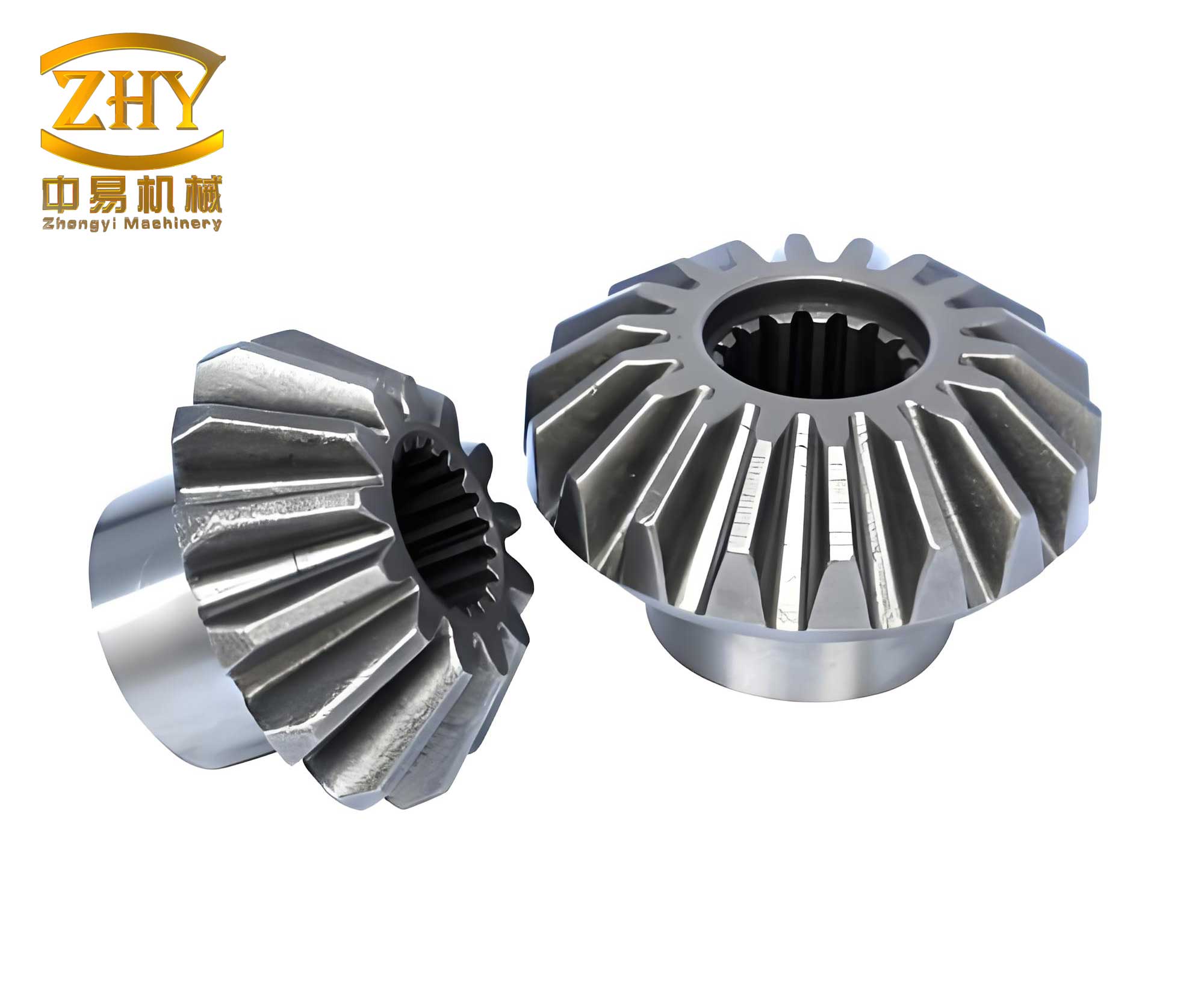
The unique geometry of a bevel gear poses a significant challenge for uniform densification during compaction. Unlike a simple spur gear, the bevel gear has a tapered profile, meaning the tooth depth varies across its face width. In a conventional compaction die, the powder is compressed primarily in the axial direction with minimal lateral flow. This results in a density gradient: regions corresponding to the shallow tooth tips experience lower compaction pressure and thus lower green density, while regions corresponding to the deep tooth roots experience higher pressure and higher density. Since the tooth flank is the primary working surface and stress concentrator, this inherent low-density zone is a critical weakness.
Structural optimization of the bevel gear design for the PM process is therefore essential. The goal is to minimize the height differential ($\Delta h$) between the tip and root lines of the tooth when projected onto the compaction axis. If we consider the tooth profile in the mid-plane of the gear, an unoptimized design has a large $\Delta h$, leading to the problematic density gradient. An optimized design modifies the root line and potentially the backing geometry (e.g., web thickness) to make $\Delta h$ as close to zero as possible. This “balanced fill” approach ensures that during compaction, the powder column height above every section of the tooth cavity is nearly equal, promoting uniform pressure transmission and, consequently, uniform green density throughout the tooth. This optimization must be performed while strictly maintaining the functional gear geometry (pressure angle, spiral angle, module) on the working flanks. Advanced computer simulations (Finite Element Analysis of powder compaction) are invaluable tools for iterating and validating these design modifications before tooling is manufactured.
The compaction process itself offers a major lever for enhancing the strength of a powder metallurgy bevel gear. While conventional room-temperature compaction can achieve densities up to about 7.1-7.2 g/cm³ for ferrous materials, Warm Compaction technology provides a significant boost. In this process, the powder blend and the tooling are heated to a controlled temperature, typically in the range of 130-150 °C. This increases the plasticity of the polymer lubricant and reduces the yield strength of the metal powder particles. The benefits are twofold: it lowers the required compaction pressure for a given density, or, more importantly for strength, it enables achieving a higher green density (often 7.3-7.5 g/cm³ or more) at the same pressure. The enhancement in green density translates directly to higher sintered density and strength. The relationship between compaction pressure ($P$), temperature ($T$), and green density ($\rho_g$) can be described by modified densification models that account for thermally activated deformation mechanisms.
Sintering is the process where the “green” compact gains its mechanical integrity through atomic diffusion and bonding at high temperature. For high-strength ferrous bevel gears, sintering is not merely a bonding step but a critical microstructural development stage. The standard sintering atmosphere of 90% N₂ – 10% H₂ at 1120°C for 30 minutes is often sufficient for standard grades. To maximize strength, the sintering cycle can be optimized by increasing the peak temperature and/or extending the sintering time. The driving force for densification and homogenization is diffusion, which follows the Arrhenius relationship. The diffusion coefficient $D$ is:
$$D = D_0 \exp\left(-\frac{Q}{RT}\right)$$
where $D_0$ is a pre-exponential factor, $Q$ is the activation energy, $R$ is the gas constant, and $T$ is the absolute temperature. Increasing $T$ has an exponential effect on diffusion rates, promoting better neck growth, pore rounding, and alloy homogenization, all contributing to higher strength. Similarly, isothermal hold time ($t$) allows these diffusion-controlled processes to proceed further. However, there is a trade-off: excessive temperature or time can lead to grain growth (reducing strength via the Hall-Petch relationship, $\sigma_y \propto d^{-1/2}$ where $d$ is grain diameter) and increased dimensional distortion, which is particularly detrimental for the precise geometry of a bevel gear.
| Sintering Parameter | Effect on Microstructure/Properties | Trade-off & Consideration for Bevel Gears |
|---|---|---|
| Higher Temperature (e.g., 1150°C vs. 1120°C) | Enhanced diffusion, greater densification, improved pore spheroidization, better alloy homogeneity. Increases strength and ductility. | Risk of excessive grain growth, potential for liquid phase formation with certain alloys (e.g., high Cu), increased distortion. Requires precise atmosphere control. |
| Longer Time (e.g., 45 min vs. 30 min) | Allows diffusion processes to proceed further, improving bond integrity and microstructural uniformity. | Diminishing returns on property improvement, promotes grain growth, reduces furnace productivity, increases energy cost. |
| Atmosphere (e.g., Higher H₂ content, Vacuum) | Better oxide reduction, cleaner surfaces for bonding, can allow for higher sintering temperatures. Vacuum sintering is excellent for high-performance alloys. | Increased cost (H₂, vacuum equipment). Carbon control can be more challenging in high-H₂ or vacuum atmospheres. |
For a high-strength powder metallurgy bevel gear destined for high-load, high-wear applications, heat treatment is almost always indispensable. The goal is to create a component with a hard, wear-resistant surface case and a tough, ductile core to withstand bending stresses and impact. Case carburizing followed by quenching and tempering is the most suitable process. The powder metallurgy bevel gear, with its interconnected porosity, presents both a challenge and an opportunity for carburizing. The porosity can allow for rapid gas penetration, leading to deep case depths if not controlled, and can also trap carburizing gases or quenchants.
The key parameters in carburizing heat treatment for a PM bevel gear are case depth, surface hardness, and core hardness. The effective case depth (ECD), typically measured to 550 HV, should be optimized relative to the tooth size. A common rule is to target a case depth between 0.25 and 0.4 times the module ($m_n$) of the bevel gear:
$$ \text{ECD} \approx (0.25 \text{ to } 0.4) \times m_n $$
This ensures the high-hardness zone is sufficiently thick to support contact stresses without being so deep as to make the tooth brittle. Surface hardness for optimal wear resistance without spalling is typically in the range of 650-820 HV0.1. The core hardness must be high enough to provide bending strength but retain adequate toughness; this is controlled by the alloy’s hardenability and the quench rate. For mating bevel gear pairs, it is common practice to specify the larger gear (which experiences more cycles) to have a surface hardness approximately 50 HV0.1 lower than the smaller pinion to promote balanced wear and life.
The carburizing process itself is governed by the diffusion of carbon into the surface. The depth of penetration ($x$) can be approximated by Fick’s law for a semi-infinite solid:
$$ x = \sqrt{D_c \cdot t} $$
where $D_c$ is the diffusion coefficient for carbon in austenite at the carburizing temperature, and $t$ is the time. In practice, the presence of porosity complicates this model, as carbon can diffuse both through the solid and through the pore network.
The complete manufacturing chain for a high-strength powder metallurgy bevel gear integrates all these elements into a cohesive process flow, as summarized below:
| Process Stage | Key Action for High Strength | Scientific/Engineering Principle Applied |
|---|---|---|
| 1. Material Design | Select pre-alloyed or diffusion-alloyed powder with balanced Ni, Cu, Mo, and controlled low C. Use high-purity, spherical powders for better packing. | Rule of Mixtures for property prediction, control of micro-segregation, optimization of hardenability. |
| 2. Structural Design | Optimize gear blank geometry to minimize axial height difference ($\Delta h$) between tooth tip and root lines. Use FEA compaction simulation. | Uniform pressure distribution during compaction (P = F/A). Minimizing density gradients ($\nabla \rho$). |
| 3. Compaction | Employ Warm Compaction technology with heated powder and tools. Use high compaction pressures within tooling limits. | Thermally-assisted plastic deformation of powder particles. Power-law relationship $\sigma \propto \rho^n$. |
| 4. Sintering | Use high-temperature sintering cycle (e.g., 1150-1180°C) in controlled atmosphere (N₂/H₂ or vacuum). Optimize time-at-temperature. | Arrhenius law for atomic diffusion ($D = D_0 e^{-Q/RT}$). Pore closure and neck growth kinetics. |
| 5. Sizing/Coining | Perform a cold repress operation to correct geometry, improve surface finish, and slightly increase density in critical areas. | Plastic deformation of sintered skeleton. Work hardening of surface layers. |
| 6. Heat Treatment | Apply controlled gas carburizing to achieve specified case depth, followed by oil quenching and tempering. | Carbon diffusion (Fick’s Law: $x \propto \sqrt{Dt}$). Austenite to martensite transformation (CCT diagrams). Tempering kinetics. |
| 7. Finishing | Implement gear grinding or honing if ultra-precision is required after heat treatment to correct distortion and improve surface finish. | Achieving required gear quality grade (e.g., AGMA or ISO standards) for noise and load distribution. |
In conclusion, the development of a high-strength powder metallurgy bevel gear is a multifaceted engineering challenge that requires a systems-level approach. It is not sufficient to focus on a single aspect of the process. Instead, the highest performance is achieved through the synergistic optimization of material chemistry, component geometry designed for manufacturability, and advanced processing techniques like warm compaction and high-temperature sintering, all capped off with a tailored heat treatment. Each step builds upon the previous one, with the common goal of maximizing density, homogeneity, and microstructural integrity. By rigorously applying these principles, the powder metallurgy bevel gear can transcend its traditional strength limitations, enabling its use in more demanding power transmission applications where performance, reliability, and cost-effectiveness are paramount. This holistic methodology provides a robust framework for engineers to design and produce powder metallurgy bevel gears that meet the escalating demands of modern industry.