
In the realm of aero-engine transmission systems, bevel gears play a pivotal role in redirecting power and ensuring smooth operation. As a researcher focused on sustainable engineering, I have extensively studied the failure mechanisms of bevel gears and developed a remanufacturing methodology centered on profile modification. This approach not only restores but often enhances the performance of worn bevel gears, offering significant economic and environmental benefits. Throughout this article, I will delve into the intricacies of bevel gear failures, the feasibility of remanufacturing, the core technology of profile modification, and the detailed工艺流程, supported by empirical data and analytical models. The keyword ‘bevel gears’ will be frequently emphasized to underscore their importance in this context.
Bevel gears are subjected to extreme conditions during service, including high loads, thermal cycles, and lubricant degradation. These factors contribute to various failure modes that compromise the integrity and functionality of bevel gears. Understanding these failures is the first step toward effective remanufacturing. The primary failure modes observed in bevel gears include scuffing, wear, pitting, and spalling. Each mode has distinct causes and manifestations, which I will explore in detail.
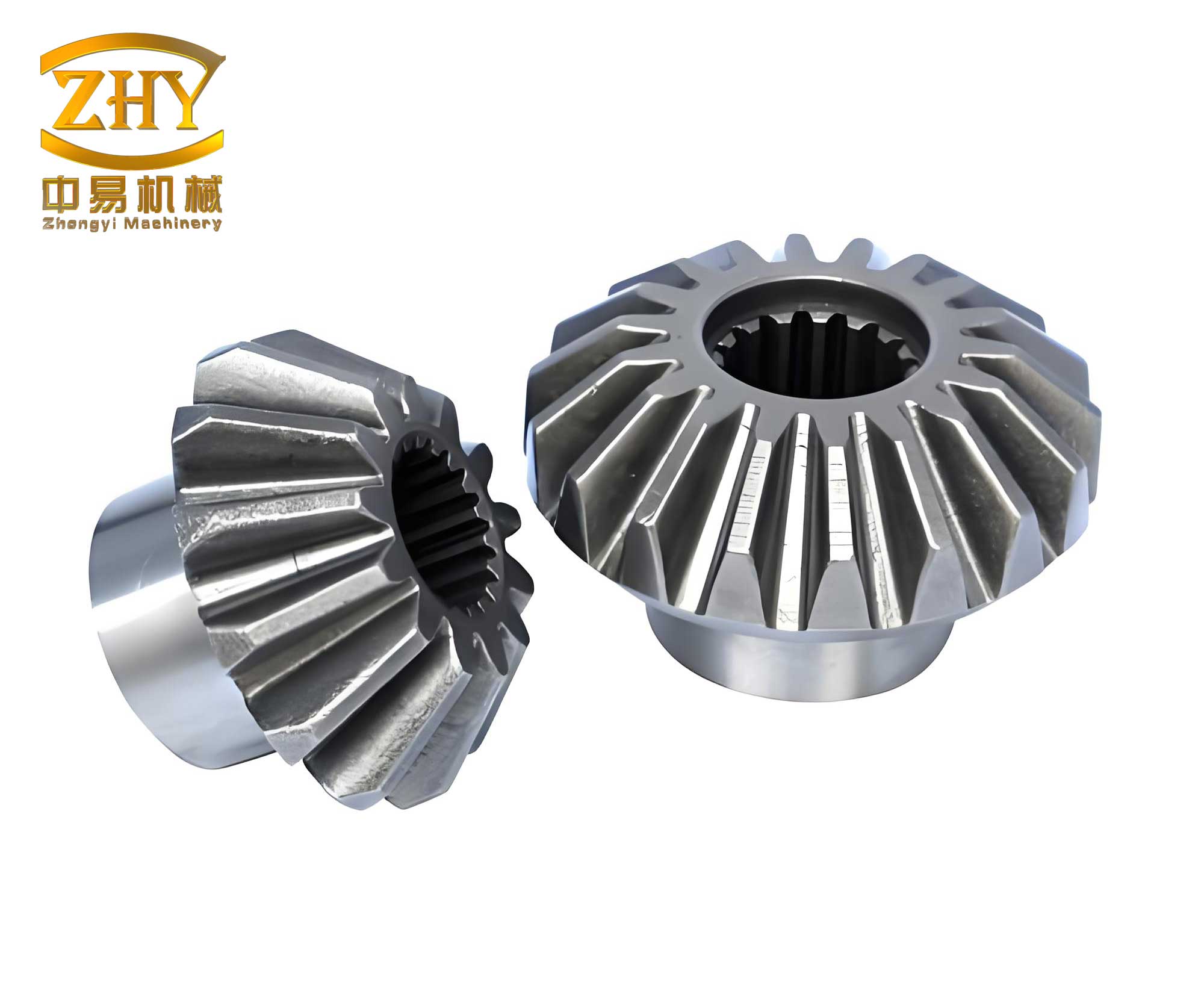
Scuffing, also known as adhesive wear, occurs when the lubricant film between mating bevel gears breaks down, leading to metal-to-metal contact and material transfer. This is often precipitated by inadequate lubrication, excessive sliding velocities, or high contact pressures. The equation for the critical temperature rise that triggers scuffing can be expressed as:
$$ \Delta T_c = \frac{\mu \cdot v \cdot p}{k} $$
where \(\mu\) is the coefficient of friction, \(v\) is the sliding velocity, \(p\) is the contact pressure, and \(k\) is the thermal conductivity. When \(\Delta T_c\) exceeds the material’s threshold, scuffing initiates. For bevel gears, this is particularly problematic in high-speed applications.
Wear in bevel gears results from abrasive particles, misalignment, or cyclic loading, leading to gradual material loss and changes in tooth profile. The wear rate can be modeled using Archard’s equation:
$$ V = K \cdot \frac{W \cdot s}{H} $$
where \(V\) is the wear volume, \(K\) is the wear coefficient, \(W\) is the normal load, \(s\) is the sliding distance, and \(H\) is the material hardness. In bevel gears, wear often concentrates at the tooth root or tip, altering the meshing characteristics and increasing noise and vibration.
Pitting and spalling are fatigue-driven failures where subsurface cracks propagate due to repeated Hertzian contact stresses. The maximum contact stress \(\sigma_{max}\) for bevel gears can be approximated using:
$$ \sigma_{max} = \sqrt{\frac{W}{\pi \cdot b} \cdot \frac{1}{\rho_{eq}}} $$
where \(b\) is the face width and \(\rho_{eq}\) is the equivalent radius of curvature. When \(\sigma_{max}\) surpasses the endurance limit, micro-pits form and coalesce into larger spalls. This is common in bevel gears subjected to heavy loads and insufficient surface hardening.
The feasibility of remanufacturing bevel gears hinges on several factors: residual life, geometric constraints, and enhancement possibilities. I have established that bevel gears with surface damage but intact core material are prime candidates for remanufacturing. The residual fatigue life must exceed the engine’s overhaul interval, which is typically verified through stress-cycle analysis. For bevel gears, the modified Goodman criterion can be applied:
$$ \frac{\sigma_a}{S_e} + \frac{\sigma_m}{S_u} \leq 1 $$
where \(\sigma_a\) is the alternating stress, \(\sigma_m\) is the mean stress, \(S_e\) is the endurance limit, and \(S_u\) is the ultimate strength. Bevel gears that satisfy this inequality are deemed suitable for remanufacturing.
Geometrically, profile modification involves removing a minimal layer of material (typically 0.02 mm) from the tooth flank, which does not compromise the carburized case depth. The required case depth for bevel gears is 0.7–1.1 mm, and remanufacturing must ensure it remains above 0.7 mm. This is validated through metallographic examination. Additionally, surface enhancement techniques like shot peening are employed to induce compressive residual stresses, improving fatigue resistance. The residual stress profile \(\sigma_r(z)\) after shot peening can be described as:
$$ \sigma_r(z) = \sigma_0 \cdot e^{-\alpha z} $$
where \(\sigma_0\) is the surface residual stress, \(\alpha\) is a decay constant, and \(z\) is the depth from the surface. For bevel gears, this enhances both bending and contact fatigue strength by up to 30%.
Profile modification is the cornerstone of bevel gear remanufacturing. It involves altering the tooth profile to mitigate meshing impacts and reduce dynamic loads. The theoretical basis lies in eliminating geometric interference during engagement and disengagement. For bevel gears, the base pitch discrepancy \(\Delta p_b\) between driving and driven gears causes interference, which can be calculated as:
$$ \Delta p_b = p_{b1} – p_{b2} $$
where \(p_{b1}\) and \(p_{b2}\) are the base pitches of the driving and driven bevel gears, respectively. To compensate, a profile modification curve is applied. The most common curve follows a power law:
$$ \Delta(x) = \Delta_{max} \left( \frac{x}{l} \right)^n $$
where \(\Delta(x)\) is the modification amount at position \(x\) along the profile, \(\Delta_{max}\) is the maximum modification, \(l\) is the modification length, and \(n\) is the curve exponent (typically between 1 and 3 for bevel gears). The maximum modification \(\Delta_{max}\) is derived from:
$$ \Delta_{max} = \delta \pm \Delta f_b $$
where \(\delta\) is the composite elastic deformation of the tooth pair, and \(\Delta f_b\) is the maximum base pitch deviation. For bevel gears with module \(m = 4\) mm, \(\Delta_{max}\) ranges from 0.015 to 0.022 mm, and \(l\) from 0.88 to 3.2 mm, aligning with ISO standards.
The modification parameters vary along the tooth due to the conical geometry of bevel gears. At the toe and heel, different angles \(\alpha_1\) and \(\alpha_2\) are used, as shown in Table 1.
| Parameter | Toe (Small End) | Heel (Large End) |
|---|---|---|
| Rotation Angle (°) | 1.3–1.8 | 0.2–0.6 |
| Modification Amount (mm) | 0.015–0.020 | 0.015–0.022 |
| Modification Length (mm) | 0.88–2.23 | 2.52–3.20 |
This tailored approach ensures optimal meshing for bevel gears across their entire face width. The modification curve is implemented on CNC gear grinding machines, producing a smooth transition that minimizes stress concentrations.
The remanufacturing process for bevel gears is meticulous and consists of sequential steps to guarantee quality. I have streamlined this process into a repeatable workflow, which I outline below.
First, the bevel gears are cleaned using aviation gasoline to remove contaminants. This is crucial for accurate defect assessment. Next, non-destructive testing (NDT) via magnetic particle inspection is conducted to detect cracks. Bevel gears with cracks are rejected, as they cannot be safely remanufactured.
Subsequently, surface defects like scratches or adhesions are polished using abrasive stones and sandpaper. The polishing depth is limited to 0.05 mm to preserve the carburized layer. Then, profile modification is performed on a Gleason CNC grinder, applying the rotationally involute curve described earlier. This step is critical for restoring the meshing geometry of bevel gears.
After modification, shot peening is applied to enhance surface hardness and induce compressive stresses. The peening parameters—such as shot size, velocity, and coverage—are optimized for bevel gears to achieve a surface hardness of HRC ≥ 60. The process is followed by another cleaning cycle to remove debris.
Quality control involves multiple inspections. Tooth profile error is measured on a coordinate measuring machine (CMM), with deviations constrained to −10 to +10 μm. Carburized case depth is verified through cross-sectional microscopy, ensuring it meets the 0.7–1.1 mm range. Microhardness tests are conducted using a Rockwell hardness tester, with surface hardness required to be HRC ≥ 60 and core hardness HRC 32–45.5. Additionally, tooth thickness and surface roughness are checked; thickness loss should not exceed 0.1 mm, and roughness should be ≤ 0.4 μm.
Finally, the remanufactured bevel gears are assembled into the gearbox, where meshing clearance and contact pattern are evaluated. The clearance should be within specified tolerances, and the contact pattern should cover at least 65% of the tooth flank, indicating proper load distribution.
To validate the remanufacturing methodology, I applied it to a case study involving an aero-engine bevel gear pair that exhibited excessive vibration. Vibration signal analysis revealed heightened harmonics at the meshing frequency, suggesting localized damage. Upon disassembly, the bevel gears showed scuffing and pitting near the pitch line. Using the discriminative criteria I established—such as wear area less than 10% of the module and pitting depth under 10% of the module—the bevel gears were deemed suitable for remanufacturing.
The remanufacturing process was executed as described. Post-remanufacturing inspections confirmed that the profile errors were within 0 to +7 μm, carburized depth was 0.93 mm, and surface hardness was HRC 62.6. Assembly tests showed optimal meshing clearance and contact patterns. Engine test runs demonstrated smooth operation with reduced noise and vibration, and no anomalies were detected over extended periods. The remanufactured bevel gears have accrued over 800 service hours without issues, proving their reliability.
The economic and environmental advantages of remanufacturing bevel gears are substantial. I have analyzed the cost breakdown, revealing that remanufacturing costs only 11.3% of producing new bevel gears. This is because remanufacturing retains the embodied energy and value-added processing of the original component. The savings are quantified in Table 2.
| Aspect | New Bevel Gear | Remanufactured Bevel Gear | Savings |
|---|---|---|---|
| Material Cost | 15% of total | 0% (reused) | 100% |
| Processing Cost | 85% of total | 11.3% of new cost | 86% |
| Energy Consumption | High | Low | 86% reduction |
| Material Usage | 100% virgin | 22% virgin (for repairs) | 78% reduction |
The energy savings of 86% and material savings of 78% translate to significant reductions in carbon footprint and resource depletion. Moreover, remanufacturing bevel gears alleviates supply chain pressures and shortens lead times from 90 days for new gears to 20 days for remanufactured ones.
From a technical perspective, the performance of remanufactured bevel gears often surpasses that of new ones due to the incorporation of profile modification and surface enhancement. The dynamic load factor \(K_v\) is reduced, as profile modification dampens meshing impacts. The revised factor can be estimated as:
$$ K_v’ = K_v \cdot \left(1 – \frac{\Delta_{max}}{m}\right) $$
where \(m\) is the module. For bevel gears with \(m = 4\) mm and \(\Delta_{max} = 0.02\) mm, \(K_v’\) decreases by 0.5%, leading to lower dynamic stresses and extended fatigue life.
Furthermore, the shot peening process increases the surface hardness and introduces beneficial compressive stresses. The enhanced endurance limit \(S_e’\) can be expressed as:
$$ S_e’ = S_e \cdot \left(1 + \beta \cdot \frac{\sigma_0}{S_u}\right) $$
where \(\beta\) is a material constant. For typical bevel gear steel, this results in a 10–30% improvement in fatigue strength.
Looking ahead, the remanufacturing of bevel gears can be further optimized through advanced technologies like laser cladding for severe damage repair or additive manufacturing for customized modifications. However, profile modification remains the core technique due to its simplicity and effectiveness. I recommend integrating real-time vibration monitoring during engine operation to predict failures and schedule remanufacturing proactively, maximizing the lifecycle of bevel gears.
In conclusion, the remanufacturing of bevel gears via profile modification is a technically robust and economically viable strategy. It addresses common failure modes such as scuffing, wear, pitting, and spalling by restoring the tooth geometry and enhancing surface properties. The process—encompassing cleaning, NDT, polishing, profile modification, shot peening, and rigorous inspection—ensures that remanufactured bevel gears meet or exceed original performance standards. With cost savings of 88.7%, energy savings of 86%, and material savings of 78%, this approach offers a sustainable pathway for the aviation and other high-precision industries. As the demand for resource efficiency grows, the remanufacturing of bevel gears will play an increasingly critical role in circular economy initiatives, ensuring that these essential components continue to drive innovation and reliability.