
The analysis of epicyclic gear trains, particularly those incorporating bevel gears, is a fundamental task in mechanical design. These systems are prized for their compactness, high power density, and ability to provide complex speed relationships, making them indispensable in applications ranging from automotive differentials to aerospace transmissions and industrial machinery. The core challenge in their kinematic analysis lies in determining the speed ratios and the absolute angular velocities of all moving members within the system. Traditional methods, such as the tabular method or the formula method, often become cumbersome and lack generality when applied to multi-degree-of-freedom systems or spatially complex arrangements involving non-parallel axes, as is common with bevel gears.
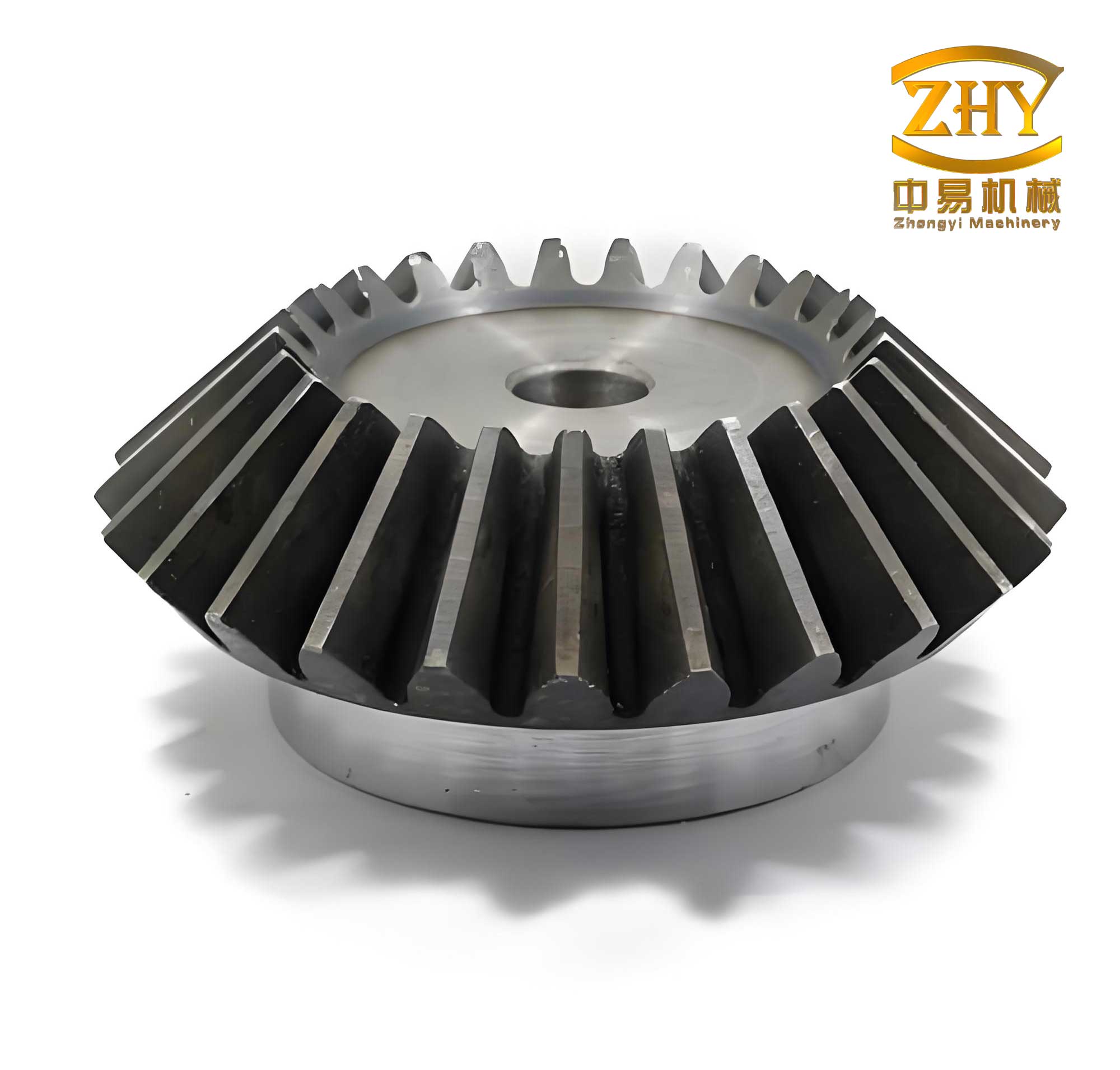
This necessitates a more systematic, algorithmic approach that is not only accurate but also amenable to computer automation. This article presents a robust and general methodology that synergistically combines Graph Theory and Screw Theory to perform the kinematic analysis of spatial epicyclic trains containing bevel gears. Graph Theory provides a clear and concise mathematical abstraction of the train’s topology, while Screw Theory offers a powerful tool for representing the kinematics of spatial joints, such as those defined by the axes of bevel gears. The method is procedural, minimizes ad-hoc calculations, and can be directly implemented in computational algorithms, paving the way for intelligent and automated design tools for complex gear systems.
Graph-Theoretic Modeling of the Gear Train
The first step in the analysis is to construct a directed graph model \( D = (V, E) \) of the epicyclic gear train. This abstract representation captures the essential connectivity between components, stripping away geometrical details to focus on topological relationships.
Graph Construction Rules:
- Nodes (V): Represent the physical links. The fixed frame (ground) is assigned node 0. The \( n \) movable links are assigned nodes \( 1, 2, \dots, n \).
- Edges (E): Represent the kinematic pairs (joints). The \( t \) revolute joints are assigned edges \( n+1, n+2, \dots, n+t \). The \( c \) gear pairs (meshes) are assigned edges \( n+t+1, \dots, n+t+c \). The total number of edges is \( k = t + c \).
- Edge Direction: Each directed edge \( e = (n_{tail}, n_{head}) \) points from the tail node to the head node. Consistent conventions are crucial:
- For edges connected to the ground (node 0), the direction is from node 0 to the other link.
- For edges connected to a planet gear, the direction is typically chosen to point towards the planet node. This convention simplifies subsequent matrix formulations.
- Edge Style: Revolute joints are represented by solid lines. Gear pairs are represented by dashed lines.
The corresponding spanning tree \( T \) is obtained by removing all dashed edges (gear pairs) from the directed graph \( D \). The spanning tree connects all nodes without forming any closed loops. The removed gear pair edges become the chords which, when added back to the tree, create the fundamental cycles (or loops) of the system. This concept is central to the analysis.
Fundamental Matrices
From the directed graph and its spanning tree, we derive several key matrices that encode the system’s topology.
1. Node-Edge Incidence Matrix (\(\Gamma_0\) and \(\Gamma\))
The complete node-edge incidence matrix \(\Gamma_0\) is of size \((n+1) \times k\). For each column representing edge \( l \), the entry corresponding to node \( n_{tail} \) is -1, the entry for node \( n_{head} \) is +1, and all others are 0.
$$ \Gamma_0 = \begin{bmatrix}
\text{Row for Node 0} \\
\text{Row for Node 1} \\
\vdots \\
\text{Row for Node n}
\end{bmatrix} $$
Since the rows sum to zero, the first row (for the fixed link) is linearly dependent and can be removed to obtain the reduced node-edge incidence matrix \(\Gamma\), of size \( n \times k \). Assuming the system is non-degenerate and the number of revolute joints equals the number of movable links (\( t = n \)), \(\Gamma\) can be partitioned into sub-matrices for tree edges (revolutes) and chord edges (gear pairs):
$$ \Gamma = [G \ | \ G^*] $$
where \( G \) is an \( n \times n \) invertible matrix corresponding to the spanning tree edges (revolutes), and \( G^* \) is an \( n \times c \) matrix corresponding to the chord edges (gear pairs).
2. Path Matrix (Z)
The path matrix \( Z \) is an \( n \times n \) matrix derived from the spanning tree \( T \). Its element \( z_{t,n} \) describes the relationship between tree edge \( t \) and the path from node \( n \) to the ground (node 0):
$$ z_{t,n} =
\begin{cases}
+1, & \text{if edge \( t \) is on the path from \( n \) to 0 and its direction agrees with the path direction.} \\
-1, & \text{if edge \( t \) is on the path but its direction opposes the path direction.} \\
0, & \text{if edge \( t \) is not on the path.}
\end{cases} $$
3. Fundamental Circuit Matrix (C)
This is the most critical matrix for kinematic analysis. Each fundamental circuit is formed by adding one chord (gear pair edge) back to the spanning tree. The \( c \times k \) fundamental circuit matrix \( C \) has one row for each chord/circuit. It can be partitioned as:
$$ C = [T \ | \ U] $$
where \( U \) is a \( c \times c \) identity matrix corresponding to the chords (gear pairs), and \( T \) is the \( c \times n \) chord-to-tree transformation matrix. Matrix \( T \) is computed from the graph matrices as:
$$ T = (G^*)^T Z^T $$
The matrix \( C \) encapsulates all the independent closed-loop constraints imposed by the gear meshes on the motions allowed by the revolute joints in the tree.
Screw Theory Fundamentals for Bevel Gear Kinematics
To analyze spatial trains with bevel gears, we need a mathematical representation for rotation about an axis in space. A unit screw \( \hat{\$} \) provides this. For a revolute joint \( k \) with its axis in space, the screw is defined by its Plücker coordinates:
$$ \hat{\$}^0_k = \begin{pmatrix} \mathbf{u}^0_k \\ \mathbf{r}^0_{c,k} \times \mathbf{u}^0_k \end{pmatrix} = \begin{pmatrix} L_k & M_k & N_k & | & P_{c,k} & Q_{c,k} & R_{c,k} \end{pmatrix}^T $$
where:
- \( \mathbf{u}^0_k = (L_k, M_k, N_k)^T \) is the unit vector along the axis of joint \( k \), expressed in the global coordinate frame \( O-X_0Y_0Z_0 \).
- \( \mathbf{r}^0_{c,k} \) is the position vector from a point on the axis of joint \( k \) to a point associated with a gear mesh \( c \) (typically the pitch point).
- The cross product \( \mathbf{r}^0_{c,k} \times \mathbf{u}^0_k \) gives the moment part of the screw \( (P_{c,k}, Q_{c,k}, R_{c,k})^T \). For the kinematic analysis of gear trains, the first moment component \( P_{c,k} \) is often the most relevant, as it relates to the relative angular velocity about the axis and the pitch radii.
The orientation vector \( \mathbf{u}^0_k \) for a joint axis can be found by rotating the global Z-axis unit vector \( \mathbf{u} = (0,0,1)^T \) by an angle \( \phi_k \) about the global X-axis (or another suitable axis), using a rotation matrix \( \mathbf{D}_{0,k} \):
$$ \mathbf{D}_{0,k} = \begin{bmatrix} 1 & 0 & 0 \\ 0 & \cos \phi_k & -\sin \phi_k \\ 0 & \sin \phi_k & \cos \phi_k \end{bmatrix}, \quad \mathbf{u}^0_k = \mathbf{D}_{0,k} \mathbf{u} = \begin{bmatrix} 0 \\ -\sin \phi_k \\ \cos \phi_k \end{bmatrix} $$
For example, a vertical axis has \( \phi_k = 0^\circ \), yielding \( \mathbf{u}^0_k = (0,0,1)^T \). A horizontal axis aligned with the global Y-axis has \( \phi_k = -90^\circ \), yielding \( \mathbf{u}^0_k = (0,1,0)^T \). This is crucial for modeling the orthogonal axes found in bevel gear differentials.
The scalar relative angular velocity about joint \( k \) is denoted \( \Delta \theta_k = \omega_{n_{head}/n_{tail}} \). When multiplied by this scalar, the screw becomes a twist representing the relative motion:
$$ \mathbf{\hat{s}}^0_k = \hat{\$}^0_k \Delta \theta_k = \begin{pmatrix} \mathbf{u}^0_k \Delta \theta_k \\ (\mathbf{r}^0_{c,k} \times \mathbf{u}^0_k) \Delta \theta_k \end{pmatrix} $$
Synthesis: Deriving the Kinematic Equations
We now combine the graph model and screw representation to formulate the governing kinematic equations.
Relative Angular Velocity Equations
The core kinematic constraint for any closed circuit (fundamental loop) in the gear train is that the sum of the twists (relative motions) around the loop must be zero for compatible motion. Mathematically, for the \( c \) fundamental circuits described by matrix \( C \), we have:
$$ [C \circledast \mathbf{\hat{s}}^0] = \mathbf{0}_{c} $$
Here, \( \circledast \) denotes the Hadamard (element-wise) product, and \( \mathbf{\hat{s}}^0 = [\mathbf{\hat{s}}^0_t \ | \ \mathbf{\hat{s}}^0_c]^T \) is the vector of twists for all \( t \) tree edges and \( c \) chords. This equation decomposes into two sets of equations corresponding to the primary and secondary parts of the screw. The most directly useful part for gear trains is often the equation derived from the secondary part (the moment), which relates angular velocities to geometrical parameters like pitch radii.
Expanding using the partition \( C = [T \ | \ U] \) and considering only the secondary part (specifically the \( P_{c,k} \) components, with \( Q_{c,k}=R_{c,k}=0 \) for typical gear train geometry), we obtain a key scalar equation for each circuit:
$$ [T \circledast \mathbf{P}_{c,t}] \boldsymbol{\Delta \theta}_t = \mathbf{0}_c $$
where:
- \( \boldsymbol{\Delta \theta}_t = (\Delta \theta_1, \dots, \Delta \theta_n)^T \) is the vector of relative angular velocities for the \( n \) revolute joints in the tree.
- \( \mathbf{P}_{c,t} \) is a \( c \times n \) matrix where element \( P_{c,k} \) is the first moment component of the screw for tree edge \( k \) relative to the pitch point of chord/circuit \( c \). For a gear mesh, \( P_{c,k} \) is typically proportional to the pitch radius of the gear associated with that joint in the circuit.
This equation system has \( c \) equations and \( n \) unknowns (\( \boldsymbol{\Delta \theta}_t \)). The degree-of-freedom (DOF) \( F \) of the gear train is given by the Gruebler-Kutzbach criterion for a spatial mechanism, which for a gear train can be simplified to \( F = n – c \). Therefore, we can partition the relative angular velocities into \( F \) independent inputs \( \boldsymbol{\Delta \theta}_F \) and \( c \) dependent outputs \( \boldsymbol{\Delta \theta}_r \). The matrix equation can be rearranged as:
$$ [\mathbf{P}_{r, F} \ | \ \mathbf{P}_{r, r}] \begin{bmatrix} \boldsymbol{\Delta \theta}_F \\ \boldsymbol{\Delta \theta}_r \end{bmatrix} = \mathbf{0} $$
Assuming \( \mathbf{P}_{r, r} \) is invertible, the dependent velocities are solved as:
$$ \boldsymbol{\Delta \theta}_r = -\mathbf{P}_{r, r}^{-1} \mathbf{P}_{r, F} \boldsymbol{\Delta \theta}_F $$
This is the relative angular velocity equation of the system, giving the speed ratios between various links.
Absolute Angular Velocities
Once the relative angular velocities \( \boldsymbol{\Delta \theta}_t \) for all revolute joints are known (both independent and solved dependent ones), the absolute angular velocity \( \boldsymbol{\omega}^0_m \) of any movable link \( m \) can be found by summing the relative velocities along the unique path from that link to ground in the spanning tree. This summation is efficiently performed using the path matrix \( Z \):
$$ \boldsymbol{\omega}^0_m = – \sum_{t \in \text{Path}(m \to 0)} \mathbf{u}^0_t \Delta \theta_t \cdot \text{sign}(t) $$
In matrix form for all links:
$$ \begin{bmatrix} \boldsymbol{\omega}^0_1 \\ \vdots \\ \boldsymbol{\omega}^0_n \end{bmatrix} = -Z^T [\mathbf{u}^0_t \Delta \theta_t] $$
where \( [\mathbf{u}^0_t \Delta \theta_t] \) is an \( n \)-element vector whose \( t \)-th entry is \( \mathbf{u}^0_t \cdot \Delta \theta_t \). This calculation yields the absolute angular velocity vector for each link in the global coordinate frame, fully describing the system’s kinematic state.
Comprehensive Analysis of an Automotive Bevel Gear Differential
To demonstrate the method, we analyze a standard automotive rear axle differential, a classic example of a two-DOF spatial epicyclic train using bevel gears.
1. System Modeling and Graph
The differential consists of: an input carrier (link 1), two side gears (links 2 and 3), and two planet bevel gears (links 4 and 5). The fixed frame is link 0. The joints are: revolute joints connecting the carrier to ground (6), the side gears to ground (7, 8), and the planets to the carrier (9, 10). The gear meshes are between the carrier gear and one side gear (11), between one side gear and a planet (12), and between the other side gear and the other planet (13).
| Component | Label | Graph Node/Edge |
|---|---|---|
| Fixed Frame | 0 | Node 0 |
| Input Carrier | 1 | Node 1 |
| Left Side Gear | 2 | Node 2 |
| Right Side Gear | 3 | Node 3 |
| Planet Gear A | 4 | Node 4 |
| Planet Gear B | 5 | Node 5 |
| Revolute: 0-1 | R01 | Edge 6 |
| Revolute: 0-2 | R02 | Edge 7 |
| Revolute: 0-3 | R03 | Edge 8 |
| Revolute: 2-4 | R24 | Edge 9 |
| Revolute: 0-5 | R05 | Edge 10 |
| Gear Mesh: 1-2 | G12 | Edge 11 |
| Gear Mesh: 3-4 | G34 | Edge 12 |
| Gear Mesh: 5-4 | G54 | Edge 13 |
Here, \( n = 5 \), \( t = 5 \), \( c = 3 \), \( k = 8 \). The directed graph and its spanning tree (with dashed edges 11, 12, 13 removed) are constructed per the rules.
2. Matrices for the Differential
The reduced node-edge incidence matrix \( \Gamma \) and its partition \( G \) and \( G^* \), the path matrix \( Z \), the chord-to-tree matrix \( T \), and the fundamental circuit matrix \( C \) are derived as follows:
$$ \Gamma = \begin{bmatrix}
-1 & 0 & 0 & 0 & 0 & 1 & 0 & 0 \\
0 & -1 & 0 & 1 & 0 & -1 & 1 & 0 \\
0 & 0 & -1 & 0 & 0 & 0 & -1 & 0 \\
0 & 0 & 0 & -1 & 0 & 0 & 0 & 1 \\
0 & 0 & 0 & 0 & -1 & 0 & 0 & -1
\end{bmatrix} = [G | G^*] $$
$$ \text{Where } G = \begin{bmatrix}
-1 & 0 & 0 & 0 & 0 \\
0 & -1 & 0 & 1 & 0 \\
0 & 0 & -1 & 0 & 0 \\
0 & 0 & 0 & -1 & 0 \\
0 & 0 & 0 & 0 & -1
\end{bmatrix}, \quad G^* = \begin{bmatrix}
1 & 0 & 0 \\
-1 & 1 & 0 \\
0 & -1 & 0 \\
0 & 0 & 1 \\
0 & 0 & -1
\end{bmatrix} $$
$$ Z = \begin{bmatrix}
1 & 0 & 0 & 0 & 0 \\
0 & 1 & 0 & 0 & 0 \\
0 & 0 & 1 & 0 & 0 \\
0 & 1 & 0 & 1 & 0 \\
0 & 0 & 0 & 0 & 1
\end{bmatrix}, \quad T = (G^*)^T Z^T = \begin{bmatrix}
1 & -1 & 0 & 0 & 0 \\
0 & -1 & 1 & -1 & 0 \\
0 & -1 & 0 & -1 & 1
\end{bmatrix} $$
$$ C = [T | U] = \begin{bmatrix}
1 & -1 & 0 & 0 & 0 & 1 & 0 & 0 \\
0 & -1 & 1 & -1 & 0 & 0 & 1 & 0 \\
0 & -1 & 0 & -1 & 1 & 0 & 0 & 1
\end{bmatrix} $$
3. Screw Parameters and P Matrix
Establish a global coordinate system at the center of the differential. The axis of joint 6 (carrier) and joint 9 (planet on carrier) are vertical (\( \phi=0^\circ \)). The axes of joints 7, 8, and 10 (side gears and one planet) are horizontal (\( \phi=-90^\circ \)). Let \( d_i \) be the pitch diameter of gear \( i \). The pitch radius determines the moment component \( P_{c,k} \). For example, for circuit 11 (involving gear mesh 11 between links 1 and 2), \( P_{11,6} \) is proportional to the moment arm of the carrier joint relative to mesh 11, which is \( d_1/2 \). Similarly, \( P_{11,7} \) is proportional to \( d_2’/2 \), where gear 2′ is the ring gear attached to the carrier (input).
| Circuit (c) | Joint (k) | \( P_{c,k} \) | Proportional To |
|---|---|---|---|
| 11 (G12) | 6 (R01) | \( P_{11,6} \) | \( d_1/2 \) |
| 7 (R02) | \( P_{11,7} \) | \( d_2’/2 \) | |
| 11 (G12) | \( P_{11,11} \) | 0 | |
| 12 (G34) | 7 (R02) | \( P_{12,7} \) | \( -d_3/2 \) |
| 8 (R03) | \( P_{12,8} \) | \( -d_3/2 \) | |
| 9 (R24) | \( P_{12,9} \) | \( d_4/2 \) | |
| 12 (G34) | \( P_{12,12} \) | 0 | |
| 13 (G54) | 7 (R02) | \( P_{13,7} \) | \( -d_3/2 \) |
| 9 (R24) | \( P_{13,9} \) | \( -d_4/2 \) | |
| 10 (R05) | \( P_{13,10} \) | \( -d_5/2 \) | |
| 13 (G54) | \( P_{13,13} \) | 0 |
Define the gear ratios: \( \mu_{12′} = d_1 / d_2′ \) and \( \mu_{34} = d_3 / d_4 \). Note that in a symmetric differential, \( d_3 = d_5 \) and the planets are identical.
4. Relative Angular Velocity Solution
The scalar circuit equation \( [T \circledast \mathbf{P}_{c,t}] \boldsymbol{\Delta \theta}_t = \mathbf{0}_c \) becomes:
$$
\begin{bmatrix}
\frac{d_1}{2} & -\frac{d_2′}{2} & 0 & 0 & 0 \\
0 & -\frac{d_3}{2} & \frac{d_3}{2} & -\frac{d_4}{2} & 0 \\
0 & -\frac{d_3}{2} & 0 & -\frac{d_4}{2} & -\frac{d_5}{2}
\end{bmatrix}
\begin{bmatrix} \Delta\theta_6 \\ \Delta\theta_7 \\ \Delta\theta_8 \\ \Delta\theta_9 \\ \Delta\theta_{10} \end{bmatrix} = \begin{bmatrix} 0 \\ 0 \\ 0 \end{bmatrix}
$$
Dividing each row by common factors and substituting ratios \( \mu_{12′} \) and \( \mu_{34} \), and noting \( d_3 = d_5 \):
$$
\begin{bmatrix}
\mu_{12′} & -1 & 0 & 0 & 0 \\
0 & -\mu_{34} & \mu_{34} & -1 & 0 \\
0 & -1 & 0 & -1 & \frac{d_3}{d_5}=1
\end{bmatrix}
\boldsymbol{\Delta \theta}_t = \mathbf{0}
$$
The system has \( n=5 \) unknowns and \( c=3 \) equations, giving \( F = 5-3 = 2 \) degrees of freedom. Choosing \( \Delta\theta_6 = \omega_{10} \) (carrier input) and \( \Delta\theta_8 = \omega_{30} \) (right side gear) as the two independent inputs, we partition and solve for the dependent velocities \( \boldsymbol{\Delta \theta}_r = [\Delta\theta_7, \Delta\theta_9, \Delta\theta_{10}]^T = [\omega_{20}, \omega_{42}, \omega_{50}]^T \):
$$
\begin{bmatrix}
\mu_{12′} & 0 & -1 & 0 & 0 \\
0 & -\mu_{34} & \mu_{34} & -1 & 0 \\
0 & 0 & -1 & -1 & 1
\end{bmatrix}
\begin{bmatrix} \omega_{10} \\ \omega_{30} \\ \omega_{20} \\ \omega_{42} \\ \omega_{50} \end{bmatrix} = \begin{bmatrix} 0 \\ 0 \\ 0 \end{bmatrix}
$$
Solving this system yields the fundamental kinematic equation of the differential:
$$
\begin{bmatrix} \omega_{20} \\ \omega_{42} \\ \omega_{50} \end{bmatrix} = \begin{bmatrix}
\mu_{12′} & 0 \\
\mu_{12′}\mu_{34} & -\mu_{34} \\
2\mu_{12′} & -1
\end{bmatrix} \begin{bmatrix} \omega_{10} \\ \omega_{30} \end{bmatrix}
$$
From the third row, we get the well-known result: \( \omega_{50} = 2\mu_{12′}\omega_{10} – \omega_{30} \). If the input ring gear is held fixed relative to the carrier (a common configuration where \( \mu_{12′} = 1 \), i.e., the carrier gear and ring gear are the same), this simplifies to the classic relationship: \( \omega_{20} + \omega_{30} = 2\omega_{10} \).
5. Absolute Angular Velocities
Using the path matrix \( Z \) and the unit direction vectors \( \mathbf{u}^0_t \), we compute the absolute angular velocity for each link. For this differential, \( \mathbf{u}^0_6 = \mathbf{u}^0_9 = (0,0,1)^T \) and \( \mathbf{u}^0_7 = \mathbf{u}^0_8 = \mathbf{u}^0_{10} = (0,1,0)^T \).
$$
\begin{bmatrix} \boldsymbol{\omega}^0_1 \\ \boldsymbol{\omega}^0_2 \\ \boldsymbol{\omega}^0_3 \\ \boldsymbol{\omega}^0_4 \\ \boldsymbol{\omega}^0_5 \end{bmatrix} = -Z^T \begin{bmatrix} \mathbf{u}^0_6 \Delta\theta_6 \\ \mathbf{u}^0_7 \Delta\theta_7 \\ \mathbf{u}^0_8 \Delta\theta_8 \\ \mathbf{u}^0_9 \Delta\theta_9 \\ \mathbf{u}^0_{10} \Delta\theta_{10} \end{bmatrix} = -Z^T \begin{bmatrix} (0,0,\omega_{10})^T \\ (0,\omega_{20},0)^T \\ (0,\omega_{30},0)^T \\ (0,0,\omega_{42})^T \\ (0,\omega_{50},0)^T \end{bmatrix}
$$
Performing the matrix multiplication gives the final state of the system:
$$
\begin{aligned}
\boldsymbol{\omega}^0_1 &= (0, 0, \omega_{10})^T \\
\boldsymbol{\omega}^0_2 &= (0, \omega_{20}, 0)^T \\
\boldsymbol{\omega}^0_3 &= (0, \omega_{30}, 0)^T \\
\boldsymbol{\omega}^0_4 &= (0, \omega_{20}, \omega_{42})^T \\
\boldsymbol{\omega}^0_5 &= (0, \omega_{50}, 0)^T
\end{aligned}
$$
6. Numerical Example
Consider a differential with the following bevel gear data: \( z_1=24, z_{2′}=32, z_3=z_5=20, z_4=17 \), module \( m=2 \) mm. The input carrier speed \( \omega_{10} = 36 \) deg/s. The pitch diameters are: \( d_1=48 \) mm, \( d_{2′}=64 \) mm, \( d_3=d_5=40 \) mm, \( d_4=34 \) mm. The ratios are \( \mu_{12′}=0.750 \) and \( \mu_{34} \approx 1.176 \).
The kinematic equation becomes:
$$
\begin{bmatrix} \omega_{20} \\ \omega_{42} \\ \omega_{50} \end{bmatrix} = \begin{bmatrix}
0.750 & 0 \\
0.882 & -1.176 \\
1.500 & -1.000
\end{bmatrix} \begin{bmatrix} 36 \\ \omega_{30} \end{bmatrix}
$$
Varying the independent input \( \omega_{30} \) (the right wheel speed) demonstrates the differential action:
| Condition | Description | ω10 (deg/s) | ω30 (deg/s) | ω20 (deg/s) | ω42 (deg/s) | ω50 (deg/s) |
|---|---|---|---|---|---|---|
| 1. Straight Line | Both wheels equal speed, no planet rotation. | 36.0 | 27.0 | 27.0 | 0.0 | 27.0 |
| 2. Right Turn (Locked) | Right wheel stopped, maximum differential action. | 36.0 | -27.0 | 27.0 | 63.5 | 81.0 |
| 3. Right Turn (Moderate) | Right wheel slowed moderately. | 36.0 | -15.0 | 27.0 | 49.4 | 69.0 |
For Condition 3, the absolute angular velocity vectors are:
$$
\begin{aligned}
\boldsymbol{\omega}^0_1 &= (0, 0, 36.0)^T \text{ deg/s} \\
\boldsymbol{\omega}^0_2 &= (0, 27.0, 0)^T \text{ deg/s} \\
\boldsymbol{\omega}^0_3 &= (0, -15.0, 0)^T \text{ deg/s} \\
\boldsymbol{\omega}^0_4 &= (0, 27.0, 49.4)^T \text{ deg/s} \\
\boldsymbol{\omega}^0_5 &= (0, 69.0, 0)^T \text{ deg/s}
\end{aligned}
$$
Discussion and Conclusion
The presented methodology, integrating Graph Theory and Screw Theory, provides a powerful and general framework for the kinematic analysis of spatial epicyclic gear trains containing bevel gears. The process is systematic and algorithmic:
- Modeling: The gear train is abstracted into a directed graph, from which fundamental topological matrices (\( \Gamma, Z, T, C \)) are derived automatically.
- Screw Representation: The spatial orientation and position of each joint axis, critical for bevel gears with non-parallel axes, are accurately captured using screw coordinates.
- Equation Formulation: The circuit matrix \( C \) and the screw parameters combine to form the scalar loop constraint equations \( [T \circledast \mathbf{P}_{c,t}] \boldsymbol{\Delta \theta}_t = \mathbf{0} \), which are purely algebraic.
- Solution: These equations are solved to find relative and then absolute angular velocities for the entire system.
The key advantages of this method are:
- Generality: It is not limited to planar or parallel-axis systems. It naturally handles the complex three-dimensional relationships inherent in bevel gear trains, multi-DOF systems, and compound trains.
- Systematic Procedure: The steps are well-defined and follow a logical sequence, minimizing ad-hoc reasoning.
- Automation Potential: The entire process, from graph construction to matrix assembly and equation solving, is highly amenable to computer implementation. This makes it ideal for integration into Computer-Aided Design (CAD) and expert systems for automated gear train synthesis and analysis.
- Clarity: The graph model provides an unambiguous representation of the train’s topology, which is especially valuable for understanding complex, multi-path systems.
While the automotive differential served as an illustrative example, the method’s true strength lies in its applicability to far more complex arrangements found in aviation, robotics, and heavy machinery, where multiple stages of planetary bevel gears and compound planets are used. Future work can extend this foundation to include dynamic analysis, efficiency calculation, and automated synthesis of gear trains meeting specific kinematic requirements, solidifying this graph-screw based approach as a cornerstone for the intelligent and digital design of advanced mechanical transmission systems.