
In the automotive industry, bevel gears play a critical role in differential systems, which are essential for transmitting power and allowing wheels to rotate at different speeds. As a precision transmission component, the axial positioning accuracy of bevel gears directly influences the meshing quality and overall performance. Specifically, the inner bore recess—a tapered surface within the bore—serves as the axial定位基准 for installation. This recess has both a depth and an angle that must be precisely measured to ensure proper assembly. However, conventional measuring tools often fail to directly assess these parameters due to the recess’s location and geometry. In my experience, this limitation can lead to quality issues in production, as operators may not detect deviations promptly, resulting in potential batch rejections and economic losses. Therefore, I have explored the application of the go/no-go gauge principle—a method where a “go” gauge passes and a “no-go” gauge stops for acceptable parts—to design specialized检具 for measuring the recess depth and angle in bevel gears. This approach not only enhances measurement accuracy but also improves efficiency on the production floor.
The go/no-go principle is rooted in metrology and is commonly used with smooth plug gauges to verify dimensional tolerances. For a hole diameter, if the go gauge (designed to the maximum material limit) enters freely and the no-go gauge (designed to the minimum material limit) does not, the part is within specification. I have adapted this concept to address the unique challenges of measuring bevel gears’ inner bore recess. The recess depth, denoted as H, is defined as the distance from the sharp point of the tapered surface to the small end face of the gear, while the recess angle, denoted as α, represents the inclination of that surface. Both parameters have specified tolerances, and their precise control is vital for the gear’s functionality. In this article, I will detail how I designed and implemented go/no-go检具 for these measurements, incorporating formulas and tables to summarize key aspects. Throughout, I will emphasize the importance of bevel gears in automotive applications and how this method benefits their manufacturing.
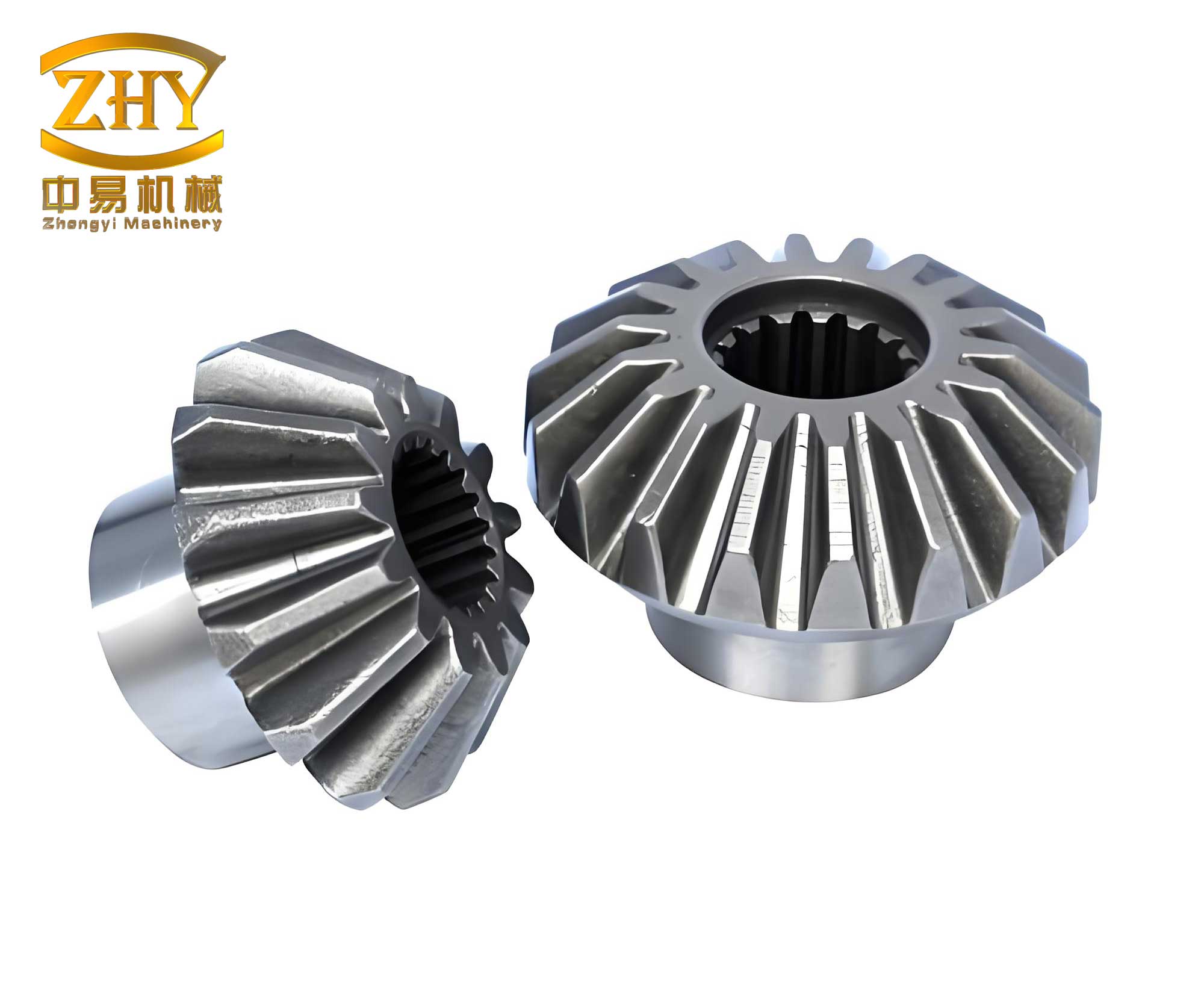
Bevel gears are widely used in differential systems due to their ability to transmit motion between intersecting shafts. The inner bore recess in these bevel gears provides a precise定位 surface for mounting, ensuring that the gears align correctly under load. However, measuring the recess depth H and angle α poses difficulties because standard tools like calipers or micrometers cannot access the sharp point directly. Advanced equipment such as profilometers or coordinate measuring machines (CMMs) offer high precision but are unsuitable for production environments due to their sensitivity to conditions, slow speed, and high cost. As a result, there is a need for simple, robust检具 that operators can use inline. Drawing from the go/no-go principle, I developed检具 that mimic the function of plug gauges but are tailored for the recess geometry. This not only facilitates quick checks but also empowers workers to take corrective actions immediately, reducing scrap rates and enhancing quality control for bevel gears.
To begin, let’s consider the recess depth H in bevel gears. As shown in technical drawings, H has a tolerance of ±δ, where H_max is the upper limit and H_min is the lower limit. The inner bore diameter is D1, and the diameter of the recess’s straight surface is D2. The challenge lies in measuring from the sharp point to the end face, which is not directly accessible. My solution involves designing a go/no-go gauge with two ends: a go end (T端) and a no-go end (Z端). Both ends have a定位面 that fits into the inner bore, ensuring alignment with the gear’s axis. The critical aspect is the tip of each end, which is sharpened to make line contact with the recess surface near the sharp point. This design allows for accurate depth assessment based on whether the gauge’s reference面 contacts the gear’s end face.
The gauge dimensions are derived from the gear specifications. For the定位面 diameter, I use a value slightly smaller than the minimum inner bore diameter D1_min to allow for a间隙配合, typically 0.02–0.04 mm less. This ensures that the gauge centers itself in the bore, maintaining coaxiality with the recess axis. The go and no-go ends have diameters larger than the maximum inner bore diameter D1_max by about 0.18–0.20 mm, so their tips engage the recess surface. However, due to this radial offset, the tip contact point is not exactly at the gear’s sharp point. To account for this, I apply a correction based on the recess angle α. Let the radial distance between the gauge tip and the sharp point be e, which is approximately half the difference between the gauge diameter and D1_max, or 0.10 mm. In a right triangle formed by this offset, the axial correction is given by:
$$ \Delta H = \frac{e}{\tan \alpha} = \frac{0.10}{\tan \alpha} $$
Thus, the effective gauge lengths are designed as:
$$ L_{\text{min}} = H_{\text{min}} – \Delta H \quad \text{for the go end} $$
$$ L_{\text{max}} = H_{\text{max}} – \Delta H \quad \text{for the no-go end} $$
Since the recess angle α typically has a tolerance of ±1°, its variation has a negligible impact on ΔH, and I can use a nominal value for α in calculations. Below is a table summarizing key parameters for the recess depth gauge design in bevel gears:
| Parameter | Symbol | Value or Formula | Notes |
|---|---|---|---|
| Recess Depth (min) | H_min | From gear drawing | Lower limit of depth |
| Recess Depth (max) | H_max | From gear drawing | Upper limit of depth |
| Inner Bore Diameter (min) | D1_min | From gear drawing | Used for定位面 design |
| Gauge定位面 Diameter | D_g | D1_min – (0.02 to 0.04) mm | Ensures间隙配合 |
| Gauge Tip Diameter | D_t | D1_max + (0.18 to 0.20) mm | Engages recess surface |
| Radial Offset | e | 0.10 mm (approximate) | Half of diameter difference |
| Recess Angle (nominal) | α | From gear drawing | Used for correction |
| Axial Correction | ΔH | 0.10 / tan α | Compensates for tip offset |
| Go End Length | L_min | H_min – ΔH | Must pass into recess |
| No-Go End Length | L_max | H_max – ΔH | Must not pass into recess |
In practice, when measuring bevel gears, I insert the go end into the recess. If the gauge’s reference面 fully contacts the gear’s end face—meaning the tip does not touch the recess surface—the depth is at least H_min. Then, I use the no-go end: if its reference面 does not contact the end face (i.e., there is a uniform gap or light透光), indicating that the tip engages the recess, the depth is no greater than H_max. Thus, a part is acceptable if the go end passes and the no-go end stops, analogous to standard go/no-go gauging. This method provides a quick binary check without requiring numerical readings, making it ideal for production lines where bevel gears are manufactured in large volumes.
Moving on to the recess angle α in bevel gears, this parameter also has a tolerance, say ±θ, with α_min and α_max as limits. Direct angle measurement is complex, but I can transform it into a linear measurement of the recess’s straight surface height, denoted as H_α. This height varies with the angle: when α is minimal, H_α is at its lower limit H_α_min; when α is maximal, H_α is at its upper limit H_α_max. By designing a go/no-go gauge for this height, I indirectly assess the angle. However, this approach assumes that the recess depth H is already within tolerance, as any deviation in H could affect the angle measurement. Therefore, I always verify the depth first before checking the angle for bevel gears.
The gauge for recess angle has a similar structure: a go end and a no-go end with定位面 fitting the inner bore. The tip diameters are designed to be slightly smaller than the minimum recess straight surface diameter D2_min by 0.02–0.04 mm, allowing free entry into the recess straight section. The tips are sharpened to line-contact the tapered surface. The gauge lengths are calculated based on H_α, but I also account for the depth tolerance ±δ to avoid false readings. Specifically, the go end length L_α_min is set to H_α_min – δ, and the no-go end length L_α_max is set to H_α_max + δ. This ensures that the gauge responds solely to angle variations when depth is controlled. The relationship between α and H_α can be derived from geometry. In a cross-section, the recess straight surface height relates to the angle via the bore dimensions, but since D2 has a larger tolerance (often around 0.2 mm), I focus on the inner bore as the primary定位面 for consistency. Below is a table summarizing the angle gauge design for bevel gears:
| Parameter | Symbol | Value or Formula | Notes |
|---|---|---|---|
| Recess Angle (min) | α_min | From gear drawing | Lower limit of angle |
| Recess Angle (max) | α_max | From gear drawing | Upper limit of angle |
| Recess Straight Surface Diameter (min) | D2_min | From gear drawing | Used for tip diameter design |
| Gauge Tip Diameter for Angle | D_tα | D2_min – (0.02 to 0.04) mm | Allows free movement in recess |
| Straight Surface Height (min) | H_α_min | Function of α_min and geometry | Derived from trigonometri |
| Straight Surface Height (max) | H_α_max | Function of α_max and geometry | Derived from trigonometri |
| Recess Depth Tolerance | ±δ | From gear drawing | Incorporated into gauge lengths |
| Go End Length for Angle | L_α_min | H_α_min – δ | Must pass when angle is at least α_min |
| No-Go End Length for Angle | L_α_max | H_α_max + δ | Must not pass when angle is at most α_max |
The geometry behind this can be expressed with formulas. For a given recess angle α, the straight surface height H_α depends on the bore diameter and recess dimensions. However, since the inner bore is used for定位, I simplify by considering the axial projection. From the sharp point to where the straight surface meets the tapered surface, the height relates to the angle through trigonometric functions. In practice, I calculate H_α_min and H_α_max using nominal values from bevel gear drawings. For instance, if the recess has a nominal angle α_nom and depth H_nom, I can compute H_α as:
$$ H_\alpha = \frac{D2 – D1}{2 \tan \alpha} + \text{adjustments} $$
But given the tolerances, I often rely on design software or iterative calculations to set gauge lengths accurately. The key is that the go/no-go principle simplifies the verification: if the go end passes (reference面 contacts end face) and the no-go end stops (reference面 does not contact), the angle α is within tolerance. This method is highly effective for bevel gears, as it converts angular measurement into a linear one that is easier to gauge in a production setting.
In my implementation, I have manufactured such gauges from hardened steel to ensure durability and precision. The gauges are calibrated against master bevel gears with known dimensions, and regular checks are performed to maintain accuracy. When testing bevel gears on the生产线, operators follow a straightforward procedure: first, use the depth gauge to confirm H is acceptable; then, use the angle gauge to check α. This two-step process takes only seconds per part, enabling 100% inspection if needed. I have observed significant reductions in defect rates for bevel gears since adopting this approach, as deviations are caught early before they escalate into batch issues.
Beyond the basic design, I have explored variations to handle different types of bevel gears. For instance, spiral bevel gears have more complex geometries, but the inner bore recess measurement can still apply with modifications. In some cases, I incorporate additional features like handles or alignment pins to improve ergonomics and repeatability. The go/no-go principle is versatile and can be extended to other parameters of bevel gears, such as bore concentricity or face runout, though that is beyond the scope of this article.
To further illustrate the mathematical foundation, let’s delve into the corrections involved. For depth measurement, the radial offset e introduces an error that must be compensated. Assuming a nominal recess angle α_nom, the correction ΔH is:
$$ \Delta H = \frac{e}{\tan \alpha_{\text{nom}}} $$
where e = (D_t – D1_max)/2. Since D_t is designed to be larger than D1_max, e is positive. In practice, I use a nominal α_nom from the gear specification, such as 45° or 30°, depending on the bevel gear design. For small angular tolerances, the variation in tan α is minimal, so this correction is robust. For example, if α_nom = 45°, tan 45° = 1, so ΔH = e = 0.10 mm. If α_nom = 30°, tan 30° ≈ 0.577, so ΔH ≈ 0.173 mm. This shows how the gauge design adapts to different bevel gears.
For angle measurement, the transformation from α to H_α requires understanding the recess geometry. Consider a cross-section through the bevel gear’s axis. The recess straight surface has diameter D2, and the tapered surface extends from the sharp point at an angle α. The height H_α from the sharp point to where the straight surface effectively begins can be approximated if D2 and the bore diameter are known. However, due to manufacturing variances, I often use empirical data from sample bevel gears to set H_α limits. The inclusion of depth tolerance ±δ in the gauge lengths adds a safety margin, ensuring that only angle deviations are detected. This is crucial because in bevel gears, the depth and angle are interdependent; controlling both is key to proper meshing.
In terms of advantages, this go/no-go gauge system offers several benefits for bevel gear production. Firstly, it is cost-effective compared to high-end measuring machines. The gauges are simple to produce and maintain, making them accessible for small and medium-sized enterprises. Secondly, it speeds up inspection—a critical factor in high-volume automotive manufacturing where thousands of bevel gears are produced daily. Thirdly, it reduces operator error, as the result is a clear pass/fail without interpretation of numerical values. Fourthly, it facilitates statistical process control (SPC) by enabling frequent checks that can track trends over time. I have integrated these gauges with SPC software in some facilities, where data from gauge usage helps identify process drifts early, allowing proactive adjustments in machining parameters for bevel gears.
However, there are limitations to consider. The gauges are specific to each bevel gear design; a new gauge must be made for different尺寸 or angles, which incurs tooling costs. Also, wear over time can affect accuracy, so regular calibration is necessary. Despite this, the overall savings from reduced scrap and improved quality far outweigh these drawbacks. Moreover, the principle can be adapted to other components with similar features, such as tapered holes in shafts or housings, though bevel gears remain a primary application due to their precision requirements.
Looking at broader industry trends, the demand for accurate bevel gears is growing with advancements in electric vehicles and autonomous driving. These systems require even tighter tolerances for efficiency and noise reduction. My experience shows that simple检具 like these go/no-go gauges complement advanced manufacturing techniques by providing immediate feedback. For instance, in CNC machining of bevel gears, operators can use the gauges after each batch to verify that the machine is still within spec, preventing long runs of defective parts. This aligns with lean manufacturing principles, where quality is built into the process rather than inspected later.
To enhance the discussion, I can present a comparison table between traditional measurement methods and the go/no-go gauge approach for bevel gears:
| Aspect | Traditional Methods (e.g., CMM, Profilometer) | Go/No-Go Gauge System |
|---|---|---|
| Speed | Slow; minutes per part | Fast; seconds per part |
| Cost | High initial investment and maintenance | Low cost for gauge fabrication |
| Environment | Requires controlled conditions (temperature, humidity) | Robust for shop floor use |
| Operator Skill | Requires trained personnel | Minimal training needed |
| Accuracy | Very high (micron level) | Adequate for tolerance ranges (typically ±0.05 mm) |
| Application | Best for lab validation and first-article inspection | Ideal for production line and in-process checks |
| Flexibility | Versatile for various measurements | Specific to designed parameters (depth/angle) |
| Impact on Bevel Gear Quality | Provides detailed data but may delay feedback | Enables real-time corrections, reducing defects |
As evident, the go/no-go system excels in production environments where speed and simplicity are paramount for bevel gears. It doesn’t replace precision instruments but rather supplements them by bridging the gap between design validation and mass production.
In conclusion, the application of the go/no-go principle to measure inner bore recess depth and angle in bevel gears has proven highly effective in my work. By designing specialized gauges that mimic plug gauges, I have enabled quick, reliable checks that uphold quality standards without compromising efficiency. The mathematical corrections for tip offset and angle transformation ensure accuracy, while the binary pass/fail outcome streamlines operator decisions. This method is particularly valuable for automotive bevel gears, where precision is critical for differential performance. As manufacturing evolves, such simple yet innovative solutions will continue to play a vital role in maintaining quality and reducing costs. I encourage wider adoption of this approach for bevel gears and similar components, as it embodies the principle of “measure twice, cut once” in a practical, production-friendly manner.
Reflecting on future developments, I envision integrating these gauges with digital readouts or IoT sensors to provide quantitative data while retaining the go/no-go simplicity. For example, a gauge could transmit pass/fail results directly to a monitoring system, enabling automated data collection for bevel gear production. This would further enhance quality assurance and support industry 4.0 initiatives. Regardless of technological advances, the core principle remains sound: leveraging basic metrology concepts to solve complex measurement challenges in bevel gears and beyond.