
The transmission system is a critical component in Electric Multiple Units (EMUs), with the gearbox serving as its core. During operation, power losses due to oil churning from high-speed rotating bevel gears are inevitable. Minimizing these churning losses while ensuring adequate lubrication for heat dissipation is a key technical challenge in gearbox design. Traditional mesh-based Computational Fluid Dynamics (CFD) methods, while effective, often struggle with the complex geometries and large deformations of free surfaces inherent in splash lubrication scenarios involving bevel gears. This necessitates the use of meshless methods for higher fidelity simulations. This article delves into the lubrication mechanisms of a spiral bevel gear transmission system used in EMUs. By employing an enhanced Moving Particle Semi-implicit (MPS) method, we analyze oil film distribution and power loss characteristics, and propose structural improvements to the gearbox housing.
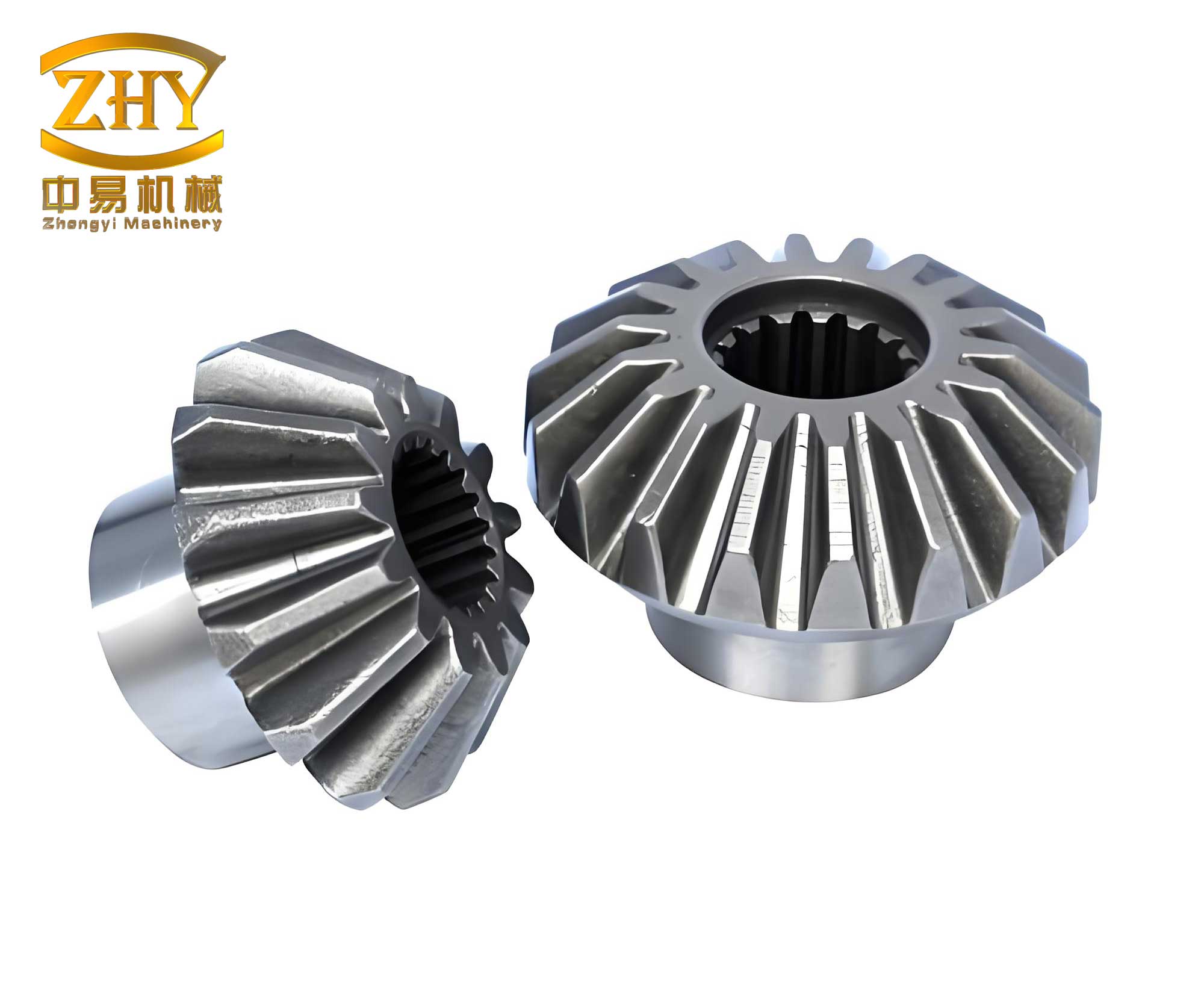
The dynamic and complex nature of oil splash within a gearbox, especially one containing bevel gears with intersecting axes, makes accurate modeling paramount. The MPS method, a Lagrangian meshless approach, is particularly suited for this task as it discretizes the fluid domain into particles, effortlessly handling fragmented flows and large free-surface deformations without the need for complex re-meshing. The governing equations for incompressible flow in the MPS framework are the continuity and Navier-Stokes equations:
$$
\frac{D\rho}{Dt} = 0
$$
$$
\frac{D\mathbf{u}}{Dt} = -\frac{1}{\rho} \nabla p + \nu \nabla^2 \mathbf{u} + \mathbf{g}
$$
where $\rho$ is fluid density, $t$ is time, $\mathbf{u}$ is velocity, $p$ is pressure, $\nu$ is kinematic viscosity, and $\mathbf{g}$ is gravitational acceleration.
Particle interactions are governed by a kernel function $w(r_{ij})$, which defines the influence radius $r_e$:
$$
w(r_{ij}) = \begin{cases}
\frac{r_e}{r_{ij}} – 1, & \text{if } r_{ij} < r_e \\
0, & \text{if } r_{ij} \ge r_e
\end{cases}
$$
The particle number density $n_i$ at particle $i$ is calculated as $n_i = \sum_{j \neq i} w(r_{ij})$, representing local fluid density. Spatial derivatives are approximated using Gradient and Laplacian models:
$$
\langle \nabla \phi \rangle_i = \frac{d}{n^0} \sum_{j \neq i} \left[ \frac{\phi_j – \phi_i}{|\mathbf{r}_j – \mathbf{r}_i|^2} (\mathbf{r}_j – \mathbf{r}_i) w(r_{ij}) \right]
$$
$$
\langle \nabla^2 \phi \rangle_i = \frac{2d}{\lambda n^0} \sum_{j \neq i} \left[ (\phi_j – \phi_i) w(r_{ij}) \right]
$$
where $\phi$ is a scalar quantity, $d$ is dimension, $n^0$ is initial particle density, and $\lambda$ is a coefficient.
A significant enhancement in this study is the integration of a thin-film flow model into the MPS boundary treatment. Standard no-slip wall boundaries in MPS prevent particle penetration but do not account for the formation and flow of lubricant films on surfaces. To predict this crucial aspect of lubrication, a two-dimensional thin-film approximation is applied at wall boundaries. By integrating the Navier-Stokes equations across the film thickness and assuming a parabolic velocity profile, the model describes the film’s evolution:
$$
\frac{\partial}{\partial t} (h \bar{\mathbf{u}}) + \nabla \cdot (h \bar{\mathbf{u}} \bar{\mathbf{u}}^T + \mathbf{C}) = -\frac{1}{\rho} h \nabla p – \frac{1}{\rho} \boldsymbol{\tau}_{disk} + \mathbf{S}_m
$$
$$
\frac{\partial h}{\partial t} + \nabla \cdot (h \bar{\mathbf{u}}) = Q_m
$$
where $h$ is film thickness, $\bar{\mathbf{u}}$ is depth-averaged velocity, $p$ is pressure (combining hydrostatic and surface tension $\sigma$), $\boldsymbol{\tau}_{disk}$ is wall shear stress, $\mathbf{C}$ is a correction tensor, and $\mathbf{S}_m$, $Q_m$ represent momentum and mass sources from impacting oil particles. This model allows us to compute the oil film thickness $h$ on both the gearbox housing and the bevel gears themselves.
The churning power loss is derived from the fluid forces acting on the gear teeth. The total resisting torque $T$ on a gear is computed by summing the pressure gradient force, viscous force, and turbulent shear force from all interacting oil particles. The total power loss $P_{loss}$ for the gearbox is then:
$$
P_{loss} = \sum_{i=1}^{n} \frac{T_i N_i}{9550}
$$
where $T_i$ and $N_i$ are the torque and rotational speed (in RPM) of the $i$-th gear, respectively.
The study focuses on a single-stage spiral bevel gearbox with a 90-degree shaft angle. The primary geometric parameters of the gear set are summarized below:
| Parameter | Input Pinion | Output Gear |
|---|---|---|
| Gear Type | Gleason | Gleason |
| Number of Teeth | 22 | 55 |
| Module (mm) | 9.2 | 9.2 |
| Face Width (mm) | 82 | 82 |
| Pressure Angle (°) | 20 | 20 |
| Spiral Angle (°) | 30 | 30 |
The gearbox housing geometry was simplified by removing non-essential features like small fillets and bolt holes, ensuring a closed domain for particle filling. The lubricant used is Emgard RW 75W-90 oil. Its properties vary with temperature $\theta$ (°C) as described by:
$$
\lg[\lg(\nu + 0.7)] = A – B \lg(\theta + 273.15)
$$
$$
\rho = 876 – 0.6 \theta
$$
where $\nu$ is the kinematic viscosity in mm²/s. Key properties at different temperatures are:
| Temperature $\theta$ (°C) | Density $\rho$ (kg/m³) | Kinematic Viscosity $\nu$ (mm²/s) |
|---|---|---|
| 40 | 852 | 116.0 |
| 60 | 840 | 50.2 |
| 80 | 828 | 25.9 |
| 100 | 816 | 16.6 |
For all subsequent simulations, the oil temperature was set to 80°C. A particle diameter of 2 mm was chosen to balance accuracy and computational cost. The simulation time was 3 seconds, with a linear acceleration phase from 0 to 1 second to avoid start-up transients. The time step $\Delta t$ was dynamically determined based on the CFL condition:
$$
\Delta t = \min \left( \Delta t_{init}, \frac{c l_0}{u_{max}}, \frac{1}{2} \frac{d_i l_0^2}{\nu + \nu_{max}} \right)
$$
To validate the enhanced MPS method, simulations were performed on a known spiral bevel gear test case and compared against experimental data for oil distribution and churning power loss. The MPS results showed excellent agreement in both oil splash patterns and quantitative power loss measurements, with errors less than 5%, confirming the method’s reliability for analyzing bevel gear lubrication.
We established multiple simulation cases to investigate the effects of input pinion speed and initial oil volume on lubrication performance. A baseline case with a pinion speed of 1200 RPM and 15L of oil was used. Furthermore, to address a potential design issue, an improved housing geometry was simulated. The improved design eliminates a protruding boss near the output bevel gear, increasing the clearance to facilitate oil splash. The case matrix is as follows:
| Case Group | Pinion Speed $n_d$ (RPM) | Initial Oil Volume $V_0$ (L) | Housing Geometry | Purpose |
|---|---|---|---|---|
| Speed Effect | 600 | 15 | Original | Analyze speed sensitivity |
| 1200 | 15 | |||
| 1800 | 15 | |||
| 2400 | 15 | |||
| 3000 | 15 | |||
| Oil Volume Effect | 1200 | 12 | Analyze oil level sensitivity | |
| 18 | ||||
| 21 | ||||
| 24 | ||||
| Structural Improvement | 600 | 15 | Improved | Evaluate design change |
| 3000 | 15 |
The transient analysis of the baseline case reveals the evolution of the lubrication state. Initially, only the output bevel gear is partially immersed. As it rotates, it scoops and throws oil. After several revolutions, a dynamic equilibrium is reached. The thin-film model allows us to quantify the lubrication condition on all surfaces. The inner walls of the housing achieve a high oil coverage ratio ($\eta$) and a relatively thick average film ($\delta$), primarily due to the splash effect. The surfaces of the bevel gears show a thinner but more uniform film, resulting from a combination of direct splash and oil carried by the gear’s own motion into the meshing zone.
The input pinion speed profoundly impacts the flow field and power loss. Higher speeds increase the kinetic energy of the oil particles, leading to more vigorous splashing. This is quantitatively shown in the following results for housing wall film thickness and power loss:
| Pinion Speed $n_d$ (RPM) | Avg. Housing Film Thickness $\delta_{wall}$ (mm) | Churning Torque, Input $T_d$ (Nm) | Churning Torque, Output $T_s$ (Nm) | Total Power Loss $P_{loss}$ (W) |
|---|---|---|---|---|
| 600 | 0.25 | 0.056 | 0.889 | 25.86 |
| 1200 | 0.34 | 0.193 | 1.229 | 86.07 |
| 1800 | 0.39 | 0.347 | 1.556 | 182.64 |
| 2400 | 0.44 | 0.404 | 11.566 | 1264.25 |
| 3000 | 0.51 | 0.811 | 47.782 | 6258.77 |
The data indicates a positive correlation between speed, wall film thickness, and power loss. The relationship between power loss and speed is highly non-linear, approximately following a power law $P_{loss} \propto n_d^{\alpha}$ where $\alpha$ increases at higher speeds. This super-linear rise is due to the output bevel gear experiencing significantly greater fluid drag as it approaches and exceeds a critical rotational threshold, dramatically increasing its contribution to the total loss.
Varying the initial oil volume alters the immersion depth of the output bevel gear. A higher oil level means more oil is available to be picked up and splashed, but also increases the submerged frontal area of the gear, affecting drag.
| Initial Oil Volume $V_0$ (L) | Avg. Housing Film Thickness $\delta_{wall}$ (mm) | Churning Torque, Input $T_d$ (Nm) | Churning Torque, Output $T_s$ (Nm) | Total Power Loss $P_{loss}$ (W) |
|---|---|---|---|---|
| 12 | 0.17 | 0.058 | 0.642 | 39.57 |
| 15 | 0.34 | 0.193 | 1.229 | 86.07 |
| 18 | 0.45 | 0.323 | 1.761 | 129.10 |
| 21 | 0.52 | 0.453 | 2.499 | 182.48 |
| 24 | 0.59 | 0.672 | 3.434 | 257.08 |
The results show that increasing oil volume effectively improves wall surface lubrication by providing more material for film formation. However, this comes at the cost of increased power loss. The contribution of the input pinion to the total loss grows with oil volume because more oil reaches the meshing zone, increasing its windage and churning effects.
Analysis of the original design revealed that a boss on the housing, located close to the periphery of the output bevel gear, acted as a barrier. It disrupted the oil splash path, causing local oil accumulation and creating a break in the oil film continuity on the upper housing wall, impairing heat transfer. The improved design removes this boss, increasing the clearance. The comparative results are significant:
| Case (Pinion Speed) | Housing Geometry | Oil Coverage $\eta$ (%) | Avg. Film $\delta_{wall}$ (mm) | Total Power Loss $P_{loss}$ (W) | Loss Reduction |
|---|---|---|---|---|---|
| 600 RPM, 15L | Original | 48.22 | 0.246 | 25.86 | – |
| 600 RPM, 15L | Improved | 53.49 | 0.287 | 19.33 | 25.3% |
| 3000 RPM, 15L | Original | 90.80 | 0.507 | 6258.77 | – |
| 3000 RPM, 15L | Improved | 92.79 | 0.717 | 5476.91 | 12.5% |
The structural improvement yields multiple benefits. First, it enhances oil splash, leading to higher and more continuous oil film coverage on the housing walls, which improves convective heat dissipation. Second, by allowing oil to flow more freely rather than being obstructed and churned turbulently near the boss, it reduces the overall churning power loss. This reduction is more pronounced at lower speeds but remains substantial at the maximum operating speed.
In conclusion, this study successfully applies an enhanced MPS method with an integrated thin-film model to analyze the splash lubrication characteristics of a high-speed train spiral bevel gearbox. The method provides high-fidelity insights into transient oil distribution, film formation, and power loss. Key findings are: 1) Housing wall lubrication is dominantly governed by splash intensity, which increases with both pinion speed and initial oil volume. 2) Gear surface films are thinner and influenced by both splash and gear motion. 3) Churning power loss exhibits a strong positive correlation with speed and oil volume, with a highly non-linear sensitivity to high rotational speeds of the bevel gears. 4) A seemingly minor structural modification—removing an obstructive boss near the output bevel gear—can simultaneously improve oil film continuity for better cooling and reduce parasitic churning losses, representing a valuable design optimization for efficiency and reliability.