
In the demanding environment of underground coal mining, the scraper conveyor stands as the critical artery for raw coal transport. Its operational reliability is paramount, dictated largely by the health of its drive system—comprising the motor, couplings, and crucially, the gear reducer. As the core of this system, the reducer faces unique constraints: a severely limited installation footprint and a cantilevered mounting configuration. These demands necessitate an exceptionally compact and robust housing design. With the continuous trend towards larger, more powerful mining equipment, where planetary reducers are now paired with motors exceeding 3,000 kW, a significant shift in housing design has emerged. The traditional split-type housing is increasingly being superseded by a stronger, more integrated monobloc casting.
Monobloc housings offer compelling advantages: superior structural integrity, enhanced longevity, and reduced failure rates. However, this unitary design introduces profound challenges during assembly, particularly for the critical bevel gear stage responsible for converting the axis of rotation. In split-type designs, the upper housing can be removed, allowing direct access for installing and shimming the input and intermediate (second) shafts to achieve the perfect bevel gear contact pattern. This established adjustment methodology fails completely with a monobloc structure, where both shafts must be inserted laterally into a single, unopenable cavity. Our research and development efforts were therefore directed at re-engineering the shaft mounting architecture and inventing a novel, practical procedure for bevel gear contact pattern adjustment from outside the sealed housing.
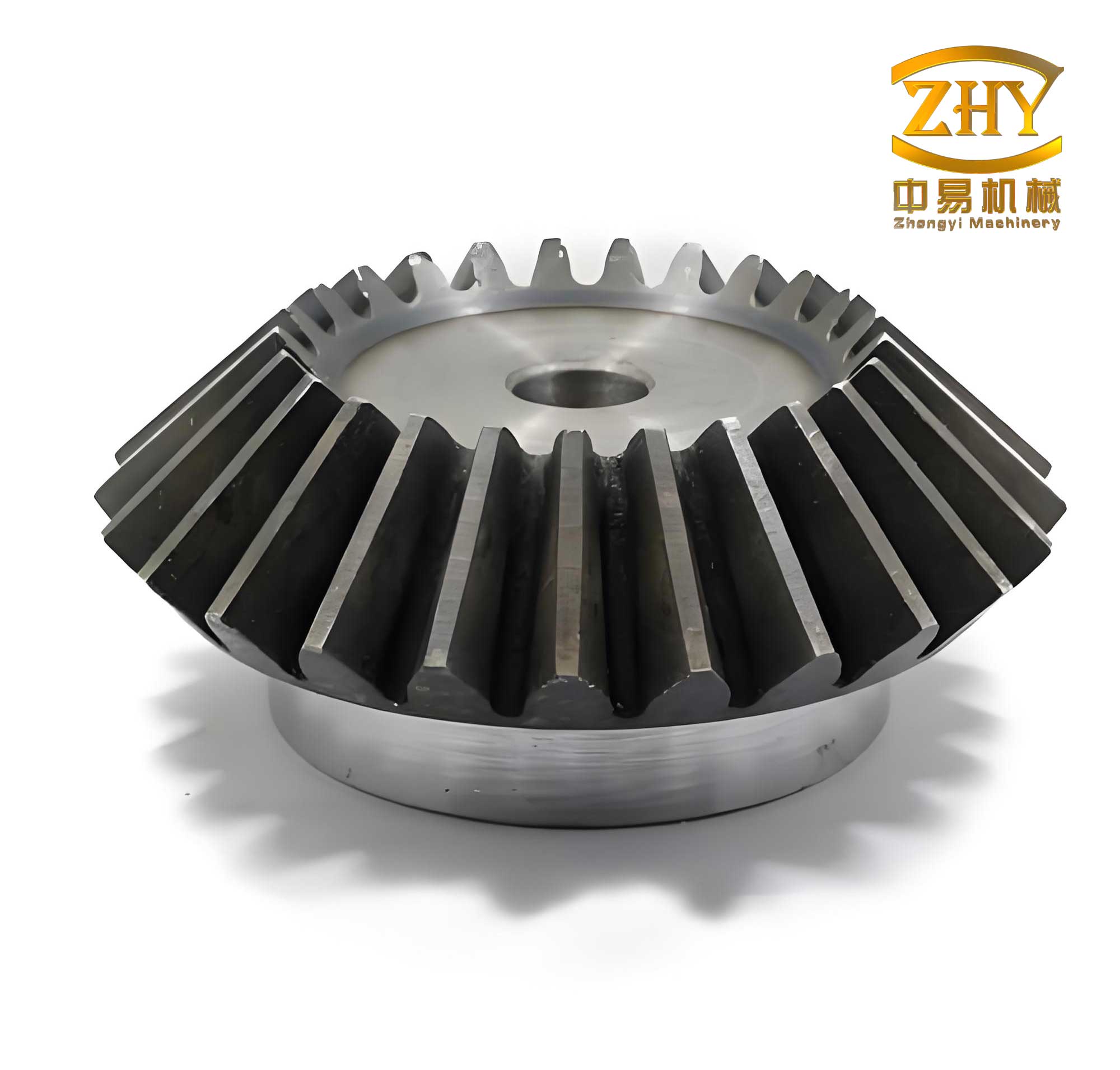
Re-engineering Shaft Mounting for Monobloc Assembly
The fundamental limitation of the monobloc housing is the lack of axial adjustability for the pre-installed bearing seats. In a split housing, shims are placed between the bearing outer rings and the housing bore’s shoulder. To replicate this adjustability in a one-piece housing, we relocated the axial adjustment and locking mechanism to the exterior. The core innovation is the implementation of flanged bearing cups for both the input shaft and the second shaft.
The input shaft, equipped with its tapered roller bearing and four-point contact ball bearing, is assembled as a cartridge unit. This cartridge is inserted axially into the housing’s machined bore. Crucially, the outer ring of the primary locating bearing is housed within a separate, flanged bearing cup. This cup’s flange sits outside the housing face. The gap between this flange and the housing face becomes the adjustment variable, $$ \delta_{input} $$.
The second shaft presented a more complex challenge due to its integration with the reducer’s side plate (which houses the planetary stage). Our solution was to create a modular sub-assembly: the second shaft, its bevel gear, and its paired bearings (typically a spherical roller bearing and a four-point contact ball bearing) are pre-assembled onto the side plate. This entire module is then installed laterally into the main housing. Similar to the input shaft, the locating bearing for the second shaft is housed in a flanged bearing cup, whose flange mates against the side plate. The adjustment gap here is denoted as $$ \delta_{second} $$.
This architecture transforms the problem. Instead of trying to shim inside an inaccessible housing, we now adjust the axial position of the entire shaft cartridge by controlling the thickness of a shim pack ($$ S_{input} $$, $$ S_{second} $$) placed in these external gaps. The flanges are then securely bolted down, locking the shafts in their precisely adjusted positions. The following table summarizes the key differences in the adjustment approach:
| Feature | Traditional Split Housing | Novel Monobloc Housing Design |
|---|---|---|
| Assembly Access | Direct vertical access after removing upper housing. | Lateral insertion of complete shaft cartridges. |
| Bearing Axial Location | Internal shimming between bearing outer ring and housing shoulder. | External shimming at flanged bearing cup. |
| Shaft Adjustment | Individual shaft adjustment possible during assembly. | Each shaft cartridge moves axially as a unit via its cup. |
| Contact Pattern Check | Direct visual access after partial assembly. | Via dedicated inspection port on housing. |
| Final Locking | Achieved by bolting the upper housing. | Achieved by bolting the external bearing cup flanges. |
Mathematical Modeling and the Adjustment Algorithm
The precise adjustment of the bevel gear contact pattern is a deterministic process governed by gear geometry and axial displacement. The primary goal is to position the pinion (on the input shaft) and the ring gear (on the second shaft) axially so their pitch cones are tangent, ensuring the contact ellipse is centered on the tooth flank with optimal size and shape.
The theoretical axial position for each gear is defined by its mounting distance ($$ MD $$) from a reference datum. In practice, deviations ($$ \Delta I $$ for pinion, $$ \Delta II $$ for ring gear) are introduced and must be corrected. The relationship between axial shaft displacement ($$ \Delta L $$) and the resulting shift in contact pattern is central to the adjustment.
For a Gleason-type spiral bevel gear pair, the sensitivity of the contact pattern to axial changes can be characterized. A simplified model for the shift of the contact ellipse center, $$ \Delta C $$, on the tooth face can be expressed as a function of the axial displacements:
$$ \Delta C_{pinion} = K_p \cdot \Delta L_{input} $$
$$ \Delta C_{ring} = K_r \cdot \Delta L_{second} $$
where $$ K_p $$ and $$ K_r $$ are sensitivity coefficients derived from the gear’s pitch and spiral angles. The total pattern shift is the vector sum of these effects. The objective of adjustment is to find the pair ($$ \Delta L_{input}, \Delta L_{second} $$) that minimizes the deviation of $$ \Delta C_{total} $$ from the ideal center, while also ensuring the contact ellipse’s major axis ($$ a $$) and minor axis ($$ b $$) meet specified length criteria, typically 60-80% and 40-60% of the face width, respectively. The ellipse can be conceptually modeled relative to the tooth centerline:
$$ \frac{(x – h)^2}{a^2} + \frac{(y – k)^2}{b^2} = 1 $$
where (h, k) represents the actual center coordinates that we control via axial adjustment.
The adjustment process is an iterative, measurement-driven algorithm. The axial play available for each bearing cup before shimming is the measured gap, $$ \delta $$. The required shim pack thickness, $$ S $$, is calculated based on the desired axial displacement $$ \Delta L $$ and the initial measured position. The fundamental equation governing the final assembly is:
$$ S = \delta – \Delta L_{required} $$
A negative $$ \Delta L_{required} $$ (moving the gear into the housing) requires a thicker shim, while a positive displacement requires a thinner one. The process flow, integrating measurement and calculation, is detailed below.
| Step | Action | Measurement/Calculation | Purpose |
|---|---|---|---|
| 1 | Initial Assembly | Insert shaft cartridges without shims. Hand-tighten cup flanges. | Establish a movable starting point for both bevel gears. |
| 2 | Pattern Check | Apply marking compound, rotate gears, inspect pattern through housing port. | Qualitative assessment of pattern location (heel/toe, flank top/bottom). |
| 3 | Initial Gap Measurement | Measure gaps $$ \delta_{input}^0 $$ and $$ \delta_{second}^0 $$ with feeler gauges or depth micrometer. | Quantify the initial axial freedom for each shaft. |
| 4 | Trial Adjustment & Measurement | Use temporary shims or jacking screws to move shafts. Re-measure gaps ($$ \delta_{input}^i, \delta_{second}^i $$) after each move. | Relate axial displacement $$ \Delta L = \delta^0 – \delta^i $$ to observed pattern change. |
| 5 | Final Shim Calculation | Once optimal pattern is achieved, calculate final shim thickness: $$ S_{final} = \delta^{optimal} $$. | Determine the precise shim pack that will lock the gears in the perfect position. |
| 6 | Permanent Assembly | Manufacture shims to calculated thickness. Install shims, apply threadlocker, and torque flange bolts to specification. | Permanently secure the accurately adjusted bevel gear alignment. |
Critical Engineering Considerations and Validation
The success of this external adjustment system hinges on several engineering factors beyond the basic algorithm. First, the design of the bearing cup and its interface with the housing must ensure that axial forces from the bevel gear mesh are transmitted directly through the cup’s flange to the housing bolts, without inducing tilt or misalignment. Finite Element Analysis (FEA) is essential to verify that the cup and housing face deformations under load are within acceptable limits to maintain bevel gear alignment.
Second, the repeatability and accuracy of the initial gap measurement ($$ \delta $$) are critical. We developed a proprietary tooling set that engages with machined datums on the housing and bearing cup flange to provide a direct, high-precision reading of the gap, eliminating errors from manual feeler gauge use. The relationship between measured gap and true axial position is calibrated as:
$$ L_{true} = L_{datum} + \delta_{measured} + C_{tool} $$
where $$ C_{tool} $$ is a known, constant calibration offset for the measurement tool.
Third, thermal effects cannot be ignored. Mining reducers operate under significant thermal loads. The differential expansion between the steel shafts, bearings, and the housing (often ductile iron) must be analyzed. The designed axial preload on the bearings and the final bevel gear backlash must account for the system’s stabilized operating temperature. The target shim thickness may include a thermal compensation factor $$ \beta $$:
$$ S_{operational} = S_{ambient} + \beta \cdot \Delta T $$
where $$ \Delta T $$ is the expected temperature rise from ambient to operating condition.
Fourth, lubrication and sealing of the new external interface are paramount. A static O-ring seal is incorporated between the bearing cup flange and the housing face. The bolt holes are carefully designed with counterbores and sealing plugs to prevent any oil leakage path along the threads.
The validation of this technology has been conducted through both laboratory rig tests and field deployments. Reducers up to 3,000 kW employing this monobloc housing and external adjustment system have been integrated into longwall scraper conveyors. Performance monitoring over thousands of operational hours shows a consistent and optimal bevel gear contact pattern, with no incidence of pattern degradation or thermal runaway associated with misalignment. Vibration spectrum analysis confirms reduced mesh frequency harmonics compared to earlier designs where adjustment was less precise.
| Metric | Legacy Split Housing Design | New Monobloc with External Adjustment | Improvement / Note |
|---|---|---|---|
| Housing Static Stiffness | Baseline | +35% to +50% | From FEA and strain gauge tests; reduces gear misalignment under load. |
| Bevel Gear Contact Pattern Consistency | Subject to assembly variation | Controlled, repeatable process | Quantified by consistent pattern dimensions across multiple units. |
| Assembly Time (Bevel Stage) | Baseline (Reference Time T) | ~1.2T to 1.5T | Initial assembly is slower due to iterative adjustment, but more reliable. |
| Field Failure Rate (Bevel Related) | Baseline | Reduced by ~60% | Based on 24-month field data from comparable duty cycles. |
| Oil Leakage Risk at Midsection | Present (split-line seal) | Eliminated | Monobloc design removes the primary leakage path. |
Conclusion and Future Directions
The development of an external flanged-bearing-cup adjustment system has successfully resolved the fundamental paradox of the high-strength monobloc reducer housing: how to achieve the precise, micron-level bevel gear alignment required for reliable high-power transmission within a sealed, un-splittable structure. By re-imagining the axial location mechanism and moving the adjustment interface to the housing exterior, we have created a practical, repeatable, and robust methodology.
This innovation directly supports the mining industry’s push towards larger, more powerful, and more reliable equipment. The enhanced structural stiffness of the monobloc housing, combined with a verifiably optimal bevel gear mesh, leads to higher power density, improved efficiency, and significantly extended service life for planetary reducers in scraper conveyor and crusher applications. The elimination of the split line also enhances sealing integrity, a critical factor in the harsh, contaminant-prone mining environment.
Future research is directed towards further automating and digitizing this adjustment process. Concepts include integrating micro-actuators into the bearing cup flange for in-situ digital adjustment, and using intra-housing optical sensors linked through the inspection port to provide real-time feedback on the contact pattern during adjustment, potentially converging on the optimal alignment via a closed-loop control algorithm. This would transform the procedure from a skilled manual craft into a precise, automated, and data-verified assembly step, setting a new standard for quality and performance in heavy-duty bevel gear transmission systems.