
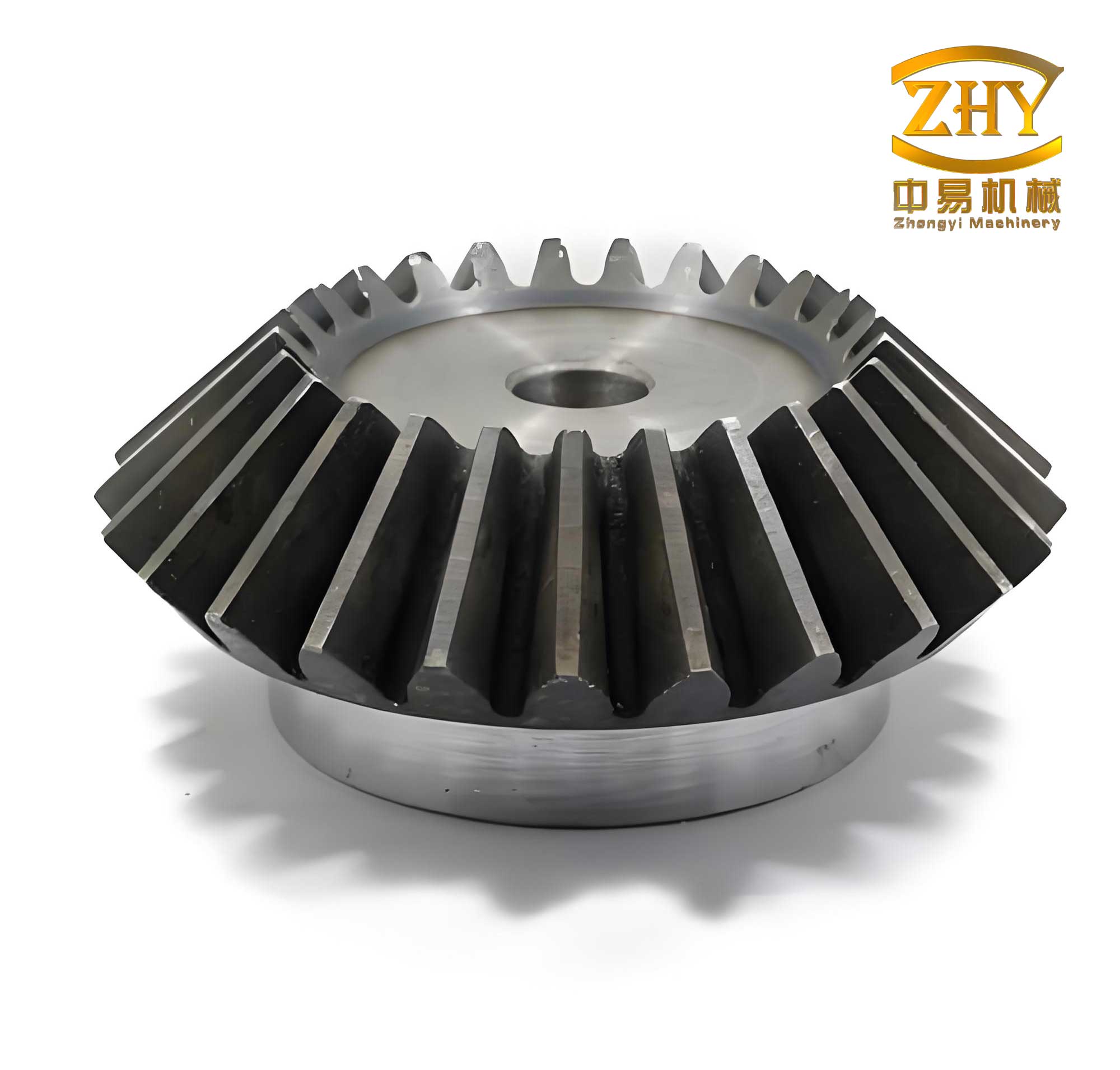
In the field of mechanical power transmission, bevel gears play a critical role in changing the axis of rotation between intersecting shafts. The precise and reliable operation of a bevel gear pair is fundamentally dependent on the housing that supports them. This housing must maintain strict alignment and positional tolerances for the gear shafts to ensure efficient power transfer and minimize wear. This article presents a comprehensive, first-person analysis of the machining process for a specific bevel gear housing, a classic example of a cross-bored component. The housing is designed to mate with two bevel gears, making its dimensional and geometrical accuracy paramount.
The primary challenge in machining this housing stems from its intersecting bore structure. Two key internal bores, which will host the shafts for the bevel gears, must not only be machined to precise diameters but also maintain an exact spatial relationship. Their centerlines must intersect within a single plane with minimal deviation. Any error in this relationship directly translates to misalignment of the bevel gears, leading to increased noise, vibration, premature wear, and potential failure. A secondary challenge involves the measurement of certain internal “space dimensions,” where direct tool access is obstructed by the housing’s geometry. The core objective of this process analysis is to devise a machining strategy that overcomes these challenges, ensuring the housing meets all specified tolerances to guarantee the optimal performance of the final bevel gear assembly.
Part Analysis and Technical Requirements
The housing is a compact, box-like casting with two primary sets of functional surfaces centered on perpendicular bores. The main bore, designated here as Bore A (Φ90mm), and the perpendicular Bore B (Φ52mm) constitute the critical features. The key technical specifications driving the process design are:
- The centerline of Bore B must be perpendicular to the centerline of Bore A with a tight tolerance, e.g., 0.012 mm.
- The distance from the face of Bore B to the centerline of Bore A is a critical dimension (e.g., 119mm).
- Both bores require fine surface finishes and precise diameters to ensure proper bearing and shaft fit.
- Various threaded holes (M3, M5, M6, M8) are required for fastening covers and other components.
The relationship between the bores can be defined geometrically. If we define the centerline of Bore A as the Z-axis, the ideal centerline of Bore B lies in the X-Y plane. The perpendicularity error ($\Delta \theta$) and the positional offset ($\Delta d$) of the Bore B centerline from its nominal intersection point with the Z-axis must be minimized. This is mathematically crucial for the correct meshing of the bevel gears, where the pitch cone apexes of both gears must coincide. Any deviation $\Delta d$ causes incorrect backlash and contact patterns.
$$ \text{Misalignment Error} = \sqrt{(\Delta d_x)^2 + (\Delta d_y)^2} $$
$$ \text{Effective Perpendicularity Error} = \Delta \theta $$
Material Selection and Initial Processing
The selected material for this bevel gear housing is gray cast iron, specifically grade HT200. This choice is justified by its excellent castability, good machinability, superior damping capacity (which absorbs vibrations from the bevel gears), and adequate strength for this application. After casting, the part undergoes a stress relief annealing process. This is a critical step to eliminate internal stresses induced during solidification, which could otherwise cause distortion during subsequent machining, irrevocably damaging the precise alignment required for the bevel gears. The stabilization of the casting prior to any significant metal removal is non-negotiable.
The as-cast dimensions include machining allowances. Based on standard casting tolerance grades (e.g., IT10) and machining allowance grades (e.g., G), the blank dimensions are calculated. For instance:
| Feature | Part Dimension (mm) | Total Machining Allowance (mm) | Blank Dimension (mm) |
|---|---|---|---|
| Overall Height | 164 | 6 | 170 |
| Bore B Face Location | 119 | 6 | 125 |
| Bore B Diameter | Φ52 | 6 | Φ46 (cored) |
| Large Recess Diameter | Φ73 | 3 | Φ70 (cored) |
Fundamentals of Process Planning
The overarching philosophy for machining this component follows established principles to ensure accuracy and efficiency:
- First Datum, Then Others: Machine the primary datums early to establish a reliable reference for all subsequent operations.
- Rough Before Finish: Separate material removal into stages (roughing, semi-finishing, finishing, fine-finishing) to progressively achieve accuracy and manage stress.
- Primary Before Secondary: Machine critical features (the main bores for the bevel gears) before less critical ones (threaded holes).
- Face Before Hole: Machine flat surfaces to create stable, perpendicular datums before drilling or boring holes related to them.
The selection of datums is the cornerstone of the plan. The finished centerlines of Bore A and Bore B themselves are the ultimate design datums. Therefore, the process aims to establish these as the process datums as soon as possible. The initial roughing operations use the largest, most stable unmachined surfaces (e.g., the bottom face and one side) as rough datums to remove bulk material and create preliminary reference faces. The goal of initial operations is to quickly generate the semi-finished surfaces that will become the precision datums for the final machining of the critical bores.
A critical decision is the sequence for machining the cross-bores. Two common strategies exist:
1. Machine Bore A completely (finish diameter, face, and related features), then use it to locate and machine Bore B.
2. Machine both bores to a semi-finished state, then perform a final simultaneous or sequential finishing operation using a precision setup that references both.
For this housing, the first strategy is often more practical. Once Bore A is finished, a precision mandrel or plug can be inserted, and the entire part can be rotated 90 degrees in a fixture to machine Bore B, directly establishing its relationship to Bore A’s axis.
| Strategy | Advantage | Potential Challenge |
|---|---|---|
| Finish Bore A First | Simple fixture design, clear process flow, easy to measure relationship from Bore B to finished Bore A. | Requires extremely accurate 90-degree fixture to maintain perpendicularity. |
| Simultaneous Finishing | Potentially higher accuracy as both relationships are finalized in one setup. | Very complex fixture and machine tool requirements (e.g., a multi-axis machining center). |
Detailed Process Route Design
Based on the analysis, the following step-by-step process route is developed. The sequence rigorously applies the principles outlined above.
| Op. No. | Operation Description | Key Objectives & Equipment | Principle Applied |
|---|---|---|---|
| 010 | Cast the housing blank in HT200. | Create near-net shape. | – |
| 020 | Stress Relief Annealing (Artificial Aging). | Stabilize material, relieve internal stresses. Furnace. | – |
| 030 | Rough machine bottom face, internal features of Bore A side (large recess Φ73, Bore A Φ90, counterbore Φ120). | Establish first machined reference face and begin clearing major internal volumes. Lathe with internal tooling, face mill, rough boring bars. | Rough Before Finish, Face Before Hole. |
| 040 | Rough machine top face, outer cylindrical surface (Φ100), and the opposite internal face (Φ80). | Complete rough machining of main volumes and establish parallel faces. Lathe, external turning tool. | Rough Before Finish. |
| 050 | Semi-finish bore Bore A (Φ90) to close to final size. Machine internal groove. | Prepare Bore A as a primary precision datum. Finish boring tool, groove tool. | Primary Before Secondary. |
| 060 | Semi-finish turn the outer diameter (Φ100). Machine external groove. | Complete primary external profile. External turning tool. | – |
| 070 | Rough mill the face where Bore B will be located. | Create a flat, perpendicular datum face for Bore B machining. Vertical milling machine, face mill. | Face Before Hole, First Datum. |
| 080 | Drill, Bore, and Finish Bore B (Φ52). This is a critical step. The part is fixtured using the finished Bore A as the primary datum. A precision plug in Bore A ensures the part’s orientation. The sequence is: Center Drill, Drill, Bore (or Core Drill), Semi-finish Bore, Finish Bore/Hone. | Achieve final diameter, surface finish, and most importantly, correct perpendicularity and intersection point with Bore A’s axis. Precision boring head on milling machine or lathe, fixture with 90° locating face. | First Datum, Primary Before Secondary, Finish. |
| 090-120 | Drill and tap all threaded holes (M3, M5, M6, M8). | Add secondary fastening features. Drill press or machining center, tap holders. | Primary Before Secondary. |
| 130 | Deburr all sharp edges. | Improve safety and finish. | – |
| 140-160 | Fine-finishing operations: Grind Bore A (ID), grind outer diameter, grind Bore B (ID). | Achieve final dimensional accuracy (IT7 or better) and superior surface finish (Ra 0.8 μm or better) for bearing seats and shaft fits. This ensures minimal runout and perfect alignment for the bevel gear shafts. Internal/External Grinder. | Rough Before Finish (Final Stage). |
| 170 | Final Inspection: Measure all critical dimensions, perpendicularity of bores, and surface finishes. Use CMM for geometric verification. | Verify part conforms to all specifications for bevel gear mounting. | – |
Analysis of Critical Operations and Quality Assurance
Operation 080: Machining the Perpendicular Bore. This is the most technically demanding operation. The fixture must locate off the finished Bore A and its adjacent face. The perpendicularity error ($\Delta \theta$) is directly controlled by the accuracy of the fixture’s 90-degree locating surface. The positional accuracy of the bore intersection is controlled by the fixture’s linear locators. The total potential error ($E_{total}$) in the Bore B axis location can be modeled as a combination of fixture error ($E_{fixture}$), machine tool geometric error ($E_{machine}$), and tool deflection/thermal error ($E_{process}$).
$$ E_{total} = \sqrt{(E_{fixture})^2 + (E_{machine})^2 + (E_{process})^2} $$
To minimize $E_{process}$, a rigid boring bar with a small overhang is used, and cutting parameters are optimized. The final boring pass takes a minimal cut to reduce forces. The use of a boring head allows for fine diameter adjustment via a micrometer, addressing the “space dimension” measurement challenge indirectly by controlling the tool path precisely.
Grinding Operations (140-160): Grinding is selected as the final operation for the bore and shaft surfaces because it provides the highest level of dimensional and geometric accuracy. It also compensates for any minor distortions that may have occurred during earlier machining or heat treatment. The grinding process for Bore B must also be carefully fixtured to maintain the established relationship with Bore A. The final quality of these ground surfaces is what ultimately ensures the smooth rotation and long life of the shafts carrying the bevel gears.
Metrology and Inspection: Verifying the key parameters requires specialized tools. While bore diameters can be checked with internal micrometers or air gauges, verifying the perpendicularity and intersection of the centerlines typically requires a Coordinate Measuring Machine (CMM). The CMM can probe both bores and mathematically construct their centerlines, reporting the actual angle between them and the minimum distance between the two lines (which should be zero at the intersection point). For the distance from the Bore B face to Bore A’s centerline, a height gauge with a indicator can be used, referencing from a precision pin placed in Bore A.
Conclusion
The successful machining of a bevel gear housing is a systematic exercise in precision process planning. The challenges posed by intersecting bores and spatial dimensions are overcome not by a single operation, but by a logically sequenced strategy built on fundamental machining principles. The sequence begins with stress-relieving the casting, establishing rough datums, and progressively creating more precise reference features. The crux of the process is the careful fixturing and machining of the second bore relative to the first, finished bore. Final grinding operations then deliver the superior finish and tolerance required for the dynamic loading of a bevel gear set. Every step, from material selection to final inspection, is dictated by the uncompromising need to provide a perfectly aligned and stable foundation for the bevel gears, ensuring efficient power transmission and operational reliability in the final assembly. This analysis underscores that the performance of precision components like bevel gears is inextricably linked to the meticulous planning and execution of their supporting structures’ manufacturing processes.