
In the development of modern tunneling equipment, such as driving-anchor integrative machines, the cutting reducer plays a critical role in ensuring efficient power transmission under harsh operating conditions. As a design engineer, I have focused on addressing the challenges of compact size, high power transmission, and reliability in these reducers. This paper presents my detailed approach to designing a double excitation bevel gear pair for the cutting reducer, which enables power confluence and directional change at the high-speed stage using two motors. The use of bevel gears is central to this design, as they offer superior performance in transmitting torque between intersecting shafts. Throughout this discussion, I will emphasize the importance of bevel gears in achieving the desired mechanical properties and operational stability.
The driving-anchor integrative machine integrates functions like excavation, support, transportation, and crawler movement into a single unit, requiring advanced technologies for optimal performance. Historically, such equipment relied on imports, but recent developments, such as the EJM340/4-2 model, have demonstrated local innovation. In this context, my design incorporates a double excitation bevel gear pair to handle high power inputs from two motors, each rated at 170 kW and 1,465 rpm. This configuration not only reduces volume but also enhances efficiency and durability. The bevel gears used here are specifically engineered to withstand impacts and heavy loads, common in mining environments. Below, I will elaborate on the structural aspects, parameter selection, computational validations, and practical outcomes of this design.
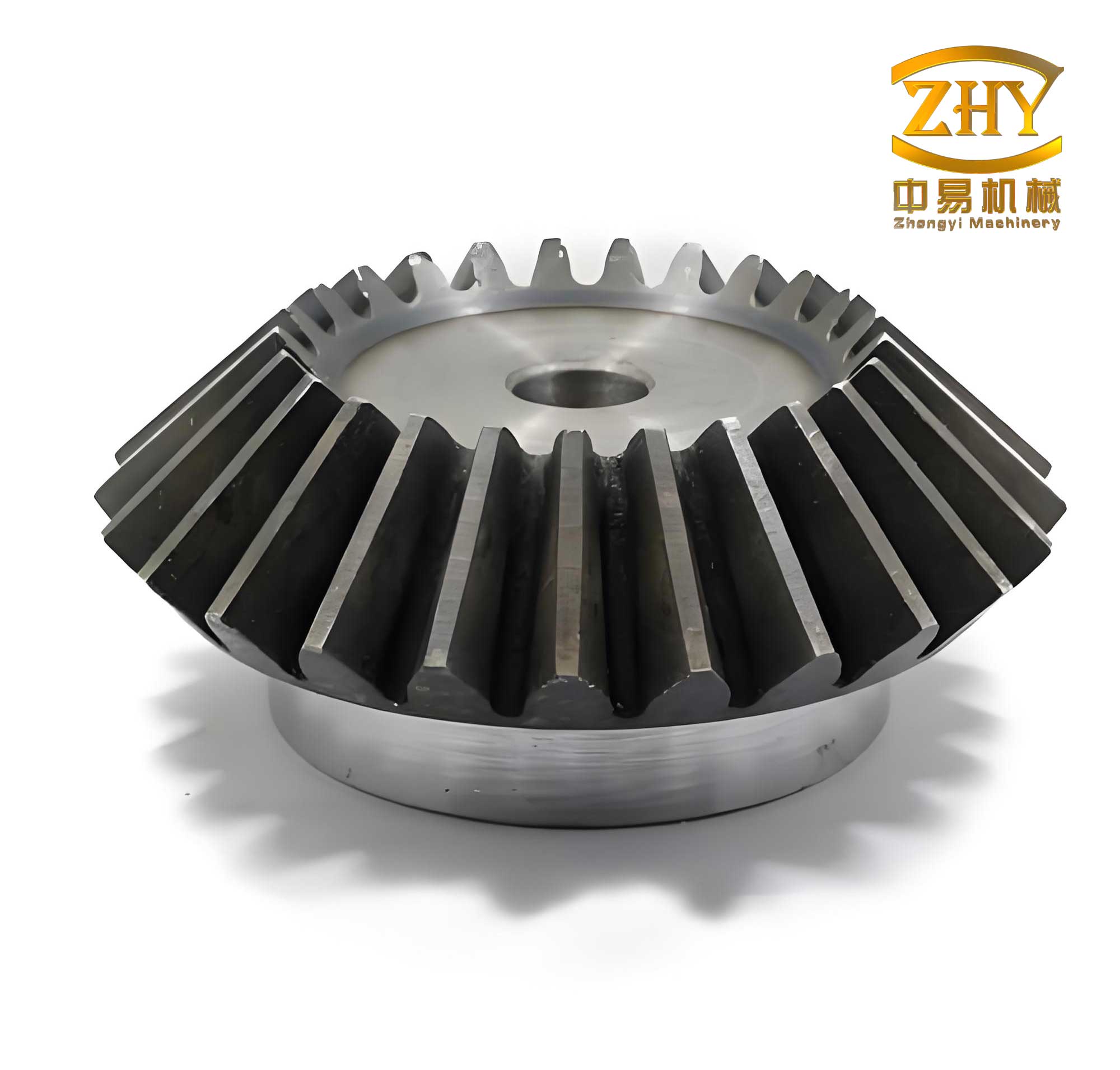
The double excitation bevel gear pair consists of two driving bevel gears and one driven bevel gear, arranged to merge power from two synchronous sources. From my perspective, this setup is innovative because it leverages the inherent advantages of bevel gears for torque transmission and directional change. The structural configuration involves cantilevered support for the driving bevel gears, with back-to-back bearing arrangements, while the driven bevel gear uses两端支撑 with face-to-face bearings. This arrangement minimizes deflections and ensures precise alignment, which is crucial for the longevity of bevel gears. The fundamental principle relies on synchronous excitation from two AC motors, which inherently balance power and avoid drag losses. In practice, any asynchrony could lead to one motor driving the other, negating power confluence. Thus, the design of bevel gears must account for dynamic synchronization, and AC drives are ideal due to their self-adaptive characteristics. I have integrated flexible coupling techniques to mitigate startup shocks, further protecting the bevel gears from premature wear.
When selecting parameters for the bevel gears, I considered various factors such as tooth profile, material, and support mechanisms. Bevel gears come in types like straight, spiral, and curved teeth, each with distinct properties. For this application, I opted for spiral bevel gears with a Klingelnberg tooth system, as they provide high power transmission capacity, smooth operation, and reduced noise. These bevel gears are particularly suited for high-speed, heavy-duty scenarios common in tunneling. To elaborate, I compared different tooth profiles in Table 1, highlighting why spiral bevel gears were chosen.
| Tooth Profile Type | Advantages | Disadvantages | Suitability for Cutting Reducer |
|---|---|---|---|
| Straight Bevel Gears | Low axial force, easy manufacturing | Limited hard-face finishing, poor for high-speed | Low |
| Spiral Bevel Gears | High power transmission, smooth operation, low noise | Complex manufacturing, higher axial force | High |
| Curved Bevel Gears | Good for large modules, moderate performance | Less common in non-standard gearboxes | Medium |
The material selection for bevel gears is critical to ensure strength and toughness. I evaluated high-performance materials like 17CrNiMo6, 18Cr2Ni4WA, and 20Cr2Ni4A, ultimately standardizing on 17CrNiMo6 due to its成熟工艺 and stability. However, alternatives are permissible if manufacturers master the热处理工艺. The bevel gears undergo carburizing and quenching, followed by grinding to achieve a精度等级 of 6, which enhances surface durability while maintaining core韧性. This process is essential for bevel gears operating in abrasive environments.
For轴及轴支撑, I designed integrated shaft-gears for both driving and driven bevel gears to improve rigidity and alignment. The support uses tapered roller bearings to handle combined radial and axial loads, which are inherent in bevel gear transmissions. The axial forces in bevel gears can be significant, and I optimized the midpoint spiral angle to reduce these forces. Specifically, for the driven bevel gear, I set the spiral angle βm to 20° to minimize axial load, as derived from force calculations. The forces on bevel gears are given by:
$$ F_{t1} = \frac{2000 T_1}{d_{m1}} $$
$$ F_{n2} = F_{r1} = \frac{F_t}{\cos \beta_m} (\tan \alpha \cos \delta – \sin \beta_m \sin \delta) $$
$$ F_{r2} = F_{n1} = \frac{F_t}{\cos \beta_m} (\tan \alpha \sin \delta + \sin \beta_m \cos \delta) $$
where \( F_{t1} \) is the tangential force, \( F_{r1} \) and \( F_{r2} \) are radial forces, \( F_{n1} \) and \( F_{n2} \) are axial forces, \( T_1 \) is input torque, \( d_{m1} \) is the midpoint pitch diameter, \( \alpha \) is pressure angle, \( \delta \) is pitch cone angle, and \( \beta_m \) is spiral angle. For the EJM340/4-2 design, with \( T_1 = 1108 \, \text{N·m} \), \( d_{m1} = 150.3 \, \text{mm} \), \( \alpha = 20^\circ \), and \( \delta = 45^\circ \), the axial force on the driven bevel gear is approximately 250 N when \( \beta_m = 20^\circ \), validating the design choice.
In the design calculations, I focused on gear strength, shaft dimensions, bearing life, and thermal balance. For the bevel gears, the transmission ratio is 1:1, with initial齿数 set to 24 based on strength requirements. The preliminary calculations for contact and bending strength used the formulas:
$$ d_1 = e Z_b Z_\phi \sqrt[3]{\frac{T_1 K_A K_{H\beta}}{\mu \sigma_{H\lim}^2}} $$
$$ d_1 = 42 \sqrt[3]{\frac{T_1 K_A K_{F\beta}}{\sqrt{\mu^2 + 1}} \times \frac{Y_F}{\sqrt{\sigma_{F\lim}}} \times \sqrt[4]{z_1}} $$
where \( d_1 \) is the pitch diameter at the large end, \( e \) is a geometric parameter, \( Z_b \) and \( Z_\phi \) are coefficients, \( K_A \) is application factor, \( K_{H\beta} \) and \( K_{F\beta} \) are load distribution factors, \( \sigma_{H\lim} \) and \( \sigma_{F\lim} \) are fatigue limits, and \( Y_F \) is form factor. After computation, I selected \( z = 24 \), module \( m = 8 \, \text{mm} \), \( d_1 = 192 \, \text{mm} \), and face width \( B = 40 \, \text{mm} \). Using specialized gear software, the safety factors for contact and bending exceeded 1.5, ensuring reliability for bevel gears under heavy loads.
For shaft design, the minimum diameter was estimated using torque formula:
$$ d’ = \sqrt[3]{\frac{5T}{[\tau](1 – \nu^4)}} $$
with \( [\tau] = 50 \, \text{MPa} \) and \( \nu = 0.8 \), giving \( d’ \approx 65 \, \text{mm} \). In practice, I set the最小轴径 to 70 mm for added safety. The bearing life was calculated using equivalent dynamic load and life factor equations:
$$ P_r = \begin{cases} F_r & \text{if } F_a / F_r \leq e \\ 0.4 F_r + Y F_a & \text{if } F_a / F_r > e \end{cases} $$
$$ f_h = \frac{f_n \cdot f_T \cdot C_r}{P_r \cdot f_d \cdot f_m} $$
where \( P_r \) is equivalent load, \( F_r \) and \( F_a \) are radial and axial loads, \( e \) and \( Y \) are bearing coefficients, \( f_n \) is speed factor, \( f_T \) is temperature factor, \( C_r \) is basic dynamic load rating, \( f_d \) is impact factor, and \( f_m \) is moment factor. For all bearings, the life exceeded 5,000 hours, meeting the design target. The detailed bearing parameters are summarized in Table 2.
| Bearing Location | Type | Radial Load (N) | Axial Load (N) | Calculated Life (hours) |
|---|---|---|---|---|
| Driving Bevel Gear I | Tapered Roller | 8500 | 1200 | 6,200 |
| Driving Bevel Gear II | Tapered Roller | 8300 | 1180 | 6,500 |
| Driven Bevel Gear | Tapered Roller | 7800 | 250 | 7,000 |
Thermal management is crucial for bevel gear systems, as excessive heat can degrade lubrication and material properties. The continuous heat generation was computed as:
$$ Q_1 = 1000 (1 – \eta) P_1 $$
with efficiency \( \eta = 0.99 \) and input power \( P_1 = 340 \, \text{kW} \) (total for two motors), yielding \( Q_1 = 3400 \, \text{W} \). The maximum heat dissipation is given by:
$$ Q_{2\max} = K S (\theta_{y\max} – \theta_0) $$
where \( K = 8.7 – 17.5 \, \text{W/(m²·°C)} \), \( \theta_{y\max} = 90°C \), and \( \theta_0 = 20°C \). Solving for required散热面积 \( S \), I found \( S \approx 5.4 \, \text{m²} \), which was impractical due to space constraints. Therefore, I incorporated a water cooling system to辅助散热, with coolers for oil circulation and subsequent use of water for dust suppression. This ensures that the bevel gears operate within safe temperature ranges.
The practical application of this double excitation bevel gear pair in the EJM340/4-2 driving-anchor integrative machine has been successful. Since its deployment in June 2018, the machine has excavated over 5,000 meters of coal巷道顺槽 without failures in the bevel gear system. The bevel gears exhibited low vibration and noise, maintained stable temperatures, and handled冲击 and重载 effectively. This validates the design approach, emphasizing the robustness of bevel gears in demanding environments. From my experience, precise engineering of bevel gears is key to achieving such performance, and future designs could explore advanced materials or lubrication techniques to further enhance寿命.
In conclusion, the double excitation bevel gear pair design for cutting reducers addresses the core needs of tunneling equipment. Through careful selection of tooth profiles, materials, and support structures, along with rigorous计算校核, the bevel gears meet all performance criteria. The use of bevel gears enables efficient power confluence and directional change, proving essential for compact, high-power reducers. As technology evolves, continuous improvement in bevel gear manufacturing and analysis will drive further innovations in mining machinery. I believe that this design paradigm can be extended to other heavy-duty applications, leveraging the versatility of bevel gears for reliable power transmission.
To further elaborate on the design aspects, I have included additional formulas and tables. For instance, the fatigue strength of bevel gears can be analyzed using stress cycles and material properties. The contact stress for bevel gears is expressed as:
$$ \sigma_H = Z_E \sqrt{\frac{F_t}{d_1 b} \cdot \frac{u+1}{u} \cdot K_A K_v K_{H\beta} K_{H\alpha}} $$
where \( Z_E \) is elasticity coefficient, \( b \) is face width, \( u \) is gear ratio, \( K_v \) is dynamic factor, and \( K_{H\alpha} \) is transverse load factor. Similarly, bending stress is given by:
$$ \sigma_F = \frac{F_t}{b m_n} Y_F Y_S Y_\beta K_A K_v K_{F\beta} K_{F\alpha} $$
with \( m_n \) as normal module, \( Y_S \) as stress correction factor, \( Y_\beta \) as spiral angle factor, and \( K_{F\alpha} \) as transverse load factor for bending. These equations were used in iterative simulations to optimize the bevel gear geometry.
Moreover, the alignment of bevel gears affects load distribution. I conducted tolerance analyses to ensure that manufacturing deviations do not compromise performance. Table 3 summarizes key tolerances for the bevel gears in this design.
| Parameter | Tolerance Range | Impact on Performance |
|---|---|---|
| Pitch Diameter | ±0.05 mm | Affects meshing and noise |
| Spiral Angle | ±0.5° | Influences axial forces and efficiency |
| Tooth Profile Error | < 0.01 mm | Critical for contact stress distribution |
| Backlash | 0.1-0.2 mm | Ensures smooth operation without binding |
The lubrication system for bevel gears also requires attention. I designed an oil circulation system with filters and coolers to maintain viscosity and remove contaminants. The oil flow rate \( Q_o \) is calculated based on heat dissipation needs:
$$ Q_o = \frac{Q_1}{\rho c_p \Delta T} $$
where \( \rho \) is oil density, \( c_p \) is specific heat, and \( \Delta T \) is temperature rise. For this application, \( Q_o \approx 10 \, \text{L/min} \) was selected to ensure adequate cooling for the bevel gears.
In terms of future work, I plan to explore the use of computational fluid dynamics (CFD) to model oil flow around bevel gears, which could further optimize cooling efficiency. Additionally, advanced surface treatments like diamond-like carbon (DLC) coatings might reduce friction and wear on bevel gears, extending their service life in abrasive conditions.
Overall, the success of this double excitation bevel gear pair design underscores the importance of integrating theoretical calculations with practical considerations. Bevel gears, when properly engineered, can withstand extreme工况 and deliver reliable performance. I encourage continued research into bevel gear dynamics and materials to push the boundaries of mining equipment capabilities. Through such efforts, we can achieve even greater efficiencies and durability in tunneling machinery.