
The transmission performance of bevel gears is a cornerstone of modern mechanical systems, underpinning efficiency and reliability in demanding sectors like aerospace and automotive engineering. A critical parameter defining this performance is Transmission Error (TE), defined as the difference between the actual angular position of the output gear and its theoretical position when driven by the input gear. Minimizing TE is directly linked to reducing vibration and noise, which are key indicators of gear quality and operational smoothness. While the measurement of TE itself is well-established, its accurate assessment is profoundly influenced by the assembly conditions of the bevel gear pair. The mounting distance—the axial distance from a reference point on the gear to the apex of its back cone—plays a pivotal role. Incorrect mounting shifts the contact pattern, exacerbating TE and diminishing performance. Therefore, the capability to measure TE while actively adjusting the mounting distance to locate the optimal meshing position represents a significant advancement in bevel gear quality assurance. This article delves into the methodology for such measurement, the corresponding control software architecture, and the analytical techniques for evaluating the results, with a central focus on enhancing the precision assessment of bevel gears.
Fundamental Principle of Single-Flank Testing for Bevel Gears
Single-flank testing is the preferred method for directly acquiring the Transmission Error of a gear pair. The principle is based on comparing the actual rotation of the driven gear against its expected, ideal rotation derived from the driver gear’s movement and the nominal transmission ratio. For a bevel gear pair with an input gear (pinion) tooth count $Z_1$ and an output gear (wheel) tooth count $Z_2$, the theoretical transmission ratio $I$ is $I = Z_1 / Z_2$.
During a test, as the input shaft rotates through an angle $\theta_1$, the ideal output angle $\theta_2’$ would be:
$$ \theta_2′ = \frac{Z_1}{Z_2} \theta_1 = \frac{\theta_1}{I} $$
High-precision rotary encoders, such as RENISHAW REXM series encoders, measure the actual angles $\theta_1$ and $\theta_2$. The instantaneous Transmission Error $TE_0$ is then calculated as the deviation of the actual output from its theoretical position:
$$ TE_0 = \theta_2 – \theta_2′ = \theta_2 – \frac{\theta_1}{I} $$
This calculation yields a continuous error signal over one or more revolutions, typically plotted as a function of the input shaft angle. This resulting TE curve encapsulates the combined effect of various manufacturing imperfections such as profile errors, pitch deviations, and run-out. The core challenge addressed in high-precision measurement is ensuring that this curve is recorded when the bevel gears are in their optimal relative position—a state found by adjusting their mounting distances.
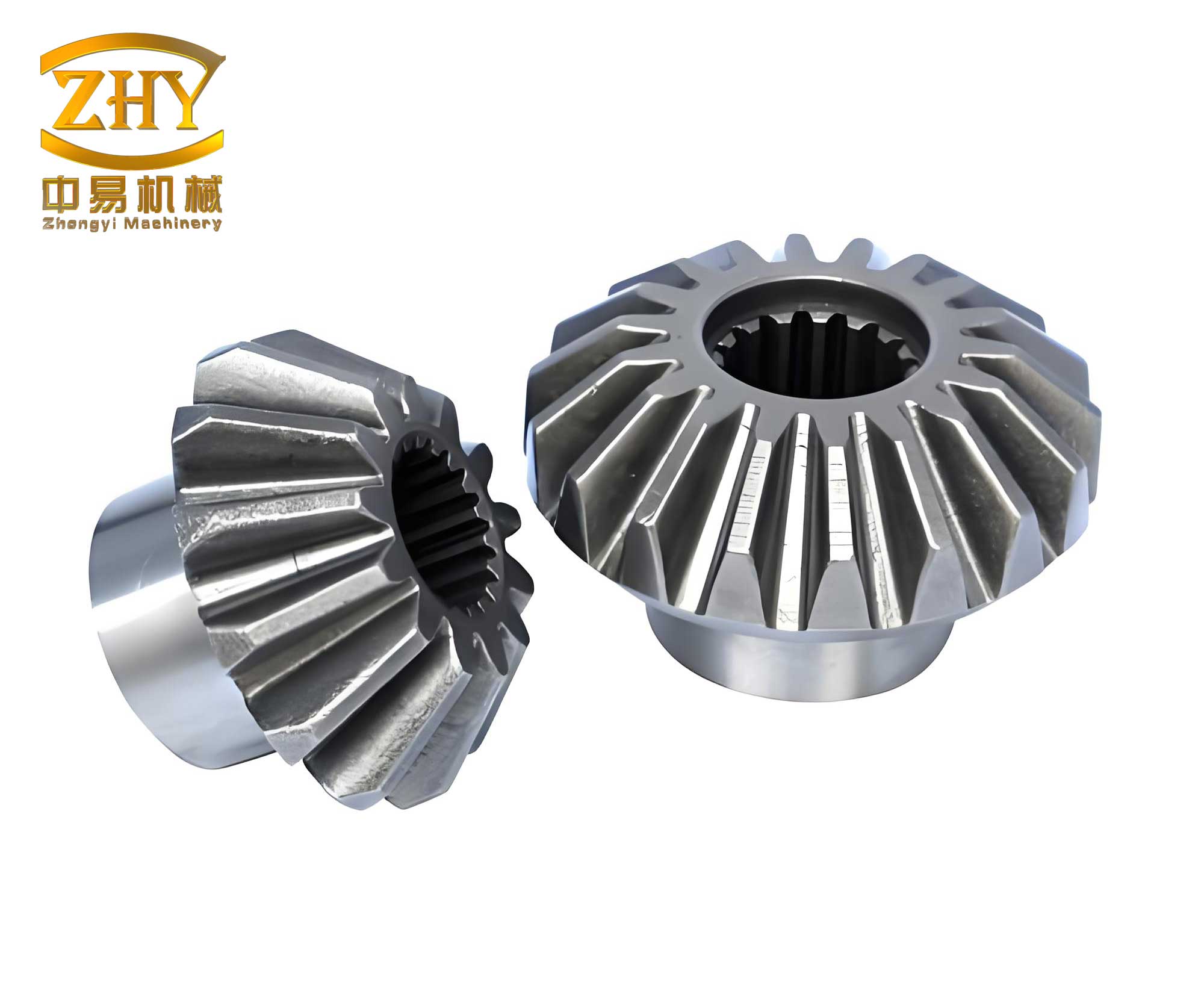
Optimization of Mounting Distance for Bevel Gear Pairs
The assembly of bevel gears typically requires fine-tuning of two main parameters: the pinion axial mounting distance, which adjusts the contact pattern location, and the wheel axial mounting distance, which controls the backlash. The goal is to find the configuration that yields the smoothest transmission, corresponding to the minimum excitation force and, consequently, the most favorable TE and vibration characteristics. The process is an empirical search involving iterative adjustments and measurements.
1. Quality Factor and Search Algorithm
The search for the optimal mounting distance is guided by a quantitative metric known as the Quality Factor, $F$. This factor is calculated from the frequency spectrum of the measured TE signal (or alternatively, a vibration acceleration signal). After applying a Fast Fourier Transform (FFT) to the time-domain signal, the amplitudes of the first three meshing harmonics ($H_1$, $H_2$, $H_3$) are extracted. These amplitudes are weighted against tolerance values ($T_1$, $T_2$, $T_3$) for each harmonic and their respective influence factors ($Q_1$, $Q_2$, $Q_3$). The Quality Factor is computed as:
$$ F = \left( \frac{H_1}{T_1} \right) Q_1 + \left( \frac{H_2}{T_2} \right) Q_2 + \left( \frac{H_3}{T_3} \right) Q_3 $$
The mounting position that yields the smallest $F$ value is deemed the optimal mounting position for the bevel gear pair. This method synthesizes the impact of dominant harmonic excitations into a single, comparable figure of merit.
2. Systematic Search Procedure
The search procedure is automated to ensure efficiency and repeatability. It begins with the bevel gears installed at their theoretical or nominal mounting distance, designated as the midpoint (Position 0). The operator defines the search parameters: the number of adjustment points on either side of the midpoint and the step distance for each axial adjustment.
To maintain a constant backlash during the search, adjustments to the pinion and wheel mounting distances are coupled. If the pinion mounting distance is decreased by $\Delta H$, the wheel mounting distance must be increased by $\Delta H \cdot \tan(\delta_1)$ to compensate, where $\delta_1$ is the pitch cone angle of the pinion. The search follows a specific sequence, alternating between positive and negative adjustment directions (e.g., 0, +Δ, -Δ, +2Δ, -2Δ, …) to systematically map the influence of mounting distance on the quality factor for the bevel gears under test. At each position, a single-flank TE measurement is performed, the TE signal is processed, its spectrum is analyzed, and the Quality Factor $F$ is computed and stored.
Comprehensive Evaluation of Transmission Error in Bevel Gears
Once the TE curve is acquired, typically at the optimal mounting position, it undergoes a multi-faceted evaluation to extract meaningful quality indicators. This evaluation includes error component separation, spectral analysis, and precision grading according to international standards.
1. Analysis of Error Components
The overall TE curve can be decomposed into specific geometric error components, as standardized in documents like GB 11365-89 and DIN 3965-1986. Four key parameters are typically extracted for bevel gears:
- Total Tangential Composite Deviation of the Gear Pair ($F_{is}’$): This is the peak-to-peak value of the entire TE curve over one revolution of the wheel. It represents the maximum range of transmission error and is calculated as:
$$ F_{is}’ = \max(\phi[i]) – \min(\phi[i]), \quad i = 1, \ldots, N $$
where $\phi[i]$ is the TE value at the i-th sample point and $N$ is the total number of samples.
- Tooth-to-Tooth Tangential Composite Deviation of the Gear Pair ($f_{is}’$): This is the maximum range of TE occurring within any single mesh cycle (one pair of teeth in contact). It is a key indicator of transmission smoothness and is found by evaluating the peak-to-peak value within each mesh interval and taking the maximum:
$$ f_{is}’ = \max(\varphi[k]), \quad k = 1, \ldots, Z_{wheel} $$
$$ \text{where } \varphi[k] = \max(\phi[k_i]) – \min(\phi[k_i]) \text{ within the k-th mesh interval.} $$
- Working Pitch Deviation ($F_p$): This reflects accumulated pitch error under load. It is obtained by taking the TE value at the midpoint of each tooth engagement period, forming an array, and calculating its range:
$$ F_p = \max(\phi_m[mid]) – \min(\phi_m[mid]), \quad m = 1, \ldots, Z_{wheel} $$
- Working Single Pitch Deviation ($f_{pt}$): This is the maximum variation between the midpoint errors of adjacent teeth:
$$ f_{pt} = \max(|\phi_{m+1}[mid] – \phi_m[mid]|), \quad m = 1, \ldots, Z_{wheel}-1 $$
2. Spectral Analysis for Bevel Gears
Transforming the TE signal from the time/angle domain to the frequency domain via FFT provides critical insights not visible in the raw curve. The spectrum reveals the amplitude of harmonic excitations. Setting the sampling frequency equal to the number of samples per wheel revolution ($N$) normalizes the frequency axis, making it easy to identify the rotational frequency of the wheel (1st order) and the meshing frequency ($Z_{wheel}$-th order) and its harmonics. Peaks at the meshing frequency and its multiples (2x, 3x, etc.) are directly associated with tooth meshing action, while lower-frequency content may indicate eccentricity or assembly issues. This analysis is fundamental both for calculating the Quality Factor during mounting optimization and for advanced diagnostic purposes in evaluating bevel gear quality.
3. Precision Grade Evaluation for Bevel Gear Pairs
The calculated error components $F_{is}’$ and $f_{is}’$ are compared against tolerance tables specified in gear accuracy standards to assign a precision grade. The methodology differs between standards. For instance, DIN 3965 provides direct tolerance tables for gear pair composite deviations $F_{i\Sigma}’$ and $f_{i\Sigma}’$ for various grades. GB 11365, on the other hand, calculates the gear pair tolerance from the individual gear tolerances using formulas based on error propagation theory. For a given module and reference diameter, the tolerances for different grades can be tabulated for comparison. The measured values for the bevel gears are compared against these tables to determine the achieved accuracy grade. The following table exemplifies a comparison of tolerance values for a specific bevel gear pair according to these two standards:
| Precision Grade | GB 11365-89 $F_{is}’$ (μm) | GB 11365-89 $f_{is}’$ (μm) | DIN 3965-1986 $F_{i\Sigma}’$ (μm) | DIN 3965-1986 $f_{i\Sigma}’$ (μm) |
|---|---|---|---|---|
| 4 | 39.2 | 13.8 | 36.1 | 15.6 |
| 5 | 60.7 | 23.7 | 50.3 | 21.2 |
| 6 | 93.1 | 34.5 | 70.8 | 30.4 |
| 7 | 131.0 | 48.8 | 99.2 | 41.7 |
| 8 | 185.2 | 71.4 | 138.1 | 58.7 |
| 9 | — | — | 221.0 | 94.0 |
| 10 | — | — | 353.4 | 150.6 |
4. Statistical Process Control (SPC) for Manufacturing Monitoring
For volume production of bevel gears, Statistical Process Control (SPC) is a powerful tool for monitoring the stability and capability of the manufacturing process, particularly the tooth-cutting operation. Key parameters like $F_{is}’$ and $f_{is}’$ are tracked over multiple production batches. Control charts, such as the $\bar{X}-s$ chart (mean-standard deviation chart), are constructed. For a parameter $x$, the center line (CL), upper control limit (UCL), and lower control limit (LCL) for the mean chart are calculated as follows, where $\bar{\bar{x}}$ is the grand mean, $\bar{s}$ is the average standard deviation, and $A_3$ is a constant based on sample size:
$$ CL = \bar{\bar{x}} $$
$$ UCL = \bar{\bar{x}} + A_3 \bar{s} $$
$$ LCL = \bar{\bar{x}} – A_3 \bar{s} $$
Similarly, control limits for the standard deviation chart are calculated using constants $B_3$ and $B_4$. Plotting batch statistics on these charts helps identify trends, shifts, or out-of-control conditions in the production of bevel gears, enabling proactive quality management.
System Architecture and Measurement & Control Software
The implementation of the described methodology requires an integrated hardware and software system. The hardware typically consists of a precision test rig with motorized spindles for driving the pinion and optionally loading the wheel, high-resolution rotary encoders on both shafts, and servo-controlled linear axes to adjust the mounting distances of the bevel gears in real-time. A central motion controller (e.g., Siemens Simotion) manages the coordinated movement of all axes, while a data acquisition card (e.g., CONTEC) captures encoder signals. The core intelligence of the system resides in the custom-developed Measurement and Control Software.
Software Design and Functionality for Bevel Gear Testing
Developed in an environment like Microsoft Visual C++/MFC, the software is architected using object-oriented principles to ensure modularity, maintainability, and scalability. Key functional modules include:
- Parameter Management: Handles input and storage of bevel gear geometry (tooth numbers, module, angles), mounting parameters, measurement settings (speed, number of revolutions), and operator information.
- Motion Control & Monitoring: Provides interfaces to command the test rig (start/stop rotation, adjust mounting distance), and monitors system status (axis positions, limit switches, alarms).
- Data Acquisition & Real-Time Display: Manages the synchronous acquisition of encoder pulses, computes the real-time Transmission Error using the formula $TE_0 = \theta_2 – \theta_1 / I$, and displays the evolving TE curve graphically.
- Mounting Distance Optimization Module: This is a critical module dedicated to bevel gear quality. It allows the user to set the search parameters (steps, step size), automates the sequential movement to each position, triggers a TE measurement at each point, performs the FFT, calculates the Quality Factor $F$, and finally identifies and reports the position yielding the minimum $F$ as the optimal mounting distance.
- Comprehensive Analysis Module: Processes the acquired TE curve to extract the four key error components ($F_{is}’$, $f_{is}’$, $F_p$, $f_{pt}$). It performs spectral analysis and automatically grades the bevel gear pair against selected standards (GB, DIN). It can generate a suite of over ten diagnostic plots, including raw TE, separated errors, spectrum, and histograms.
- SPC Analysis Module: Implements statistical process control. It allows input of historical batch data for $F_{is}’$ and $f_{is}’$, calculates control limits according to standard formulas, and generates $\bar{X}-s$ control charts to visualize process stability for bevel gear manufacturing.
- Data Management & Reporting: Saves all measurement parameters, raw data, and analysis results to structured files (e.g., database or XML). It supports querying historical records and generating detailed test reports for printing or export.
The software’s class structure would include core entities like CParameter (encapsulating gear data), CTransmission (handling TE calculation and analysis), CAdjustment (managing the mounting search algorithm), CSPC (for statistical analysis), along with corresponding dialog classes for user interaction. Sequence diagrams would define workflows, such as the process of adding a new bevel gear part number or executing a full mounting optimization cycle.
Experimental Validation and Results for Bevel Gears
To validate the methodology and software, a practical test was conducted on a sample bevel gear pair. The parameters of the test bevel gears are summarized below:
| Parameter | Pinion | Wheel |
|---|---|---|
| Number of Teeth (Z) | 24 | 35 |
| Module (mm) | 4 | 4 |
| Pressure Angle | 20° | 20° |
| Nominal Mounting Distance (mm) | 102.9 | 82.1 |
The mounting distance optimization was performed with the pinion’s axial position as the variable. The search was conducted at five positions relative to the nominal setting: -0.4 mm, -0.2 mm, 0 mm (nominal), +0.2 mm, and +0.4 mm. At each position, the TE was measured, and the Quality Factor $F$ was computed from the harmonic amplitudes in the spectrum. The search results clearly indicated the optimal position.
| Pinion Mounting Offset (mm) | Quality Factor (F) | Rank |
|---|---|---|
| -0.4 | Minimum Value | Optimal |
| -0.2 | Higher than minimum | 2 |
| 0.0 (Nominal) | Higher | 3 |
| +0.2 | Higher | 4 |
| +0.4 | Highest | 5 |
The TE curves measured at the nominal position and at the identified optimal position (-0.4 mm offset) were then analyzed in detail. The results demonstrate the tangible benefit of mounting optimization for bevel gears:
| Mounting Position | $F_{is}’$ (μm) | $f_{is}’$ (μm) | DIN Grade |
|---|---|---|---|
| Nominal | 836 | 173 | 12 |
| Optimal (-0.4 mm) | 826 | 161 | 12 |
While both configurations resulted in the same precision grade according to DIN 3965 (Grade 12), the optimized mounting for the bevel gears yielded measurable improvements: a reduction of 10 μm in the Total Tangential Composite Deviation ($F_{is}’$) and a more significant reduction of 12 μm in the Tooth-to-Tooth Composite Deviation ($f_{is}’$). This latter improvement directly correlates with enhanced smoothness and potentially lower noise generation in the bevel gear pair. The experiment conclusively shows that the developed method and software effectively guide the assembly of bevel gears to their best functional position and provide a precise, multi-faceted assessment of their transmission quality.
Conclusion
The accurate measurement of Transmission Error under adjustable mounting conditions represents a sophisticated approach to quality assurance for bevel gears. This methodology, integrating precise motion control, automated optimal mounting search based on a spectral Quality Factor, comprehensive error decomposition, standards-based grading, and statistical process monitoring, provides a holistic view of gear pair performance. The development of dedicated measurement and control software is essential to orchestrate the complex hardware, execute the algorithms, and present actionable results. The experimental validation confirms that actively seeking the optimal mounting distance can lead to measurable improvements in key transmission error parameters for bevel gears, even when the assigned precision grade remains unchanged. This system and its underlying principles are not only applicable to conventional bevel gears but can also be effectively extended to the testing of face gear pairs and other complex gear geometries where assembly alignment is critical for performance. By bridging the gap between manufacturing tolerances and real-world assembly conditions, this approach contributes significantly to the production of quieter, smoother, and more reliable gear transmissions.