
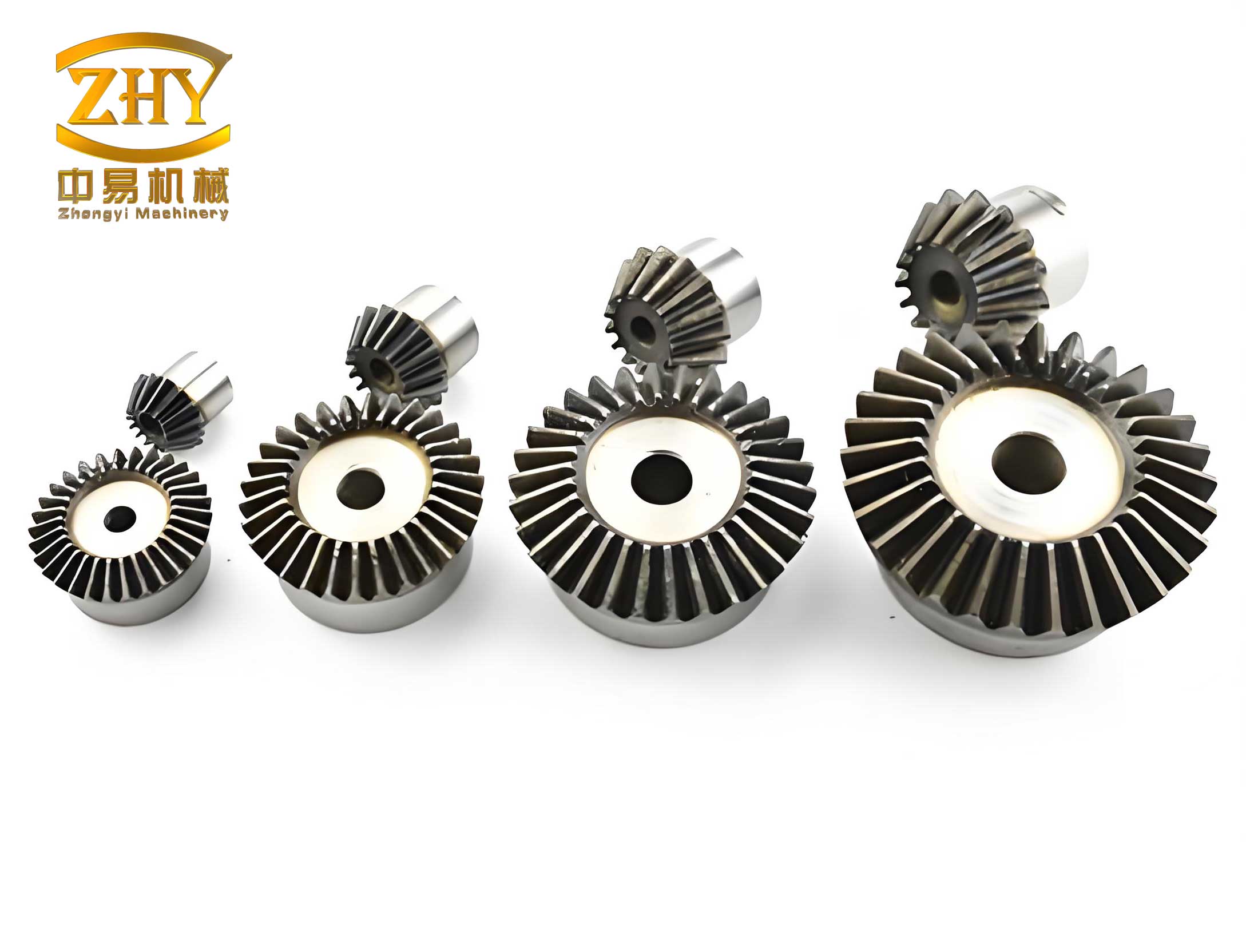
The manufacturing of high-performance bevel gears, especially for critical applications like engine cylinder assemblies, demands precision, consistency, and superior material properties. Traditional plastic forming processes, such as forging, often rely heavily on operator experience and iterative trial-and-error for parameter setting. This approach faces significant challenges in predicting complex deformation behaviors, controlling microstructural evolution, and preemptively identifying potential defects. Consequently, achieving optimal mechanical properties and high production success rates for complex components like bevel gears remains a persistent hurdle. The integration of machine learning (ML) offers a paradigm shift, enabling data-driven optimization, intelligent process control, and automated quality assurance. This article details a comprehensive ML-enhanced plastic forming methodology for engine cylinder bevel gears, focusing on process design, key parameter extraction via Principal Component Analysis (PCA), virtual process simulation, and deep learning-based defect inspection.
1. Holistic Design of the Plastic Forming Process for Bevel Gears
The successful plastic forming of bevel gears hinges on a meticulously designed, multi-stage process. Each stage must be tailored to the material’s characteristics and the final product’s stringent requirements for strength, durability, and dimensional accuracy. The core process can be systematically broken down into three fundamental stages: Raw Material Preparation, Forming & Shaping, and Post-Forming Treatment & Validation.
1.1 Raw Material Preparation
This initial stage is critical for setting the foundation for quality. It encompasses two main activities:
- Material Selection: The choice of material directly determines the gear’s performance under high torque, speed, and cyclic loading. Common candidates for automotive bevel gears include various grades of cast iron and steel, selected for their favorable balance of strength, toughness, castability, and machinability.
- Pre-processing: The selected raw stock undergoes essential preparatory steps. This includes surface treatments like degreasing, descaling, and cleaning to remove impurities that could become defect initiation sites. This is followed by precision cutting or blanking to obtain a pre-form (blank) of the required volume and approximate shape, ensuring efficient material usage and smooth progression into the forming stage.
1.2 Forming & Shaping
This is the core transformation stage where the blank acquires the precise geometry of the bevel gear. It involves two key decisions:
- Forming Method Selection: Based on the gear design, required precision, and desired grain flow, a suitable plastic forming method is chosen. For high-strength bevel gears, forging is often preferred due to its ability to refine the microstructure, improve density, and enhance mechanical properties through controlled deformation. The blank may be heated to a specific temperature (hot/warm forging) to increase material plasticity and reduce forming forces.
- Process Parameter Definition: This is where the complexity lies. The forming outcome is governed by a multitude of interacting parameters (e.g., die temperature, billet temperature, forging speed, press force, lubrication condition). Manually optimizing this high-dimensional parameter space is inefficient. Our methodology employs machine learning, specifically PCA, to intelligently identify the most influential parameter set, drastically simplifying optimization and focusing efforts on the variables that truly impact the quality of the bevel gears.
1.3 Post-Forming Treatment & Validation
After shaping, the bevel gears require further treatment and rigorous checking to meet final specifications.
- Heat Treatment: Processes like quenching and tempering are applied to achieve the target surface hardness, core toughness, and overall wear resistance necessary for the demanding operating environment of engine bevel gears.
- Defect Detection and Finishing: This final quality gate is crucial. We implement a deep learning-based visual inspection system to automatically detect surface and subsurface defects. Following inspection, finishing operations like deburring, shot blasting, or precision machining are performed to achieve the final dimensional tolerances and surface finish.
The following table summarizes the key aspects of this designed process flow:
| Process Stage | Key Activities | Objective for Bevel Gears |
|---|---|---|
| 1. Raw Material Prep | Material Selection; Surface Cleaning; Blanking | Ensure high-quality, contaminant-free starting stock of correct volume. |
| 2. Forming & Shaping | Heating; Forging/Pressing (ML-optimized); Lubrication | Achieve precise gear geometry with improved mechanical properties via controlled deformation. |
| 3. Post-Forming & Validation | Heat Treatment; ML-based Defect Detection; Deburring/Finishing | Attain final hardness/toughness; Guarantee defect-free quality; Meet dimensional specs. |
2. Machine Learning for Intelligent Process Parameter Extraction
The plastic forming process for bevel gears is influenced by a high-dimensional set of parameters n (often 30+), including equipment settings (press type, speed), process variables (temperatures, forces), and geometric controls. These parameters are often correlated, leading to redundancy and complicating analysis. Directly using all parameters is inefficient for modeling and optimization. Principal Component Analysis (PCA), an unsupervised machine learning algorithm, is employed to reduce dimensionality while preserving the most critical information.
Let X = [xij] represent the original standardized process data matrix, where xij is the value of the j-th parameter for the i-th historical production sample (i = 1,…, m; j = 1,…, n). The first step is to compute the correlation matrix R of these n parameters.
PCA solves the eigenvalue problem for the correlation matrix:
$$ |R – \lambda_i I_n| = 0 $$
where \(\lambda_i\) are the eigenvalues (\(\lambda_1 \geq \lambda_2 \geq … \geq \lambda_n \geq 0\)) and \(I_n\) is the identity matrix. Each eigenvalue \(\lambda_i\) corresponds to an eigenvector \(b_i\), which defines a principal component (PC) direction.
The principal components themselves, the new uncorrelated variables, are linear combinations of the original standardized parameters:
$$ p_j = Z \cdot b_j, \quad j=1,2,…,l $$
where \(p_j\) is the j-th principal component score vector, \(Z\) is the standardized data matrix, and \(b_j\) is the j-th eigenvector.
The proportion of total variance explained by the k-th PC is \(\lambda_k / \sum_{i=1}^n \lambda_i\). We select the first \(l\) principal components such that their cumulative variance contribution rate meets a predetermined threshold \(\gamma\) (e.g., 90-95%):
$$ \frac{\sum_{i=1}^l \lambda_i}{\sum_{i=1}^n \lambda_i} \geq \gamma $$
These \(l\) principal components, a reduced set encapsulating the essential behavior of the forming process for bevel gears, are then used as the primary inputs for process simulation, optimization models, and control strategies. This step transforms the complex, correlated process data into a streamlined, informative feature set critical for manufacturing high-quality bevel gears.
3. Bevel Gear Forming Simulation and Results Based on Extracted Parameters
Applying the PCA method to historical data from forging bevel gears reveals significant parameter correlations. For instance, parameters like rough datum and blank datum show high correlation, as do roundness and cylindricity. This confirms the redundancy PCA aims to eliminate.
The table below shows the contribution rates of the top principal components extracted from a typical bevel gear forming dataset:
| Principal Component | Contribution Rate (%) | Cumulative Rate (%) |
|---|---|---|
| PC1 | 16.78 | 16.78 |
| PC2 | 16.60 | 33.38 |
| PC3 | 14.47 | 47.85 |
| PC4 | 11.89 | 59.74 |
| PC5 | 10.42 | 70.16 |
| PC6 | 9.65 | 79.81 |
| PC7 | 6.13 | 85.94 |
| PC8 | 4.26 | 90.20 |
| PC9 | 2.11 | 92.31 |
| PC10 | 1.04 | 93.35 |
The first 8 principal components capture over 90% of the total variance in the original, high-dimensional process data. This means the complex forming behavior of the bevel gears can be effectively modeled and controlled using less than one-third of the original number of parameter dimensions, significantly enhancing simulation efficiency and optimization focus.
Using these extracted principal components to guide the Finite Element Method (FEM) simulation of the bevel gear forging process allows for accurate prediction of material flow, stress-strain distribution, and potential defect formation (like folding or underfill) before physical trials. The simulation provides a cloud diagram of effective strain or stress, visually verifying the uniformity of deformation and ensuring the process parameters derived from the ML model are viable for producing sound bevel gears.
4. Defect Detection in Formed Bevel Gears Using Deep Learning
Even with an optimized process, variations in raw material batches or minor environmental fluctuations can lead to defects in the final bevel gears. Traditional manual inspection is slow, subjective, and prone to missing subtle flaws. We employ a deep learning-based computer vision system for automated, high-precision defect detection.
The system is trained on thousands of images of both defect-free and defective bevel gears, with annotations for various flaw types (pores, cracks, scratches, material folds, etc.). A typical pipeline involves:
- Image Acquisition: High-resolution cameras capture detailed images of each bevel gear from multiple angles.
- Cascaded Classification: A series of neural networks (e.g., CNNs) work in a cascade. The first classifier quickly distinguishes potentially defective gears from obvious good ones. Subsequent, more complex classifiers then analyze the “suspect” regions to identify the specific defect type.
- Posterior Probability & Decision: Each classifier outputs a posterior probability for its decision. Based on these probabilities and pre-set decision weights (balancing false positives and false negatives), a final determination is made.
- Result Output: The gear is flagged as accepted or rejected, and in case of rejection, the defect type and location are reported for corrective action or scrapping.
This automated inspection ensures consistent and reliable quality control for every single bevel gear produced, catching defects that might be invisible to the human eye and providing traceable data for continuous process improvement.
5. Experimental Validation and Performance of ML-Optimized Bevel Gears
To validate the efficacy of the ML-enhanced plastic forming process, bevel gears were manufactured using the parameters derived from the PCA-optimized model. After forming, heat treatment, and passing the deep learning-based inspection, samples were subjected to standard mechanical tests. The results were compared against the design specifications initially targeted for the engine cylinder bevel gears.
| Mechanical Property | Test Result (Formed Bevel Gear) | Design Specification Target |
|---|---|---|
| Brinell Hardness (HBW) | 228 | 232 |
| Tensile Strength (MPa) | 648 | 652 |
| Yield Strength (MPa) | 609 | 613 |
| Elongation at Break (%) | 16.0 | 15.8 |
The test data demonstrates an excellent concordance between the achieved properties and the design targets. The tensile and yield strengths are marginally lower (by ~0.6%) but well within acceptable engineering tolerances for bevel gears. Notably, the elongation is slightly higher, indicating the formed gear may possess better toughness—a beneficial outcome. The hardness is also within a very close range. This consistency confirms that the ML-driven process reliably reproduces the desired material performance, crucial for the reliable function of bevel gears in service.
Furthermore, the control over the forming process, guided by the extracted principal components, allows for optimal strain rate management during forging. Numerical simulation shows that the strain rate profile follows an ideal path: higher initially to initiate deformation efficiently, then gradually decreasing to prevent exceeding the material’s allowable strain limit and to avoid defects like cracking. This controlled deformation is key to achieving the homogeneous microstructure that underpins the measured mechanical properties of the bevel gears.
The effectiveness of the deep learning inspection system is summarized in the following detection results from a random sample batch:
| Bevel Gear Sample ID | Defect Detected? | ML-Identified Defect Type | Confirmed Defect Type |
|---|---|---|---|
| z-0001 | Yes | Gas Porosity | Gas Porosity |
| z-0013 | No | None | None |
| z-0042 | Yes | Crack | Crack |
| z-0054 | Yes | Sand Inclusion | Sand Inclusion |
| z-0108 | Yes | Geometric Deviation | Geometric Deviation |
The system demonstrates high accuracy in identifying a wide range of defects, from surface irregularities like porosity to more subtle geometric deviations, ensuring that only bevel gears meeting the strictest quality standards proceed to final assembly.
6. Conclusion
The integration of machine learning into the plastic forming process for engine cylinder bevel gears presents a transformative advancement over traditional methods. By employing Principal Component Analysis, the high-dimensional, correlated process parameter space is intelligently reduced to a set of dominant, uncorrelated factors. This not only streamlines process simulation and optimization but also provides profound insight into the key variables controlling the quality of the bevel gears. The subsequent use of deep learning for automated defect inspection establishes a robust, objective, and highly sensitive quality assurance checkpoint. Experimental validation confirms that this integrated approach yields bevel gears with mechanical properties consistently meeting or closely approximating design targets, while significantly enhancing process efficiency and first-pass success rates. This machine learning-driven framework marks a significant step towards intelligent, data-driven manufacturing, ensuring the reliable production of high-performance bevel gears essential for advanced automotive powertrains.