
In my extensive experience with aero-engine components, I have encountered numerous cases where bevel gears, critical for power transmission, suffer from premature failure. This article delves into a detailed investigation of tooth surface spalling in bevel gears used in a specific engine model. The failure occurred after prolonged ground testing, manifesting as initial pitting and crushing, eventually leading to severe spalling. Through a first-person narrative, I will recount the analytical process, incorporating material science, metallurgical examination, and mechanical principles to unravel the root causes. The importance of bevel gears in aero-engines cannot be overstated; they operate under extreme conditions of load, speed, and temperature, making their reliability paramount. My aim here is to provide a comprehensive, technical discourse that not only explains this particular failure but also offers general insights into bevel gear durability.
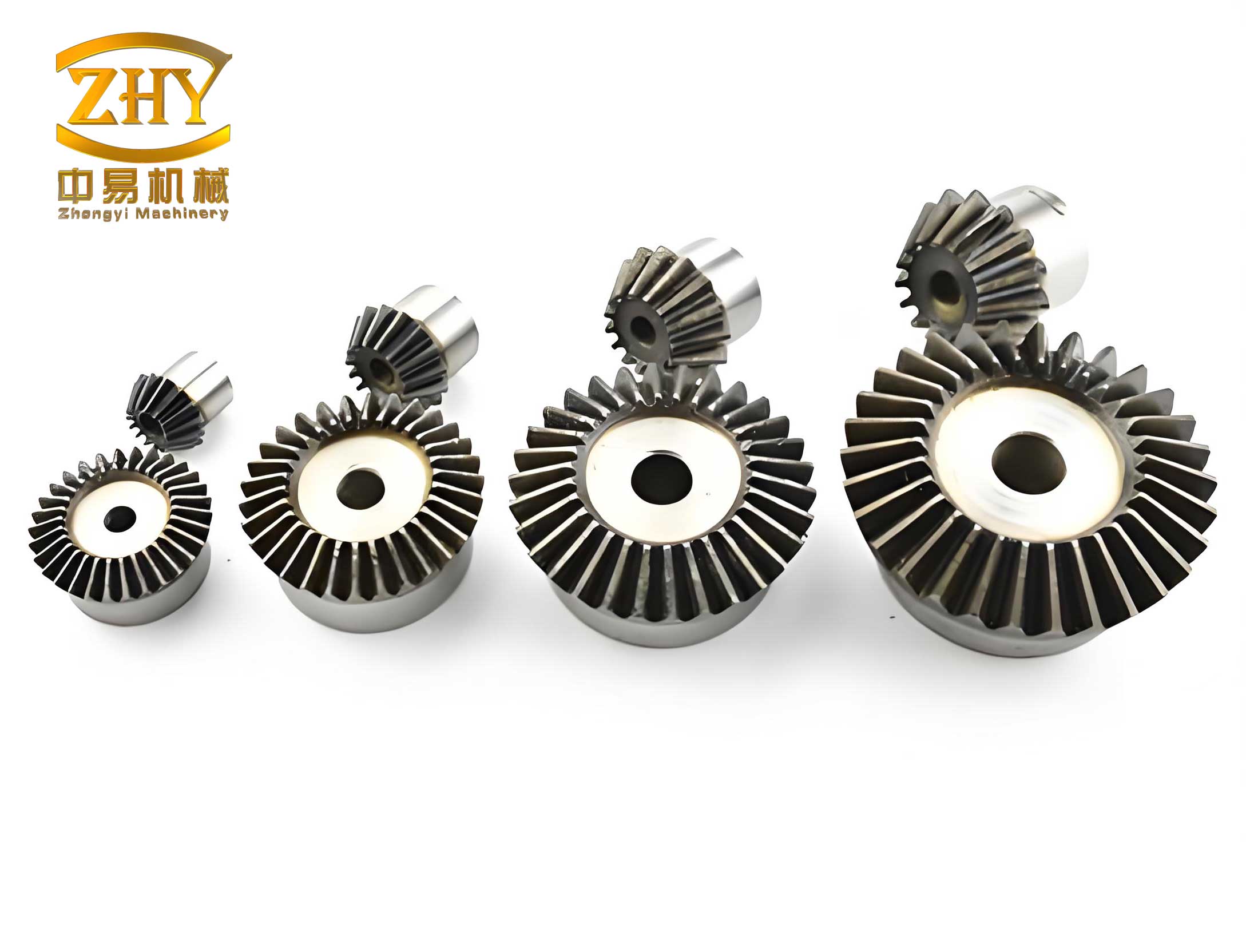
The investigation began with a thorough visual and microscopic examination of the failed bevel gears. These bevel gears, manufactured from 18CrNi4A steel through forging, exhibited distinct wear patterns. On the driving bevel gear, each tooth showed signs of extrusion deformation across the entire flank, with wave-like wrinkles and spalling located about two-thirds from the tooth tip. The driven bevel gear similarly displayed extrusion lines, metal adhesion, pitting, and spalling. Under electron microscopy, the spalled areas appeared bright with clear linear features, transgranular cracks, secondary cracks, and fatigue striations, indicative of contact fatigue. No other defects like burns were noted. This initial assessment set the stage for deeper material and metallurgical analysis.
To understand the failure mechanisms, I conducted a series of material tests. The chemical composition of the bevel gears was verified, confirming it as 18CrNi4A, a case-hardening steel commonly used for high-strength components. The macro-etching revealed flow lines consistent with the gear geometry, and no abnormalities were found in the fracture surfaces or non-metallic inclusions. However, microhardness traverses and metallographic examination provided critical data. The case depth of the driving bevel gear was slightly above the design specification, while the driven gear’s case depth was within limits. The surface microstructure consisted of high-carbon martensite, granular carbides, and residual austenite, whereas the core exhibited low-carbon martensite and minor ferrite. Hardness measurements, both surface and core, met the required specifications. These findings are summarized in the table below.
| Parameter | Driving Bevel Gear | Driven Bevel Gear | Design Requirement |
|---|---|---|---|
| Case Depth (mm) | 1.25 | 1.10 | 1.00 – 1.20 |
| Surface Hardness (HRC) | 60-62 | 59-61 | 58-62 |
| Core Hardness (HRC) | 38-40 | 38-40 | 35-42 |
| Surface Microstructure | High-C Martensite + Carbides + RA | High-C Martensite + Carbides + RA | Fine Martensite, Minimal RA |
| Core Microstructure | Low-C Martensite + Ferrite | Low-C Martensite + Ferrite | Low-C Martensite |
Given that the material properties largely conformed to specifications, the failure necessitated a focus on the mechanical and operational aspects of the bevel gears. The spalling depth was measured to be within the hardened case layer, and the presence of conchoidal marks and fatigue striations pointed towards contact fatigue as the dominant failure mode. I theorized that uneven distribution of contact stress during meshing was the primary culprit. To validate this, I reviewed the dynamic testing data of the gear pair, which indeed revealed anomalous load distribution across the contact zone. The fundamental issue lies in how bevel gears transmit torque under high-speed conditions; any misalignment or surface irregularity can lead to localized stress concentrations.
The contact stress between mating teeth of bevel gears can be modeled using Hertzian theory. For two curved surfaces in contact, the maximum contact pressure \(\sigma_H\) is given by:
$$ \sigma_H = \sqrt{ \frac{F}{\pi L} \cdot \frac{ \frac{1-\nu_1^2}{E_1} + \frac{1-\nu_2^2}{E_2} }{ \frac{1}{R_1} + \frac{1}{R_2} } } $$
where \(F\) is the normal load, \(L\) is the length of contact, \(\nu_1, \nu_2\) are Poisson’s ratios, \(E_1, E_2\) are Young’s moduli, and \(R_1, R_2\) are the effective radii of curvature at the contact point. For bevel gears, these parameters vary along the tooth flank due to the conical geometry. If the contact is not uniform, the actual stress can significantly exceed the design value. In the failed bevel gears, I postulated that micro-geometric deviations led to edge loading, where the contact patch shrinks, increasing \(\sigma_H\) locally. This is exacerbated by dynamic loads from engine vibrations. The following table illustrates how key parameters influence contact stress.
| Parameter | Symbol | Effect on Contact Stress \(\sigma_H\) | Typical Value for Bevel Gears |
|---|---|---|---|
| Normal Load | \(F\) | Proportional to \(\sqrt{F}\) | 500-2000 N |
| Effective Radius | \(R_{eff} = \left( \frac{1}{R_1} + \frac{1}{R_2} \right)^{-1}\) | Inversely proportional to \(\sqrt{R_{eff}}\) | 5-20 mm |
| Modulus of Elasticity | \(E\) | Proportional to \(\sqrt{1/E}\) for similar materials | 210 GPa (steel) |
| Poisson’s Ratio | \(\nu\) | Minor influence | 0.3 |
| Contact Length | \(L\) | Inversely proportional to \(\sqrt{L}\) | 10-30 mm |
Once the contact stress exceeds the material’s yield strength, plastic deformation occurs at the surface. This is often seen as the extrusion lines and wrinkles observed on the failed bevel gears. Repeated loading leads to cyclic plasticity, initiating microcracks at stress concentrators such as surface folds or inclusions. The mechanism of crack propagation in bevel gears is governed by mixed-mode fatigue, combining both normal and shear stresses. The shear stress \(\tau\) due to friction can be estimated as:
$$ \tau = \mu \sigma_H $$
where \(\mu\) is the coefficient of friction. For lubricated bevel gears, \(\mu\) can range from 0.05 to 0.1, but under boundary lubrication conditions, it may increase. The subsurface shear stress, which peaks slightly below the surface, drives crack growth. According to subsurface fatigue theory, the critical shear stress \(\tau_{max}\) occurs at a depth \(z\) given by:
$$ z = 0.78 a $$
where \(a\) is the half-width of the contact patch. Cracks initiate at this depth and propagate towards the surface, eventually causing spalling. The fatigue life \(N_f\) can be approximated using the Basquin equation:
$$ \sigma_a = \sigma_f’ (2N_f)^b $$
where \(\sigma_a\) is the stress amplitude, \(\sigma_f’\) is the fatigue strength coefficient, and \(b\) is the fatigue strength exponent. For case-hardened bevel gears, the complex stress state requires multi-axial fatigue criteria. I often use the Dang Van criterion for high-cycle fatigue:
$$ \max_{t} \left[ \frac{\tau(t) + a_{DV} \sigma_H(t)}{b_{DV}} \right] \leq 1 $$
where \(a_{DV}\) and \(b_{DV}\) are material constants. In the case of these bevel gears, the uneven load distribution led to localized stress amplitudes that exceeded the endurance limit, resulting in premature fatigue.
Another contributing factor is the thermal effects during operation. Frictional heating can cause localized tempering or softening of the case-hardened surface, reducing hardness and fatigue resistance. The flash temperature \(\Delta T\) at the contact can be estimated using the Blok formula:
$$ \Delta T = \frac{\mu F v}{4 \sqrt{\pi \lambda \rho c a}} $$
where \(v\) is the sliding velocity, \(\lambda\) is thermal conductivity, \(\rho\) is density, and \(c\) is specific heat. For steel bevel gears, \(\Delta T\) can reach several hundred degrees Celsius in hotspots, potentially altering the microstructure. Although no overt burning was found, microstructural changes like overtempered martensite could weaken the surface. This interplay between mechanical stress and thermal effects is crucial in understanding bevel gear failures.
To mitigate such failures, I recommend a multi-faceted approach. First, improving the manufacturing precision of bevel gears is essential. This includes tighter tolerances on tooth geometry, better control of heat treatment to ensure uniform case depth, and enhanced surface finishing techniques like grinding or superfinishing. Second, dynamic analysis should be integrated into the design phase. Using finite element analysis (FEA) to simulate the meshing of bevel gears under load can identify stress concentrations. The governing equation for dynamic response can be expressed as:
$$ [M]\{\ddot{x}\} + [C]\{\dot{x}\} + [K]\{x\} = \{F(t)\} $$
where \([M]\), \([C]\), and \([K]\) are mass, damping, and stiffness matrices, \(\{x\}\) is displacement vector, and \(\{F(t)\}\) is time-varying load vector. Solving this for bevel gear systems helps optimize tooth modifications like crowning or tip relief to ensure even load distribution. Third, material selection and processing can be enhanced. For instance, using cleaner steels with lower inclusion content, or applying advanced surface treatments like shot peening to induce compressive residual stresses, which improve fatigue life. The beneficial stress \(\sigma_{res}\) from shot peening can be modeled as:
$$ \sigma_{res}(z) = \sigma_{max} e^{-kz} $$
where \(\sigma_{max}\) is the surface compressive stress and \(k\) is a decay constant. This counters the tensile stresses from contact loading.
Lubrication also plays a pivotal role. The use of high-performance lubricants with extreme pressure (EP) additives can reduce friction and wear. The film thickness \(h\) in elastohydrodynamic lubrication (EHL) can be calculated using the Dowson-Higginson equation:
$$ h = 2.65 \frac{R^{0.43} (\eta_0 v)^{0.7} E’^{0.03}}{F^{0.13}} $$
where \(\eta_0\) is base viscosity, \(v\) is rolling speed, and \(E’\) is effective modulus. Maintaining adequate film thickness prevents metal-to-metal contact, reducing pitting and spalling in bevel gears. Regular monitoring through vibration analysis and oil debris analysis can detect early signs of deterioration in bevel gears, allowing for proactive maintenance.
In conclusion, the spalling failure of these bevel gears was primarily driven by uneven contact stress distribution leading to contact fatigue, exacerbated by dynamic loads and possibly minor thermal effects. While material properties were largely adequate, the mechanical interaction during service was the weak link. This analysis underscores the complexity of bevel gear performance in aero-engines. Future designs must incorporate comprehensive dynamic simulation, precision manufacturing, and robust material engineering to enhance the durability of bevel gears. Through continuous improvement and rigorous testing, the reliability of these critical components can be assured, contributing to the overall safety and efficiency of aviation systems.
Reflecting on this investigation, I emphasize that bevel gears are not just simple mechanical elements; they are sophisticated components whose failure analysis requires a holistic approach. The integration of metallurgy, mechanics, and tribology is essential. As bevel gears continue to be employed in advanced aerospace applications, ongoing research into their failure modes and prevention strategies will remain vital. I hope this detailed account provides valuable insights for engineers and researchers working with bevel gears in high-performance environments.